
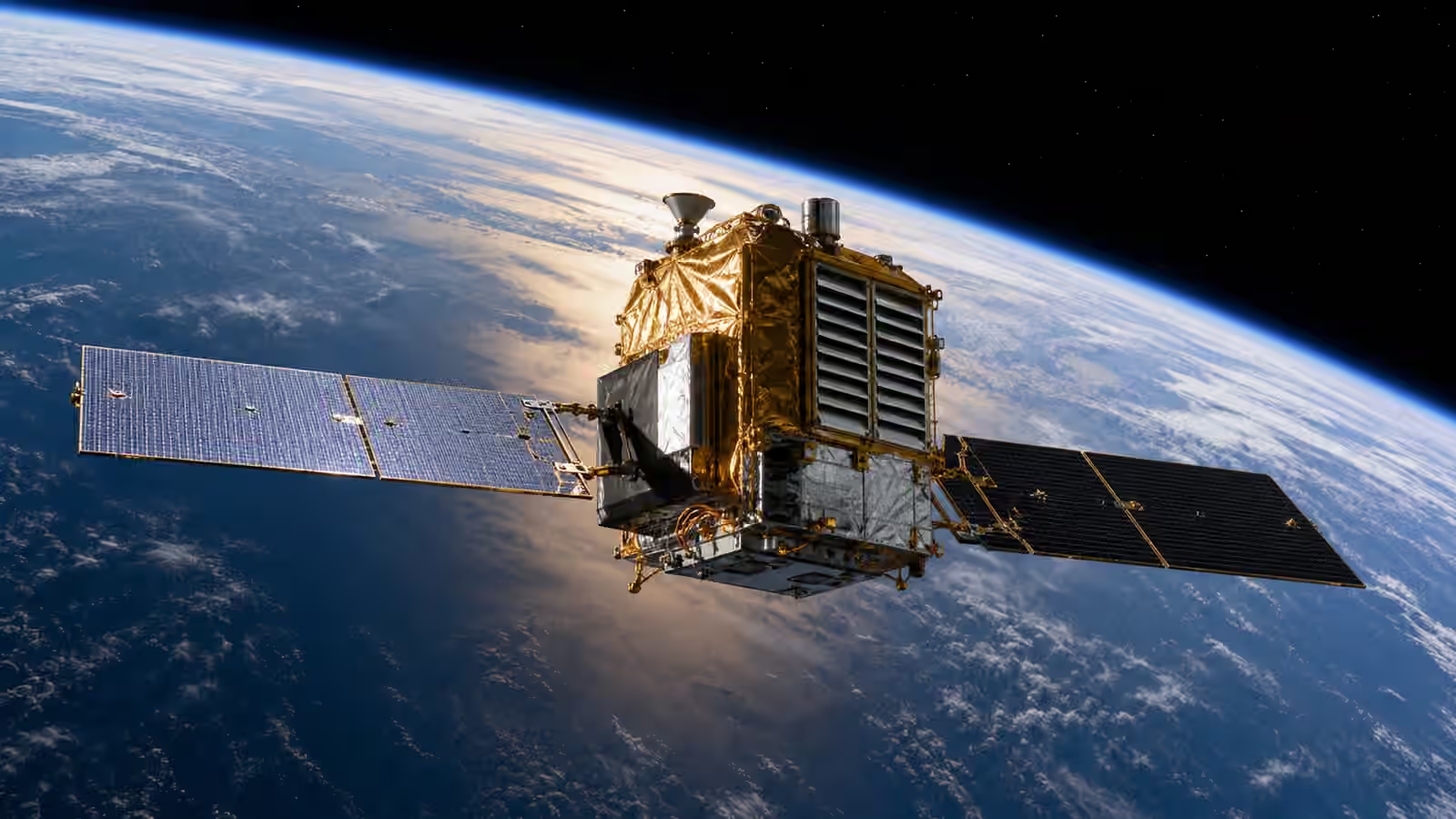
A satellite does not live in ordinary cold. It lives in a place where heat has few easy ways to leave, sunlight can be intense, shadow can arrive suddenly, and every surface becomes part of the machine’s temperature story. The same spacecraft may spend part of an orbit facing direct Sun, part of it looking into darkness, and part of it carrying heat from electronics that cannot be allowed to cook themselves. Thermal control is the engineering discipline that keeps that changing environment from turning useful hardware into a short experiment.
Thermal control sounds like a supporting detail until something depends on it. Batteries age faster outside their comfort range. Propellant can become too cold or too warm. Optics can distort. Clocks can drift. Electronics can shut down. Adhesives, lubricants, mechanisms, and sensors may behave differently after enough hot and cold cycles. A payload can be brilliant on paper and still fail as a service if the spacecraft cannot hold it inside a usable thermal envelope.
This is why thermal control belongs beside Satellite Bus and Payloads rather than hidden in a footnote. The payload creates value, but the bus has to make that value physically possible. Power, pointing, structure, propulsion, data handling, and thermal design are not separate little kingdoms. They are one vehicle negotiating with sunlight, vacuum, eclipse, and its own waste heat.
Space Is a Radiator Problem
On Earth, machines shed heat through air, conduction into surrounding materials, liquid cooling loops, fans, convection, and the simple fact that a room has a surrounding environment. In orbit, the rules narrow. There is almost no air to carry heat away from the outside of the spacecraft. Heat can move by conduction through the spacecraft structure and by radiation from surfaces, but it does not float off into a breeze. If a component generates heat, that heat must have a designed path to somewhere that can reject it.
That makes radiators important. A radiator is not just a panel that happens to be exposed. It is a surface chosen and placed so it can emit heat to space while avoiding too much unwanted solar heating, reflected sunlight from Earth, or infrared energy from the planet below. The radiator’s coating, orientation, area, connection to internal hardware, and exposure during normal pointing all matter. A radiator that is shaded at the wrong time or blocked by a deployed antenna is no longer doing the same job it did in a drawing.
This is one reason spacecraft design is full of compromises. A communications antenna may want one view. A camera may need another. Solar arrays want sunlight. Radiators often prefer a clean view to cold space. Thrusters need plume clearance. Star trackers need darkness and a clear sky. The thermal engineer is not merely asking for a convenient panel. They are negotiating with every subsystem that also needs a good place to look.
Sunlight and Eclipse Are Not Small Details
Low Earth orbit can move a satellite from sunlight to eclipse and back again many times during a day. A geostationary spacecraft has different cycles, including seasons when eclipses become operationally important. Lunar and deep-space missions face their own thermal rhythms. The timing is not decorative. It changes how much power is available, how batteries are used, when heaters must run, and whether instruments can stay stable enough for useful work.
During sunlight, surfaces absorb energy. During eclipse, surfaces radiate heat away without the same solar input. The spacecraft therefore needs enough thermal inertia, insulation, heater capacity, and operational planning to ride through transitions. If an instrument needs a stable temperature, the mission may avoid certain activities until the spacecraft reaches equilibrium. If a battery cools too much in eclipse, heaters may consume power that the payload wanted. If a radiator is too effective in one attitude, a component can become cold even while another part of the spacecraft is warm.
These tradeoffs connect thermal control to Satellite Operations After Launch . Operators do not simply command the most interesting observation or the highest data-rate contact whenever they want. They watch temperatures, trends, power state, attitude, eclipse timing, and margins. Sometimes the correct operational choice is to delay an activity because the spacecraft is thermally tired from the last one.
Insulation Is a Tool, Not a Blanket
Gold and silver foil on spacecraft is often multilayer insulation, usually called MLI. It looks like a dramatic wrapping, but its purpose is practical. MLI reduces unwanted heat exchange by radiation. It can help keep a warm component from losing too much heat, or help keep a sensitive area from absorbing too much heat from elsewhere. It is not magic, and it is not the same as wrapping a person in a winter coat. It has seams, penetrations, edges, fasteners, vent paths, and workmanship details that affect performance.
Good insulation is designed around the machine. A blanket may need to avoid moving mechanisms, deployment hinges, thruster plumes, vents, sensors, optical paths, or grounding paths. It may need to be removable during integration and then reinstalled without trapping contamination or blocking access. A loose blanket edge can become a mechanical concern. A poorly handled surface can change thermal behavior. The humble-looking foil is part of the spacecraft’s configuration, not decoration.
Heaters play a different role. They add heat when the environment or operating state would otherwise make hardware too cold. Batteries, propulsion lines, valves, tanks, clocks, and some instruments may need heater control. But heaters spend power, and power is always tied to mission priorities. A spacecraft that needs more heater energy in a cold case may have less available for payload work or communications. Thermal design therefore becomes part of the power budget, not a separate comfort feature.
The Payload Sets the Hardest Temperatures
Different payloads care about temperature in different ways. An optical imager may need stable alignment and low distortion. An infrared sensor may need very careful thermal conditions so it can measure faint signals. A radar payload may generate bursts of heat during operation. A communications payload may have amplifiers that run hot and must shed heat efficiently. A navigation spacecraft may care about clocks and signal stability. A science mission may need instruments at temperatures that require dedicated radiators or coolers.
The bus must support those needs without sacrificing the rest of the spacecraft. If the payload demands a cold, stable deck, the structure, radiator path, pointing rules, power system, and operations schedule may all be affected. If the payload generates heat in pulses, the spacecraft may need to spread that heat, reject it between activities, or limit how often the payload can run. This is why a satellite’s thermal design begins with the mission rather than with a generic temperature target.
Thermal control also shapes data and service. An Earth observation satellite may avoid imaging when thermal conditions would degrade focus or calibration. A broadband spacecraft may have to manage amplifier heat during heavy traffic. A maneuver described in Satellite Propulsion and Stationkeeping may change attitude, use heaters, warm tanks, or interrupt the normal radiator view. A thermal constraint can appear to the outside world as a scheduling constraint, a data-quality constraint, or a maintenance rule.
Testing Tries to Find the Surprise Early
The best time to discover a thermal problem is while the spacecraft is still on Earth. Thermal vacuum testing places hardware in a chamber with low pressure and controlled hot and cold conditions. It cannot perfectly reproduce the whole orbital life, but it can reveal bad assumptions, weak thermal paths, heater control problems, unexpected gradients, contamination concerns, and components that behave differently when air is removed from the situation.
This is why Satellite Manufacturing and Testing treats environmental testing as part of the spacecraft’s truth. A component that passed a bench test in a room may still have trouble when mounted inside the actual vehicle, wrapped in insulation, connected through real thermal interfaces, and operated alongside other heat sources. Integration changes context. Thermal vacuum testing helps the team learn that context before launch.
Testing also validates models. Spacecraft thermal analysis uses models of surfaces, materials, heat paths, power dissipation, orbital conditions, and attitudes. Those models guide design, but they are still models. Test data lets engineers tune assumptions and identify margins. A few degrees of unexpected behavior can matter if the mission already had little slack. A large mismatch may send the team back to insulation, heater settings, surface coatings, radiator sizing, or operating rules.
Thermal Control Continues After Launch
Once in orbit, thermal control becomes a living operational concern. Telemetry shows temperatures across the spacecraft. Operators watch how those temperatures respond to Sun angle, eclipse, payload use, downlinks, maneuvers, seasonal geometry, safe modes, and aging. A trend that seems mild at first may reveal a degrading surface, a heater that cycles more often than expected, a changing battery condition, or a payload mode that runs warmer than planned.
An anomaly can make thermal control urgent. If a spacecraft enters safe mode, it may adopt an attitude that protects power and communications but changes which surfaces face the Sun. If a reaction wheel issue limits pointing, radiator views may change. If a solar storm increases atmospheric drag or radiation stress, as described in Space Weather , operators may alter plans and watch temperatures more carefully. A thermal problem rarely arrives alone. It often travels with power, attitude, communications, or fault-protection decisions.
The end of a mission can also be thermal work. A satellite planning disposal may need enough power and heater capability to keep propulsion hardware usable for the final maneuvers. Passivation may involve batteries, tanks, and stored energy. A vehicle described in Satellite End of Life still has to remain controllable long enough to leave responsibly. Thermal margin near retirement is therefore not wasted caution. It can be part of the last useful act of the mission.
Reading Heat as Infrastructure
Thermal control is easy to overlook because it does not produce the headline service. It does not take the picture, route the internet traffic, broadcast the timing signal, or perform the avoidance burn by itself. Yet every one of those services depends on components staying inside temperatures where they behave predictably.
When you read about a satellite, ask what creates heat, what must stay stable, where the heat goes, and what attitudes the spacecraft needs to maintain. Ask what happens in eclipse, what happens during heavy payload use, and whether the end-of-life plan still works when the spacecraft is old. These questions make the hardware more understandable because they connect the beautiful exterior to the daily physics of keeping it alive.
Space infrastructure is not only launch capacity, orbital slots, spectrum, and ground stations. It is also the quiet discipline of keeping machines within limits while they cross sunlight and shadow thousands of times. A satellite that manages heat well can keep its payload useful, its batteries healthier, its propulsion ready, and its operations predictable. A satellite that manages heat poorly may fail in ways that look mysterious from the ground but began with a missing path for energy to leave.
The spacecraft does not care whether thermal control sounds exciting. It cares whether the next orbit is survivable, whether the next activity is within margin, and whether the service people expect on Earth can continue without asking hardware to live outside its limits.


