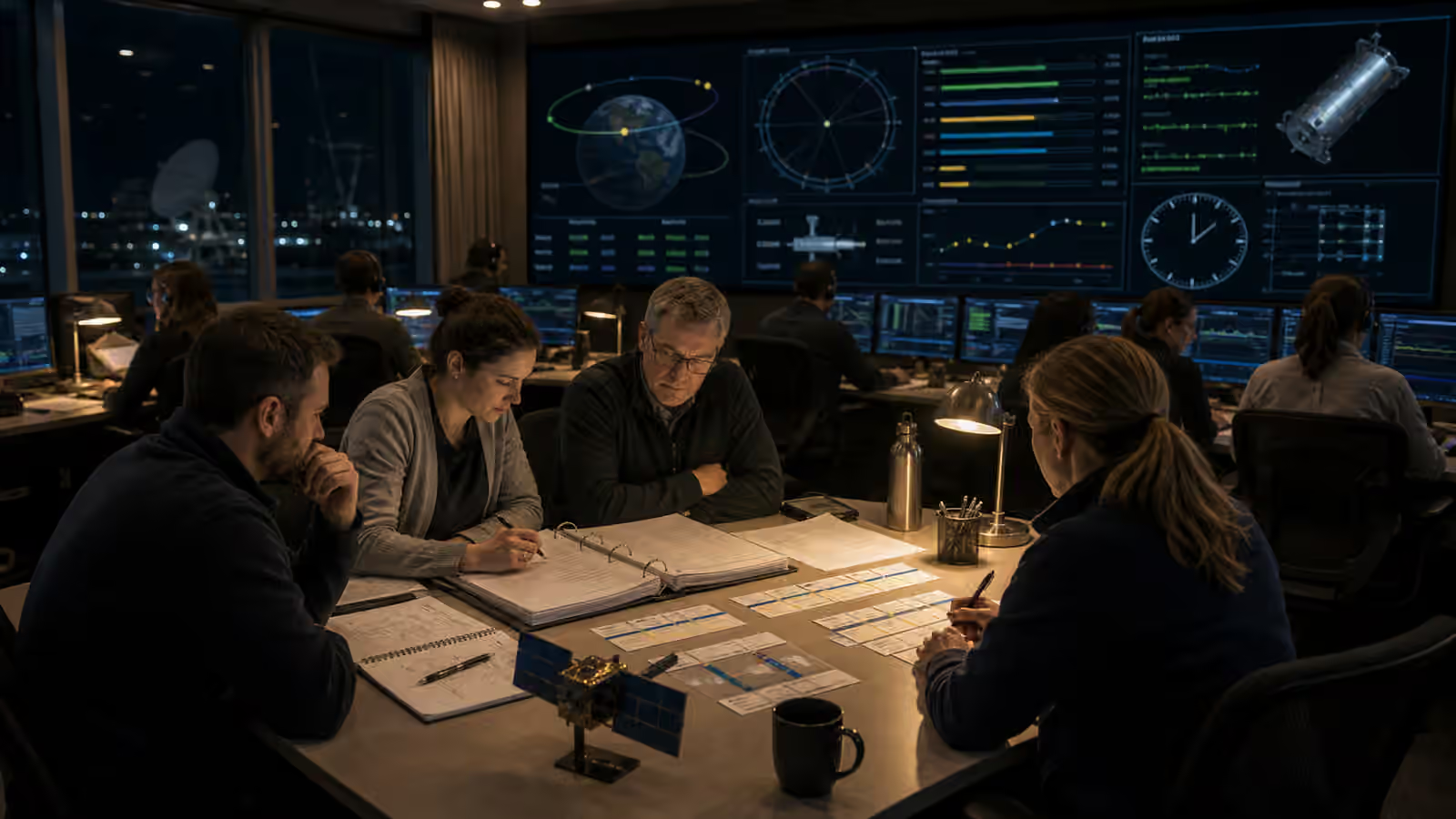
A satellite does not simply look down and send useful answers home. Someone has to decide what it should do next. That decision can involve customer requests, weather, orbit geometry, power, pointing, onboard storage, downlink windows, calibration needs, regulatory limits, security rules, and the health of the spacecraft. A useful data product may begin as a question on Earth, but it becomes a space operation only after that question survives a chain of constraints.
This planning work is called tasking when it assigns observations or activities to a satellite. It is called payload operations when the focus is the instrument, antenna, transponder, experiment, or service hardware that creates mission value. The names matter less than the discipline. Spacecraft are not magic cameras or floating servers. They are limited machines moving quickly through changing opportunities.
Satellite Operations After Launch explains the broader rhythm of keeping a spacecraft alive and useful. Tasking sits inside that rhythm. It turns mission goals into near-term commands without forgetting that the spacecraft must still keep its batteries healthy, its temperatures inside limits, its attitude controlled, and its data recoverable.
A Request Is Not Yet a Plan
A tasking request may sound simple. Image this field. Revisit this port. Watch this wildfire region. Collect radar data through clouds. Measure sea ice. Route capacity to this coverage area. Run this payload experiment. From the user’s side, the request is the need. From the operator’s side, it is the beginning of a negotiation with orbit.
The satellite may not pass over the target at the right time. It may pass over at night when an optical sensor needs daylight. Clouds may block the view. A radar instrument may be able to observe, but power or thermal limits may restrict how long it can operate. The spacecraft may need to turn away from a normal attitude, which affects solar array pointing, antenna contact, or another scheduled observation. A downlink pass may be too short to return the data immediately.
Earth Observation Sensors shows why different instruments answer different questions. Tasking is where those differences become calendar pressure. An optical image, radar scene, infrared measurement, and hyperspectral observation do not share the same lighting needs, data volume, pointing constraints, or calibration habits. The operator has to schedule the instrument that can answer the question, not merely the satellite that happens to be nearby.
Orbit Creates Windows, Not Freedom
A low-Earth orbit satellite sees a strip of Earth as it moves. It may return to similar regions on a predictable cycle, but the exact opportunity depends on altitude, inclination, local time, pointing ability, and target geometry. A constellation can create more frequent chances, yet the fleet still has limits. A satellite cannot observe every place at once, and a high-priority request can displace another customer or science objective.
Orbital Regimes and Mission Design explains the geometry behind those windows. Tasking turns the geometry into operating choices. A planner may choose a lower-quality opportunity today because the next good pass comes too late. Another request may wait because the satellite would need an aggressive slew that costs too much power or violates a pointing rule. A third may be assigned to a different spacecraft in the fleet because that vehicle has better storage margin or a better downlink path afterward.
The public often hears about revisit time as a simple number. Real tasking makes it messier. A satellite may revisit a region, but not with the right lighting, angle, weather, instrument mode, customer priority, or data path. Service promises depend on the difference between passing overhead and collecting usable evidence.
Payloads Have Operating Personalities
Every payload has a personality. A camera may need stable pointing, clean optics, correct exposure, and calibration frames. A radar payload may need high power, thermal recovery time, and careful radio-frequency coordination. A communications payload may need beam planning, gateway capacity, spectrum discipline, and user demand forecasts. A science instrument may need quiet periods, reference measurements, or sequences that cannot be interrupted casually.
Satellite Bus and Payloads describes the split between the hardware that creates value and the bus that supports it. In tasking, that split becomes a conversation. The payload asks for time, pointing, energy, data volume, and thermal margin. The bus answers with what the spacecraft can safely afford. A good plan respects both. A payload activity that damages the bus or starves the batteries is not a successful observation.
This is why payload operators work closely with flight dynamics, power, thermal, communications, ground systems, cybersecurity, and mission management. A plan that is excellent for the instrument may still be poor for the spacecraft. A plan that protects the spacecraft too conservatively may fail the mission promise. The useful schedule is the one that balances value with evidence that the vehicle can execute it.
Storage and Downlink Are Part of Tasking
Data does not become useful when it is collected. It becomes useful when it is preserved, downlinked, processed, validated, and delivered. A satellite can fill onboard storage faster than it can empty it, especially when imaging, radar, or high-rate instruments are involved. A tasking plan therefore has to know where the data will go after collection.
Ground Stations and Satellite Data Pipelines are part of the same story. A planner may schedule observations before a strong ground contact so storage does not saturate. Another plan may hold low-priority data onboard until a cheaper or less congested pass. A disaster-response request may take priority because latency matters more than ordinary backlog. A data product that arrives too late can fail even if the spacecraft collected it perfectly.
Downlink also competes with other spacecraft needs. Transmitters draw power and create heat. Antennas need pointing. Ground stations have finite schedules. Spectrum rules and interference avoidance matter. Satellite Spectrum and Interference explains why radio links are shared infrastructure. Tasking is one of the places where that invisible resource becomes a daily constraint.
Calibration Protects Trust
Tasking systems can become too hungry for collection. The pressure to gather more images, more scenes, more measurements, or more coverage can push calibration into the background. That is a mistake. Payloads need checks against known references, dark frames, internal lamps, stable targets, cross-calibration with other instruments, or other evidence that the measurement still means what users think it means.
Payload Calibration and Validation covers that trust layer in detail. From a tasking viewpoint, calibration is not downtime in a lazy sense. It is one of the activities that lets later data be believed. If an instrument drifts and nobody protects calibration time, the mission may produce more data while quietly reducing its value.
The same is true for health monitoring. A payload may need rest periods, heater cycles, contamination avoidance, safe pointing, or limits on repeated use. A sensor that is treated like an infinite resource may age, drift, or fail earlier than expected. Good payload operations treat the instrument as a working system with memory, not as a button that can be pressed without consequence.
Priorities Need Clear Rules
Tasking becomes difficult when demand exceeds opportunity. Commercial customers may compete with one another. Science priorities may compete with calibration. Emergency response may interrupt ordinary collection. A government customer may require protected handling. A constellation may need to balance regional service quality across many users. The schedule becomes a statement of values as well as a technical plan.
Clear priority rules help operators avoid improvising under pressure. The rules do not need to be cruel or rigid, but they must be understandable. A planner should know when an urgent request can preempt routine work, how conflicts are recorded, who approves unusual commands, and how customers are told that a request was not feasible. Ambiguity wastes time and can create unfairness or unsafe decisions.
Spacecraft Command, Telemetry, and Tracking connects here because a tasking plan eventually becomes commands. Those commands need authorization, validation, timing, and records. The fact that a customer wanted an image does not mean the spacecraft should accept any command that appears to point the payload at the target. Command discipline is how tasking becomes operations rather than wishful scheduling.
Good Tasking Makes Space Feel Reliable
The best tasking systems often disappear from the user’s attention. A city receives flood imagery. A farmer gets field information. A ship receives a connectivity service. An analyst sees updated port activity. A researcher gets calibrated data. Behind that apparent simplicity is a chain of orbital prediction, target selection, spacecraft planning, payload rules, command generation, downlink, processing, quality checks, and delivery.
That chain is one reason space is becoming infrastructure. Infrastructure is not only hardware. It is the habit of making useful service repeatable under constraint. Satellite tasking is where a moving spacecraft, a demanding payload, and a human need meet on a schedule. Done well, it turns limited orbital chances into trusted work. Done poorly, it creates beautiful data nobody asked for, urgent requests that miss their window, and spacecraft stress that could have been avoided.
The question behind every task is not simply what should the satellite collect. It is what the mission can responsibly do next, given the orbit, the spacecraft, the payload, the ground system, the users, and the evidence needed to trust the result.