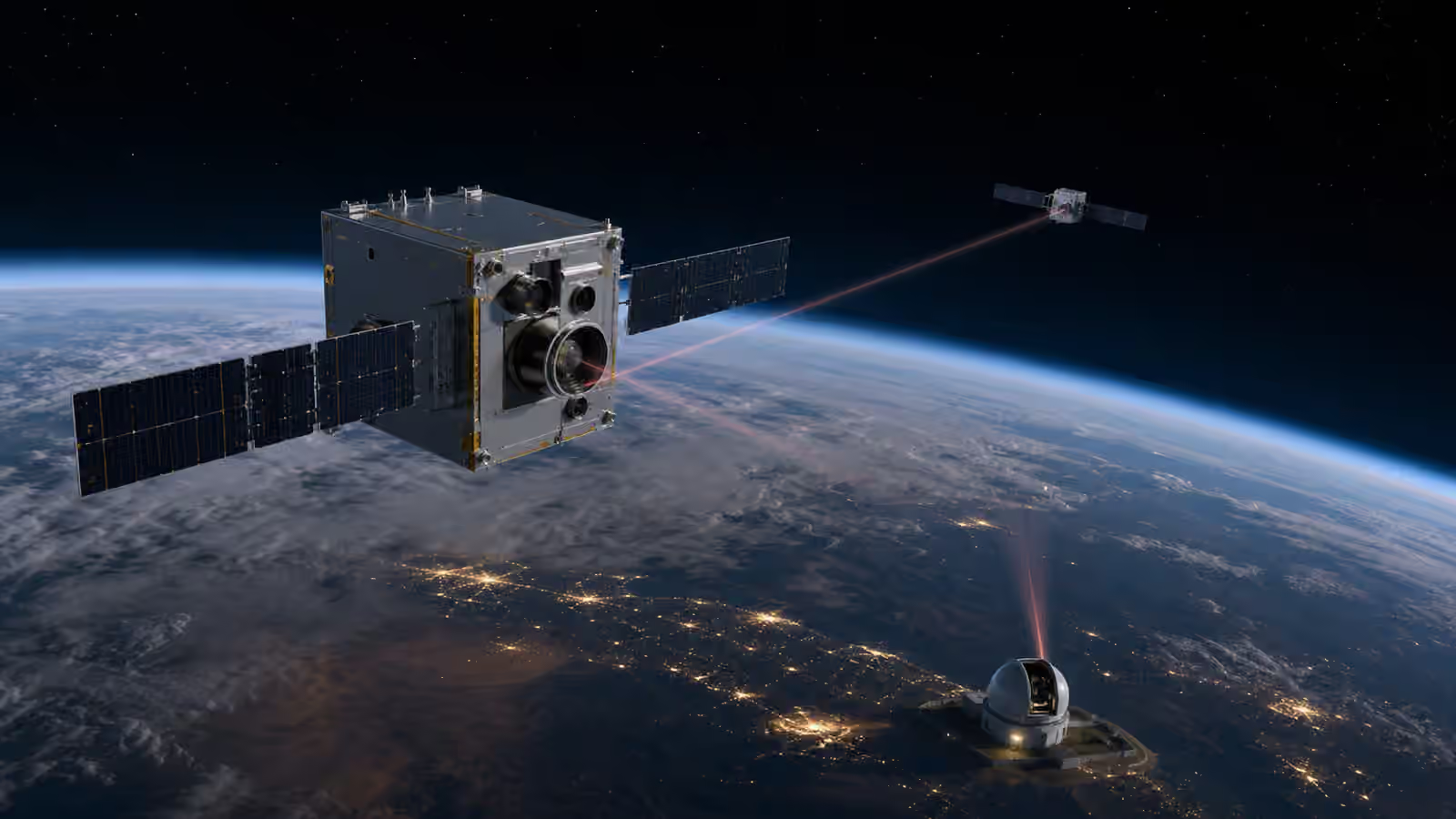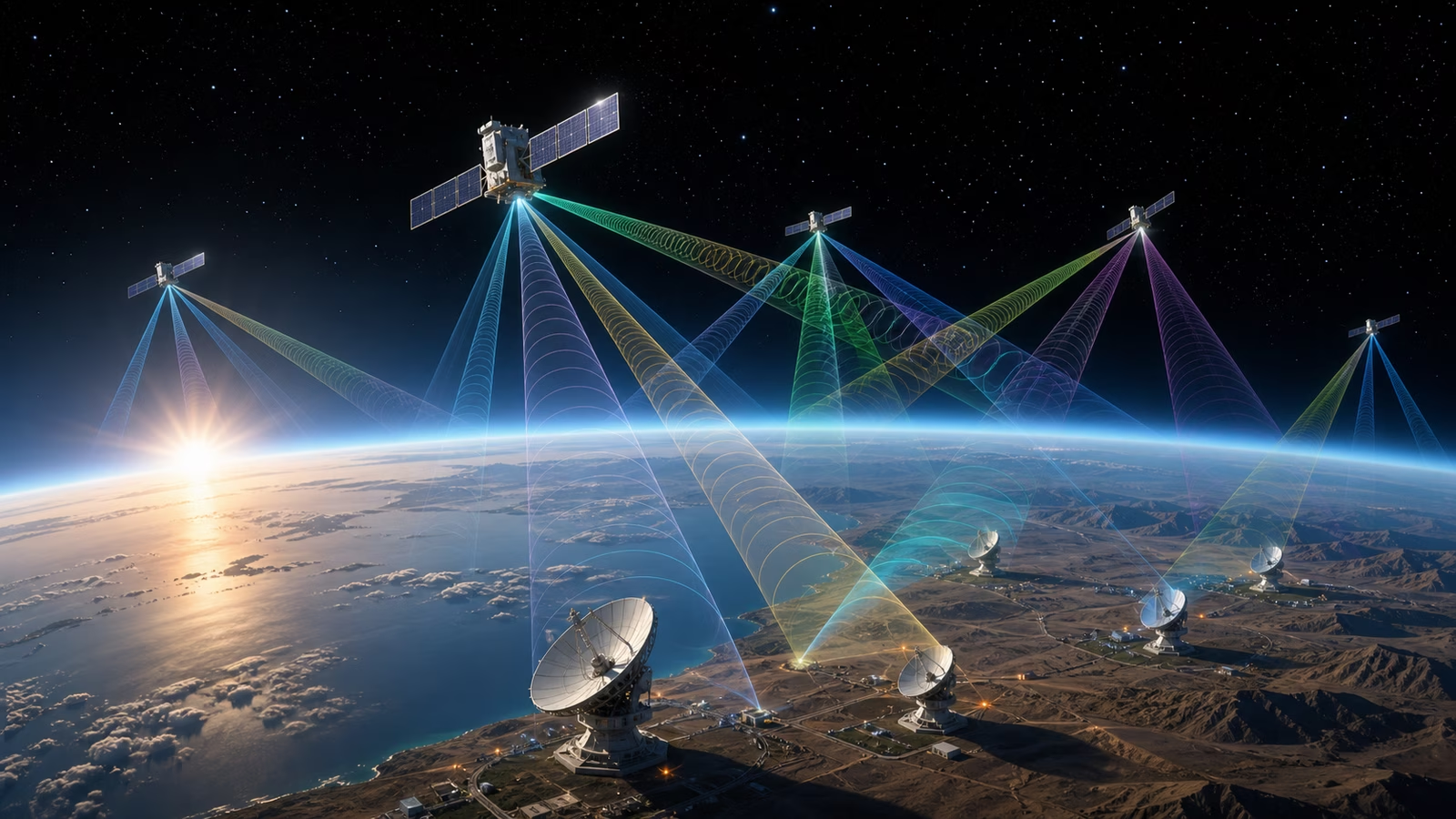
Spectrum is one of the easiest parts of space infrastructure to overlook because no one can see it. Rockets are visible. Satellites can be drawn, photographed, tracked, and counted. Ground stations have dishes, fences, cables, control rooms, and generators. Spectrum has none of that physical drama, yet every satellite service depends on it. A spacecraft may be healthy, its orbit may be correct, and its ground team may be ready, but the mission still fails as a service if radio signals cannot move cleanly between space and Earth.
In ordinary language, spectrum means the range of electromagnetic frequencies that carry radio communication. A satellite uses part of that range to receive commands, send telemetry, downlink images, relay internet traffic, broadcast timing signals, or connect phones beyond the reach of cell towers. Those links feel invisible when they work. A map updates, a ship receives data, a weather image arrives, or an emergency message leaves a remote valley. Behind that convenience is a negotiated and engineered use of airwaves that many other systems also need.
This makes spectrum less like empty air and more like shared road space. The road has lanes, speed limits, merge points, blind spots, heavy trucks, small cars, local traffic, long-distance traffic, and rules that prevent one driver from treating the whole surface as private property. The analogy is imperfect because radio waves can overlap in ways vehicles cannot, but the basic idea holds. A satellite system succeeds only when it uses its lane without making the surrounding traffic unusable.
Why satellites need radio links
A satellite is not valuable simply because it is in orbit. It becomes valuable when it can exchange information. A communications satellite relays traffic between users and networks. An Earth observation satellite sends sensor data down for processing. A navigation satellite broadcasts timing and positioning signals that receivers can interpret. A science mission may return measurements from far beyond low Earth orbit. Even a spacecraft that mostly acts on its own needs command links, health reports, and recovery paths when something unexpected happens.

That is why spectrum sits beside the ground station story. The dish, radio, modem, fiber connection, operations console, and security system are all physical parts of the link. Spectrum is the medium the link uses. If the ground station is the harbor, spectrum is the shipping channel. A larger harbor does not help if vessels cannot enter safely.
Different missions use different kinds of links. Some need small command channels that are reliable but not especially fast. Some need high-rate downlinks that can move large Earth observation files during a short pass. Some need broad coverage for consumer connectivity. Some need extremely stable timing signals. A satellite internet network, a weather satellite, a lunar relay, and a direct-to-phone system all share the larger radio environment, but they do not have identical needs.
The engineering question is therefore not just whether a satellite can transmit. It is whether it can transmit at the right frequency, with the right power, antenna pattern, timing, coding, and coordination so the intended receiver can hear it while other users are not drowned out.
Interference is about confusion, not just noise
People often imagine interference as static, like an old radio hiss. That can happen, but satellite interference is broader. It can mean an unwanted signal raises the noise floor so a receiver has trouble hearing a weak spacecraft. It can mean two systems use nearby frequencies in a way that makes separation difficult. It can mean a powerful transmitter points energy where it was not expected. It can mean equipment has poor filtering, an antenna has sidelobes, or a signal reflects and arrives in a confusing form.
The practical result is uncertainty. The receiver sees energy that does not belong to the conversation it is trying to hold. Sometimes the link slows down. Sometimes packets are lost. Sometimes an operator has to reduce data rates, switch channels, wait for a cleaner contact, or use a different ground site. In severe cases, interference can interrupt service or make a command path unavailable at the moment it is needed.
This matters because many satellite signals are weak by the time they reach the receiver. Space is far away even when the spacecraft is in low Earth orbit. A satellite has limited power, limited antenna size, thermal constraints, and a moving geometry. The ground receiver may be listening for a carefully shaped signal that arrives after spreading across hundreds or thousands of kilometers. A nearby source of unwanted energy can be small in the abstract and still large compared with the signal the receiver wants.
Interference is not always malicious. It can come from a misconfigured system, poor coordination, unexpected weather effects, equipment failure, a new service operating near an old one, or too many systems trying to grow in the same spectral neighborhood. That is why spectrum work belongs to normal infrastructure planning, not only to emergency response or security.
Frequency choices shape mission design
The frequency a satellite uses is not an afterthought. Lower frequencies can travel well and may be useful for certain kinds of coverage or resilience, but they often have less room for high data rates and may face heavy competition from existing services. Higher frequencies can support wider bandwidths and faster links, but they can be more sensitive to rain, atmospheric absorption, pointing precision, and equipment cost. The details vary by band and mission, but the pattern is durable: every frequency choice carries tradeoffs.
This is why spectrum connects to orbital regime and mission design . A low-Earth orbit satellite moves quickly, which changes how long it can see a ground station and how its signal shifts during a pass. A geostationary satellite appears fixed from the ground, which simplifies some pointing problems but creates others around coverage, latency, power, and orbital slot coordination. A constellation with many satellites has to think about aggregate interference, not only one clean link in isolation.
Frequency also shapes antennas. Some systems use narrow beams that concentrate energy toward a specific area. Others need broader coverage. Phased-array antennas can steer beams electronically, which is useful for moving satellites and mobile terminals, but beam steering does not remove the need for careful coordination. A sharp flashlight is still a light source. If enough flashlights sweep across the same room, the room becomes hard to read.
The most mature satellite designs treat spectrum as a scarce mission resource from the beginning. They plan link budgets, antenna patterns, filters, modulation, coding, ground station geography, coordination obligations, and operational procedures as one system. A spacecraft built first and forced to find clean airwaves later may discover that the invisible infrastructure is less flexible than the metal hardware.
Direct-to-phone service raises the stakes
Direct-to-phone satellites make the spectrum problem easier to understand because they connect space infrastructure to an object people already know: the ordinary mobile phone. A phone has a small antenna, a small battery, and radio hardware designed primarily for terrestrial networks. Asking it to communicate with a satellite is very different from connecting a dish or specialized terminal.
The satellite must close a difficult link without overwhelming neighboring users. It may need large antennas, careful beam control, low data rates, patient protocols, and coordination with mobile network operators. It also has to coexist with terrestrial cellular service that may use related spectrum on the ground. A satellite signal that is helpful in a remote area can become a problem if it interferes with dense terrestrial networks, and terrestrial transmitters can also make it hard for the satellite system to hear phones.
That is why direct-to-phone satellites are not just a launch or handset story. They are a spectrum coordination story. The service sounds simple at the user level, especially when framed around emergency messaging or coverage gaps. The underlying system is a careful negotiation among phone limits, satellite power, antenna size, beam geography, terrestrial networks, regulators, and expectations about what kind of service the link can honestly provide.
The same pattern appears in satellite internet. A user terminal may look like a consumer product, but it participates in a coordinated radio system involving satellites overhead, gateway stations, other terminals nearby, and neighboring services. When people compare satellite networks only by speed or coverage, they miss the quieter question of how the network shares spectrum at scale.
Coordination is infrastructure
Spectrum coordination can sound bureaucratic, but it is part of the engineering. Operators typically need licenses, filings, technical studies, interference analyses, and ongoing obligations. International coordination matters because radio waves and satellites do not stay politely inside national borders. A spacecraft may pass over many countries in one orbit. A geostationary satellite may serve broad regions. A signal may affect users far from the business office that planned it.
The point is not that every rule is perfect or that governance is simple. The point is that uncoordinated radio use makes space infrastructure fragile. If each operator maximizes its own signal without regard for others, the shared environment degrades. A single link may look strong in isolation while the whole neighborhood becomes less usable.
This is one of the practical reasons space law and orbital governance matter. Governance is not only about dramatic disputes over territory or resources. It is also about the daily usefulness of communications channels, orbital slots, filings, interference protections, and responsibilities when systems affect one another. A satellite economy cannot be built on everyone shouting louder.
Good coordination is also operational. Operators monitor interference reports, adjust beams, change frequencies when permitted, schedule contacts, investigate anomalies, and maintain records. Ground teams need to know whether a link problem is caused by spacecraft health, antenna pointing, weather, software, congestion, or interference. The radio environment becomes part of mission awareness.
Security and trust depend on clean links
Spectrum is also connected to resilience. A satellite service that cannot distinguish trusted signals from unwanted ones is vulnerable, even if the spacecraft hardware is healthy. Jamming, spoofing, unauthorized transmitters, and signal manipulation sit at the edge between spectrum management and cybersecurity. Not every interference event is an attack, but every critical system needs a way to notice when the radio environment no longer behaves as expected.
This is why satellite cybersecurity and resilience includes more than passwords and software patches. Command authentication, encrypted links, monitoring, anomaly response, ground system discipline, and radio-frequency awareness all reinforce one another. A secure command path still needs a usable channel. A usable channel still needs trust that the signal is what it claims to be.
Navigation and timing systems show the issue clearly. Their signals are widely used and often weak at the receiver. Disruption can affect maps, ships, aircraft, telecom timing, financial systems, grid operations, and logistics. The solution is not a single magic shield. It is layered resilience: better receivers, alternative timing sources, monitoring, procedures, backup communications, and awareness that satellite-derived services are part of a larger infrastructure stack.
The invisible layer becomes visible when it fails
Most people notice spectrum only during failure. A terminal loses connection. A data downlink is delayed. A navigation receiver behaves strangely. A satellite operator sees unexpected noise during a pass. A regulator receives complaints. A service has to explain why coverage is not the same everywhere. The invisible layer suddenly becomes visible because something ordinary stops working.
That is the central lesson. Spectrum is not a decorative technical detail beneath the real space story. It is one of the shared resources that lets the space story become useful on Earth. Launch access can place more hardware in orbit. Manufacturing can make satellites cheaper and more capable. Ground stations can receive and process data. But all of those gains still depend on clean enough links through a crowded radio environment.
When reading about a new satellite system, it helps to ask spectrum questions early. What frequencies does the service rely on? How weak is the user link? What other services operate nearby? How does the system avoid interfering with neighbors? What happens during congestion, rain fade, jamming, or a failed gateway? How much of the promise depends on coordination that users will never see?
Those questions make space infrastructure more realistic. They move attention from the visible hardware to the shared conditions that make the hardware useful. Spectrum is not glamorous, but neither are drainage, traffic signals, power substations, or cable landings. Infrastructure often looks plainest at the place where society depends on it most.
Satellites work in the sky, but they speak through a commons. Keeping that commons usable is part of keeping space useful.