Propulsion is easy to misunderstand because most people meet it first at launch. A rocket climbs through the atmosphere on fire and noise, so propulsion becomes the dramatic thing that gets a machine into space. Once the payload separates, the story often goes quiet. The satellite appears to be in orbit, the mission has begun, and the engine work seems finished.
For many spacecraft, the engine work has only changed scale. After launch, propulsion becomes smaller, slower, and more strategic. It may raise an orbit, trim an insertion error, hold a geostationary satellite near its assigned longitude, counter atmospheric drag in low Earth orbit, avoid a close approach, change the timing of a ground track, unload momentum from reaction wheels, or reserve enough capability for disposal at the end of life. These burns may last seconds, minutes, or many hours. They rarely look theatrical. They are still part of what makes the satellite useful.
A satellite without propulsion can still be valuable. Some missions rely on careful orbital insertion, aerodynamic drag, magnetic torquers, reaction wheels, or short lifetime expectations. But a satellite that can maneuver has more choices. It can preserve coverage, manage risk, correct drift, and leave more responsibly. Propulsion is therefore not only a hardware subsystem inside the Satellite Bus and Payloads story. It is a practical link between mission design, daily operations, traffic coordination, and the final condition of the orbital neighborhood.
Stationkeeping Is How Orbit Becomes Service
An orbit is not a perfectly fixed rail. Gravity from Earth is dominant near Earth, but the Moon, the Sun, Earth’s uneven mass distribution, solar radiation pressure, and traces of atmosphere all tug on spacecraft in ways that matter over time. A low satellite gradually loses altitude to drag. A geostationary satellite drifts away from its assigned orbital slot unless corrected. A constellation satellite may need to keep its spacing relative to neighbors. A navigation satellite may need its orbit known and maintained carefully because timing and position services depend on predictable geometry.
Stationkeeping is the ordinary work of staying where the service needs the spacecraft to be. The word can sound like parking, but it is more active than that. It means measuring the orbit, predicting how it will change, deciding when a correction is worth making, commanding the burn, and then confirming the result. The maneuver may be tiny compared with launch, yet it can decide whether an antenna beam covers the right region, whether an imaging satellite revisits a target at the planned time, or whether a constellation keeps enough satellites in the right places to maintain service.
This is why Orbital Regimes and Mission Design cannot be separated from propulsion. A low Earth orbit broadband spacecraft, a medium Earth orbit navigation satellite, a high geostationary communications satellite, and a small technology demonstrator do not share the same maneuvering problem. Their altitudes, speeds, perturbations, fuel margins, ground contact patterns, and acceptable service interruptions differ. The propulsion system is chosen for the orbit and the mission, not for prestige.
Chemical Propulsion Buys Force Quickly
Chemical propulsion releases energy from stored propellants and turns that energy into thrust. It is useful when a spacecraft needs a relatively strong push in a short period. A satellite may use chemical thrusters for orbit raising, insertion corrections, stationkeeping, collision avoidance, attitude control support, or end-of-life disposal. The exact system can vary from simple cold gas to monopropellant, bipropellant, or newer small-satellite approaches, but the general virtue is responsiveness.
Responsiveness matters in operational life. If a conjunction warning gives an operator a limited window to reduce collision risk, a burn that can happen promptly is valuable. If a satellite must correct a significant launch vehicle injection error, higher thrust can shorten the recovery. If a vehicle needs to move away from a protected orbital region at retirement, a dependable final maneuver can be more important than a little extra payload operation squeezed out of the last fuel.
The tradeoff is that chemical propulsion usually carries finite consumables and plumbing that must survive launch, temperature changes, and years of storage. Tanks, valves, lines, filters, regulators, thrusters, catalysts, seals, and sensors all become part of the spacecraft’s reliability picture. Propellant also occupies mass and volume that could otherwise support payload, power, structure, or thermal control. There is no free maneuver. Every burn spends a resource the mission may need later.
Operators therefore treat chemical fuel like mission authority. It is not merely a number in a tank. It is the remaining ability to hold position, avoid trouble, recover from surprises, and leave the orbit well. A satellite that spends propellant casually may keep service going today while making tomorrow’s disposal harder.
Electric Propulsion Trades Time for Efficiency
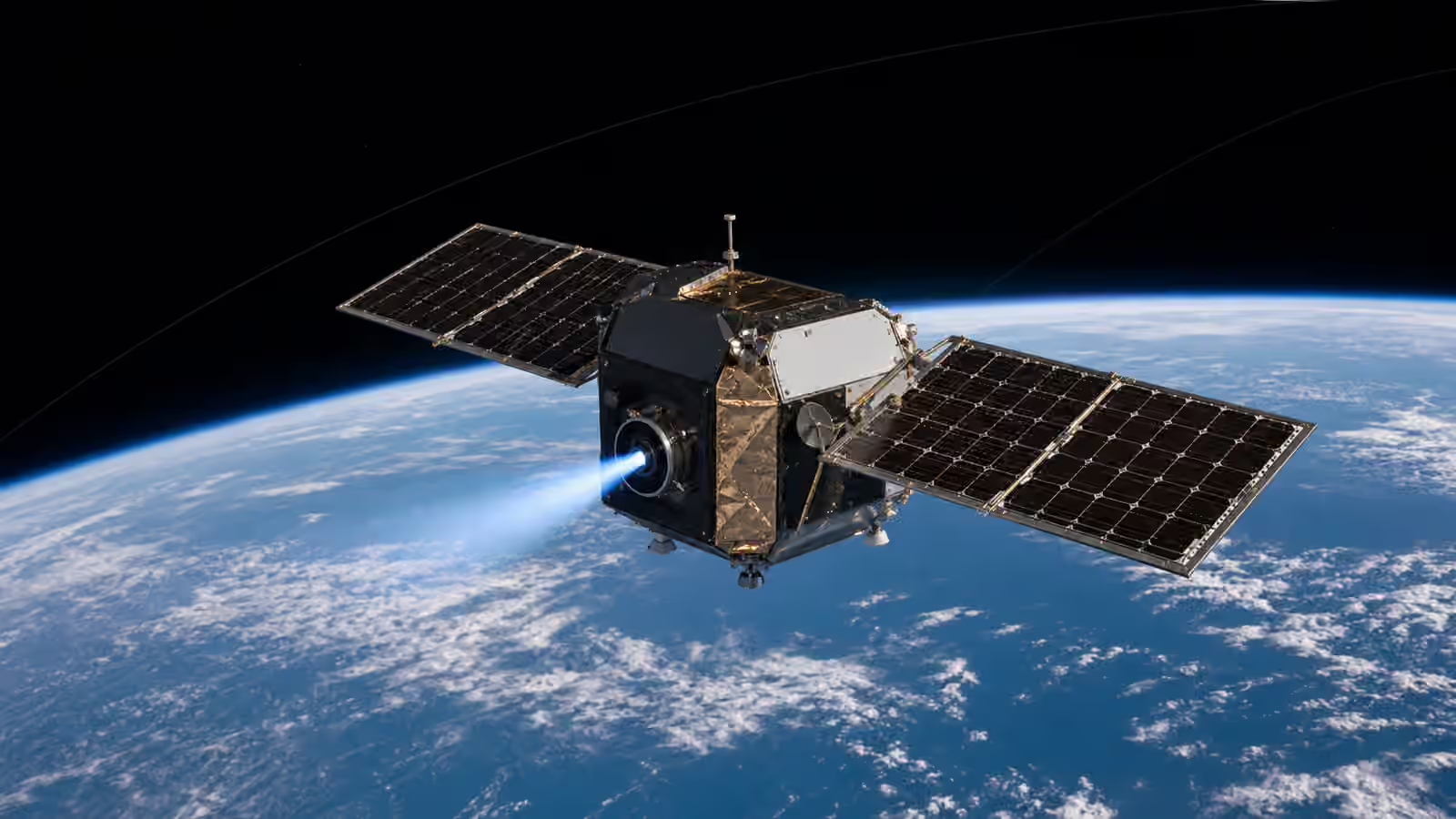
Electric propulsion uses electrical power to accelerate propellant more efficiently than many chemical systems. The thrust is usually low, but the propellant use can be much more economical. That makes it attractive for missions that can tolerate slow maneuvers: orbit raising over weeks or months, long-term stationkeeping, fine adjustments across a constellation, or deep-space cruise where patience can be exchanged for mass savings.
The image of propulsion as a shove does not quite fit electric systems. They are often more like steady pressure. A spacecraft may thrust for long arcs, coast, thrust again, and gradually reshape its orbit. The burn can be gentle enough that the spacecraft’s operations plan, power budget, thermal design, and attitude control all have to cooperate for long periods. The thruster is only one part of the system. Solar arrays must supply power. The bus must reject heat. The spacecraft must point so the thrust vector goes where intended while still protecting antennas, sensors, and thermal surfaces.
This is one reason electric propulsion belongs in an infrastructure guide rather than a hardware catalog. It changes schedules and operations. A satellite that uses electric propulsion to reach its working orbit may not become fully useful immediately after launch. A constellation that uses low-thrust systems may need careful phasing plans so satellites arrive at their service slots without crowding each other or wasting power. A mission planner has to ask not only whether the system is efficient, but whether the customer, operator, ground network, and payload can live with the maneuver timeline.
Electric propulsion also makes end-of-life planning more subtle. It can preserve propellant across a long service life, but it still needs power, attitude control, command access, and functioning hardware near retirement. An efficient thruster is not a disposal plan by itself. The satellite must still be able to execute the final sequence.
Drag Is Both Enemy and Tool
Low Earth orbit is close enough to the upper atmosphere that drag matters. The air is extremely thin, but satellites move so fast that even a small amount of drag can lower an orbit over time. Drag can be troublesome because it changes altitude, ground track timing, and constellation spacing. It can shorten mission life or require repeated reboost maneuvers. During periods of stronger solar activity, the upper atmosphere can expand, and low orbiting spacecraft can lose altitude faster than expected.
Drag is not only a problem. It can also help with disposal. A satellite placed low enough may naturally reenter within a useful timeframe after it stops operating, especially if mission design and area-to-mass ratio support that outcome. Some spacecraft can increase drag near the end of life by changing attitude or deploying drag devices. That approach may suit some small satellites better than carrying a larger propulsion system.
The tradeoff is control. Passive drag can be slow and variable, while propulsion gives operators more authority. A responsible design asks what happens under both healthy and failed conditions. If the satellite works normally, can it lower itself or manage its reentry path as intended? If it fails early, will natural drag still remove it from orbit soon enough for the mission’s risk posture? Those questions connect propulsion directly to Satellite End of Life , where the last phase is part of the mission rather than an afterthought.
Maneuvering Is a Team Sport
A satellite maneuver begins long before a thruster fires. Orbit determination teams estimate where the spacecraft is and where it will be. Mission planners decide whether the desired change is worth the cost. Flight dynamics specialists design the burn. Operators check spacecraft health, power, temperature, attitude, command timing, and communication windows. The ground system prepares to send commands and receive telemetry. After the maneuver, the team measures what actually happened and updates predictions.
This chain is why Satellite Operations After Launch is so closely tied to propulsion. A burn is a physical event, but it is also a procedural event. The spacecraft may need to pause payload work, point away from a normal service attitude, warm a thruster, configure valves, change fault-protection settings, or avoid transmitting during a sensitive period. A maneuver can solve one problem while creating temporary stress elsewhere in the satellite.
Collision avoidance makes the coordination especially visible. A close approach warning is not a command to panic. It is a prompt to evaluate probability, uncertainty, maneuverability, service impact, fuel cost, and coordination with other operators. Sometimes the best decision is to maneuver. Sometimes better tracking data reduces concern. Sometimes a small change in timing is enough. The propulsion system gives the operator options, but judgment decides when to spend them.
The same is true for constellations. A single satellite’s maneuver can affect coverage, handovers, radio links, and neighboring spacecraft. Fleet operations depend on choreography. The public sees internet service, imagery refresh, or timing reliability. Behind that service, operators are keeping many moving machines in usable geometry.
Attitude Control Is Related but Different
Spacecraft also need to point. Cameras, antennas, solar arrays, radiators, and thrusters all care about orientation. Attitude control is often handled by reaction wheels, control moment gyros, magnetorquers, small thrusters, or combinations of those systems. This can blur the language because some thrusters support both pointing and orbit changes, while some pointing systems do not change the orbit meaningfully at all.
The distinction matters. A reaction wheel can rotate a satellite, but it cannot provide unlimited momentum management. Over time, environmental torques can spin wheels toward their limits, and the spacecraft may need magnetorquers or thrusters to unload that accumulated momentum. A satellite may be able to aim a camera beautifully and still lack the propulsion needed to raise its orbit or perform a disposal burn. Another satellite may have strong orbit-control thrusters but need careful attitude sensors and software to use them accurately.
Good spacecraft design treats pointing, propulsion, power, and thermal control as connected. A thruster plume must not contaminate optics or strike sensitive surfaces. A burn attitude must still allow enough power or keep batteries within limits. A propulsion tank must stay within temperature constraints. A high-precision payload may need quiet periods after maneuvers before taking measurements. The subsystem boundaries are useful for engineering, but the spacecraft experiences them as one machine.
Fuel Margin Is Operational Freedom
Fuel margin is one of the clearest examples of hidden infrastructure value. A satellite with healthy payload electronics but no maneuvering margin may become hard to use responsibly. It may be unable to hold its assigned position, respond to collision warnings, maintain constellation spacing, or retire cleanly. A satellite with enough remaining maneuver capability has room to adapt.
That freedom is not only technical. It affects business and governance. Customers care whether service continues reliably. Other operators care whether the spacecraft can coordinate in shared orbit. Regulators and insurers may care whether disposal plans are credible. Investors may care whether a satellite can extend service or recover from an imperfect launch. Fuel that never appears in a product brochure can shape all of those outcomes.
This also explains the interest in In-Space Servicing and Refueling . If a valuable spacecraft runs low on propellant while the payload still works, refueling or life-extension service can change the economics. It can also preserve end-of-life capability. But servicing is easiest when satellites are designed with accessible interfaces and cooperative behavior. A spacecraft built with no thought for maintenance is harder to help later.
The Small Burn Is Part of the Big System
Satellite propulsion is not the loudest part of spaceflight, but it is one of the places where space becomes infrastructure. It turns orbit from a one-time achievement into a maintained condition. It lets operators correct, preserve, avoid, phase, retire, and sometimes rescue. It also forces discipline because every maneuver spends something: propellant, power, time, thermal margin, operational attention, or service availability.
The useful question is not whether a satellite has impressive thrusters. It is what maneuvering promises the mission actually needs. A low orbit constellation may need frequent drag compensation and collision avoidance. A geostationary communications satellite may need years of north-south and east-west stationkeeping. A navigation satellite may need orbital predictability. An Earth observation spacecraft may need timing and pointing that preserve revisit patterns. A short-lived demonstration may need very little propulsion if its orbit and end-of-life plan are chosen carefully.
Once you see propulsion this way, the satellite no longer looks like hardware that simply coasts after launch. It looks like a participant in an ongoing traffic system. Its small burns hold a service together, protect neighbors, and preserve the option to leave well. The fire of launch gets the spacecraft to space. The quieter maneuvering afterward helps decide whether it can keep being useful there.