
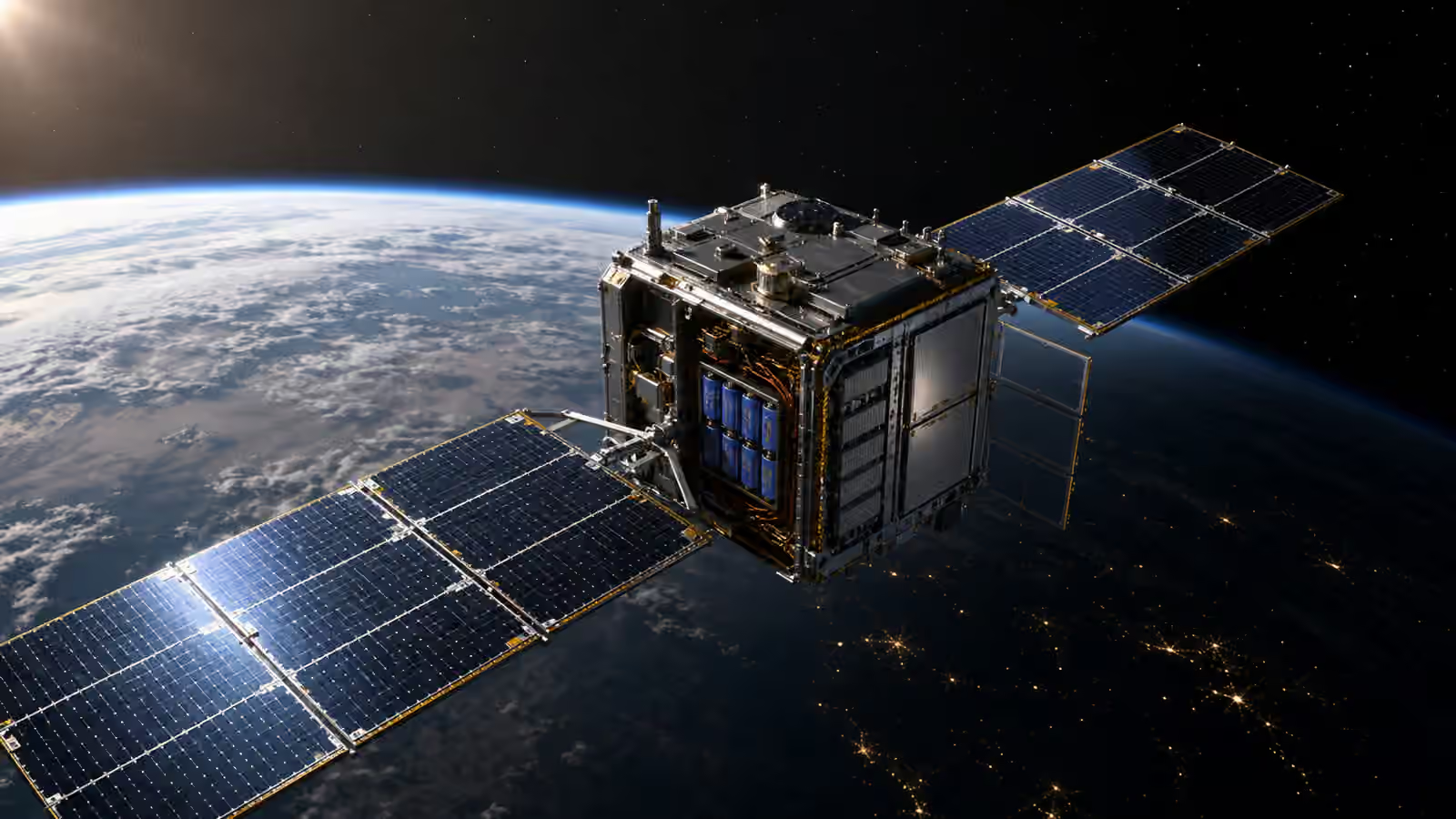
A satellite can look serene from the outside. Solar panels unfold, antennas point outward, and the spacecraft appears to float above Earth without friction or fatigue. Inside the mission, the mood is less relaxed. Every command, transmission, heater cycle, processor task, deployment, and maneuver spends energy from a budget that changes from orbit to orbit.
Power is one of the quiet disciplines that turns hardware into infrastructure. A satellite needs enough electricity to serve the payload, protect itself, communicate with the ground, survive shadow, and still keep margin for the strange days that eventually arrive. It is not enough to ask how much power the solar arrays can make under perfect sunlight. The better question is what the spacecraft can still do when the Sun angle is poor, the batteries are older, the payload is busy, the heaters are on, and the operations team needs a recovery path.
This is why power belongs beside Satellite Bus and Payloads rather than in a footnote. The payload creates the mission’s promise, but the electrical power system decides how often that promise can be kept. A radar instrument may need short bursts of high power. A broadband satellite may need steady energy for amplifiers and routing. An imaging spacecraft may spend power on pointing, data handling, thermal stability, and high-rate downlinks. The bus does not simply provide electricity. It negotiates among needs that cannot all peak at the same time.
Sunlight Is Not a Constant
Solar arrays are the most visible part of many satellites, so it is tempting to treat them as a simple answer. Put panels on the spacecraft, point them toward the Sun, and the mission has power. In practice, solar power is a changing geometry problem.
A solar array produces best when sunlight strikes it cleanly and the cells are healthy. That condition may not align with the payload’s preferred attitude. An Earth observation satellite may need to point a sensor at the ground. A communications satellite may need to hold antennas over a service area. A telescope may need to avoid glare. A spacecraft can have solar array drives that rotate panels independently, but drives add mass, mechanisms, wiring, failure modes, and control rules. Fixed arrays are simpler, but they make the whole spacecraft attitude part of the power plan.
Orbit matters too. Low Earth orbit spacecraft can move from sunlight into eclipse many times in a day. A sun-synchronous mission may have repeatable lighting, while another low orbit may see longer or shorter shadows depending on season and geometry. A geostationary spacecraft has long periods of continuous sunlight, but eclipse seasons still matter operationally. A lunar or deep-space mission faces a different set of sunlight angles, distances, shadows, and communication constraints. The orbit described in Orbital Regimes and Mission Design therefore becomes an electrical design input, not only a path through space.
Solar arrays also age. Radiation, micrometeoroid impacts, thermal cycling, contamination, deployment stress, and ordinary degradation reduce output over time. Engineers usually design against end-of-life capability, not the first bright day after launch. A spacecraft that looks comfortable at beginning of life may have a tighter budget years later. That aging is not a surprise if it was carried honestly in the design.
Batteries Carry the Night
Eclipse is where the power system shows its character. When sunlight disappears, the spacecraft runs from stored energy. Batteries keep computers alive, radios available, heaters cycling, sensors protected, and sometimes payload activities moving through shadow. They are not emergency accessories. They are part of normal orbital breathing.
Battery management is more than capacity. Operators care about state of charge, depth of discharge, temperature, cell balance, charge rates, discharge rates, and long-term health. A battery that is repeatedly pushed too deeply or held outside its thermal comfort zone may age faster. A battery that is oversized for every imaginable case adds mass and cost. A battery that is barely sufficient can turn ordinary operations into a constant negotiation.
Thermal control and power are closely tied. Batteries often need heaters in cold cases, and heaters consume the very energy the batteries are trying to preserve. Electronics and payloads generate heat when they run, which can ease one thermal problem while creating another. Satellite Thermal Control explains the heat side of that bargain, but the electrical side is just as important. A heater that protects a battery may reduce downlink time. A payload run that warms an instrument may force a later cooling period. A safe attitude that points arrays well may expose a radiator poorly.
This is why a power budget is not a single spreadsheet row. It is a schedule, a thermal case, an attitude plan, and a fault plan at the same time.
The Budget Is Built From Modes
Spacecraft usually operate in modes. There may be a launch and early operations mode, a commissioning mode, a nominal mission mode, a payload observation mode, a downlink mode, a maneuver mode, a safe mode, and a disposal mode near the end. Each mode has different loads and different priorities.
Safe mode is especially revealing. It is the state a spacecraft enters when something is wrong or uncertain. A good safe mode reduces demands, protects temperatures, seeks enough power, preserves communications, and gives operators time to understand the problem. It may stop the payload, simplify pointing, limit nonessential heaters, or choose an attitude that favors solar input. But safe mode is not magic. If the power design leaves too little margin, the spacecraft may struggle to stay alive long enough for recovery.
Operational planning turns those modes into a daily rhythm. The team may avoid scheduling a high-power payload activity just before a long eclipse. It may delay a downlink if battery state is low. It may warm propulsion hardware before a maneuver, then account for the heater load. It may limit imaging during a period when the array geometry is poor. Satellite Operations After Launch is full of these quiet decisions. The public service may look continuous, but the spacecraft is constantly being asked what it can afford.
Power converters, regulators, switches, harnesses, fuses, and distribution units make this discipline physical. They route energy from arrays and batteries to loads with the right voltage, protection, and control. A spacecraft is not one big extension cord. It is an electrical organism with branches that can be isolated, monitored, shed, or prioritized. Fault protection may switch off a load that draws too much current. Redundancy may preserve a critical path if one unit fails. Telemetry lets operators see currents, voltages, temperatures, and trends before a small problem becomes a mission problem.
Peak Power Can Be Harder Than Average Power
Average power can hide the real stress. A satellite may look healthy across a whole orbit but still face difficult peaks. A transmitter may draw heavily during a short ground-station pass. A radar payload may need intense bursts. A processor may run hot during onboard analysis. A propulsion system may need valves, heaters, electronics, and attitude control at the same time. A deployment motor may require a brief but important load early in the mission.
Those peaks connect power to data and communications. An Earth observation satellite may collect more data than it can downlink immediately, then spend a high-power pass sending it home. A communications spacecraft may have traffic patterns that vary by region and time. A navigation satellite may value stable clocks and signal generation over dramatic peaks. Satellite Spectrum and Interference describes the radio environment, but the radio link also depends on available spacecraft power, amplifier behavior, antenna pointing, and thermal limits.
Peak power also affects margins. If the spacecraft cannot run every desirable activity together, the mission needs rules. It may prohibit certain combinations, require battery thresholds before payload use, or reserve energy for command and recovery. These rules can seem conservative until an anomaly arrives. Then the reserved margin becomes the difference between options and improvisation.
Testing Finds the Hidden Assumptions
Power-system assumptions should be challenged while the spacecraft is still on Earth. Engineers test solar array deployment, battery behavior, charge control, power distribution, fault protection, electrical interfaces, and mode transitions. They verify that loads draw what they claim, that harnesses are correct, that protection behaves as expected, and that software does not command an unsafe combination by accident.
Environmental testing adds context. Vibration can reveal weak connections. Thermal vacuum testing can change battery behavior, heater duty cycles, converter performance, and sensor readings. Electromagnetic compatibility tests can expose unwanted interactions among electronics. Satellite Manufacturing and Testing treats these tests as a way to learn the spacecraft’s truth before launch. For power systems, that truth is often found in the dull details: a voltage drop across a harness, a current spike during startup, a heater that cycles more often than the model predicted.
Documentation matters because the power system changes over time. A waiver, replacement, late harness reroute, software setting, or battery test result may become important years later when operators investigate a trend. The satellite in orbit is partly maintained by the records made before it left the ground.
Power Shapes the Ending
End-of-life planning also depends on electrical discipline. A spacecraft may need power for final tracking, command reception, attitude control, propulsion preparation, deorbit operations, passivation, or movement to a disposal orbit. A vehicle that uses every remaining resource on service may have little left for a responsible ending.
Satellite End of Life is often discussed in terms of debris, disposal orbits, deorbit burns, and passivation. Power sits underneath all of that. Batteries may need to be managed or safed. Pressure vessels and stored energy may need attention. Radios must still respond. Computers must still execute commands. Heaters may still be needed for propulsion hardware or electronics. The final phase is not separate from the power budget. It is one of the budget’s last tests.
This is also where infrastructure thinking becomes concrete. A satellite is not mature because it has the largest arrays or the newest battery chemistry. It is mature when its energy system supports the whole mission arc: launch, commissioning, service, anomalies, aging, and retirement. It can power the valuable work without spending away its ability to recover or leave responsibly.
When you read about a spacecraft, ask where its energy comes from, where it is stored, what loads dominate, what happens in eclipse, what ages fastest, and what power is reserved for trouble. Those questions make the machine less mysterious. They reveal the satellite as a set of promises balanced against sunlight, shadow, chemistry, heat, and time.
Space infrastructure depends on that balance. A satellite that manages power well can keep its payload useful, its operators informed, its batteries healthier, its heaters honest, and its final plan reachable. A satellite that treats power as an afterthought may fail in ways that look sudden from the outside but were really written into the budget from the beginning.


