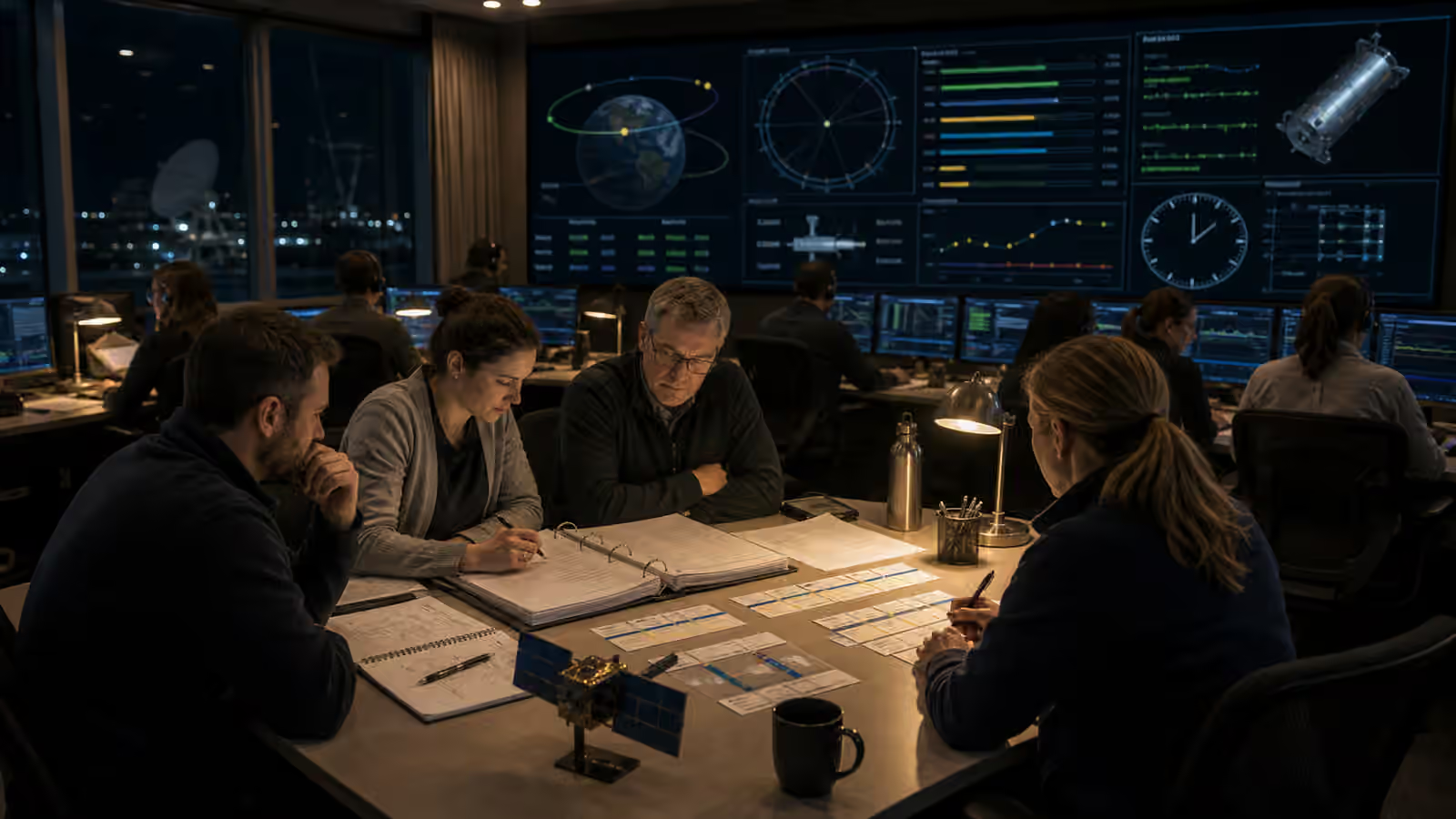
Launch gets the noise, the countdown, the flame, and the headline. Operations get the years.
A satellite is not useful because it reached orbit once. It is useful because it wakes up, points correctly, talks to the ground, manages power, keeps itself warm or cool enough, avoids collisions, survives radiation, receives software updates, handles anomalies, and delivers data or service day after day. The rocket is the dramatic doorway. The operations team is the group that has to live in the house.
This is easy to miss because space stories often end at separation. The payload is deployed, the crowd cheers, and a webcast shows a small object drifting away from the upper stage. For the satellite team, that moment is not the ending. It is the beginning of the most delicate part of the mission.

First Contact
After deployment, the first concern is whether the satellite is alive and communicating. The spacecraft may be tumbling slowly, waiting for antennas to deploy, or operating on a safe mode with limited power. Ground stations listen for a signal. Operators compare what they hear against what the satellite should be sending. A small satellite may have only brief passes over a ground station, so the team may get minutes at a time to understand its condition.
The first telemetry can feel like a medical chart. Battery voltage, temperatures, radio status, computer state, attitude estimates, solar array behavior, and fault flags all tell part of the story. A healthy satellite does not simply say hello. It reports whether its organs are behaving.
Commissioning follows. The team checks subsystems, deploys appendages if needed, verifies sensors, calibrates pointing, tests radios, validates payloads, and moves the spacecraft from survival mode toward mission mode. This can take days, weeks, or longer depending on the satellite. Rushing is dangerous. A command that is harmless on the ground can behave differently in orbit if the spacecraft is in an unexpected state.
Operations begins with humility. The satellite is far away, moving fast, and reachable only through narrow windows of communication or scheduled links. The team has to trust procedures, logs, simulations, and discipline.
The Routine Is the Mission
Once a satellite is commissioned, operations becomes a rhythm. The spacecraft collects data, relays communications, observes Earth, measures weather, supports navigation, tests technology, or serves another mission. The ground team schedules activities, uplinks commands, downlinks data, monitors health, and watches for trends.
Routine does not mean simple. A satellite lives in a harsh environment. Sunlight heats surfaces. Eclipse cools them. Radiation can flip bits or damage electronics. Atmospheric drag changes low orbits. Solar activity affects communications and orbit predictions. Reaction wheels wear. Thrusters have limited propellant. Batteries age. Sensors drift. A component that worked perfectly for two years can begin to show a strange pattern on a Tuesday afternoon.
The operations team looks for those patterns before they become failures. A temperature that slowly rises, a battery that holds less charge, a wheel that draws more current, or a radio link that becomes less reliable may be a clue. Good operations is often the art of noticing boring numbers early.
This is where space becomes less like adventure fiction and more like maintenance culture. The mission survives because people respect logs, procedures, checklists, configuration control, and clear communication. The difference between a recoverable anomaly and a lost spacecraft can be one rushed command, one stale assumption, or one missing handoff note.
Pointing, Power, and Thermal Balance
Most satellites must manage three constant needs: where they point, how they power themselves, and how they control temperature.
Pointing matters because antennas, cameras, sensors, and solar arrays all care about direction. An Earth observation satellite may need to aim precisely at a target. A communications satellite may need to hold beams over service areas. A solar array needs sunlight. A telescope may need to avoid glare. Attitude control uses sensors and actuators to understand orientation and change it, but each maneuver has costs and constraints.
Power is equally unforgiving. Solar arrays generate electricity when illuminated. Batteries carry the satellite through eclipse or high-demand periods. The operations plan has to avoid draining batteries too deeply, overloading systems, or scheduling too many power-hungry activities at once. A satellite with a brilliant payload and poor power management becomes a very expensive lesson.
Thermal control is the quiet third problem. Electronics, batteries, propellant, optics, and payloads often need specific temperature ranges. Space is not simply cold; it is extreme. Sun-facing surfaces can heat strongly while shaded parts cool. Satellites use coatings, heaters, radiators, insulation, and operational choices to stay within limits. Sometimes the safest command is not the most scientifically exciting one. It is the one that keeps the spacecraft healthy for tomorrow.
Anomalies Are Normal
An anomaly is something unexpected. It might be a computer reset, a sensor reading outside limits, a missed communication pass, an attitude-control issue, a stuck deployment, a payload glitch, or a software behavior that appears only in orbit. Anomalies do not always mean disaster. They are part of operating complex machines remotely.
The first rule is to avoid making the situation worse. Operators gather telemetry, preserve evidence, compare against known failure modes, and decide whether the satellite is safe. They may put the spacecraft into a protective mode, pause payload operations, or wait for more data. The pressure to act quickly is real, but a premature command can turn confusion into damage.
Good teams practice. They run simulations, write contingency procedures, define authority, and train for off-nominal events. They also learn from each anomaly. A one-time reset may become a monitored risk. A recurring fault may require a software patch. A thermal surprise may change scheduling. The mission becomes more robust because the team treats problems as information.
Software updates are part of this story. Modern satellites often depend on onboard software that can be patched or reconfigured. That flexibility is powerful, but it demands caution. Updating a spacecraft is not like updating a phone on a couch. The team has to validate the change, preserve recovery paths, schedule the upload, verify installation, and ensure the satellite can survive if the update fails midway.
Traffic, Weather, and Neighbors
A satellite also has to share orbit. Operators monitor conjunction warnings, which estimate close approaches with other spacecraft or debris. If the satellite can maneuver, the team may plan an avoidance burn. That decision is not automatic. Maneuvers use propellant, interrupt service, and depend on uncertainty in tracking data. But ignoring risk can be far worse.
Space weather adds another layer. Solar storms can affect drag, radiation levels, communications, and navigation. A low Earth orbit satellite may experience increased atmospheric drag during heightened solar activity, changing its orbit faster than expected. Operators may adjust plans, protect instruments, or prepare for degraded service.
The satellite is therefore not alone. It operates inside a neighborhood shaped by physics, other operators, debris, ground networks, regulators, and customers. A good operations plan understands that neighbors matter.
End of Life Is Part of the Design
Responsible operations includes the ending. A satellite should not simply work until it dies and becomes debris. Depending on orbit and mission, the end-of-life plan may involve deorbiting, moving to a disposal orbit, passivating energy sources, lowering collision risk, and complying with debris mitigation rules.
This ending has to be protected during the mission. If all propellant is spent on routine maneuvers, there may be none left for disposal. If a satellite is operated until critical systems fail, it may lose the ability to leave safely. End-of-life planning is not pessimism. It is orbital stewardship.
For a satellite constellation, this responsibility multiplies. One failed spacecraft is a problem. Many failed spacecraft can become a hazard. Operations quality is therefore part of the business model, not a hidden engineering detail.
The Part of Space That Becomes Infrastructure
The more society depends on satellites, the more operations matters. Weather forecasts, internet service, disaster response, agriculture, shipping, defense, science, mapping, and climate monitoring all depend on spacecraft that remain useful after the launch video fades. Reliability is not produced by the rocket alone. It is produced by the years of careful work that follow.
When you read about a new satellite system, ask what happens after orbit insertion. How are the satellites commissioned? How are anomalies handled? How often can software be updated? How is collision risk managed? What is the end-of-life plan? How much ground infrastructure is needed to keep the service running?
Those questions reveal the real maturity of a space project. Launch proves that a spacecraft can reach the stage. Operations proves whether it can perform.
The quiet truth is that space infrastructure is made of repeated attention. A satellite may be above the atmosphere, but its usefulness is maintained by people on the ground who read telemetry, argue with uncertainty, write careful commands, and keep asking whether the machine will still be healthy tomorrow.
That is the work after launch. It is less spectacular than fire, and far more important.