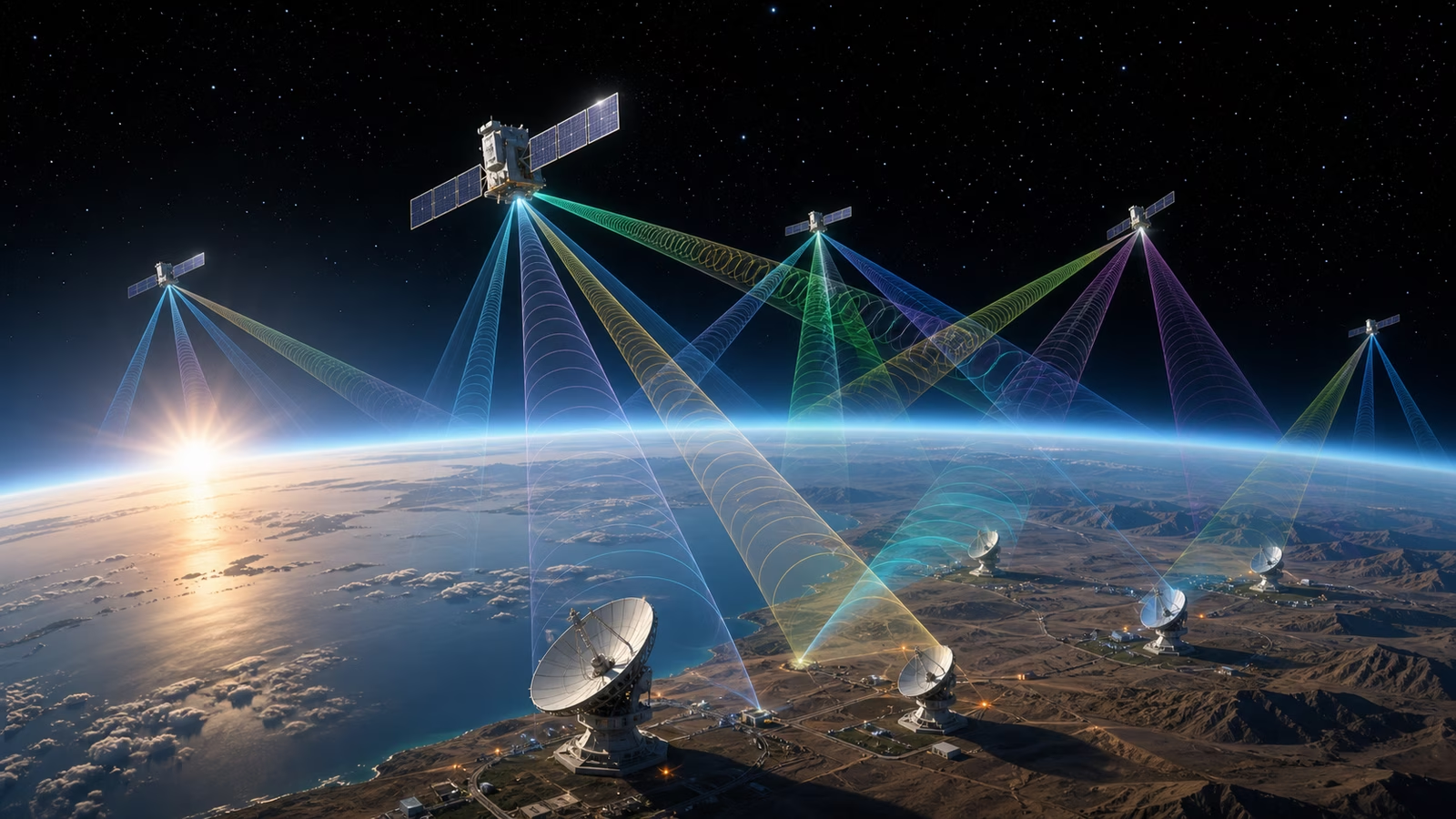
A satellite constellation can look like a set of individual machines passing over Earth one after another. In practice, the most capable constellations begin to behave more like moving networks. The satellites are still spacecraft, with batteries, radios, computers, thermal limits, pointing constraints, and finite lifetimes. But when they can talk to one another, they are no longer only collectors or repeaters waiting for the next ground contact. They can pass traffic across orbit, route around gaps, and sometimes deliver data through a satellite that is hundreds or thousands of kilometers away from the place where the data began.
Inter-satellite links, often called crosslinks, are the connections that make this possible. A crosslink may use radio frequency equipment, optical terminals, or another specialized communication system to connect one spacecraft to another. The basic idea is simple. Instead of forcing every bit of data to descend immediately to a ground station, the network can move that data sideways through space until a better path appears. The engineering is not simple at all. It asks satellites to point accurately at fast-moving neighbors, keep clocks and routing tables aligned, manage power and heat, protect command paths, and operate a network whose nodes never stop moving.
That is why crosslinks belong beside Satellite Constellation Design rather than as a footnote inside a radio specification. The constellation guide explains how coverage, phasing, handovers, capacity, replenishment, and orbital traffic shape a fleet. Inter-satellite links add the networking layer. They turn a collection of spacecraft into a system that can carry information through the sky before it returns to Earth.
Why satellites talk to satellites
The ordinary satellite communication path goes from spacecraft to ground or from ground to spacecraft. That path is still essential. A ground station connects orbital work to terrestrial fiber networks, data centers, users, operators, and mission control. Ground Stations remains the earthside half of the story. But ground stations are not always where a satellite needs them at the moment it needs them.
A low Earth orbit spacecraft sees only part of Earth at once. It may collect an image over the ocean, pass over a remote research site, serve an aircraft route, or receive traffic from a region with no nearby gateway in view. Without a crosslink, that data may have to wait in onboard storage until the satellite passes over a suitable ground station. For some missions, waiting is acceptable. A mapping archive can tolerate delay. For others, delay changes the value of the data. Disaster response imagery, weather observations, maritime awareness, and broadband traffic are more useful when the system can move them promptly.
Crosslinks provide another path. A satellite that cannot see a gateway may be able to see a neighboring satellite. That neighbor may send the traffic to another satellite, and eventually the network may reach a spacecraft that has a strong ground connection. The path can be longer in distance but better in service because it avoids waiting for a local ground contact. In a constellation, geography becomes a routing problem instead of a hard wall.
This does not make ground infrastructure obsolete. It changes what ground infrastructure is asked to do. Gateways can be fewer, better placed, or used more flexibly when the fleet can move traffic across orbit, but the traffic still has to enter the terrestrial internet, mission archive, control system, or user network somewhere. Crosslinks reduce dependence on immediate local descent. They do not remove the need for disciplined ground operations.
Optical links are precise instruments
Many modern crosslink discussions focus on optical links. An optical terminal sends a tightly focused beam of light between spacecraft. Compared with a broad radio beam, the optical beam can carry high data rates with less spreading and less spill into the surrounding radio environment. It can also be difficult to intercept casually because the beam is narrow. Those strengths make optical links attractive for broadband constellations, Earth observation systems with large data volumes, and relay networks that need efficient space-to-space transfer.
The narrow beam is also the burden. Two satellites must find each other, point accurately, acquire the link, and keep it stable while both vehicles move through orbit. This is not the same as shining a flashlight across a room. The terminals may be separated by long distances, the spacecraft may be slewing for other reasons, and vibration or thermal distortion can disturb alignment. The link may need fine steering mirrors, sensors, control loops, careful mechanical mounting, and software that knows when to try again after a loss.
The pointing story connects directly to Satellite Attitude Control . A spacecraft that carries optical crosslinks may need to balance antenna or terminal pointing against solar array orientation, payload tasking, thermal limits, and collision-avoidance maneuvers. If the satellite is an imaging spacecraft, it may want to point its payload at Earth while also maintaining a space-to-space link. If it is a broadband spacecraft, it may need to keep user beams, gateway links, and crosslinks coordinated as the geometry changes. A clean line on a network diagram becomes a sequence of attitude-control decisions.
Radio crosslinks can be more forgiving in some geometries and bands, but they bring their own constraints. They occupy spectrum, can create or receive interference, and may need larger antennas or lower data rates depending on distance and frequency. Satellite Antennas and Link Budgets explains why every link is an accounting problem. Crosslinks add another ledger. The spacecraft must budget power, pointing loss, noise, interference, data rate, coding, hardware aging, and neighbor geometry for links that may change many times during an orbit.
Routing through a moving sky
On Earth, network engineers still deal with failures, congestion, maintenance, and changing demand, but most routers do not race around the planet every ninety minutes. Orbital routing is different because the topology changes predictably and constantly. A satellite may see one neighbor now, a different neighbor later, and a gateway only during certain windows. The best path for traffic is not only the shortest path on a map. It is the path that will remain available long enough, has enough capacity, respects priority, avoids overload, and reaches a ground exit where the data can continue its journey.
This is where Satellite Onboard Computers and Data Handling becomes part of the network. The satellite is not merely carrying a radio. It is making decisions about queues, storage, packet forwarding, timing, fault handling, and downlink priority. A remote sensing satellite may decide that fresh disaster imagery should move first while routine archive data waits. A broadband constellation may route customer traffic through multiple orbital hops before it reaches a gateway. A timing or navigation support system may treat certain control messages as more urgent than ordinary payload data.
Routing also has to be predictable enough for operators to trust. A fleet cannot rely on improvisation alone. It needs planned contact schedules, expected neighbor relationships, capacity models, software versions, telemetry, and rehearsed responses when links fail. Because orbital motion is predictable, some routing can be planned ahead. Because spacecraft and weather and demand are not perfectly predictable, the system also needs flexibility. The skill is to combine orbital foresight with operational humility.
The moving network can help with resilience. If one gateway is unavailable, traffic may reach another. If one satellite has a failed terminal, neighbors can route around it if the constellation has enough geometry and capacity. But resilience is not automatic. A network can also spread problems quickly. A software mistake in routing logic, a bad clock assumption, or a mismanaged update can affect many satellites at once. Fleet-scale communications need the same caution described in Satellite Cybersecurity and Resilience : staged changes, monitoring, authentication, recovery paths, and clear authority.
Crosslinks change latency and capacity
The public often hears about crosslinks as a way to reduce latency. Sometimes that is true, but the better statement is more careful: crosslinks can change where latency comes from. A path through several low Earth orbit satellites may avoid a long terrestrial detour or a wait for a gateway pass. It may be useful over oceans, polar regions, sparsely connected areas, or moving platforms. For some routes, a space path can be competitive because signals move quickly through vacuum and because the network may find a more direct geometry than the available ground infrastructure.
Latency is not only distance. It includes acquisition time, routing decisions, buffering, queueing, handovers, gateway processing, terrestrial backhaul, and application behavior. A crosslinked constellation that is overloaded may still feel slow. A system with excellent optical terminals but poor routing discipline may still drop traffic. A service that depends on small user terminals may still be limited by the user link rather than the crosslink. Satellite Internet and Low-Earth Orbit Networks shows why user experience is the product of the whole system, not one impressive component.
Capacity has a similar texture. Crosslinks can move capacity from where a satellite is to where a gateway is, but they do not create infinite capacity. Every hop uses terminal time, power, processing, and link margin. A satellite that spends effort relaying traffic for others may have less room for its own users or payload data. The network may have to decide which traffic deserves the best route and which traffic can wait. In this sense, crosslinks make the constellation more flexible while also making traffic management more important.
The hidden spacecraft costs
An inter-satellite link terminal is not a weightless idea. It has mass, volume, power demand, thermal behavior, alignment needs, software, test requirements, and failure modes. It may need a clear field of view through the spacecraft layout. It may need stable mounting so the pointing system can trust its alignment. It may generate heat that Satellite Thermal Control has to reject. It may draw power at moments when the satellite is already handling payload work, user beams, heaters, battery charging, or propulsion activity.
Those costs matter because spacecraft design is a negotiation. A small satellite may not have room for many terminals. A high-capacity broadband satellite may carry several because network performance depends on multiple neighbor paths. An Earth observation spacecraft may decide that one relay path is enough for selected urgent data. A mission with a strong global ground network may prefer more ground stations and simpler spacecraft. The right answer depends on the service, orbit, budget, manufacturing plan, and risk tolerance.
Testing is another cost. A crosslink has to work as installed, not merely as a component on a bench. Engineers need to verify terminal alignment, acquisition behavior, software modes, thermal performance, radio or optical safety rules, and compatibility with fleet operations. Satellite Manufacturing and Testing is relevant here because network equipment becomes part of the spacecraft’s physical reality. A terminal blocked by a deployed appendage, shifted by thermal distortion, or starved of power during a busy mode can turn a networking plan into an operations problem.
Reading crosslink claims
When a satellite system claims inter-satellite links, the useful question is not simply whether the hardware exists. Ask what the links are for. Are they carrying customer traffic, payload data, command and control, timing, routing updates, or only selected relay traffic? Ask how many terminals each satellite carries, which neighbors it can see, how links are acquired, what happens when a terminal fails, and how traffic reaches the ground. Ask whether the system has enough gateway capacity after the orbital relay has done its work.
The strongest crosslink architectures are not impressive because they draw bright lines between satellites. They are impressive because the lines fit the rest of the mission. The orbit supports useful neighbor geometry. The spacecraft can point and power the terminals. The onboard computers can queue and route data. The ground segment can absorb the traffic. The operations team can update software without losing the fleet. The security design treats every path as a path that must be trusted, monitored, and recoverable.
Inter-satellite links are therefore best understood as infrastructure inside infrastructure. They are not the whole satellite service, and they are not a decorative upgrade. They are a way of giving a moving fleet more choices. A satellite can wait for Earth, or it can hand data to a neighbor. A constellation can depend on one gateway path, or it can search for another. Operators can treat the sky as a set of isolated passes, or they can manage it as a network whose shape changes with every orbit.
That network is hard to build well. It asks for clean mechanics, accurate pointing, disciplined spectrum use, strong software, careful thermal and power budgeting, and a ground system that knows what to do when the data finally arrives. When those pieces work together, crosslinks make space feel less like a set of distant machines and more like a maintained layer of communications infrastructure. The satellites are still moving. The service feels steadier because the network has learned how to move with them.