
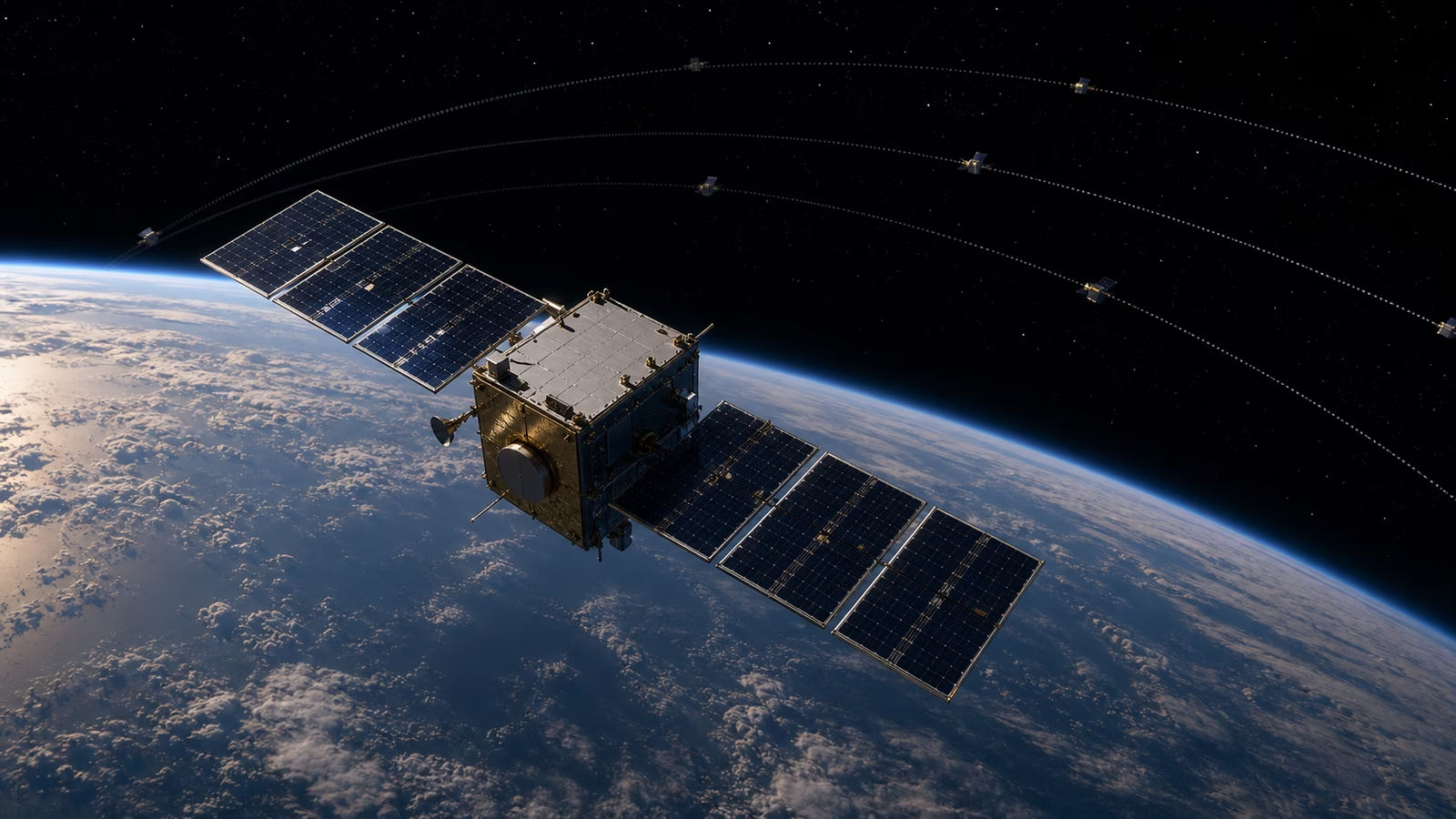
A satellite mission does not end when the press release gets quiet. It ends when the spacecraft has been left in a condition that other operators, future missions, and the orbital environment can live with. That last phase may be less glamorous than launch, deployment, or the first images from orbit, but it is one of the clearest tests of whether space infrastructure is being treated responsibly.
Satellites are not parked in a private sky. They share orbital regions with weather spacecraft, Earth observation platforms, communications constellations, navigation services, scientific missions, crewed stations, debris fragments, rocket bodies, and future spacecraft not yet built. Every object that remains in orbit becomes part of the traffic picture. A mission that worked beautifully for its owner can still create trouble if its end is ignored.
End-of-life planning is the discipline of asking the last question early. What happens when the fuel runs low? What happens if the satellite loses contact? Can it lower its orbit? Can it move to a disposal orbit? Can batteries, tanks, wheels, and stored energy be made safer? Who monitors it after service ends? What if the spacecraft fails before the planned final maneuver?
The best time to answer those questions is before launch, when the spacecraft can still be designed around them.
Low Earth Orbit Usually Needs a Way Down
In low Earth orbit, the atmosphere is thin but not absent. It drags on satellites, especially at lower altitudes, and over time that drag can pull objects down until they reenter. For some missions, natural decay may be fast enough. For others, especially at higher low-Earth altitudes, waiting passively can leave a dead spacecraft in orbit for too long.
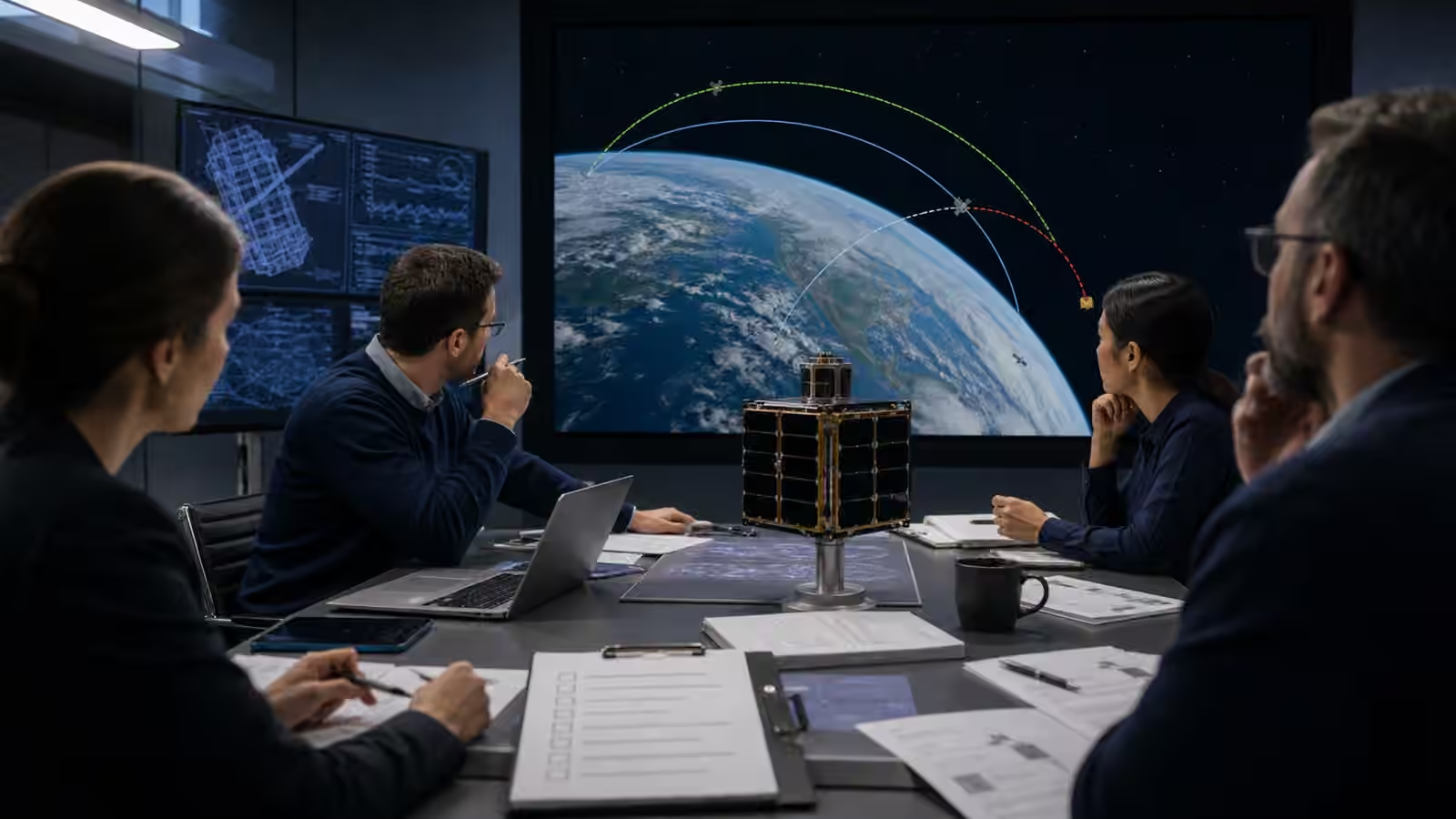
A controlled or assisted deorbit is one way to reduce that risk. The satellite may use remaining propellant, electric propulsion, drag devices, or mission design choices that make reentry happen within an acceptable window. The goal is to avoid leaving a nonresponsive object circling through busy orbital lanes for years longer than necessary.
Deorbiting sounds simple from the ground, but it depends on planning. The spacecraft needs enough control authority, enough energy, enough knowledge of its orbit, and enough operational margin to perform the final sequence. If operators wait until the vehicle is barely alive, they may discover that the last responsible act now requires resources the mission has already spent.
That is why end-of-life is not a cleanup chore after the mission. It is part of mission design.
Higher Orbits Have Different Endings
Not every satellite can come down quickly. Some operate in higher orbits where atmospheric drag is weak and deorbiting would require too much energy. In those cases, disposal may mean moving the spacecraft away from the protected operational region. For some high-altitude missions, that can mean a graveyard orbit or another disposal strategy that reduces interference with active spacecraft.
The principle is the same even when the maneuver differs. A spacecraft should not remain as a long-term hazard in the most useful orbital corridor if there is a responsible alternative. The chosen end state depends on altitude, mission type, propulsion, regulations, operator capability, and the physical limits of the spacecraft.
This is one reason broad slogans about space sustainability can be misleading. Low Earth orbit, medium Earth orbit, geostationary orbit, lunar trajectories, and deep-space missions do not all share the same disposal problem. Each region has its own traffic, physics, and consequences. Responsible end-of-life planning begins by respecting those differences.
Passivation Makes Dead Spacecraft Less Dangerous
A satellite at the end of its mission may still contain stored energy. Batteries, pressurized tanks, residual propellant, reaction wheels, and other components can pose risks if left in a bad state. Passivation is the process of making the spacecraft safer by reducing stored energy and preventing later breakups where possible.
This work matters because debris is not only created by collisions. It can also come from explosions, ruptures, or structural failures after a mission has ended. A dead spacecraft that breaks apart becomes many objects, each harder to track and avoid than the original. The problem multiplies.
Passivation is not visually dramatic. It may involve venting, discharging, safing systems, disabling charging paths, or leaving the vehicle in a stable configuration. It is exactly the kind of engineering that rarely gets attention until it fails. But for the shared orbital environment, quiet safety steps are valuable.
The responsible operator thinks about the satellite after it stops being useful.
End of Life Depends on Communication
A satellite cannot execute a graceful retirement if operators cannot command it, understand it, or predict it. End-of-life planning therefore depends on the ground system too. Operators need telemetry, tracking, procedures, trained people, and enough time to act before the spacecraft becomes unrecoverable.
This can be harder than it sounds. A mission near the end may have aging components, shrinking power margins, degraded sensors, limited fuel, or intermittent communication. The team may be smaller than it was during commissioning. The budget may be tighter. The excitement may have moved elsewhere. That is when discipline matters most.
A good operations culture does not treat retirement as an afterthought. It preserves procedures, monitors margins, rehearses final steps, and keeps responsibility clear. The spacecraft may be old, but it is still part of the traffic system.
Constellations Raise the Stakes
End-of-life planning becomes even more important when satellites are launched in large numbers. A single failed retirement may be manageable. A constellation with many failed retirements can change the risk environment for everyone. Reliability percentages that sound excellent on paper can still produce many dead objects when the fleet is large enough.
This does not mean constellations are automatically irresponsible. It means their disposal plans need to be treated as core infrastructure, not public relations. The design should assume some failures. The operations system should track vehicle health across the fleet. Replacement strategies should consider what is being left behind. Collision avoidance, maneuver coordination, and data sharing become part of the sustainability story.
The future of low Earth orbit may include more satellites because many useful services depend on them. That future only works if end-of-life behavior improves alongside launch capability.
Responsibility Is Larger Than Compliance
Rules and guidelines matter, but responsible end-of-life planning should not be reduced to the thinnest possible compliance claim. The orbital environment is shared, and its most valuable regions can be degraded by choices that seemed individually convenient. A company, agency, or university mission may meet a minimum requirement and still deserve scrutiny if its design leaves little margin for failure.
The ethical question is straightforward. If a mission benefits from using a shared orbit, what does it owe the other users of that orbit after its useful life ends? That question applies to commercial operators, governments, universities, startups, and anyone else sending hardware above the atmosphere.
It also applies to customers and investors. A satellite service should be judged not only by coverage, bandwidth, imagery, or launch cadence, but by how it handles the end of the spacecraft’s life. Sustainability is not a separate virtue added after success. It is part of whether the infrastructure deserves trust.
The Last Maneuver Is Part of the Mission
Spaceflight culture often celebrates beginnings. Rollout, ignition, staging, orbit insertion, first contact, first image, first service. Endings deserve their own seriousness. The final maneuver, the final command, the safe configuration, the documented disposal, and the continued tracking of what remains are part of the mission’s record.
A satellite that retires cleanly leaves more than data behind. It leaves room. Room for other spacecraft, future services, scientific missions, and a space environment that does not become a junk drawer of abandoned hardware.
That is the mature view of space infrastructure. The mission is not only what the satellite does while alive. It is also how carefully it leaves the orbit it borrowed.


