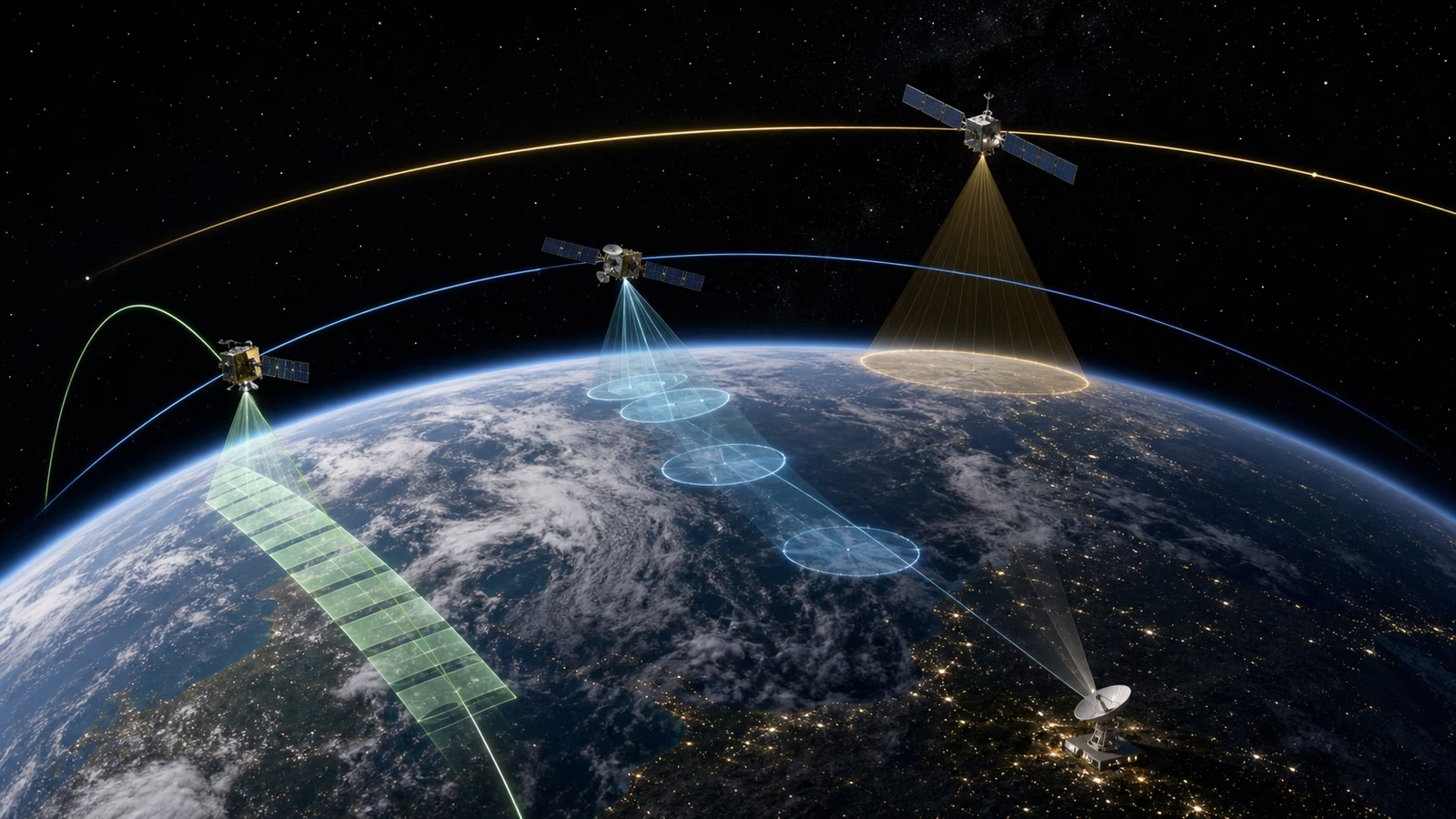
A satellite constellation is easy to mistake for a simple multiplication problem. If one satellite can see part of Earth, many satellites can see more of it. If one spacecraft can carry a radio, a camera, or a timing signal, a fleet can make the service feel continuous. That intuition is useful, but it is incomplete. A constellation is not only a group of satellites. It is a moving architecture.
The design question begins with geometry. Each satellite moves along its own orbit while Earth turns beneath it. The satellites must be spaced so that coverage, capacity, revisit time, and handovers work together rather than leaving awkward gaps. The ground segment must know when each spacecraft is visible. The radios must share spectrum without shouting over one another. The operations team must monitor a fleet instead of a single vehicle. Replacements must arrive before old spacecraft fail in numbers that hurt the service. End-of-life plans must work at scale, because even a modest failure rate becomes a real traffic issue when the fleet is large.
That is why constellation design belongs beside Orbital Regimes and Mission Design and Satellite Operations After Launch . Orbit explains the path. Operations explains the daily care. The constellation view explains how many paths become one service.
Coverage Is Not the Same as Service
Coverage is the first promise many constellations make, but it can be a slippery word. A satellite may have line of sight to a region and still not provide the service people expect. A communications satellite may cover a town but have too little capacity at a busy hour. An Earth observation satellite may pass over a farm but at the wrong time of day, through clouds, or with a sensor that is not scheduled for that target. A navigation satellite may be visible but poorly placed in the sky for a precise receiver solution. The footprint on a map is only the outer edge of the design problem.
For low Earth orbit communications, coverage is especially dynamic. A spacecraft crosses the sky quickly, so the user terminal or gateway must move from one satellite to the next. The network must know which satellite can serve which user, which beams are available, what capacity remains, and how the connection should change hands. Satellite Internet and Low-Earth Orbit Networks describes the user-facing service. The constellation design underneath it is a choreographed sequence of access opportunities.
Earth observation constellations use the same idea differently. Their problem is often revisit time, not continuous connection. If a wildfire, flood, ship, crop field, or construction site must be observed frequently, one satellite may not be enough. A fleet can reduce waiting time, add viewing angles, and create more chances to collect a useful scene. Yet more satellites do not automatically make better data. The orbit, sensor swath, local time, downlink plan, weather, tasking software, and customer priority all decide whether the fleet sees what matters soon enough.
Planes, Phasing, and the Shape of the Fleet
A constellation usually has structure. Satellites may be arranged in orbital planes, which are like repeated tracks tilted around Earth. Within each plane, spacecraft are phased so that they do not bunch together. Across planes, the spacing must fit the service goal. A communications constellation may want a smooth pattern of satellites passing over users. A navigation constellation wants receivers to see several spacecraft from different parts of the sky. An imaging constellation may want repeat visits at useful local times. A weather or climate system may prefer stable sampling rather than raw satellite count.
The word phasing sounds abstract until something goes wrong. If satellites are unevenly spaced, the service may have periods of plenty and periods of weakness. A region might see several satellites in quick succession and then wait too long. A handover might occur at a poor elevation angle. A ground station might receive more passes than it can handle during one hour and too few during another. A fleet that looks large in a press release can still be badly arranged for the work it claims to do.
Launch strategy is part of this geometry. A dedicated launch can place many satellites close to the desired plane, while a rideshare may require compromise and later maneuvering. Payload Integration and Rideshare Launches shows why the handoff from factory to flight is not a mere shipping step. A constellation may need orbit raising, drift, or careful timing before the satellites settle into their slots. Electric propulsion can save propellant but stretch the deployment schedule. Chemical propulsion can move faster but spends mass differently. Either way, Satellite Propulsion and Stationkeeping becomes a fleet-planning topic, not only a subsystem note.
Handovers Make Motion Feel Stable
The user should not have to care that the satellite overhead is moving. That is one of the strange achievements of a well-designed constellation. The hardware is racing through orbit, but the service feels stable because the system manages handovers. A user terminal, gateway, or onboard router may shift traffic from one spacecraft to another while preserving the connection well enough for the application.
Handovers are not only radio events. They involve timing, pointing, authentication, routing, spectrum coordination, power, and sometimes the motion of beams across the ground. The network must avoid dropping users during busy periods. It must prevent two satellites or beams from using the same resource in a way that creates interference. It must decide when a slightly weaker satellite now is better than a stronger one that will soon disappear below the horizon. The graceful handover is the visible result of many small predictions.
Direct-to-phone systems make this even harder because the handset is a small, power-limited device with an antenna never designed to behave like a large dish. Direct-to-Phone Satellites explains why those links are constrained. Constellation design adds the timing layer. The satellite must be where the phone can see it, with enough link margin, spectrum access, beam control, and network coordination to turn a brief sky path into a useful message or call.
Capacity Is a Geography Problem
Constellation maps often emphasize global coverage, but demand is not global in an even way. People, ships, aircraft, farms, sensors, emergency sites, and industrial users are clustered. Some regions are dense. Some are remote. Some are seasonal. Some are quiet until a disaster changes everything. A constellation that can cover an ocean may still face congestion over a city, an air corridor, a shipping lane, or a popular rural region with few terrestrial options.
This is why capacity planning is tied to orbital design. A satellite passes over many places whether or not they need service. The network has to put usable capacity where demand exists, sometimes with steerable beams, inter-satellite links, gateways, or traffic management. Adding satellites can help, but only if they add capacity in the right places and at the right times. Otherwise the fleet may improve the coverage map more than the customer experience.
Ground infrastructure remains part of the answer. Ground Stations explains the earthside half of space infrastructure, and constellations need that earthside half to scale. Gateways must be placed where they can see satellites, connect to terrestrial networks, meet licensing requirements, and survive weather and power problems. Optical inter-satellite links can reduce dependence on nearby gateways for some paths, but they introduce their own pointing, routing, thermal, and operational burdens. A constellation is therefore a data logistics system wrapped around orbital motion.
Fleet Operations Change the Meaning of Reliability
One satellite can fail as an individual story. A constellation fails statistically. This does not make individual spacecraft unimportant. It changes the question. Designers must ask how many satellites can be unavailable before service degrades, how fast replacements can be launched, how anomalies are isolated, how software updates are rolled out, and how the fleet behaves when a common design flaw appears across many vehicles.
Reliability at fleet scale has a different texture from reliability in a one-of-a-kind mission. A unique science spacecraft may be treated as precious hardware that must survive as long as possible. A constellation spacecraft may be designed for repeatable manufacturing, shorter life, and planned replenishment. That can be a rational architecture, but it demands honesty. Shorter life does not excuse poor disposal. Replaceable satellites still need safe operations, collision avoidance, passivation, and responsible retirement.
Software becomes part of fleet discipline. A patch that helps one satellite may need to be staged across many. Operators may update a small group first, watch telemetry, then expand the rollout. A routing change may affect capacity across regions. A fault response may need to distinguish one vehicle’s odd behavior from a pattern that suggests a larger issue. Satellite Onboard Computers and Data Handling explains how spacecraft make local decisions; constellation operations decide how those local decisions fit a fleet rulebook.
Shared Orbit Requires Shared Discipline
Constellations make orbital stewardship more urgent because scale magnifies ordinary risks. Each satellite may be small, but each is still an object moving at orbital speed. Each must be tracked. Each may need maneuver capability or another credible method for managing collision risk and end of life. Each consumes some part of the radio environment. Each can create trouble if it fails silently in a crowded region.
Space Debris and Orbital Traffic treats debris as infrastructure maintenance, and constellations are one of the clearest reasons that maintenance culture matters. A low individual failure rate can still leave many dead spacecraft if the fleet is large. Avoidance maneuvers become more common. Tracking data must be exchanged and interpreted. Operators need clear rules for who moves, when to move, and how to avoid creating confusion during a close approach.
Spectrum has the same scaling problem. One satellite can coordinate a link. A constellation with many beams, terminals, gateways, and neighboring systems must manage aggregate interference. Satellite Spectrum and Interference explains why the radio commons is finite. Constellation design turns that lesson into daily engineering. The fleet has to serve its users without making the shared environment less usable for everyone else.
Replenishment Is Part of the Architecture
A mature constellation is never simply finished. Satellites age, fuel runs down, batteries fade, solar arrays degrade, technology improves, and customer demand moves. Replenishment is not a public-relations afterthought. It is part of the architecture from the start.
This creates a supply-chain rhythm. Factories must build repeatable spacecraft. Launch providers must deliver replacements. Operators must insert new vehicles without disrupting existing service. Old satellites must leave safely. The fleet must absorb design changes across generations without becoming unmanageable. The result is closer to maintaining a transportation or communications network than flying one heroic mission.
Replenishment also creates an ethical and operational test. If new satellites arrive faster than old satellites leave responsibly, the service is borrowing from the orbital environment. Satellite End of Life explains why the last phase belongs inside mission design. For constellations, the last phase repeats again and again. Retirement must be boring, reliable, and measured, because the fleet’s usefulness depends on leaving room for itself and others.
Reading a Constellation Claim
The useful habit is to listen for the architecture behind the promise. A constellation that claims global service should be able to explain its orbits, ground segment, capacity strategy, handovers, replenishment plan, spectrum use, collision avoidance, and retirement method. A constellation that claims frequent imagery should be able to explain revisit time, sensor limits, tasking, downlink latency, cloud workarounds, and data delivery. A constellation that claims resilient timing or navigation should be able to explain geometry, monitoring, signal integrity, and alternatives when part of the fleet is unavailable.
The public often sees satellite count because count is easy to report. Count matters, but it is not the service. The service lives in spacing, timing, capacity, links, software, ground stations, regulations, operators, and responsible endings. A smaller fleet with strong architecture may be more useful than a larger fleet arranged poorly. A large fleet can be powerful when its geometry, manufacturing, operations, and stewardship all support the same promise.
Constellations are one of the places where space most clearly becomes infrastructure. They replace the image of a lone spacecraft with the harder image of a maintained system. The satellites move, the ground turns, demand changes, storms happen, radios share spectrum, software evolves, and old vehicles make room for new ones. The fleet works when all of that motion has been designed into something ordinary enough to depend on.