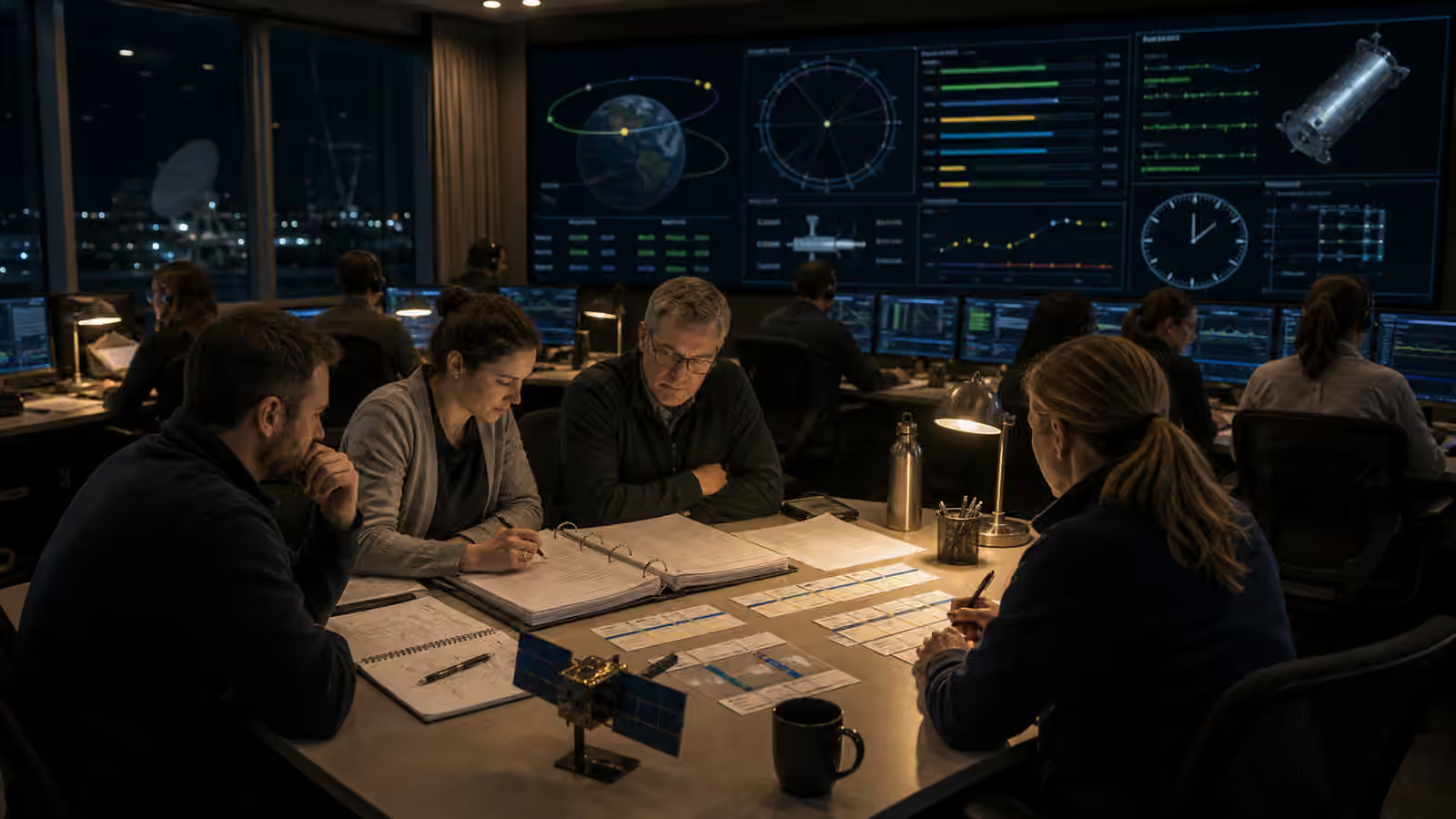
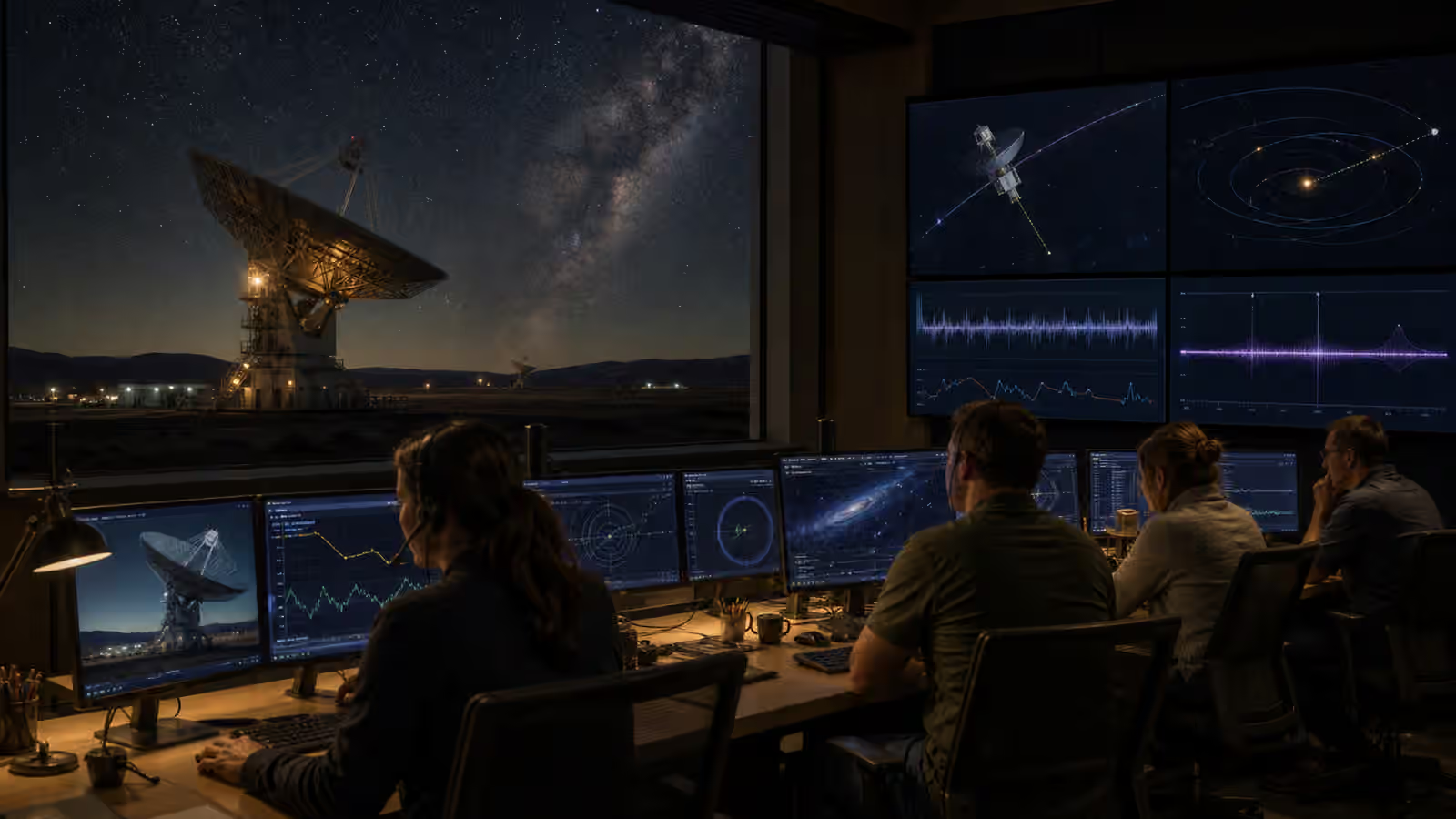
Commissioning is the careful bridge between a spacecraft that has reached orbit and a spacecraft that is trusted to provide service. It begins with uncertainty. The satellite may be exactly where expected, nearly where expected, or still being identified among other objects from the same launch. It may be spinning gently, charging well, running a safe startup sequence, or waiting for a first command. The team has a plan, but the first lesson of commissioning is that the plan must listen to the spacecraft.
The commissioning phase is sometimes compressed in public stories because it lacks the drama of launch and the polish of a live service. Inside a mission, it is one of the most important periods. Hardware that passed clean-room testing has now experienced launch loads, deployment dynamics, vacuum, sunlight, eclipse, and its first real orbital environment. Satellite Manufacturing and Testing explains the evidence collected before launch. Commissioning asks whether that evidence still matches the machine in space.
First Contact Is a Measurement, Not a Celebration
The first confirmed contact with a spacecraft is a meaningful moment, but it should not be treated as proof that everything is healthy. A short beacon may confirm that the radio is alive, the spacecraft has power, and the ground network is looking in the right place. It may not prove that the vehicle has a stable attitude, healthy batteries, correct software state, deployed appendages, usable payloads, or the orbit estimate needed for later contacts.
Operators usually approach first contact with layered expectations. A beacon might be enough for one pass. A set of housekeeping telemetry may be the goal for the next. A command response may come later, after the team confirms that the spacecraft is in the right mode and the ground system is using the correct command dictionary. Spacecraft Command, Telemetry, and Tracking is the discipline that keeps these early conversations from becoming improvised guesses.
Tracking also matters immediately. The launch provider may supply deployment information, but the mission still needs its own orbit estimate refined by observations. A wrong orbit estimate can cause missed passes, poor antenna pointing, and confusion about whether a spacecraft is silent or simply not where the ground system expected it to be. Flight Dynamics and Orbit Determination turns early measurements into the geometry of future work.
Deployment Checks Are Slow for a Reason
Many satellites launch in a folded, restrained, or dormant configuration. Solar arrays, antennas, booms, lens covers, thermal doors, propulsion systems, or payload mechanisms may need to deploy or be enabled after separation. Each step changes the vehicle. A solar array adds power but may change inertia. An antenna improves the link but may create thermal or pointing effects. A payload door may expose sensitive optics to contamination or sunlight conditions that have to be understood.
The temptation is to hurry because the mission feels incomplete until everything is open. Good commissioning resists that pressure. A team may wait for the right thermal state, battery level, ground contact sequence, attitude condition, or lighting geometry before commanding a mechanism. It may rehearse the command path, define the telemetry that proves success, and prepare an alternate plan if the deployment is partial.
Satellite Structures and Deployable Mechanisms explains why folded hardware deserves respect. In commissioning, the mechanism is no longer an engineering drawing. It is a one-time or low-cycle event on an inaccessible vehicle. The team has to make the command count and then prove, with telemetry and sometimes indirect evidence, that the expected shape now exists in orbit.
Subsystems Earn Trust One at a Time
Commissioning often proceeds through subsystem checkout. Power comes first because every later activity depends on it. Operators look at solar array current, battery charge and discharge behavior, eclipse margins, power modes, and unexpected loads. Satellite Power Systems shows why a healthy energy budget is not just about average generation. Peaks, heater cycles, transmitter use, and payload activity can create short-term demands that matter.
Thermal behavior is checked over time because orbit repeats its lessons. A component may be acceptable for one sunlit arc and uncomfortable after several cycles. A radiator may work in one attitude and underperform in another. A heater may run more than expected. Satellite Thermal Control is a commissioning topic because the spacecraft’s real heat paths reveal themselves through telemetry, not through intention.
Attitude control earns trust through pointing modes, sensor performance, actuator response, and safe transitions. A satellite may need to detumble, find the Sun, point panels, aim antennas, stabilize an instrument, or slew between targets. Satellite Attitude Control explains the hardware. Commissioning proves the closed behavior, including how the vehicle responds when the environment is less tidy than the simulation.
Payload Activation Is Not the Beginning of Service
Payload teams are often eager to turn on the instrument or communications service that justified the mission. Commissioning protects that ambition by refusing to confuse activation with readiness. A payload can power on and still require calibration, pointing refinement, background measurements, dark frames, flat fields, radio tests, timing checks, thermal settling, or comparison against known references. The first data may be beautiful and still not service-grade.
Earth Observation Sensors is a good example. An optical instrument may need focus checks and calibration. A radar payload may need careful power and geometry planning. An infrared sensor may be sensitive to thermal state. A communications payload may need link characterization across users, gateways, and antenna patterns. Payload commissioning is the phase where the mission learns how laboratory performance became orbital performance.
The ground segment is part of that same test. Downlink rates, storage behavior, data routing, metadata, clocks, quality flags, and operator tools all meet the real spacecraft. Satellite Data Pipelines may look like a ground problem, but commissioning exposes whether the space and ground halves agree on what the data means.
Configuration Discipline Prevents Mystery
Commissioning produces many changes. Tables are adjusted, thresholds are refined, schedules are rewritten, procedures are corrected, displays are improved, and flight software settings may be updated. Without configuration discipline, the team can lose track of the spacecraft it is commissioning. A later anomaly then becomes harder to diagnose because no one can say exactly which command sequence, parameter value, or software state was active.
Spacecraft Software Verification and Configuration Control belongs near every commissioning plan. The spacecraft is being changed while it is being understood. Each change needs a reason, a record, and a rollback or recovery thought where practical. This does not mean the process must be slow for its own sake. It means the team should never trade a clear spacecraft for a slightly faster schedule.
Commissioning ends when the mission has enough evidence to operate within defined limits. That standard is better than a ceremonial handoff. A satellite can enter limited service, expand into fuller service, and continue refining its operations as flight experience grows. Satellite Operations After Launch takes over from here, but commissioning leaves the foundation: a spacecraft whose behavior has been observed, recorded, and bounded rather than merely hoped into service.