
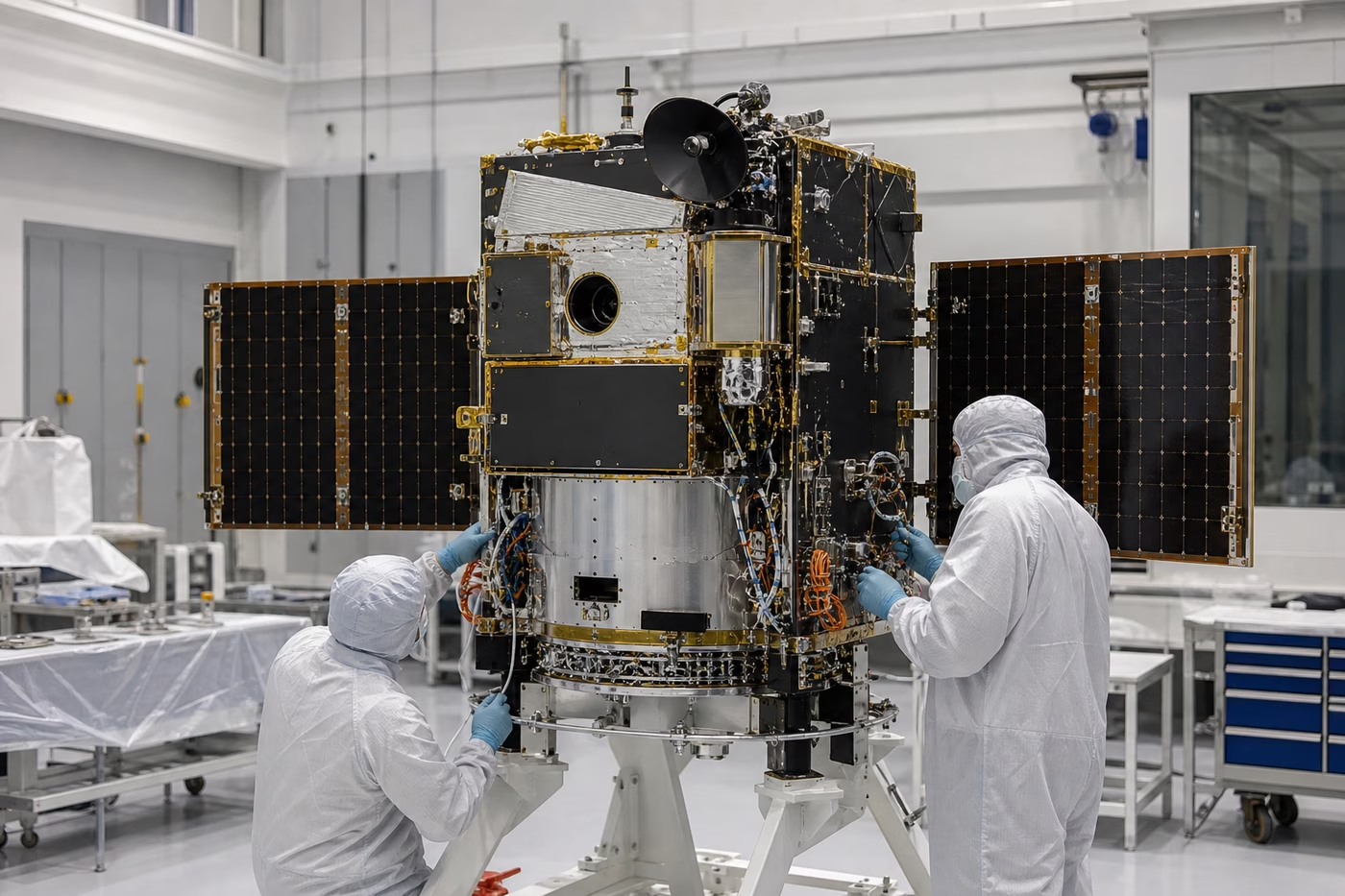
A satellite is often described by the service it provides. It is a weather satellite, a navigation satellite, a broadband satellite, an imaging satellite, or a science mission. That language is useful because it starts with what people need. But inside the clean room and later in orbit, every one of those missions has to become a physical machine with power, structure, computers, radios, thermal control, propulsion, pointing systems, sensors, software, and enough margin to survive the ride to space.
The useful way to read a satellite is to separate the bus from the payload. The payload is the reason the spacecraft exists. It may be a camera, radar instrument, communications repeater, navigation signal package, weather sensor, scientific detector, or technology demonstration. The bus is the supporting body that keeps that payload alive and useful. It supplies power, holds the payload in the right shape, points it in the right direction, moves heat away, stores and routes data, talks to the ground, and carries the hardware through launch and years of operation.
This distinction is simple, but it changes how the rest of space infrastructure makes sense. Satellite Manufacturing and Testing is not only about assembling a shiny object. It is about proving that all these bus and payload interfaces will survive vibration, vacuum, temperature swings, and human error. Satellite Operations After Launch is not only about sending commands. It is about keeping the bus healthy enough that the payload can keep doing its job.

The payload defines the promise
The payload usually gets the public attention because it is closest to the mission’s value. An Earth observation satellite is judged by the imagery or measurements it returns. A communications satellite is judged by the capacity and coverage it supports. A navigation satellite is judged by the quality and trustworthiness of its timing signals. A space telescope is judged by what it can see. The payload is where the service becomes specific.
That specificity drives design choices early. A high resolution camera may need precise pointing, a stable thermal environment, careful contamination control, and enough downlink capacity to send large images to Earth. A radar payload may need bursts of electrical power, a deployable antenna, careful timing, and a processing chain that can handle large volumes of data. A communications payload may care about antennas, amplifiers, spectrum coordination, beam shaping, and thermal control. A navigation payload may care deeply about clocks, signal integrity, and ground monitoring.
None of those needs are decorative. They decide how large the solar arrays must be, how much heat the spacecraft must reject, how accurately it must point, what orbit makes sense, how often it must contact the ground, and how much redundancy is worth carrying. The payload writes a set of demands, and the bus has to answer them without becoming too heavy, too expensive, too fragile, or too difficult to operate.
The bus is the working body
The spacecraft bus can sound like a background utility, but it is the machine that turns a payload from an instrument into a service. A good bus is not glamorous. It is dependable. It keeps power available, temperatures inside limits, attitude controlled, clocks disciplined, data moving, radios linked, and faults contained.
Structure is the first visible part. The bus has to hold components in the right positions through launch loads and then keep them aligned in orbit. A payload may need a camera aperture to remain stable relative to star trackers, a solar array hinge to deploy cleanly, or an antenna to keep its shape after heating and cooling cycles. The structure also carries paths for heat, cables, propellant lines, fasteners, and access during integration. A neat-looking spacecraft can still be badly designed if technicians cannot inspect, test, or repair the important interfaces before launch.
Power is the next constraint. Solar arrays and batteries form the spacecraft’s electrical budget, but the budget is not just an average number. A satellite may have peak loads when transmitting, imaging, maneuvering, heating components, or running a processor-heavy task. It may pass through eclipse and depend on batteries. It may age as solar cells degrade and batteries lose capacity. A responsible design does not assume the best day in orbit will last forever. It asks what the spacecraft can still do when the battery is older, the orbit is less favorable, and the payload wants more power than the bus can comfortably provide.
Thermal control is equally practical. Space is not a single temperature. Sunlit surfaces can heat strongly while shaded parts cool. Electronics, batteries, propellant, optics, and clocks often have different temperature preferences. The bus may use insulation, radiators, heaters, conductive paths, coatings, and operational rules to keep the spacecraft inside limits. A payload that takes beautiful measurements on a test bench can become unstable if the bus cannot keep it thermally comfortable.
Pointing is part of the product
Many satellite services depend on pointing. A camera must aim at a target. A communications antenna must illuminate the right service area. A solar array must find the Sun. A telescope must avoid glare. A radar instrument must know its geometry. The attitude determination and control system handles this job by combining sensors, actuators, software, and procedures.
Sensors tell the spacecraft how it is oriented. Actuators change that orientation. The details vary by mission, but the basic problem is always a negotiation among precision, power, lifetime, mass, and risk. A satellite may use reaction wheels for fine control, magnetorquers to interact with Earth’s magnetic field, thrusters for momentum management or maneuvers, and star trackers or Sun sensors to understand where it is pointing. Each element introduces its own failure modes and operational habits.
This is why the orbit and the spacecraft cannot be designed separately. A satellite in low Earth orbit moves quickly relative to the ground, so an imaging or communications payload may need to track targets across a fast-changing geometry. A geostationary satellite appears almost fixed from Earth, but it must still maintain its assigned position and antenna pointing. A sun-synchronous Earth observation mission may use a repeating geometry to compare scenes under similar lighting. The orbit described in Orbital Regimes and Mission Design becomes real inside the pointing system.
Pointing errors can be service errors. A slightly blurred image, a weaker communications link, a missed ground contact, or a lost calibration opportunity may begin as an attitude-control problem. The customer may never hear the words reaction wheel or star tracker, but they feel the result when the service is worse.
Data needs a path home
A payload can produce more data than the spacecraft can immediately send. That is especially true for Earth observation instruments, radar systems, and some science missions. The bus must store data, protect it, prioritize it, and send it when a link is available. This turns the spacecraft into part of a logistics chain rather than a simple sensor.
The chain continues through radios, antennas, spectrum rights, ground stations, terrestrial networks, processing systems, and users. A satellite may collect an image during one part of its orbit and downlink it later when it passes over a ground station. If the mission needs lower latency, the operator may need more ground sites, relay links, inter-satellite links, onboard processing, or a different orbit. The data path connects the onboard design to Ground Stations and Satellite Spectrum and Interference . A payload is only useful if its output can leave the spacecraft reliably and legally.
Onboard computing has changed this conversation. Some satellites can process data before sending it down, compress images, detect events, prioritize scenes, manage networking, or update software after launch. That flexibility is powerful, but it also increases the need for careful security and operational discipline. A spacecraft computer is not just a box that stores bits. It is part of command authority, mission scheduling, fault protection, and service quality.
Margins are not wasted space
Beginners sometimes imagine spacecraft design as a search for the lightest possible machine. Mass matters because launch performance and cost matter, but the lightest possible version is not automatically the best version. Spacecraft need margin. They need power margin, thermal margin, data margin, pointing margin, propellant margin, schedule margin, and sometimes physical room for technicians to work without damaging something.
Margin is what keeps small surprises from becoming mission-ending surprises. A heater may need more energy during a cold case than expected. A downlink may run slower because weather or interference reduces link quality. A component may run warmer in orbit than it did in a lab. A battery may age faster than planned. A propulsion system may need extra fuel for collision avoidance or end-of-life disposal. A satellite designed with no slack can look efficient until the first ordinary problem arrives.
The hard part is that margin is never free. Extra battery capacity adds mass. More redundancy adds cost and complexity. Larger radiators affect layout. More propellant requires tank volume. Better pointing may need more expensive sensors or actuators. Engineers are not simply adding safety blankets. They are choosing where uncertainty is most likely to hurt the mission.
The bus shapes the ending too
The spacecraft’s final responsibility is not separate from its design. A satellite that must deorbit needs enough control, power, tracking, propulsion, or drag capability to do so. A geostationary spacecraft may need propellant and control authority to move away from its protected operating region. Batteries and pressure vessels may need passivation. Software must support final operations. Operators need confidence that the vehicle will still respond when the useful payload work is nearly over.
That is why Satellite End of Life begins long before the last command. The bus carries the resources that make a responsible ending possible. If every bit of propellant, power margin, or operational attention is spent chasing short-term service, the satellite may lose the ability to leave well.
Design choices also affect future repair. A spacecraft with visible docking aids, accessible interfaces, cooperative navigation markers, and documented servicing points is easier to inspect or refuel than one built as a sealed custom puzzle. In-Space Servicing and Refueling depends on this shift. Repairable infrastructure begins as a design habit, not as a rescue plan improvised after failure.
Reading a satellite like infrastructure
The most useful question is not whether a satellite looks advanced. It is what promise the payload makes and what the bus must do to keep that promise. A broadband spacecraft promises capacity and coverage, so ask about antennas, power, thermal load, spectrum, routing, and ground links. An imaging spacecraft promises useful observations, so ask about orbit, pointing, sensor stability, data storage, downlink, and processing. A navigation spacecraft promises trusted time and position, so ask about clocks, signal integrity, monitoring, and long-term orbital control.
This habit makes space easier to understand because it joins the visible mission to the hidden machine. Launch puts the spacecraft into its working environment. The orbit shapes its opportunities. The payload creates value. The bus keeps the value available. Ground systems turn the value into a service. Operations preserve the service over time.
Space infrastructure is not built from dramatic moments alone. It is built from well-matched interfaces. The bus and payload have to agree with the orbit, the launch environment, the ground segment, the spectrum plan, the operations team, the customer need, and the end-of-life path. When that agreement is strong, a satellite becomes more than hardware overhead. It becomes a reliable part of the systems people use on Earth.


