
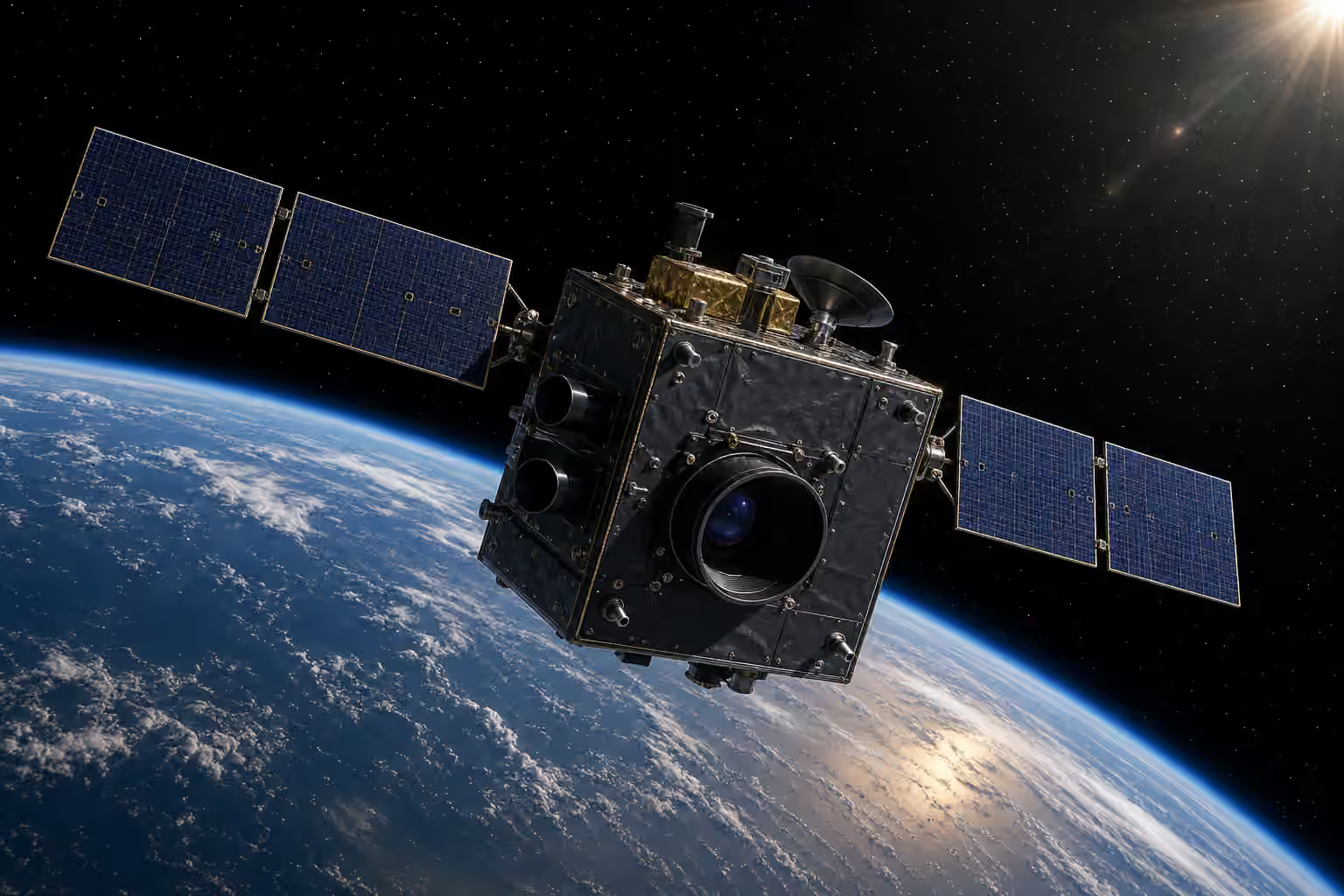
A satellite can reach the right orbit and still fail at its work if it cannot point. A camera that drifts a little during an exposure returns a blurred scene. A communications antenna that misses its coverage area loses link margin. A solar array that cannot face the Sun runs the battery down. A radiator that stares at the wrong part of space may stop rejecting heat the way the thermal model expected. The spacecraft’s attitude, meaning its orientation in space, is therefore not a detail after launch. It is one of the ways a mission becomes a service.
This is easy to confuse with altitude. Altitude is how high the spacecraft is above Earth. Attitude is which way it is facing. The two are connected because orbit changes the geometry of every target, ground station, Sun angle, and eclipse, but they are not the same problem. Orbital Regimes and Mission Design explains the path a satellite follows. Attitude control explains how the spacecraft turns its body along that path so the useful hardware sees what it must see.
The full name of the discipline is often attitude determination and control. Determination means figuring out the spacecraft’s orientation. Control means changing or holding that orientation. Both halves matter. A satellite that can turn but does not know where it is pointing is not reliable. A satellite that knows its attitude but lacks the tools to correct it is only an observer of its own drift.
Pointing Is a Mission Requirement
Every payload writes its own pointing demands. An Earth observation spacecraft may need to point an optical sensor at a city, coastline, farm, or disaster area while moving quickly across the ground. A radar satellite may need a precise viewing geometry so its measurements can be interpreted later. A communications spacecraft may need to hold antenna beams over customers or track a gateway. A navigation satellite may care less about dramatic slews and more about stable, predictable orientation that protects signal quality and timing equipment. A science mission may need long quiet stares at a target while avoiding the Sun, Earth glare, or thermal disturbances.
Those needs turn into pointing requirements. Engineers may describe accuracy, stability, knowledge, jitter, slew rate, and settling time. Accuracy asks whether the spacecraft points at the intended direction. Stability asks whether it stays there long enough. Knowledge asks how well the spacecraft knows where it was actually pointing. Jitter describes tiny vibrations or rapid motion that can disturb an instrument even when the average direction looks correct. Slew rate describes how quickly the satellite can turn from one attitude to another. Settling time describes how long it takes after a turn before the payload can trust the environment again.
These words can sound abstract, but they show up in ordinary service quality. A blurry image, a lower data rate, a missed ground contact, a smeared star field, a calibration error, or a payload that must wait before collecting data can all begin as attitude-control limits. The public sees the product. The operator sees the pointing budget.
The Spacecraft Needs Senses
A spacecraft determines attitude by combining measurements from sensors. Star trackers are among the most precise. They look at patterns of stars and compare them with an onboard catalog, allowing the spacecraft to estimate its orientation. They are powerful because stars provide a stable reference, but they need a clear view and can be affected by bright objects, stray light, contamination, or operational attitudes that block the sky.
Sun sensors provide another kind of reference. They help the spacecraft know where the Sun is, which is essential for power-positive safe modes and solar array pointing. Earth sensors or horizon sensors can help some missions understand the direction of the planet. Magnetometers measure Earth’s magnetic field and are especially useful in low Earth orbit when paired with magnetic actuators. Gyroscopes measure rotation rates, helping the spacecraft bridge gaps between other measurements and sense motion during slews.
No single sensor is a complete answer. A star tracker may be temporarily blinded or unavailable. A gyro may drift. A Sun sensor may be too coarse for fine payload pointing. A magnetometer depends on an environment that changes with position. The attitude system therefore works as a set of cross-checks rather than a single magic instrument. Software estimates the most likely orientation from imperfect clues, compares that estimate against expected motion, and decides whether the spacecraft is behaving normally.
That estimation work is part of the Satellite Bus and Payloads story because attitude control is not only an external pose. It depends on computers, timing, power, thermal behavior, sensor placement, structural alignment, and the payload’s own calibration. A camera may be bolted to one deck while the star tracker sits on another. If the structure flexes with temperature or launch stress, the relationship between those lines of sight may change. Knowing where the bus points is not always the same as knowing where the instrument points unless the interfaces are understood.
The Spacecraft Needs Muscles
Once the satellite knows its attitude, it needs actuators to change or maintain it. Reaction wheels are common tools for fine control. A wheel spinning inside the spacecraft can speed up or slow down, and conservation of angular momentum turns the spacecraft in response. Reaction wheels are useful because they can make precise adjustments without spending propellant, but they have limits. Environmental torques from atmospheric drag, Earth’s magnetic field, solar radiation pressure, gravity gradients, and other effects can slowly build momentum in the wheels. If a wheel approaches its limit, the spacecraft needs a way to unload that momentum.
Magnetorquers help with that in low Earth orbit. They create a magnetic moment that interacts with Earth’s magnetic field, producing torque on the spacecraft. They are simple and do not use propellant, but they are not equally effective in every direction at every moment. The local magnetic field decides what torque is available. Magnetorquers are therefore patient tools, good for dumping wheel momentum and coarse control, but not a universal substitute for all pointing needs.
Thrusters can also control attitude. Small firings can rotate a spacecraft, unload momentum, orient the vehicle for a burn, or recover from a tumble. Thrusters are especially important for some larger spacecraft and for maneuvers that tie attitude to orbit control. The cost is that propellant is finite, plume directions matter, and firing can disturb sensitive payload work. Satellite Propulsion and Stationkeeping covers the maneuvering side of that story, but the attitude-control link is just as practical. A propulsion system can only push in the desired direction if the spacecraft is pointed correctly first.
Some missions use control moment gyros or other specialized actuators when they need stronger or faster pointing authority. The choice is driven by mission need. A satellite that slowly holds an antenna pattern, a small imager that takes short scenes, a large observatory that needs extraordinary stability, and a maneuvering spacecraft near another vehicle do not want the same control design.
Slewing Is a Planned Event
Turning a spacecraft is not the same as rotating a model in a viewer. A slew changes where solar arrays, antennas, radiators, sensors, and thrusters face. It can interrupt communications, change thermal conditions, alter power generation, and disturb payload calibration. The spacecraft may need to avoid pointing a star tracker too close to the Sun or allowing a sensitive instrument to view Earth glare. It may need to keep an antenna within range of a ground station during part of the motion or delay a downlink until the attitude is stable again.
Operators plan slews around these constraints. An Earth observation satellite may need to roll toward a target off its ground track, collect the scene, then return to a power or communications attitude. A communications satellite may need to maintain extremely steady beams instead of making frequent dramatic turns. A spacecraft preparing for a stationkeeping burn may need to rotate into the burn attitude, warm or configure propulsion hardware, execute the maneuver, then return to nominal service. Each activity spends time, power, thermal margin, and operational attention.
This is why Satellite Operations After Launch treats routine activity as real mission work. Pointing commands are not casual. They are scheduled against battery state, ground contacts, payload priorities, heater rules, fault-protection limits, and the current health of the attitude system. A satellite with a healthy payload may still have to skip an opportunity if the required attitude would leave too little margin elsewhere.
Safe Mode Starts With the Sun
When a spacecraft becomes confused or detects a serious fault, it may enter safe mode. The exact behavior depends on the design, but the priority is usually survival rather than payload work. A common goal is to find or maintain the Sun so the spacecraft can generate power, keep essential electronics alive, and wait for help from the ground. The attitude system becomes the path back to a recoverable state.
Safe mode is deliberately conservative. The spacecraft may stop payload operations, use simpler sensors, reduce motion, point solar arrays in a safer direction, and transmit a basic signal. It may not point perfectly, but it tries to avoid the worst outcomes: a drained battery, overheated hardware, frozen propulsion lines, or a lost communications attitude. In that moment, the attitude-control system is no longer optimizing service quality. It is protecting the vehicle long enough for operators to understand what happened.
Recovery can be slow because the team must avoid compounding the fault. If the satellite has lost a star tracker, a wheel, a gyro, or a sensor reference, operators need to know what control authority remains. If the spacecraft is tumbling, ground contacts may be intermittent. If the attitude is power-poor, command windows may be short. The calm-looking phrase “returned to service” can hide days of careful estimation, command design, and verification.
Jitter Is the Small Motion That Matters
Not all pointing problems are large turns or obvious tumbles. Some are tiny motions that matter because the payload is sensitive. Reaction wheels can create vibration. Mechanisms can move. Thermal changes can flex structures. Thruster firings can leave residual motion. A solar array drive can introduce disturbances. Even if the spacecraft’s average pointing direction is correct, small motion during an exposure, measurement, or communication interval can degrade performance.
This is why structural design, thermal control, and attitude control cannot be fully separated. A star tracker may report an orientation, but the payload may ride on a structure that bends slightly as temperatures change. A radiator orientation that helps one component may create a gradient elsewhere. A wheel mounted in a convenient place may transmit vibration through a sensitive deck. Satellite Thermal Control explains the heat side of that negotiation, but attitude engineers feel the result whenever stability depends on a structure that is not perfectly rigid.
The solution is not always a stronger actuator. Sometimes the answer is better isolation, quieter wheel operation, a different activity schedule, improved calibration, more stable thermal conditions, or payload processing that accounts for measured motion. Mature pointing design is as much about knowing what not to disturb as it is about turning quickly.
Pointing Knowledge Becomes Data Quality
For many missions, it is not enough to point well. The mission must know where it pointed afterward. Earth observation data, for example, needs geolocation. If an image is used to track a coastline, map a crop field, monitor a fire, or compare change over time, analysts need confidence that each pixel corresponds to the right place on Earth. That depends on orbit knowledge, timing, sensor geometry, and attitude knowledge working together.
A similar pattern appears in communications and navigation. Antenna pointing affects link quality and coverage. Timing services depend on predictable spacecraft behavior and carefully monitored signals. Science missions may need to reconstruct exactly where an instrument was looking when data was collected. The attitude system therefore extends beyond mechanical control. It becomes part of the metadata that makes the payload output trustworthy.
The ground segment helps close this loop. Calibration campaigns, telemetry review, orbit determination, payload analysis, and anomaly investigation all use attitude data. Ground Stations are not just command pipes. They are part of the feedback system that lets operators compare intended pointing with actual performance and adjust the mission over time.
Reading Attitude Control as Infrastructure
Attitude control is easy to overlook because it hides inside the bus. It does not look like the payload, and it is not as dramatic as launch. Yet it decides whether the payload can face the right target, whether the spacecraft can survive an anomaly, whether solar arrays get light, whether antennas keep links, whether thermal surfaces see useful space, and whether maneuvers happen in the intended direction.
When you read about a satellite, ask what has to point and how tightly. Ask how the spacecraft knows its orientation, what actuators it uses, what happens if a sensor fails, how momentum is managed, and how pointing data is used after the fact. These questions reveal whether the mission has treated orientation as a deep design requirement or as a line item on a subsystem chart.
Space infrastructure is built from machines that keep promises while moving through changing geometry. A useful satellite is not only in the right orbital neighborhood. It is awake, oriented, measured, controlled, and ready to place its payload where the mission needs it. Attitude control is the quiet discipline that turns a spacecraft from an object in orbit into an instrument aimed with purpose.


