Landing on another world compresses years of engineering into a few unforgiving minutes. A spacecraft that has survived launch, cruise, navigation corrections, thermal cycling, software updates, and long communications delays must suddenly become an aircraft, a brake, a navigator, a hazard detector, and a landing machine. Entry, descent, and landing is often shortened to EDL, but the short phrase hides a chain of events where each step hands a narrower set of possibilities to the next.
Reentry, Heat Shields, and Recovery explains the return through Earth’s atmosphere. Planetary landing systems share some of that physics, especially heating and deceleration, but the mission goal is different. A return capsule may only need to survive, slow down, and reach a recovery zone. A planetary lander may need to arrive upright, avoid hazards, preserve instruments, communicate through delay, and begin work in a place no human crew can inspect.
Entry starts before the atmosphere
Entry is not a moment at the top of the atmosphere. It begins with mission design and navigation. The spacecraft must arrive at the right location, speed, angle, and time. Too steep, and heating and loads can exceed the design. Too shallow, and the vehicle may skip, miss the target, or fail to slow enough. The entry corridor can be narrow, especially when the destination has an atmosphere that is thick enough to heat the spacecraft but not thick enough to make braking easy.
Flight Dynamics and Orbit Determination is therefore part of landing. Cruise tracking, trajectory correction maneuvers, navigation uncertainties, atmospheric models, and target geometry all shape the landing ellipse. The ellipse is not a decorative circle on a map. It is the region where the mission believes the vehicle may land after accounting for navigation error, atmospheric variability, vehicle performance, and guidance limits.
Choosing that ellipse is also a science and safety trade. The most scientifically interesting terrain may be rough, steep, dusty, shadowed, or full of rocks. The safest terrain may be dull. Modern landing systems can reduce uncertainty and avoid some hazards, but they cannot make every place safe. A mission that promises a landing site is really promising that its navigation, sensing, autonomy, and mechanical design can handle the place it chose.
Heat shields buy time
The first job of atmospheric entry is to remove enormous speed without destroying the spacecraft. A heat shield protects the vehicle as the atmosphere turns kinetic energy into heat. The shield may ablate, meaning it chars and carries heat away as material erodes. It may use insulating structures, special materials, or shapes chosen to manage the shock layer and keep sensitive hardware inside survivable limits.
Heat shield design is a mission argument. A heavier shield may protect better but steal mass from instruments, propellant, batteries, or structure. A lighter shield may be efficient but less forgiving. The shape affects stability, lift, heating distribution, and where the vehicle can fly. Spacecraft Materials and Contamination Control usually focuses on orbital survival and cleanliness, but materials judgment is just as important during the violent thermal story of entry.
After peak heating, the spacecraft is still moving fast. The heat shield has not landed the mission. It has made the next phase possible.
Descent systems stack their effects
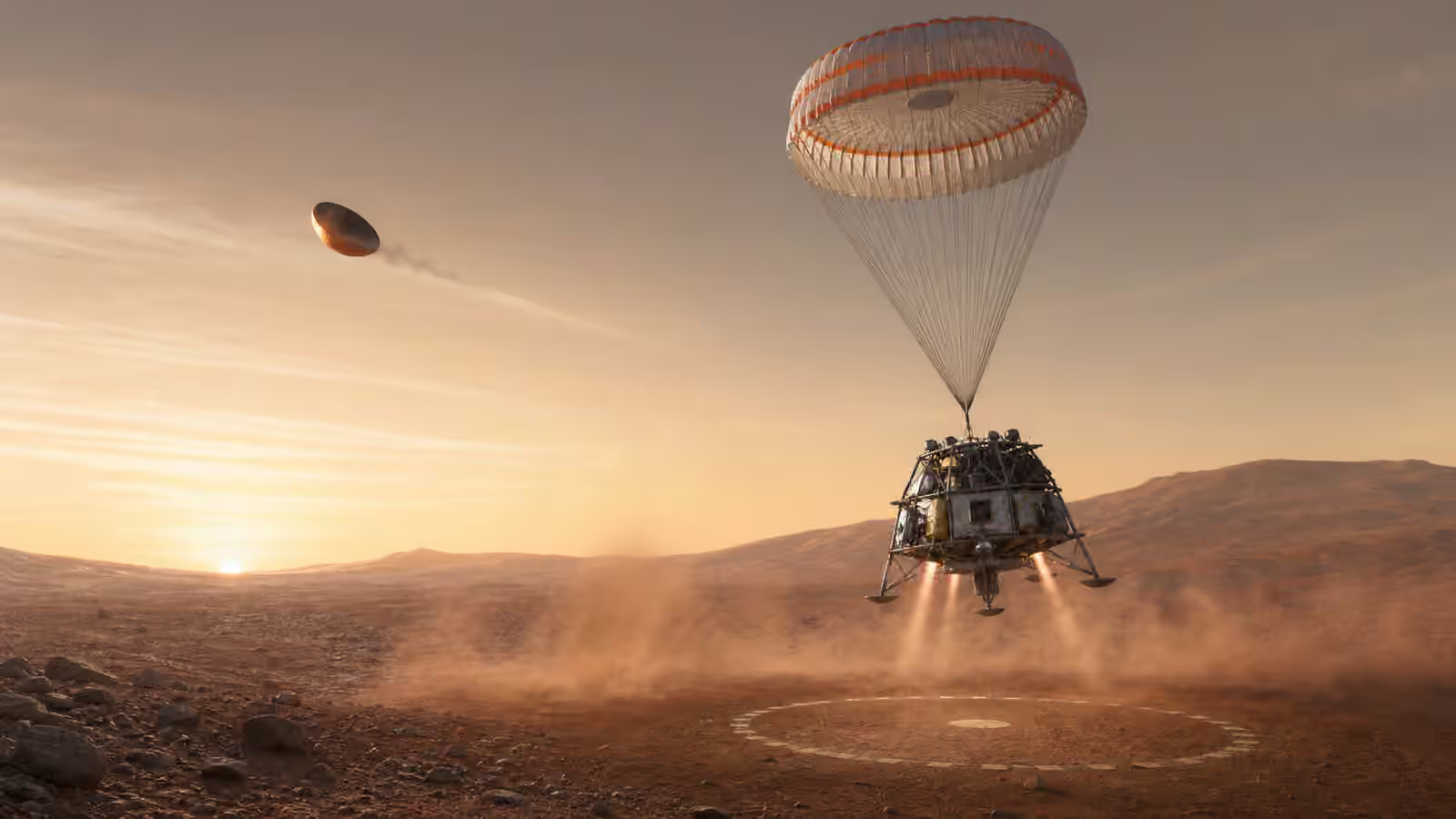
A lander may use several methods to slow down. A blunt body creates drag during entry. A parachute can add drag in an atmosphere where parachutes work. A backshell may separate. A heat shield may drop away so sensors or landing radar can see the surface. Retrorockets may reduce speed near the ground. Airbags, crushable structures, legs, sky-crane systems, or other touchdown devices may absorb the final energy.
Each event has timing rules. A parachute deployed too early may fail from high loads. Too late, and there may not be enough altitude to slow. A heat shield released too soon may expose sensitive hardware to heating or debris. Too late, and the lander may not have time to sense terrain. Engine ignition has to happen at the right altitude, attitude, and velocity. The sequence is choreography, but it is choreography performed by software and hardware under conditions the mission can only estimate.
This is where Spacecraft Software Verification and Configuration Control becomes a landing topic. The EDL software has to handle sensor inputs, state transitions, timers, guidance logic, fault responses, and actuator commands without waiting for Earth. There is no joystick rescue through interplanetary delay. The spacecraft must carry the landing procedure inside itself.
Autonomy earns the last meters
The last part of landing is often the most local. The vehicle may need to know its altitude, velocity, attitude, horizontal motion, fuel state, and distance to hazards. It may use radar, lidar, cameras, inertial sensors, star trackers, terrain-relative navigation, or combinations of these. A simple mission may accept a broad safe plain. A more ambitious mission may try to land near a specific feature, avoid boulders, or adjust its touchdown point after seeing the ground.
Autonomy does not mean the spacecraft is intelligent in a loose sense. It means the mission has defined bounded choices the vehicle can make faster than Earth can intervene. Satellite Fault Protection and Autonomy explains this idea in orbital operations. Landing makes it immediate. A lander may need to reject a bad sensor reading, choose a safer patch, throttle engines, or continue through a minor anomaly because stopping is not an option.
Terrain-relative navigation is especially powerful because it lets the spacecraft compare what it sees with a map. That can shrink the landing ellipse and open sites that were previously too risky. But the map must be good, the lighting must be understood, the camera must perform, and the computer must make decisions within seconds. A better sensor can make a mission braver, but only if the whole system can trust it.
Dust and plume effects are part of landing
Touchdown is not only contact between legs and ground. Engine plumes can lift dust, obscure sensors, blast nearby hardware, erode surfaces, or contaminate instruments. On the Moon, dust can travel far in vacuum and strike equipment at high speed. On Mars or other dusty bodies, local atmosphere changes how plumes spread and how dust moves. Lunar Infrastructure discusses landing pads and dust control because repeated landings turn plume effects from one mission’s inconvenience into a site-level infrastructure issue.
A robotic lander also needs a stable posture. If it lands on a slope, one leg sinks, or a rock catches a footpad, the mission may lose power generation, communication geometry, instrument access, or mobility deployment. A successful landing is not only a low vertical speed. It is an orientation and surface interaction that leaves the spacecraft able to begin operations.
Touchdown still needs proof
The public moment is often a signal that the lander reached the surface. Inside the mission, touchdown is the start of evidence collection. Operators need to know battery state, attitude, temperatures, structural loads if measured, communication path, solar array status, antenna pointing, dust cover condition, instrument health, and whether anything deployed or failed during landing. Satellite Commissioning and Early Orbit Operations is about satellites after separation, but the same cautious habit applies after planetary touchdown. Arrival does not prove readiness.
The first images from a landed mission can be emotionally powerful, but they are also engineering data. They show horizon tilt, nearby hazards, dust on surfaces, footpad behavior, terrain texture, shadow direction, and whether planned activities still make sense. A mission may spend time simply learning the place it has reached before moving, drilling, sampling, or deploying instruments.
Landing is infrastructure when it becomes repeatable
One heroic landing proves that a mission survived. Repeated landings prove that a transportation system may be forming. Space infrastructure needs the second idea. If lunar cargo, Mars science, sample return, asteroid operations, or commercial surface services are to become routine, landing systems must become understandable, inspectable, and improvable. Teams need records of what the atmosphere did, how guidance performed, how dust behaved, how hardware aged, and what margins were real.
Planetary landing is dramatic because failure is visible and final. It is also practical because every surface plan depends on it. A rover cannot explore without a landing system. A habitat cannot be assembled without cargo delivery. A sample cannot be returned unless the mission first arrives safely enough to collect it. The last minutes before touchdown are therefore not an epilogue to the cruise. They are the bridge between a spacecraft passing a world and a machine becoming part of that world’s surface.