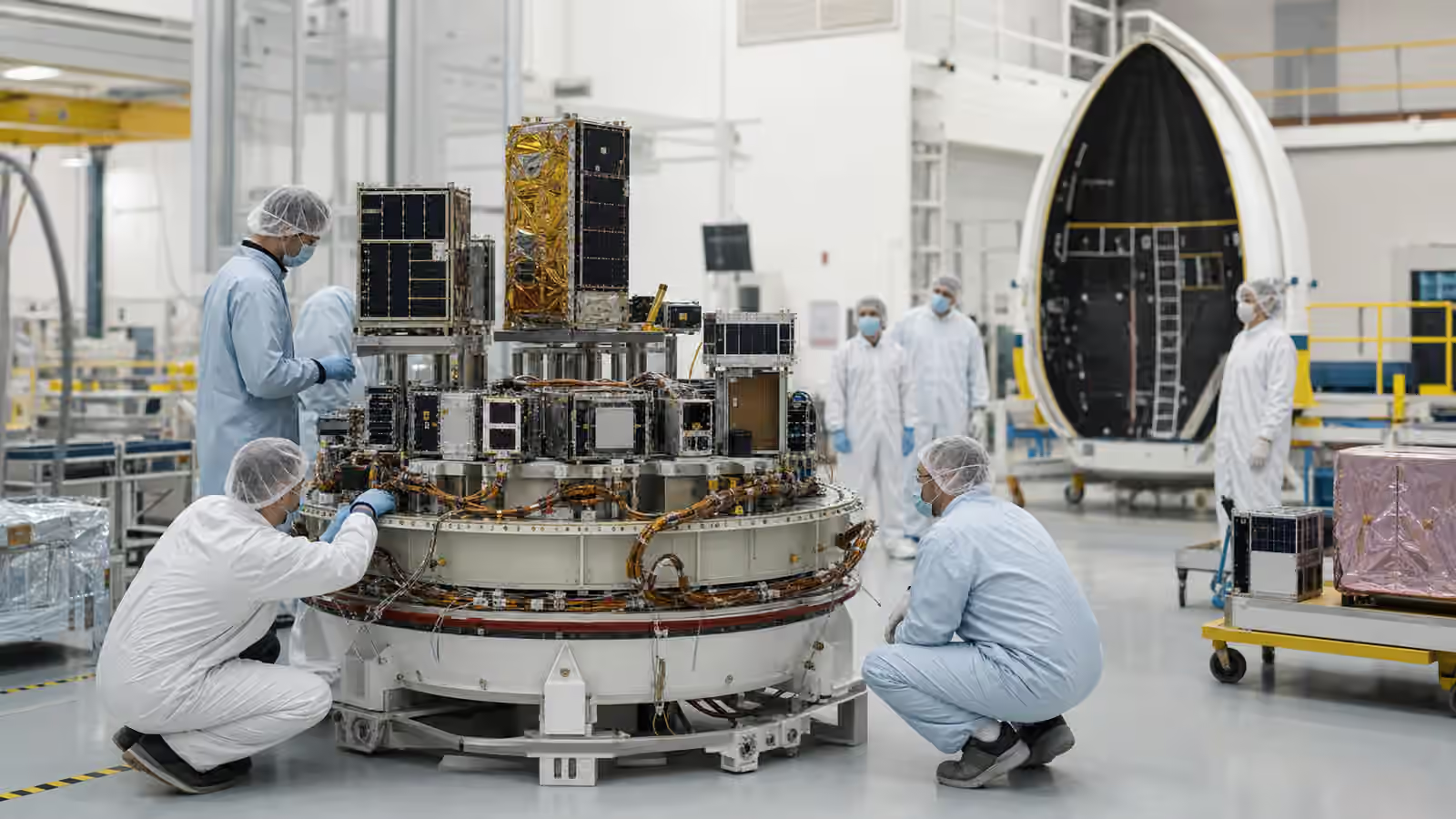
A satellite does not leave the factory and simply climb into a rocket. Between the clean room and orbit is a careful handoff where the spacecraft becomes cargo, the rocket becomes transportation, and every interface between them has to be understood before anyone commits to flight. This stage is called payload integration, and it is one of the least glamorous parts of space infrastructure. It is also where many practical mission choices become impossible to ignore.
Payload integration sits between Satellite Manufacturing and Testing and launch day. The spacecraft may already have survived vibration, thermal vacuum, deployment checks, software tests, and review boards, but it still has to be mounted, connected, protected, monitored, and eventually released without harming itself, the rocket, or neighboring payloads. If the mission is flying as part of a rideshare, the negotiation becomes even tighter. The satellite is no longer alone in the fairing. It is one passenger among many, sharing volume, schedule, target orbit, separation timing, safety rules, and ground procedures.
The public usually sees the rocket at the pad. The operator sees a chain of promises that started much earlier. The spacecraft promises that it will not leak, shed debris, transmit at the wrong time, deploy early, overheat, contaminate another payload, or demand an orbit the launch cannot provide. The launch provider promises that the mechanical loads, electrical interfaces, environments, access rules, and separation sequence match the mission plan. Payload integration is where those promises are tested in hardware.
The adapter is not just a bracket
The most obvious integration hardware is the adapter. It may be a ring, plate, dispenser, canister, clampband, or custom structure that joins the payload to the launch vehicle. From a distance it can look like support furniture. In practice, it is a mission-critical part of the flight system because it decides how loads move into the satellite, how the spacecraft is held during launch, and how it is released into orbit.
Launch is a rough ride. The payload stack has to survive vibration, acoustic energy, acceleration, pressure changes, and separation shock. The adapter carries those forces through bolts, rails, fittings, release mechanisms, and structural paths that must match the spacecraft’s design. A satellite that passed environmental testing on its own still needs to be safe in its actual flight configuration. Cables may be routed differently. Covers may be installed. Access may be limited. Neighboring payloads may create keep-out zones that were not present in the test chamber.
Adapters also shape how a spacecraft begins its independent life. A clean separation is not only a theatrical moment after upper stage cutoff. It decides the initial tumble rate, clearance from other objects, timing of first contact, and sometimes the earliest deployment sequence. If the spacecraft exits with unexpected motion, Satellite Operations After Launch begins with a harder problem. The adapter has finished its job only when the payload is safely away and the operator can begin commissioning with enough confidence to act.
Rideshare changes the meaning of launch
A dedicated launch lets a customer shape the mission around one payload or one constellation deployment. A rideshare launch is different. Several customers buy room on the same rocket, often because the economics are attractive and the launch cadence is useful. The trade is that the rocket cannot perfectly satisfy every passenger. One mission may care most about inclination. Another may care about altitude. Another may care about schedule. Another may only need a broad range of acceptable conditions and can tolerate compromise.
This is why rideshare is not only a cheaper ticket. It is a design environment. A spacecraft team has to ask what orbit it can accept, how much propulsion it has for orbit raising or phasing, how quickly it needs ground contact, whether it can wait through a delayed campaign, and what constraints come from other payloads. Orbital Regimes and Mission Design describes why altitude, inclination, local time, and ground track matter. Rideshare makes those choices practical because the desired orbit may not be the exact orbit being sold.
The compromise can still be worthwhile. A small Earth observation satellite may accept a slightly different altitude if it can reach space months earlier. A technology demonstration may care more about flight heritage than perfect geometry. A communications payload may use onboard propulsion to move from a drop-off orbit toward an operational slot. But each compromise has consequences. Propellant spent after deployment is propellant unavailable later. Time spent drifting or raising orbit is time before full service. A ground network may need to handle early contacts from a less convenient trajectory.
The fairing is a crowded room
Inside the rocket fairing, volume is scarce. The spacecraft must fit not only as a static object but as part of a launch stack with clearance for vibration, thermal blankets, access tools, deployment paths, and safety rules. A folded antenna, solar panel, boom, or cover can look harmless on a drawing and still create trouble if it intrudes into another payload’s space or blocks a technician from reaching an important connector.
Fairing volume also has a cleanliness and contamination story. Some payloads are sensitive to particles, vapors, outgassing, or human handling. Others may include deployable mechanisms that need covers, locks, or remove-before-flight items. Integration teams have to control what materials enter the fairing, how long hardware remains exposed, how late a battery can be charged, what inspections are possible, and how the payload is monitored after encapsulation. Once the fairing closes, access becomes expensive or impossible without disturbing the launch campaign.
The shape of the stack can affect the launch provider as much as the satellite owner. Mass properties matter. The rocket cares where weight sits, how the stack responds to vibration, how the upper stage controls attitude, and whether separation events create unacceptable risk. A rideshare mission may carry many small satellites, but the whole assembly still has to behave like a predictable payload. The adapter, dispensers, and satellites become one structure until the planned sequence starts taking it apart.
Interfaces turn paperwork into hardware
Payload integration relies on interface control. That phrase can sound dull, but it is the language that keeps teams from discovering physical disagreements too late. An interface control document records the mechanical attachment, electrical connections, data links, environmental limits, access needs, radio restrictions, battery rules, hazardous systems, purge requirements, lifting points, mass properties, and separation behavior that the payload and launch provider have agreed to honor.
The document matters because people remember different versions of a spacecraft. A drawing may show one antenna location. A test article may have used another bracket. The flight unit may carry a late change. The launch provider needs the real configuration, not the cleanest story. This is the same discipline that makes manufacturing records useful after launch. A mission team can only integrate the spacecraft it actually built.
Electrical interfaces are especially easy to underestimate. Some payloads need power from the launch vehicle before deployment. Some need battery charging, health monitoring, thermal conditioning, or late access to load software. Others are intentionally quiet and self-contained until release. The launch provider needs assurance that a payload will not emit radio signals, fire a deployment mechanism, change state unexpectedly, or draw power outside agreed limits. Safety begins before the rocket moves.
Separation is choreography
A rideshare deployment is a sequence, not a spill. The upper stage may release payloads one at a time, change attitude between deployments, wait for separation distances to grow, and avoid pointing sensitive surfaces or exhaust toward other spacecraft. Each payload needs a clean path away from the stack. The timing may also shape early ground contact. If a satellite is released over a region with no suitable ground station pass, operators may wait before hearing from it. If first contact is urgent, the deployment plan has to account for that need.
Separation also creates a traffic-management problem. Many objects leaving one launch can start in related orbits. Operators, tracking networks, and catalogs must identify which object is which. This can be difficult when several small satellites look similar to sensors on the ground. Early communication, planned deployment order, known physical characteristics, and cooperation among operators help turn a cluster of new objects into named spacecraft with responsible owners.
This is where payload integration connects to Space Debris and Orbital Traffic . A successful launch is not only one where every payload leaves the rocket. It is one where the released spacecraft, adapters, dispensers, covers, and upper stage do not create unnecessary hazards. Responsible missions think about what remains after deployment, how the upper stage is passivated or disposed of, and whether any small hardware could become a long-lived debris object.
The schedule belongs to the whole stack
Launch campaigns are shared calendars. A satellite team may be ready, but another payload may need more time. The rocket may need maintenance. The range may have a conflict. Weather may delay rollout. A customer on a rideshare may have less control over these shifts than on a dedicated mission. That does not make rideshare unreliable by nature; it means the schedule is a property of the whole stack, not one spacecraft.
The handoff to The Spaceport Ground System adds another layer. Payload arrival, storage, fueling if permitted, encapsulation, transport to the pad, range safety reviews, contamination controls, and data connections all belong to the spaceport’s operational world. A late payload issue can affect the rocket. A launch vehicle issue can affect all payloads. An access request that sounds simple in a factory may be complicated once the spacecraft is inside a sealed fairing on a campaign timeline.
Launch Windows and Mission Timing also become more interesting when many missions share a ride. The window may serve the primary orbit, range availability, recovery conditions, and upper stage mission plan. Secondary payloads may have to accept the same clock. A small satellite designed with flexible operations can absorb this better than one whose whole mission depends on a narrow launch time.
Good rideshare design starts early
The best time to think about rideshare is not after the spacecraft is built. It is during mission design. A team that knows it may fly as a secondary payload can choose compatible dimensions, standard deployment hardware, robust battery behavior, flexible communications plans, and enough maneuvering margin to handle a less-than-perfect insertion. It can design covers, connectors, lifting points, and late-access procedures that make integration easier instead of treating the launch provider as an afterthought.
This is where Satellite Bus and Payloads becomes practical. A payload may define the service, but the bus has to survive the path to service. A brilliant sensor that cannot fit a realistic launch envelope is not ready. A communications payload that requires a forbidden radio state during ascent is not ready. A spacecraft with delicate deployables but no clear integration plan is asking the launch campaign to solve design problems under pressure.
Standardization helps because launch integration rewards repeatable habits. Common form factors, qualified dispensers, known separation systems, and clear interface documents reduce the number of custom surprises. They do not remove engineering judgment. They give teams a shared starting point so each mission can spend attention on the risks that are genuinely unique.
The handoff is part of the mission
Payload integration is easy to treat as logistics because it happens after design and before the visible launch. That is the wrong mental model. It is part of the mission’s engineering chain. The orbit a rideshare can provide affects service. The adapter affects loads and separation. The fairing affects volume and access. The deployment sequence affects first contact and traffic identification. The schedule affects operations planning. The upper stage disposal plan affects the orbital neighborhood.
Space infrastructure depends on these quiet handoffs becoming routine. Reusable rockets can lower some launch barriers, but they do not erase the need to mount payloads correctly. More frequent launches can create more opportunity, but they also create more integration traffic. Small satellites can be built faster, but they still have to share hardware, airspace, range rules, spectrum discipline, and orbital responsibility.
The useful question is not simply which rocket carries a satellite. It is how the spacecraft becomes part of that rocket for a few critical hours, how it leaves, and what compromises it carries into its working life. Payload integration is the bridge between a machine people can still touch and a service people hope to trust from orbit. When that bridge is designed well, the launch is not just a ride. It is the first operation of the satellite’s useful life.