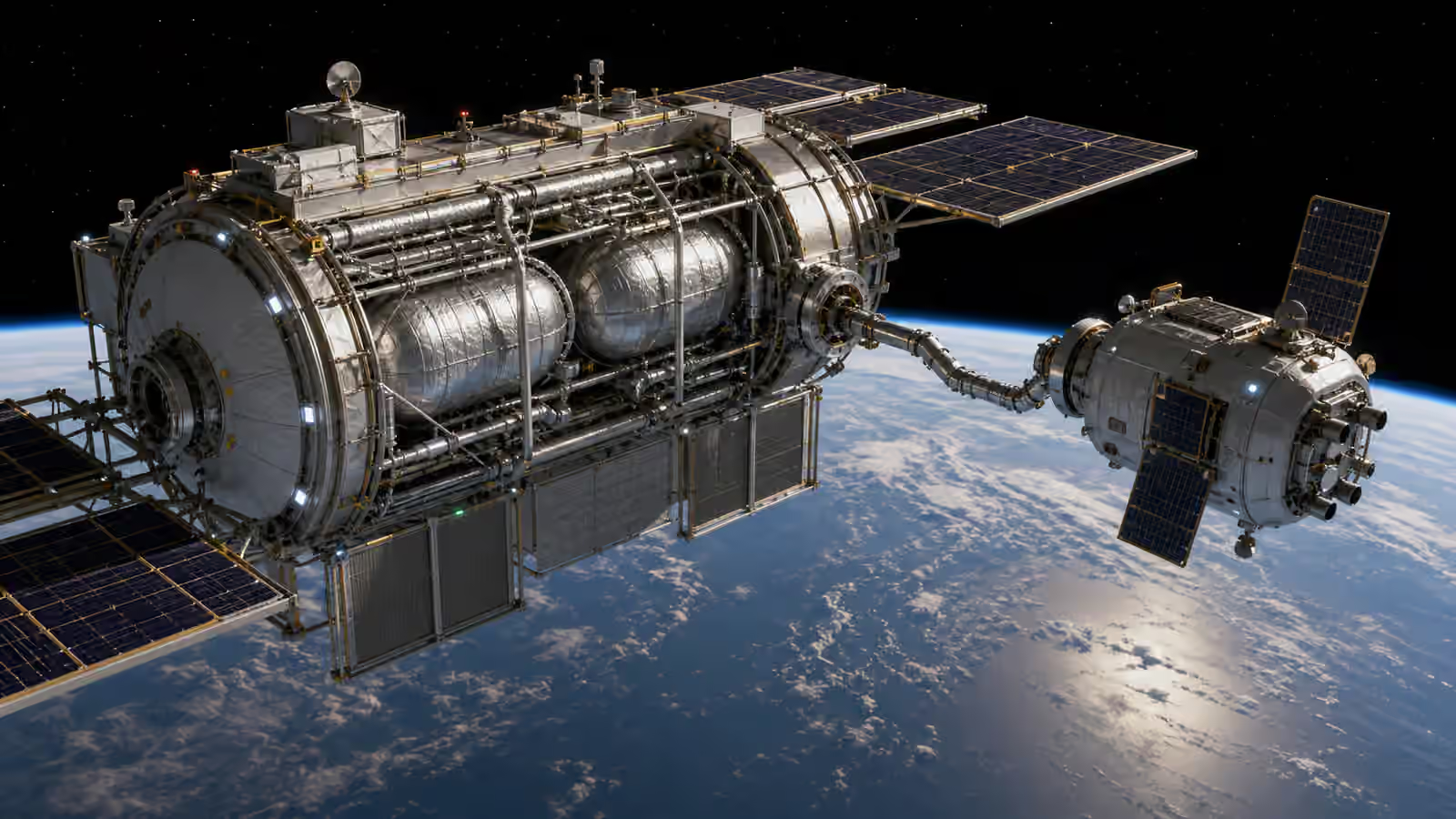
Launch is powerful, but it is not always precise in the way every payload wants. A rocket may deliver several satellites to one useful drop-off orbit, while each satellite would prefer a slightly different altitude, inclination, phasing, local time, or operational slot. A spacecraft may be small enough to buy a rideshare seat but not large enough to carry all the propulsion needed for the final move. An orbital transfer vehicle, often called a space tug, exists in that gap between getting to space and getting exactly where the mission needs to work.
The idea is familiar from ports and rail yards. A large ship crosses the ocean, but smaller tugs help maneuver near the harbor. A freight train carries many cars, but yard engines sort them into the right tracks. In orbit, the physics is different and the stakes are higher, but the logistics need is recognizable. Space becomes more useful when transportation does not end at the first parking place.
The Last Mile Can Be the Mission
Upper Stages and Orbit Insertion explains the final rocket work before a satellite begins operations. The upper stage may perform coast phases, restarts, circularization, and deployment. But a launch provider must serve the whole mission profile, not only one payload’s ideal destination. On a rideshare flight, the upper stage may not be able to visit every orbit each customer wants. On a dedicated flight, using the upper stage for complex delivery can still be costly or constrained by mission rules.
An orbital transfer vehicle can carry one or more payloads after deployment and move them closer to their desired positions. It may raise altitude, change phasing, adjust inclination modestly, circularize an orbit, or deliver payloads into several separated slots. Sometimes it acts like a carrier that releases satellites one by one. Sometimes it hosts a payload for a period of operations. Sometimes it provides propulsion, power, communications, or attitude control that the payload itself does not have.
This last-mile service changes spacecraft design. A small satellite with limited propulsion may accept a rideshare launch if a tug can handle the orbit change. A constellation operator may use a transfer vehicle to spread satellites into useful positions faster. A technology payload may fly as a hosted instrument instead of becoming a full spacecraft. The tug does not remove the need for mission design. It gives mission designers another lever.
Tugs Are Spacecraft With a Job
A space tug is not a magic engine bolted to a box. It is a spacecraft with power, guidance, navigation, control, communications, thermal control, propulsion, software, safety logic, payload interfaces, and an operating team. It must survive launch, separate cleanly, identify its state, manage attached payloads, maneuver responsibly, and avoid creating debris.
Propulsion is the most obvious feature. Chemical propulsion can provide higher thrust, which may be useful for quicker maneuvers or heavier payloads. Electric propulsion is usually lower thrust but can be efficient for gradual orbit changes. The right choice depends on payload mass, desired timeline, available power, target orbit, and mission economics. A tug may trade speed for efficiency, or simplicity for flexibility.
Guidance and control matter just as much. Moving through orbit means changing velocity in planned ways. The vehicle has to know where it is, where it is going, how its payloads affect mass properties, and how to point thrusters without harming sensitive hardware. The more payloads it carries, the more it resembles a small mission campaign rather than one maneuver. It may deploy one satellite, wait for separation distance, reorient, perform another burn, and prepare the next release.
Rideshare Makes the Need Visible
Payload Integration and Rideshare Launches shows why shared launches are attractive and why they involve compromise. A rideshare can lower barriers to orbit, but the drop-off conditions may not match every customer’s preferred mission geometry. Without a tug, the satellite must carry enough onboard capability to bridge the gap or accept a reduced mission.
That is not always a problem. Many spacecraft are designed for orbit raising and phasing. Satellite Propulsion and Stationkeeping explains how small burns keep spacecraft useful after launch. But propulsion adds mass, volume, complexity, safety review, and operational burden. For very small spacecraft, the trade can be severe. A tug can centralize some of that mobility in one vehicle.
There is also a schedule story. If a transfer vehicle can use frequent launches and then perform custom delivery, customers may get more practical access to useful orbits. Instead of waiting for a launch that perfectly matches a narrow target, a mission can ride to a nearby starting point and let in-space logistics do the rest. This is especially valuable when launch cadence grows faster than perfect mission-specific opportunities.
Delivery Is Only One Business Model
The simplest tug story is delivery, but orbital transfer vehicles can support several kinds of work. A tug may host sensors, radios, or experiments that do not need their own full bus. It may reposition a payload over time. It may provide temporary power and communications during commissioning. It may inspect objects, assist with disposal, or move a failed satellite if the interfaces and permissions allow.
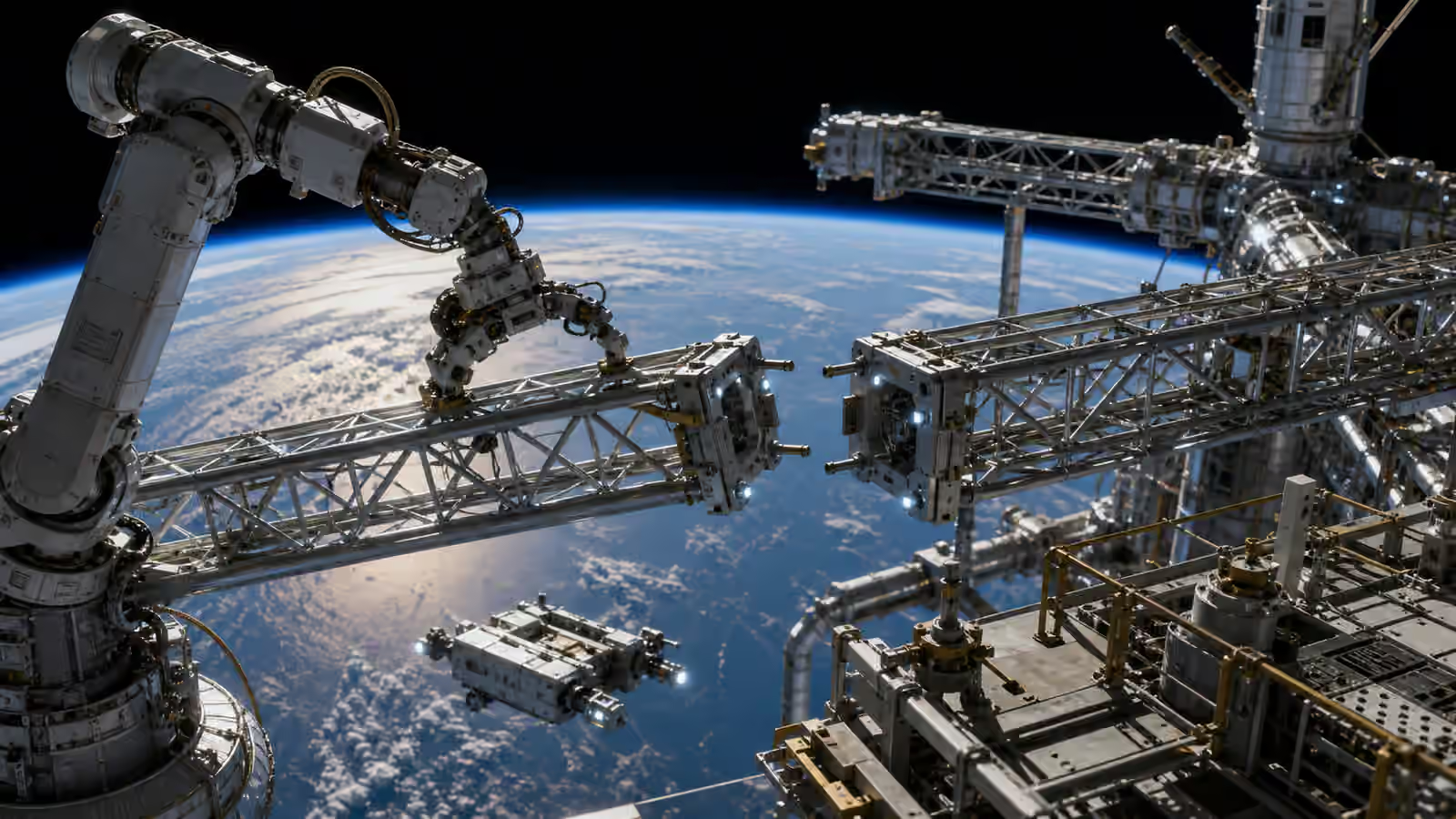
This overlaps with In-Space Servicing and Refueling , but the emphasis is different. Servicing focuses on maintaining, repairing, refueling, or removing spacecraft already in orbit. A transfer vehicle focuses on transportation and positioning, often early in a mission. In practice, mature orbital infrastructure may blur the line. A vehicle that can approach, dock, refuel, tow, or dispose of a satellite is participating in a larger logistics network.
Hosted payloads are another useful model. A customer may want to test an instrument, collect a limited data set, or demonstrate a component without building a whole satellite. If the tug can provide power, pointing, data handling, and downlink, the payload can ride as part of the vehicle. That turns the tug into a platform, not merely a delivery truck.
Interfaces Decide What Is Possible
Space logistics becomes easier when interfaces are planned. A tug needs mechanical attachments, separation systems, electrical connections, data links, keep-out zones, and safe handling rules. If the payload is only being carried and released, the interface may be similar to a launch dispenser. If the tug provides power or data, the interface becomes deeper. If docking or refueling is involved, the target must be designed or adapted for contact.
Standard interfaces matter because custom integration slows everything down. A tug that can accept common small-satellite form factors, known adapters, and clear software protocols is easier to schedule and trust. The same logic appears across the guidebook shelf. Satellite Manufacturing and Testing depends on repeatable verification. Satellite Structures and Deployable Mechanisms depends on launchworthy physical interfaces. A transfer service must make those interfaces routine without pretending every payload is identical.
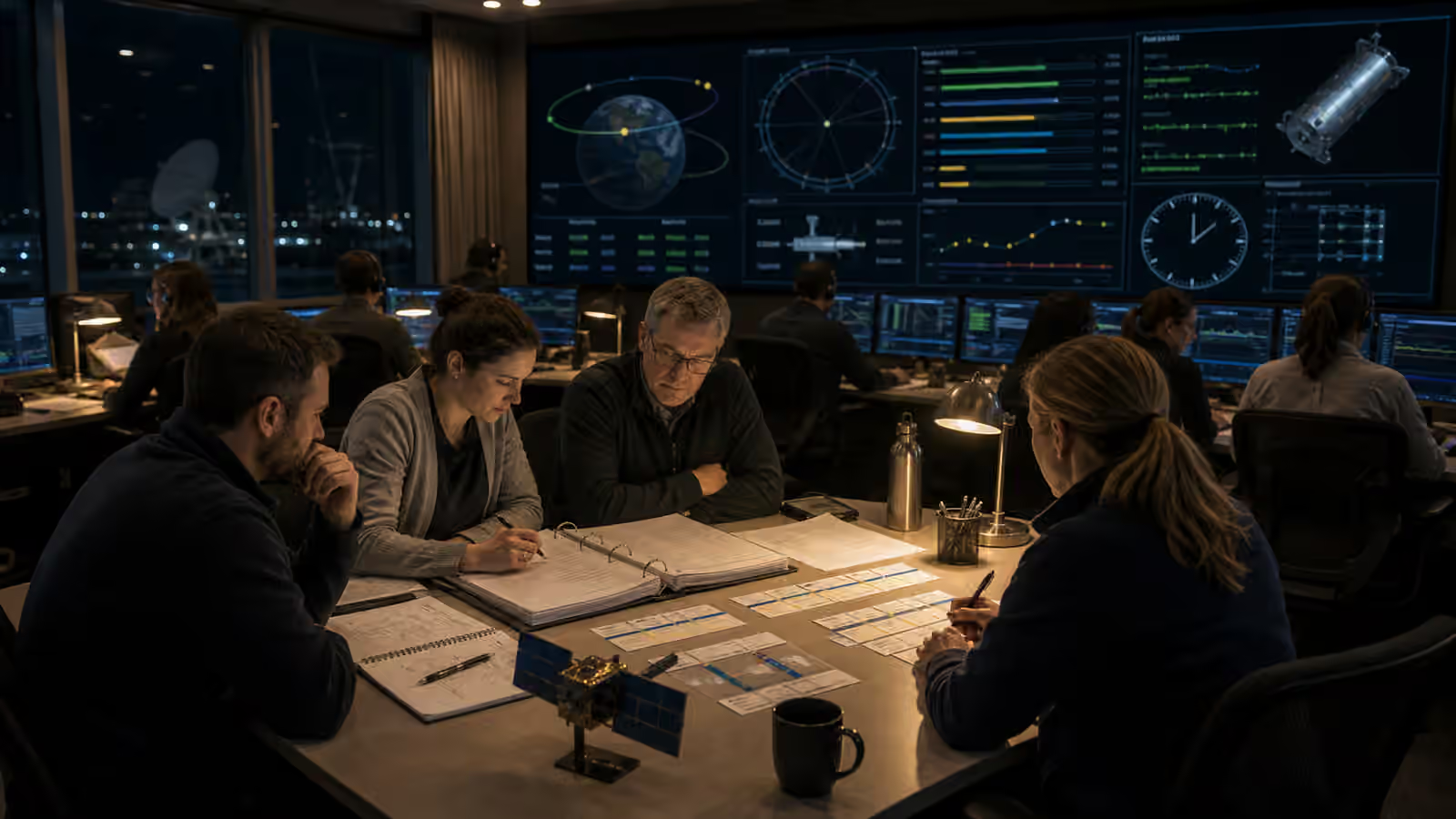
The payload owner also needs operational clarity. When does responsibility transfer from launch provider to tug operator to satellite operator? Who commands a release? Who tracks the objects? How are anomalies handled if a payload does not separate? How is the transfer vehicle disposed of when its work is done? These questions are not paperwork afterthoughts. They define whether the mission is safe to fly.
Moving Objects Changes the Traffic Picture
Every maneuvered object in orbit participates in traffic management. A tug may carry multiple payloads, release them over time, and change orbit between events. Tracking networks need to identify what separated when. Operators need ephemerides accurate enough for conjunction assessment. Other spacecraft need confidence that the transfer vehicle is under control and that deployment debris is not being left behind.
This connects directly to Space Debris and Orbital Traffic and Satellite End of Life . A tug that improves delivery but leaves a long-lived uncontrolled object has not improved the orbital environment. Responsible transfer vehicles include passivation, disposal plans, collision avoidance procedures, and clear communication with tracking services.
The more active in-space logistics becomes, the more normal these operating habits must be. Orbit cannot become a useful transportation network if every transfer is treated as a one-off surprise. Schedules, notices, tracking, identity, and disposal have to become part of the service.
A Sign of a Maturing Space Economy
Orbital transfer vehicles are important because they make space less binary. The old question was often whether a rocket could place a satellite into the target orbit. The newer question is how launch, transfer, onboard propulsion, ground operations, and end-of-life planning work together. A mission may use a reusable rocket to reach a shared orbit, a transfer vehicle to move closer to the working location, onboard propulsion for fine stationkeeping, and a planned disposal sequence at the end.
That layered approach is what infrastructure tends to look like. No one vehicle does every job. Large systems use specialized tools connected by reliable interfaces. Space tugs are one of those tools. They do not make launch easy, and they do not make orbital mechanics disappear. They make the path from launch opportunity to useful service more flexible.
The careful way to read a tug proposal is to ask what constraint it actually relaxes. Does it reduce onboard propulsion needs? Does it make rideshare more practical? Does it speed constellation deployment? Does it provide a hosted platform? Does it improve disposal? The value is not in the name. It is in the specific movement, service, and responsibility the vehicle can perform without adding more risk than it removes.
When that balance works, a space tug is not a novelty. It is part of the logistics layer that lets space missions stop treating the first orbit as destiny.