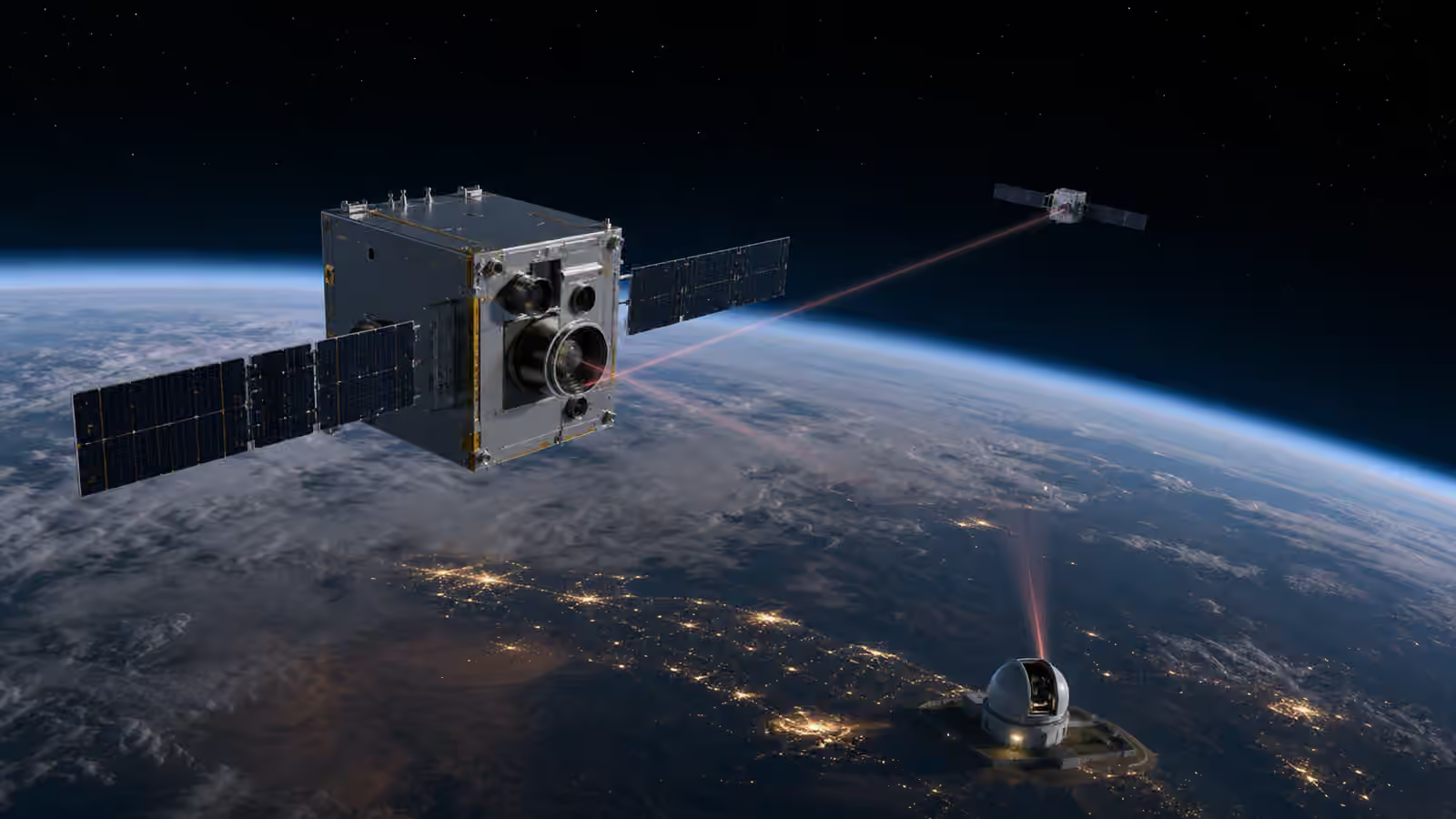
Optical communications in space sound futuristic because the visible image is so clean: a narrow beam of light moving data between spacecraft, or from orbit to a telescope-like terminal on Earth. The practical story is more demanding. A laser link is not simply radio with a prettier beam. It is a communications system that trades broad coverage for precision, high potential data rates, lower beam spread, and a different set of operational constraints.
Radio links remain the foundation of most space operations. Satellite Spectrum and Interference explains why radio frequencies are coordinated so carefully, and Satellite Antennas and Link Budgets shows how power, gain, distance, noise, and margins decide whether a link closes. Optical communications use the same engineering habit of accounting for every loss and uncertainty, but the hardware and operating feel are different. The beam is tighter, the pointing problem is sharper, and the atmosphere becomes a different kind of gatekeeper.
A narrow beam changes the link
A radio antenna can spread energy across a wide footprint. That is useful when a satellite needs broad coverage, when user terminals move, or when the mission values tolerance over raw concentration. An optical terminal sends light through a much narrower beam. Less energy spills into places that do not need it. More of the signal can arrive at a carefully aimed receiver. That makes optical links attractive for missions that need to move large amounts of data, especially imagery, science products, or network traffic.
The same narrowness creates discipline. A radio link may tolerate modest pointing errors because the beam is broad enough to include the receiver. A laser terminal may need fine pointing, acquisition, and tracking. The spacecraft has to know where the other terminal is, aim within tight limits, detect the incoming signal, and keep the beam stable while both platforms move. Satellite Attitude Control becomes part of the communications story because jitter, slews, reaction wheel behavior, structural flex, and thermal motion can disturb the link.
This is why optical communications are often described as a system capability rather than a box bolted onto a satellite. The terminal matters, but so do the orbit, pointing sensors, onboard computer, power modes, thermal design, ground schedule, weather plan, and the data system waiting behind the link.
Space-to-space links have a different kind of freedom
Optical links between satellites avoid many of the atmosphere problems that affect space-to-ground paths. There are no clouds between two spacecraft in vacuum, no rain fade, and no turbulent air column bending the beam. This makes optical crosslinks attractive for constellations that want to move data across orbit before downlinking. Inter-Satellite Links covers the fleet networking layer. Optical communications give that layer one of its highest-capacity physical paths.
A constellation with optical crosslinks can reduce dependence on a nearby ground station. A satellite over an ocean, polar region, or remote disaster area may pass data to another satellite that has a better route to a gateway. The network begins to behave less like isolated spacecraft taking turns over antennas and more like a moving mesh. That does not make routing easy. It changes where the hard work sits. The fleet must predict contacts, align terminals, manage queues, prioritize traffic, and handle handovers as spacecraft move across the sky.
Optical crosslinks also create security and interference differences. A narrow beam is harder to accidentally intercept than a broad broadcast, and it is less likely to interfere with a neighbor. It is not automatically secure, and it still needs encryption, authentication, and operations discipline, as Satellite Cybersecurity and Resilience makes clear. The beam shape helps, but the mission still needs trustworthy command paths, protected ground systems, and data handling that does not confuse secrecy with safety.
Space-to-ground links meet weather
When an optical link points down to Earth, the atmosphere becomes part of the design. Clouds can block the path. Haze, dust, turbulence, and weather can degrade it. A radio ground station may work through conditions that stop an optical terminal completely. That makes optical ground architecture less about one perfect site and more about diversity. A mission may need terminals in several climates, fallback radio links, onboard storage, and scheduling logic that can wait for clear skies.
The ground terminal often looks more like an observatory than a familiar satellite dish. It needs a telescope, detectors, tracking systems, weather awareness, site security, network connections, and procedures for coordinating passes. Ground Stations explains the earthside half of space infrastructure. Optical ground stations add a more weather-sensitive, optics-sensitive version of that same earthside work.
Atmospheric turbulence can make the received light dance and blur. Engineers may use adaptive optics, larger apertures, modulation choices, coding, or site selection to preserve performance. None of that removes the need for operational humility. A high-rate optical downlink can be excellent when conditions cooperate and unavailable when a cloud deck arrives at the wrong time. The mission has to know what happens then. Does the spacecraft store data? Does it downlink over radio at a lower rate? Does it switch to another optical site? Does the user-facing product tolerate delay?
Data rates are not the whole promise
The public shorthand for optical communications is often speed. That is understandable, because high-rate downlinks are a major reason to use lasers. Earth observation missions can collect more data than older downlink paths comfortably move. Science missions can produce bursts of valuable measurements. Constellations can carry user traffic that should not wait for the next convenient ground pass.
But data rate alone is not the useful measure. Reliability, latency, contact duration, pointing overhead, weather availability, power draw, storage limits, and network integration all decide the value of the link. A very fast link that is available only rarely may not serve the mission as well as a slower link that is dependable. A fast crosslink that cannot be scheduled cleanly may create queues instead of relieving them. A beautiful optical terminal that overheats during high-rate use is not a network solution.
Satellite Data Pipelines is the other half of this story. A downlink only matters when the receiving system can ingest, process, validate, store, and deliver the data. Optical communications can move the bottleneck. A mission that used to wait on the radio link may suddenly wait on ground processing, product generation, or user delivery. Infrastructure improves one constraint at a time, and each improvement exposes the next weak point.
Deep-space links ask for patience
Optical communication is also attractive beyond Earth orbit, where distance makes every bit expensive. A probe far from Earth has limited power and a long path home. A narrower beam can help concentrate signal energy, but pointing becomes even more unforgiving. The spacecraft has to aim at Earth with great precision while Earth moves, the probe moves, and the signal takes time to arrive. Deep-Space Power Systems matters because communications can become one of the major loads in a distant mission’s budget.
Deep-space optical links are not a replacement for every radio path. Radio can be more forgiving for acquisition, emergency modes, and weather-resilient communication. Optical links may become a high-rate path when geometry, pointing, and ground conditions support it. A serious mission architecture treats the two as complementary rather than as rivals. The dependable low-rate conversation may still be radio. The data-heavy transfer may use light when the mission can earn it.
The useful mental model
Optical communications make space networks more capable by making links more precise. That precision is the benefit and the burden. Narrow beams can carry more data, reduce spillover, and connect spacecraft into faster networks. They also demand pointing, tracking, weather planning, ground diversity, thermal control, cybersecurity, and data systems that can absorb the speed.
The best way to understand laser communications is to stop picturing a magic line of light and start picturing a chain of agreements. The spacecraft agrees to point. The terminal agrees to stabilize. The ground site agrees to see through the weather. The onboard recorder agrees to hold data until the link appears. The network agrees to route traffic without losing context. The product system agrees to turn the delivered bits into something users can trust. When those agreements work, optical communication becomes less like a spectacle and more like a higher-capacity layer in the infrastructure overhead.