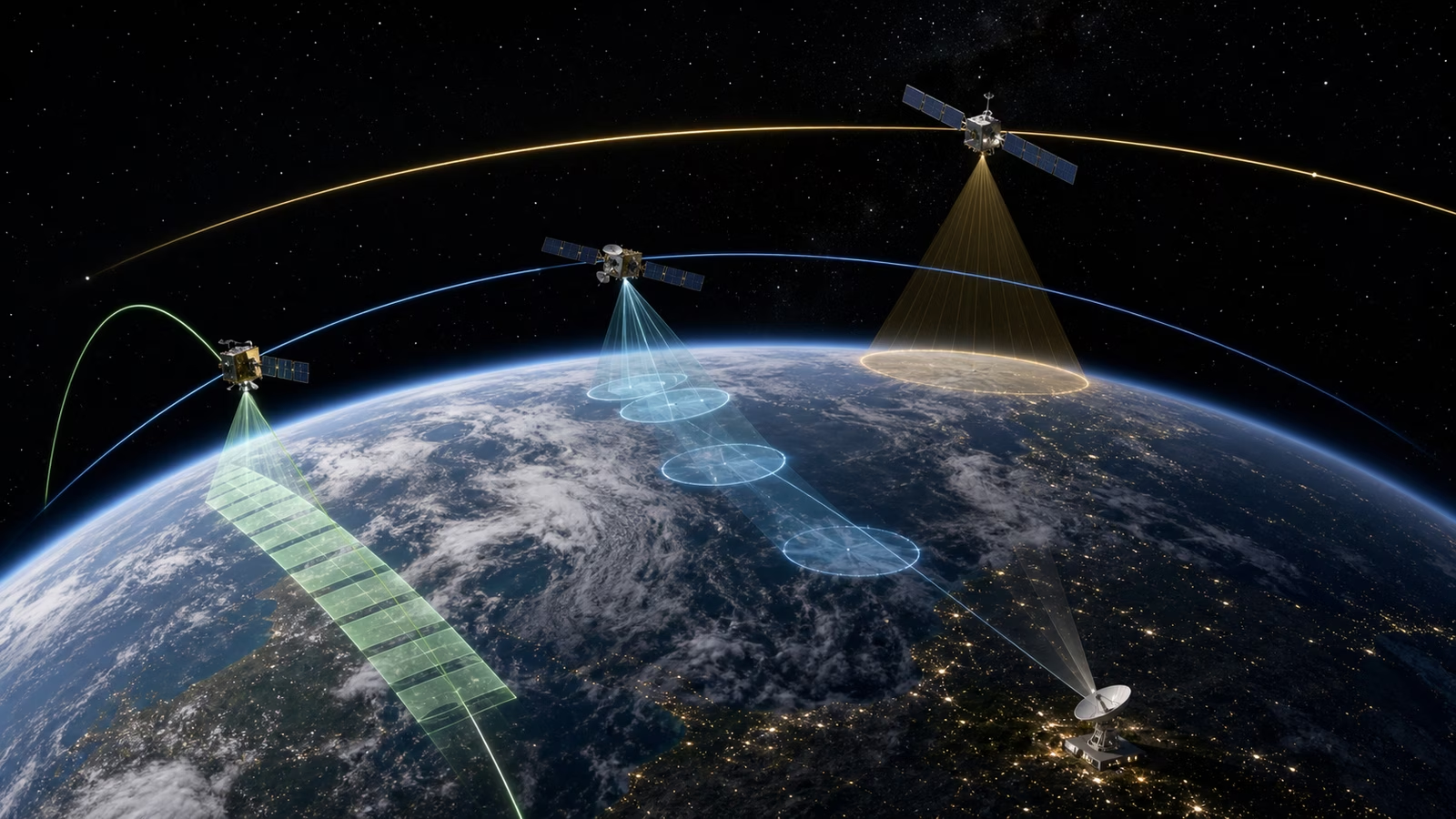
A spacecraft is tested before launch, but the mission also has to be rehearsed. The vehicle may survive vibration, thermal vacuum, deployment checks, and software tests, yet still leave the team unprepared for the awkward middle of real operations: a late ground pass, an unexpected temperature trend, a thruster that behaves slightly differently than the model, a payload queue filling faster than planned, a safe mode during a holiday shift, or a launch injection that is good enough but not exactly the orbit people practiced in presentations.
Mission simulation is the bridge between design confidence and operational confidence. It asks how the spacecraft, ground system, software, data pipeline, people, and procedures behave together before the real mission makes rehearsal impossible. Space Mission Architecture and Tradeoffs explains how mission choices become a system. Simulation tests whether that system can be operated when time is moving, telemetry is incomplete, and decisions have consequences.
A Simulation Is an Argument About Reality
No simulation is the mission itself. A model is always a selective version of reality. It includes some forces, timings, limits, and behaviors while simplifying others. The value of a simulation depends on whether those choices match the decision being rehearsed. A launch-window analysis needs one kind of model. A thermal safe-mode drill needs another. A constellation capacity forecast needs a different one again.
This is why good simulation work begins with a question. Are we testing whether a spacecraft can reach its first contact window? Are we checking whether batteries survive an eclipse sequence? Are we rehearsing command approval during a possible collision-avoidance maneuver? Are we estimating how long a data product will take to reach users after downlink? The question decides how much fidelity is needed and where low fidelity is acceptable.
The phrase digital twin can make this sound more magical than it is. At its best, a digital twin is a maintained model of the actual system, updated as hardware, software, configuration, and operations knowledge evolve. It is not merely a pretty three-dimensional object on a screen. It is a working representation that helps the team reason about state, behavior, margins, and change.
The Spacecraft Model Is Only One Piece
The most obvious model is the spacecraft. It may include orbit propagation, attitude behavior, power generation, battery charge, thermal states, communication windows, memory use, propulsion, payload modes, and fault responses. Those models can be simple or detailed. A small mission may use lightweight tools and carefully reviewed spreadsheets for some questions. A large or critical mission may need high-fidelity simulation environments with hardware-in-the-loop testing.
But the spacecraft model is not enough. A mission includes ground stations, networks, operators, scheduling tools, approval chains, data systems, and users waiting for products. Ground Stations shows how brief contacts can become the earthside half of a mission. A simulation that ignores ground constraints may prove a plan that cannot actually be commanded or downlinked.
The same is true of the Satellite Data Pipelines that turn measurements into useful products. If a disaster-monitoring mission claims rapid response, the simulation has to include more than the satellite’s ability to look at the target. It has to include tasking, collection, onboard storage, downlink, processing, quality checks, delivery, and the possibility that the first data set is partial or cloud-covered.
Rehearsal Finds Human Problems
Space teams often discover that a rehearsal exposes people and process problems faster than hardware problems. A command procedure may be technically correct but hard to follow at night. A display may hide the one telemetry value that operators need first. A meeting rule may delay a decision that should be made within minutes. Two teams may use the same word for different things. A shift handover may omit a constraint that the next operator assumes was cleared.
These are not soft issues. They are mission behavior. A spacecraft can only execute the commands that people prepare and approve. A ground team can only interpret the telemetry it can see and trust. If the procedure is confusing, the system is confusing. If a simulation makes smart people hesitate for the wrong reason, it has found a real defect.
This is especially important for anomalies. Satellite Fault Protection and Autonomy describes onboard responses that keep a spacecraft safe when conditions move outside limits. Operators need to practice what happens next. Which alarms matter first? What data is stale? Which commands are safe? How long can the spacecraft remain in the current mode? Who has authority to change the plan? What if the next ground contact is shorter than expected?
Digital Twins Need Configuration Discipline
A model that no longer matches the spacecraft can become dangerous because it looks authoritative while being wrong. If a heater setting changed after thermal testing, the simulation must know. If a battery was replaced, the model must reflect the installed unit. If a flight software update changed a fault threshold, the simulator and procedures must catch up. If a component has a waiver or known quirk, the operational model should not pretend the ideal design is flying.
This ties simulation directly to Satellite Manufacturing and Testing . Configuration control, test records, calibration data, and anomaly reports are not paperwork stored for audits. They are the raw material for believable rehearsal. The digital model inherits the spacecraft that exists, not the spacecraft that the first design review imagined.
The need does not stop at launch. A satellite ages. Solar arrays degrade. Batteries change behavior. Reaction wheels accumulate wear. Propellant margins shrink. Thermal surfaces change. Ground networks evolve. Operations teams learn patterns that were invisible during design. A useful digital twin absorbs that experience. It becomes less like a launch-era prediction and more like a living operational notebook with physics behind it.
Simulations Should Fail Before Missions Do
A rehearsal that always succeeds is not generous. It is suspicious. Teams need simulations that create uncomfortable but plausible failures. A missed command load, a late station outage, a stuck deployment indication, a bad ephemeris file, a downlink with gaps, an unexpected safe mode, an overfull recorder, a cyber alert, or a conjunction warning can reveal whether the mission is genuinely ready.
The goal is not theater. It is practiced judgment. The team should learn which decisions are routine, which require expert review, which can wait, and which must be made before the next orbital event closes the option. A good simulation gives people enough realism to feel pressure without manufacturing melodrama. Space operations are hard enough without adding fake panic.
The best failures also test recovery paths. If the spacecraft enters safe mode, can it find the Sun, preserve power, communicate, and wait for commands? If a ground station is unavailable, can another station take the pass? If a data pipeline receives an incomplete product, can users see the quality flag? If a maneuver is delayed, does the next planning cycle still make sense? Simulation turns resilience from a word into a sequence of actions.
Constellations Make Simulation Harder
A single spacecraft is already complex. A constellation adds fleet behavior. Satellites hand users to one another. Inter-satellite links route data across moving nodes. Ground stations schedule many contacts. Capacity varies by geography and time. Replacement satellites enter the pattern. Some vehicles drift toward disposal while others are commissioned. A local anomaly can have service effects somewhere else.
Satellite Constellation Design and Inter-Satellite Links show why fleet geometry and orbital networking are system problems. Simulation is where those problems become operational. The team can ask what happens if several satellites are unavailable, if a gateway is congested, if a solar storm changes drag assumptions, or if demand is higher than expected in one region.
For constellations, simulation also supports replenishment and end-of-life planning. The model has to account for satellites that are aging, maneuvering, avoiding debris, entering service, leaving service, or waiting for launch. The fleet is never frozen. A static diagram of orbital shells may explain the design, but operations require a model that moves.
The Model Is a Training Ground
Mission simulation is also how new operators learn the spacecraft without touching the real one. They can practice nominal passes, command building, telemetry interpretation, anomaly response, and handover habits. They can make mistakes in an environment where mistakes become lessons instead of incident reports. This matters because space infrastructure depends on people who can act calmly when the system is noisy.
Training models do not need perfect fidelity for every lesson. A procedure trainer can teach command flow without modeling every thermal node. A fault drill can teach decision-making without reproducing every sensor detail. A high-fidelity engineering simulation can support design choices that a training tool should not try to answer. The mature organization knows which tool is for which decision.
Rehearsal Keeps Architecture Honest
Simulation has a useful way of embarrassing elegant architecture. A design that looked balanced in a review may reveal that the operations team has too little time between contacts. A power margin may vanish when two modes overlap. A data plan may depend on a ground station schedule that is unavailable during the most important orbit. A fault response may preserve the spacecraft but delay the payload product beyond its useful time.
Those discoveries are valuable because they arrive before the mission has spent its choices. A simulation can send the team back to change requirements, add margin, simplify a procedure, adjust a ground contract, revise a safe mode, or accept a risk explicitly. This is not a sign that planning failed. It is what planning is for.
Spaceflight cannot be made predictable in every detail. It can be made more rehearsed, more observable, and more honest about its assumptions. A mission simulation is the place where a team learns the difference between a system that works on paper and a system that people can operate when orbit starts moving under them.