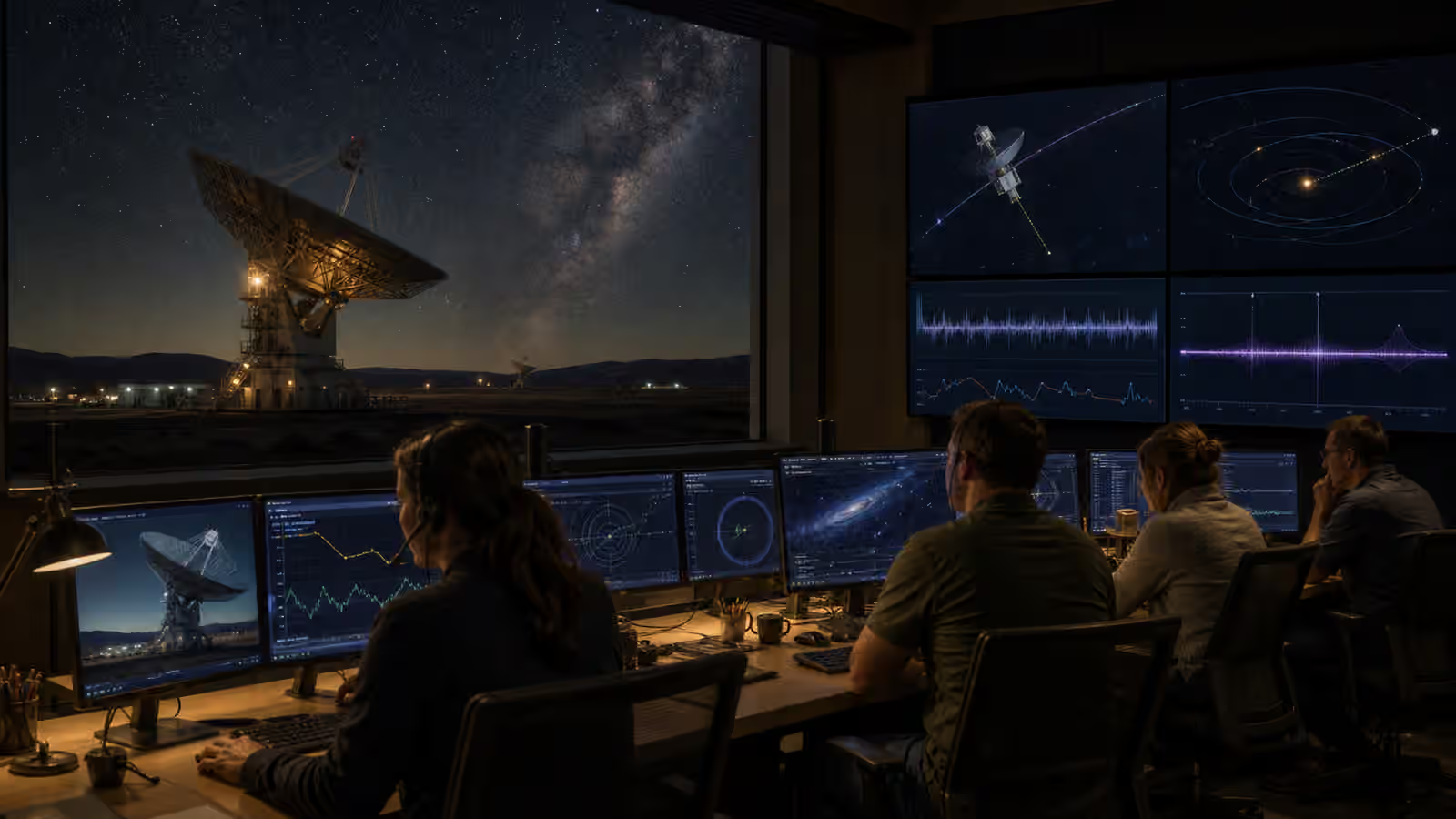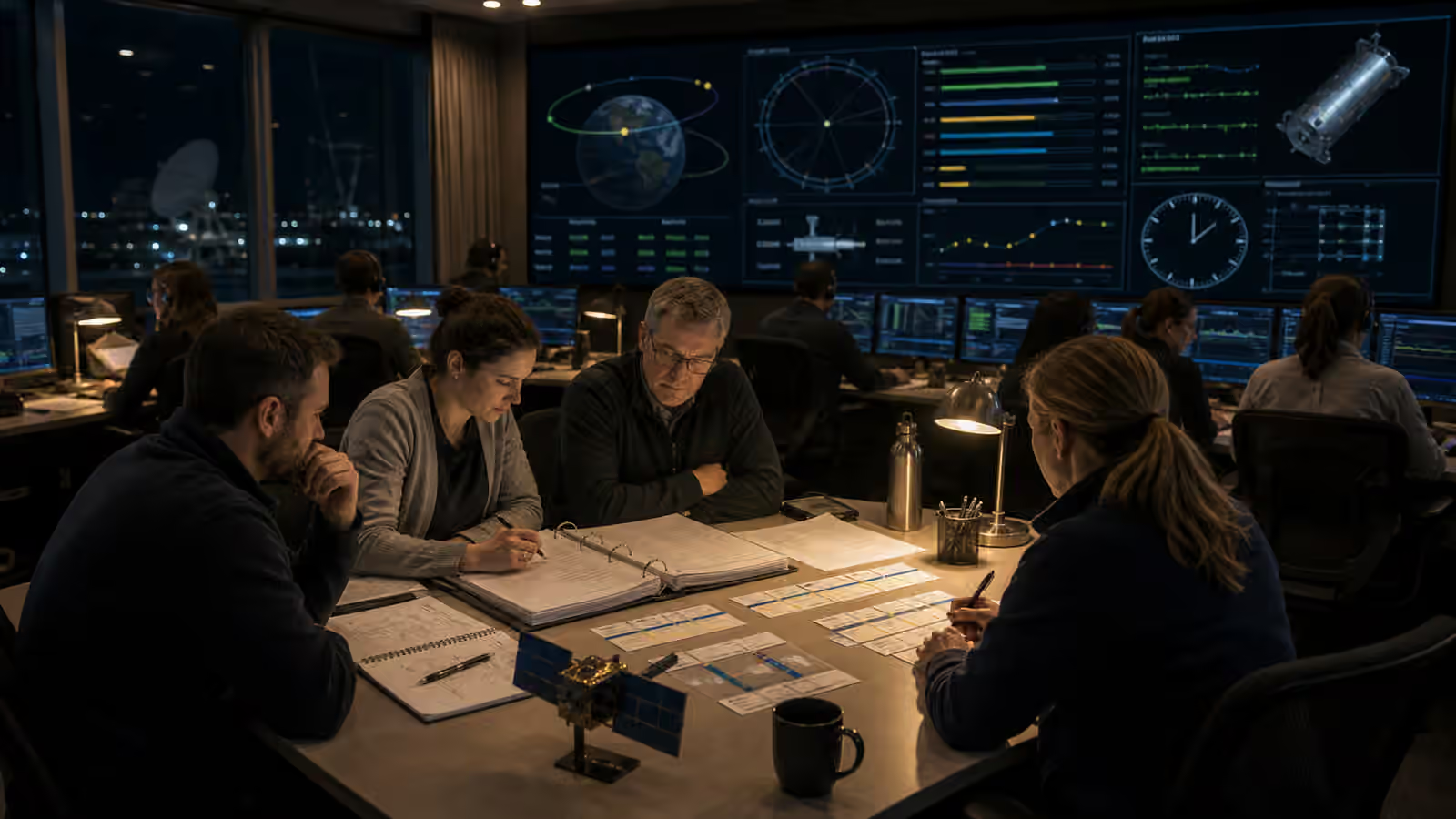
A mission operations center is where a spacecraft becomes a long conversation instead of a finished machine. The hardware is already beyond reach. It may be in low Earth orbit, near the Moon, or on a path that makes every command feel delayed by distance and consequence. The operations team cannot tighten a connector or wipe a sensor. It has to work through commands, telemetry, procedures, timing, models, and judgment.
This is why operations centers are quieter than people expect. Good spacecraft operations rarely look like dramatic countdown rooms. They look like teams checking evidence, comparing values against limits, waiting for the right ground pass, and deciding whether a planned command is still appropriate. Spacecraft Command, Telemetry, and Tracking explains the language of that conversation. A mission operations center is where the language is used under time pressure without letting pressure become improvisation.
The Room Is a Decision System
The consoles, displays, logs, and wall screens are only the visible parts of the system. The deeper structure is role clarity. Someone owns spacecraft health. Someone owns the payload. Someone watches power. Someone tracks thermal behavior. Someone follows attitude control. Someone manages the pass timeline. Someone has authority to approve commands. In a small mission, one person may cover several roles, but the responsibility still has to be explicit.
Without clear roles, telemetry becomes noise. A battery current that looks harmless to one operator may matter to a power specialist because it occurs at the wrong point in the orbit. A thermal trend may look slow until someone connects it to a new attitude profile. A missed packet may be a communications nuisance or the first sign that an onboard computer has changed state. Operations centers organize attention so that small clues are not lost in the volume of normal data.
The center also organizes time. Spacecraft do not wait conveniently while a team debates. A pass over a ground station may last minutes. A maneuver window may close. An eclipse may begin. A payload may need to stop before it overheats or fills storage. Satellite Operations After Launch is built around this rhythm: the mission is always moving, even when the spacecraft appears quiet.
Flight Rules Keep Judgment From Starting Cold
Flight rules are written before the stressful moment. They define what the team will do when certain conditions appear, who can approve exceptions, which actions require review, and when a command should be delayed. The point is not to remove judgment. The point is to give judgment a prepared floor.
A good flight rule is usually specific enough to guide action and flexible enough to respect context. It may say that a payload should not be powered during a low-battery state, that a maneuver should not proceed without fresh orbit determination, that a software update needs a recovery path, or that a safe-mode spacecraft should complete a health assessment before nonessential activities resume. Each rule carries experience from design, testing, simulation, and earlier operations.
Mission Simulation and Digital Twins matters here because many flight rules are rehearsed before flight. A simulation can reveal that a rule is too vague, too slow, or missing a telemetry check. A procedure that sounds clear in a document may become confusing when operators have to use it during a short pass. Rehearsal turns written caution into practiced behavior.
Flight rules also help teams resist false confidence. If a spacecraft looks healthy but one required check is missing, the rule can slow the team down. If a value is outside limits but an approved recovery path exists, the rule can keep the team from freezing. In both cases, the rule is not a substitute for expertise. It is a way to keep expertise attached to evidence.
Every Pass Has a Shape
For many spacecraft, contact with Earth comes in passes. The satellite rises into view of a ground station, communicates for a short period, and then drops below the horizon. During that time, operators may need to receive stored telemetry, send commands, verify responses, update onboard schedules, collect payload data, or prepare for the next contact. A pass plan is the script that keeps those actions from competing randomly.
The plan begins before the antenna locks on. Operators need the expected orbit, ground station configuration, command load, telemetry products, and decision points. They need to know which commands are routine and which require permission. They need to know what telemetry proves success. They also need to know what will be skipped if contact is shorter than expected.
Ground Stations explains why earthside infrastructure is not a background detail. An operations center depends on antennas, networks, timing, security, scheduling, and data routing. A perfect command procedure is useless if the link budget is poor, the wrong antenna is scheduled, or the downlink path cannot deliver telemetry to the people making decisions.
Pass discipline becomes especially important during commissioning, recovery, and payload activation. Satellite Commissioning and Early Orbit Operations shows how many first-flight activities depend on proving one step before attempting the next. Operations centers preserve that sequencing when the mission is most tempting to hurry.
Anomalies Are Stories Built From Evidence
An anomaly is not simply something going wrong. It is a difference between expected behavior and observed behavior that the team has to explain well enough to act. A temperature may drift upward. A wheel may draw extra current. A star tracker may reject measurements. A command may not return the expected response. A payload may produce data that looks valid but does not match calibration history.
The first task is to describe the anomaly without making the cause up too early. If a transmitter is quiet, the problem might be power, attitude, ground configuration, software state, antenna pointing, a schedule error, or a real hardware fault. If the team chooses one explanation too quickly, it may send commands that make the situation harder to understand. The better habit is to separate what is known, what is inferred, and what remains unknown.
Satellite Fault Protection and Autonomy gives the spacecraft side of this story. Safe modes, watchdogs, and autonomous responses are designed to keep trouble small. The operations center has to interpret what the spacecraft did for itself, then decide whether to restore service, collect more evidence, or leave the vehicle in a protected state while the team prepares a better plan.
Anomaly response also depends on records. Which command version was sent? Which parameter changed last week? Which procedure was used during the previous pass? Which software build is on board? Spacecraft Software Verification and Configuration Control is not only a prelaunch discipline. It is what keeps an operations center from debugging an imaginary spacecraft.
Calm Is Engineered
The calm in a good operations center is not personality. It is engineered through training, authority, procedures, displays, and communication habits. Operators learn how to speak concisely, how to challenge a command without creating confusion, how to acknowledge uncertainty, and how to stop a sequence when the evidence no longer supports it. The team also learns what not to say. Guessing aloud can be useful in a back room, but it can become dangerous if it sounds like a decision in the control room.
This is why many missions separate real-time operations from analysis support. The console team handles the pass and immediate decisions. Specialists may work nearby on deeper diagnosis, simulation, data review, or procedure changes. The structure keeps the real-time loop from drowning in every possible theory while still giving the mission access to expertise.
The same discipline appears in handovers. Spacecraft operations can continue for years. People change shifts, rotate roles, take leave, and move to other missions. A good center leaves enough record for the next operator to understand not only what happened, but why the previous team chose the current state. Logs, shift notes, anomaly reports, and configuration records are part of the spacecraft’s memory.
The Center Is Part of the Spacecraft
It is tempting to think of the spacecraft as the thing in orbit and the operations center as a support office. For practical purposes, they are one system. The vehicle carries hardware, software, sensors, actuators, limits, and autonomy. The ground carries people, procedures, models, records, authority, and communication paths. A mission succeeds when those halves understand each other well enough to make timely, conservative decisions.
That is why operations should be designed early, not added after launch. A spacecraft that sends clear telemetry, supports safe command modes, records useful events, and tolerates delayed decisions is easier to operate responsibly. A ground system that gives operators the right data, with the right history, at the right time, is as important as a polished payload display.
Space infrastructure becomes dependable when missions can be operated repeatedly without relying on heroic improvisation. The work is routine until it is not, and the routine is what makes the hard moments survivable. A mission operations center is the place where flight rules, telemetry, ground passes, anomaly discipline, and human judgment keep a distant machine inside responsible care.