A lunar landing site becomes useful only when people and machines can move beyond the footprint of the lander. Power systems, habitats, instruments, cargo pallets, resource prospects, and landing zones may sit hundreds of meters or many kilometers apart. Without mobility, every plan shrinks to what can be reached by a short walk, a robotic arm, or a fixed cable. Rovers turn a point on the Moon into a worksite with routes, tasks, cargo flow, and memory.
Lunar Infrastructure introduces the Moon as a logistics problem. Surface mobility is one of the most practical pieces of that problem because it connects the others. A power station is less valuable if no rover can carry tools to it. A promising resource patch is less useful if a prospecting vehicle cannot reach it safely. A habitat is less resilient if crews cannot move spares, inspect equipment, or retreat from a failing worksite.
Terrain is the first design partner
The Moon is not a smooth gray parking lot. It has slopes, craters, ridges, loose regolith, rocks, shadows, and lighting that can flatten visual cues. At the poles, long shadows and low Sun angles can make navigation difficult while also preserving cold regions that interest science and resource planners. A rover is therefore designed with terrain, not merely for terrain. Wheel size, suspension, ground clearance, traction, steering, speed, stability, and sensor placement all reflect what the route may demand.
Loose regolith changes the driving problem. A wheel can dig in, slip, throw dust, or lose traction on slopes. A vehicle that performs well on one surface may struggle on another. Engineers test in simulants and terrain beds, but lunar soil behavior is difficult to reproduce fully on Earth because gravity is lower and the dust has unusual texture. A rover that drives conservatively may accomplish more than one that treats every route like a road.
This is why route planning matters. Operators may prefer longer paths with lower slopes, better lighting, clearer communication, and known terrain over shorter paths that risk entrapment. Cislunar Communications and Navigation explains why lunar location and links are part of infrastructure. Mobility depends on them. A rover has to know where it is, how to return, and when it can talk.
Dust is a mobility problem
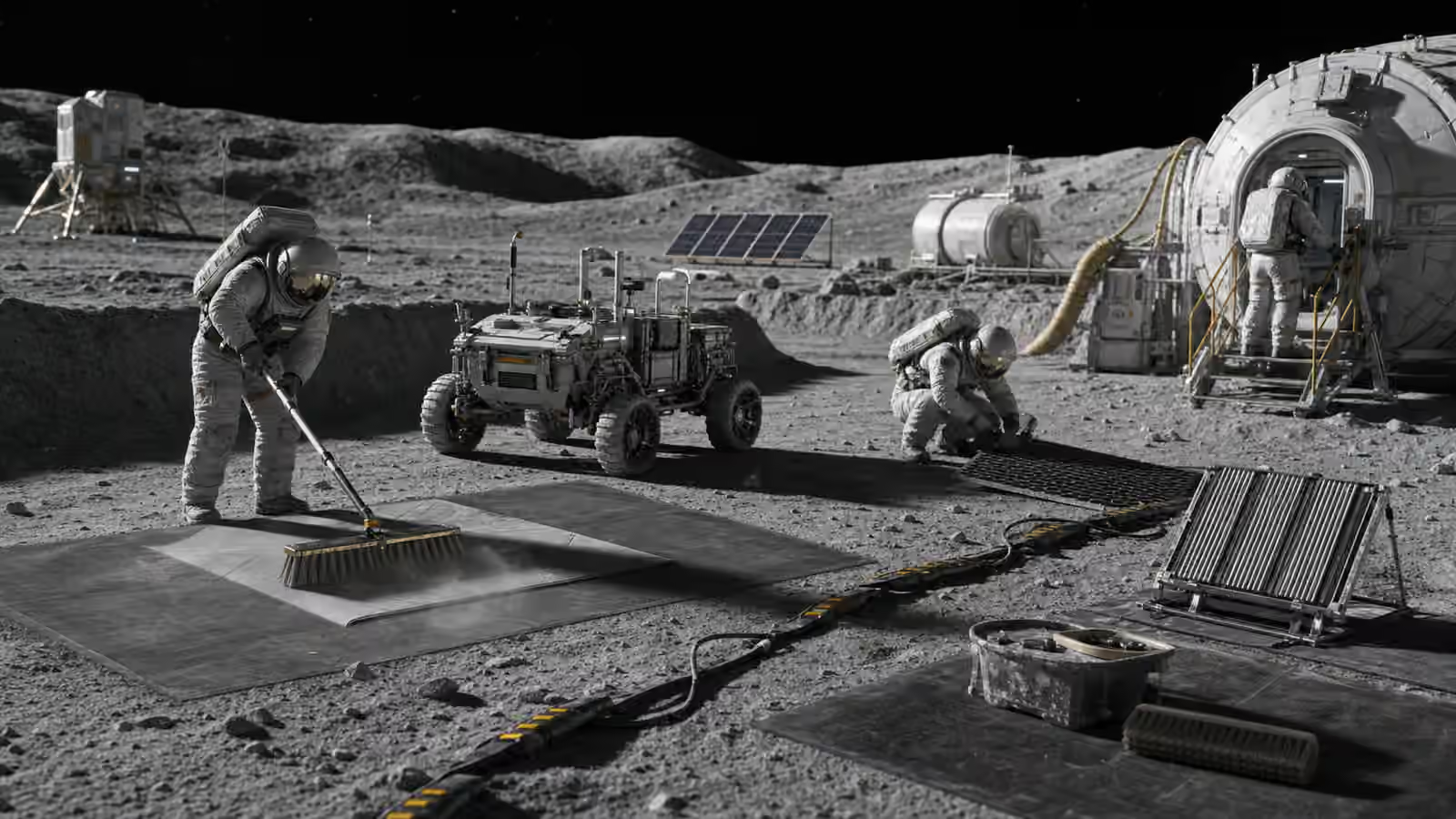
Lunar dust is a surface mobility issue before it is a housekeeping issue. It coats radiators, solar panels, cameras, seals, joints, connectors, bearings, suit fabrics, and optical surfaces. A rover creates dust by moving. It also carries dust from one place to another. The vehicle’s wheels, suspension, fenders, cable runs, and tool interfaces all need to respect a material that is fine, abrasive, clingy, and difficult to ignore.
Lunar Resource Prospecting and ISRU treats regolith as a possible feedstock. Surface mobility treats it as the road, the hazard, and the mess. If a rover supports resource work, it may spend much of its life near excavation, drilling, hauling, or processing equipment. That makes dust control part of the mission’s production system, not a cosmetic preference.
Dust also affects human mobility. A crewed rover may need suit ports, external tool stowage, cleaning procedures, filtered cabin systems, and rules about what crosses the habitat boundary. The rover becomes an airlock partner as much as a vehicle. If the vehicle brings dust into the living volume, the mobility gain can become a life-support burden.
Power decides the shape of a traverse
Every rover traverse is also an energy plan. The vehicle needs power for driving, computing, communications, thermal control, instruments, lights, drilling tools, sample handling, and sometimes crew life support. Solar power can work well in some regions and poorly in shadows or during long nights. Batteries add mass and need thermal care. Charging stations, swappable packs, power cables, or nuclear systems may change how far and how often a rover can travel.
Satellite Power Systems explains energy discipline in orbit. On the lunar surface, the same habit becomes route discipline. A rover should not drive to a place it cannot leave. It should not arrive at a worksite with too little power to operate instruments or survive a delay. It should know how temperature, terrain, payload mass, wheel slip, and communication windows affect the return margin.
Thermal control is part of that power story. The lunar surface swings between harsh sunlight, cold shadow, and long environmental cycles. Electronics, batteries, lubricants, displays, sensors, and crew systems may all have temperature limits. A rover that enters a permanently shadowed region may face a very different thermal environment from one working on a sunlit ridge. The route is not only horizontal distance. It is a path through heat and cold.
Cargo turns rovers into infrastructure
Some rovers are explorers. Others are trucks. A lunar worksite will need both habits. Instruments have to be placed. Samples have to be moved. Tools, spare parts, cables, antennas, solar arrays, structural pieces, tanks, and construction materials may need transport between landers and sites. A rover designed only for passengers may not handle cargo well. A rover designed only for cargo may not support delicate science or crew emergencies.
Space Mission Logistics and Cargo Planning fits naturally here because surface logistics can become the difference between a landing and a sustained program. If every lander must place every item exactly where it will be used, site planning stays brittle. If rovers can move cargo safely, planners gain flexibility. A mislanded pallet may still be recovered. A spare part can be delivered to a failed asset. A science instrument can be placed where it belongs instead of where the lander happened to touch down.
Cargo mobility also creates interface questions. How is a pallet attached? Can a rover lift it or only tow it? Does the cargo need power during transport? Can dusty connectors be mated by a suited crew member? Can a robot handle the task without damaging the payload? Surface mobility is full of these ordinary questions because infrastructure becomes real through interfaces.
Crew mobility is not just a faster walk
A pressurized rover changes the scale of crewed exploration. It can carry astronauts farther from a habitat, provide shelter, extend work time, and reduce the need to spend every minute inside a suit. But it also becomes a small spacecraft on wheels. It needs air, pressure, carbon dioxide removal, thermal control, power, displays, windows or cameras, navigation, communications, emergency supplies, and procedures for getting home if something fails.
Space Habitats and Life Support explains why living systems are infrastructure. A pressurized rover is a mobile version of that lesson. It may not be a home, but it has to protect people long enough to make distance useful. The more ambitious the traverse, the more the rover must behave like a dependable shelter rather than a vehicle with seats.
Unpressurized rovers have their own place. They can be lighter, simpler, and useful near a base or lander. They keep crew in suits, so they may be better for short work trips, cargo handling, inspection, or contingency support. A mature surface program will likely use several kinds of mobility instead of expecting one rover to do every job.
Autonomy makes mobility scalable
Robotic rovers cannot always wait for step-by-step driving from Earth. Delay, limited communication windows, shadows, terrain occlusion, and operator workload all push toward some autonomy. A rover may need to avoid rocks, maintain a route, protect itself from wheel slip, pause when uncertain, or return to a safe state. That autonomy should be bounded and understandable. The vehicle should not become mysterious to the team responsible for it.
Mission Simulation and Digital Twins matters because mobility plans can be rehearsed in terrain models before hardware moves. Operators can test routes, sunlight, power, communication, dust exposure, and contingency stops. The real Moon will still correct the simulation, but rehearsal gives the team a way to notice when reality diverges.
Routes become memory
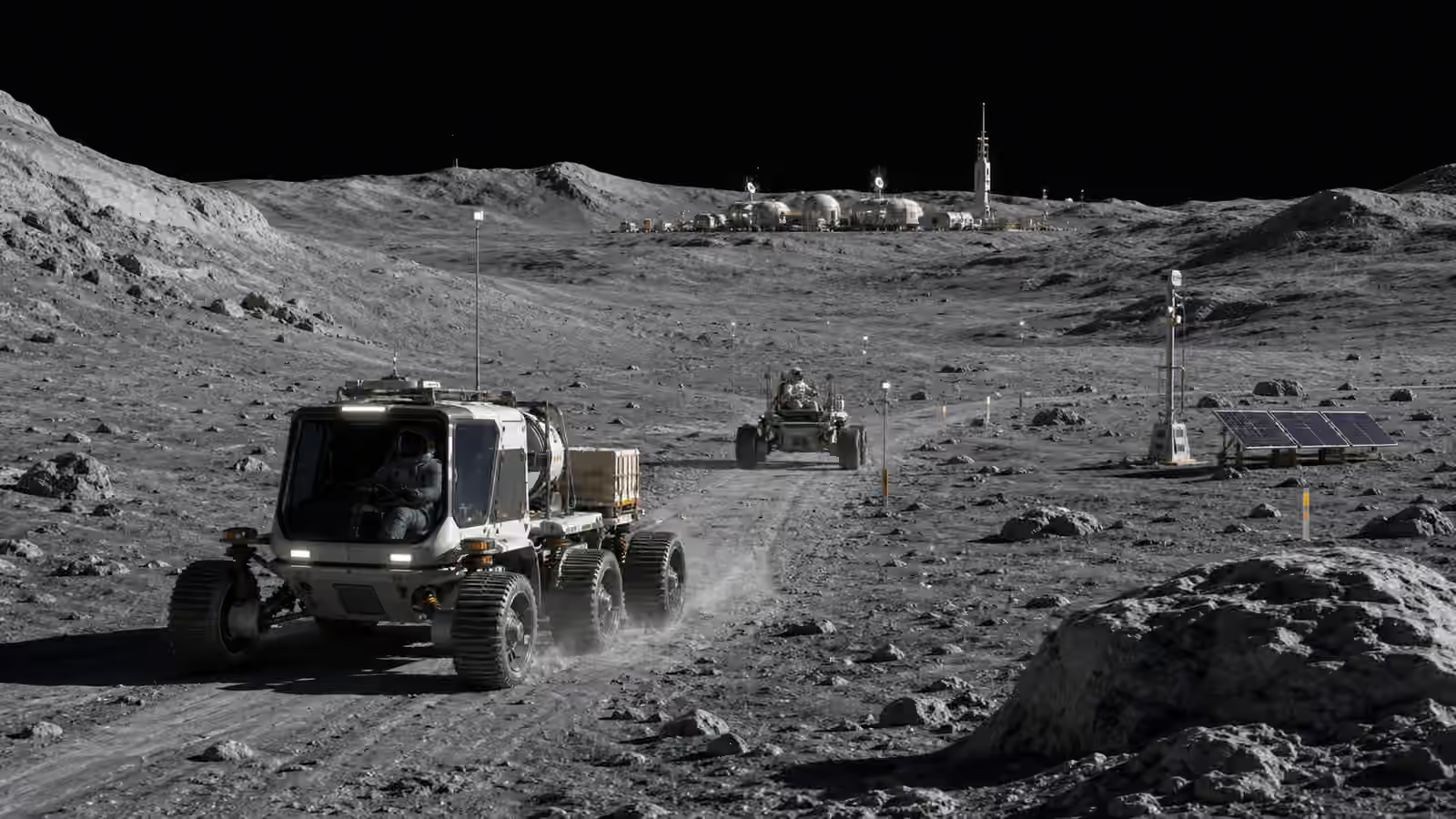
Over time, rover tracks can become infrastructure. A route that has been driven, mapped, and understood is safer than untouched terrain. Operators learn which slopes are benign, which shadows hide rocks, where communication drops, where dust is worst, and where a vehicle can turn around. Markers, beacons, charging points, relay nodes, and cleared pads can turn repeated travel into a primitive road network.
That is the deeper reason lunar mobility matters. Rovers are not only vehicles that move across a landscape. They are tools for making the landscape less unknown. Each traverse can leave behind data, experience, maps, inspected hardware, delivered cargo, and better confidence for the next trip. A landing site becomes a worksite when movement stops being a stunt and becomes a habit the surface system can rely on.