
Space infrastructure does not end at the edge of the atmosphere.
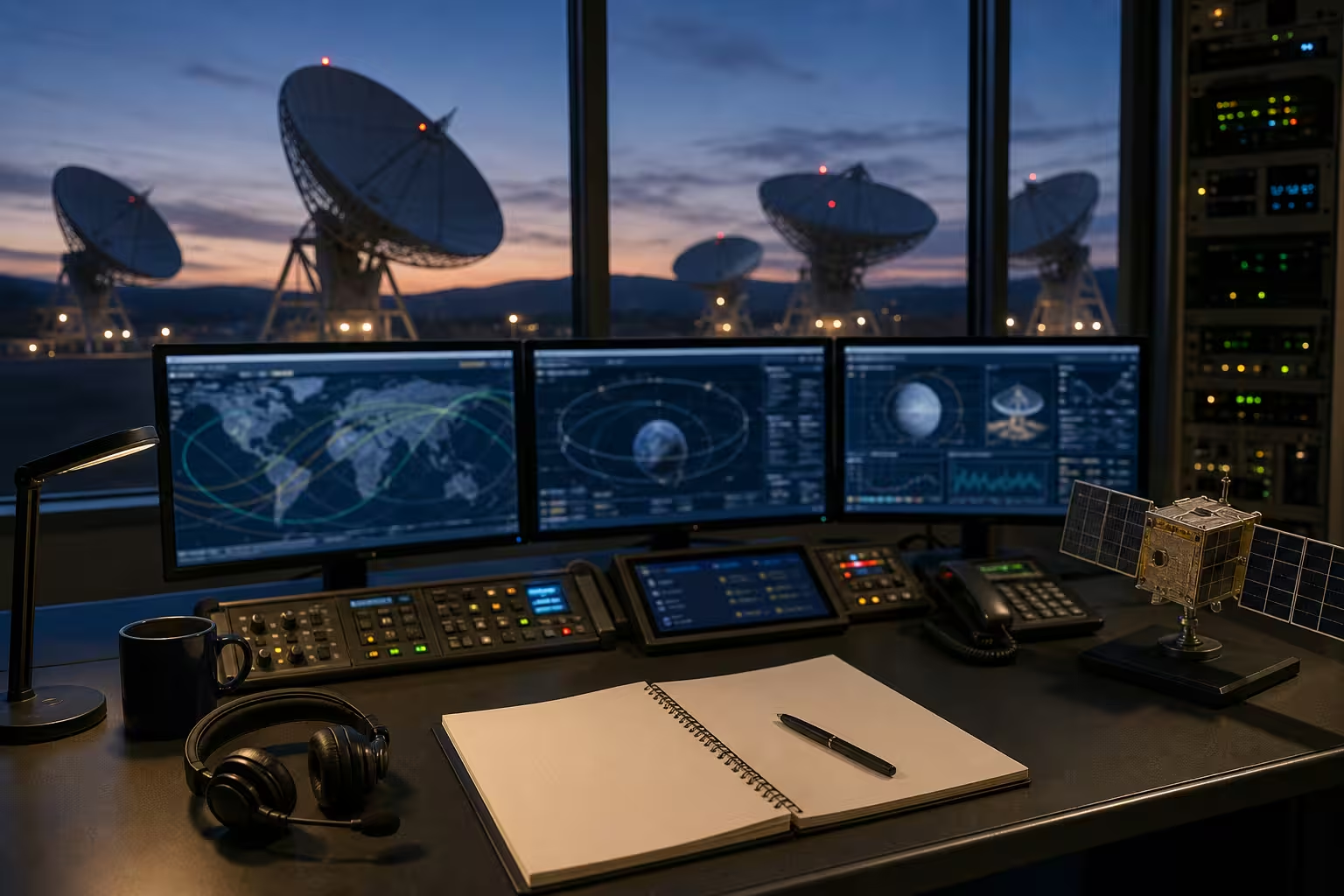
Every satellite story eventually comes back to the ground. A spacecraft may be built for orbit, but its work has to be commanded, monitored, timed, received, processed, secured, and delivered to someone on Earth. That earthside system is called the ground segment, and the most visible part of it is the ground station: antennas, radios, networks, control rooms, software, schedules, and people or automated systems that keep contact with machines moving overhead.
Rockets get the drama. Satellites get the beautiful renderings. Ground stations get the responsibility of making space useful after launch.
The satellite is only half the link
A satellite without a ground connection is a very expensive object having a private experience. It can sense, compute, store, relay, or navigate, but value appears when information crosses the link between orbit and Earth.

For an Earth observation satellite, the link may carry images, radar data, weather measurements, or instrument health reports. For a communications satellite, the ground station may connect space traffic to the internet or telephone network. For a navigation satellite, ground systems monitor timing and orbit so users can trust the signal. For a scientific mission, a dish may receive faint data from far away and send carefully timed commands back.
The link is not always continuous. A low-Earth orbit satellite moves quickly across the sky. A single ground station may see it for only a short pass before it disappears below the horizon. During that window, the station may upload commands, download stored data, check health, and hand off responsibility to another station. A satellite network may rely on many ground sites spread across geography so contact opportunities are frequent enough.
Geostationary satellites are different because they appear fixed relative to the ground, but they still need ground infrastructure. The shape of the orbit changes the ground problem. It does not remove it.
A dish is a timing machine
To a passerby, a ground station may look like a collection of dishes. To an operator, each antenna is part of a timing system.
The station needs to know where the satellite will be, when it will rise, how fast it will move across the sky, which frequency to use, what data rate is possible, what weather may interfere, and what other satellites or users are competing for time. The antenna points. The radio locks. The software confirms identity. The pass begins. Minutes matter.
A missed contact can be harmless if the satellite has storage and another pass coming soon. It can be serious if the spacecraft needs urgent commands, if data must arrive quickly, or if a maneuver depends on precise timing. Mission operations is often less romantic than the public imagines. It is scheduling, monitoring, checking, and not making mistakes.
This is why ground stations are not just dishes in fields. They are part of an operations culture. Procedures matter. Redundancy matters. Logging matters. Cybersecurity matters. Weather reports matter. A loose cable, software error, spectrum conflict, or missed schedule can become a space problem without ever leaving Earth.
Data has to come down before it can matter
Earth observation is a good example of why ground stations matter. A satellite may capture an image of wildfire smoke, crop stress, flood extent, sea ice, or storm structure. But the image is not useful simply because the sensor saw it. The data has to come down, be processed, corrected, analyzed, packaged, and delivered to people or systems that can act on it.
Latency is the time between observation and use. For some applications, a delay of hours is acceptable. For others, minutes matter. Disaster response, maritime monitoring, weather forecasting, military awareness, financial signals, and emergency communications can all care deeply about how quickly data moves from orbit to decision.
Ground stations are one lever in that latency. More stations, better geography, inter-satellite links, cloud-connected ground networks, and smarter onboard processing can all reduce delays. But each choice has cost, complexity, and governance implications. A satellite constellation is not only a set of objects in orbit. It is a data logistics system.
That logistics system has to be built on Earth.
Geography still matters in space
It is tempting to think satellites make geography irrelevant. In reality, ground station geography is a major design constraint.
A station near the poles can see many passes from satellites in polar orbits because those satellites pass near the poles on each lap. A station near the equator may serve different orbital needs. A site with clear skies may be better for optical links. A politically stable location with strong fiber connectivity may be valuable for commercial networks. A site with low radio interference can be more useful than one in a noisy environment. Local regulation, land access, weather, power, security, and network backhaul all shape the map.
This means the ground segment has its own geopolitics. Where data lands can affect who controls it, who can interrupt it, which laws apply, and how resilient the system is during conflict or disaster. A satellite network may be global in ambition, but its ground infrastructure sits in particular jurisdictions, on particular land, connected to particular terrestrial networks.
Space is not separate from Earth. It is entangled with Earth through antennas, cables, permits, power, and trust.
Spectrum is invisible infrastructure
Ground stations also depend on spectrum, the range of radio frequencies used to communicate. Spectrum is invisible, but it is not infinite. Different services need different bands. Signals can interfere. Regulators coordinate use. Operators have to follow licenses and technical rules. As satellite constellations grow, spectrum coordination becomes more important, not less.
A beautiful satellite is useless if it cannot communicate reliably. A powerful transmitter can become a problem if it interferes with others. A ground station has to be engineered not only for its own link, but for the crowded radio environment around it.
This is one reason space law and communications policy are part of space infrastructure. The physical dish and the legal permission belong together.
Security begins on the ground
Cybersecurity in space often sounds exotic, but many risks begin with ordinary ground systems. Commands are generated on Earth. Software is updated from Earth. Data flows through terrestrial networks. Operators use accounts, terminals, cloud systems, and procedures. If those systems are weak, the satellite may inherit the weakness.
Security is not only about preventing someone from taking over a spacecraft. It is also about protecting data integrity, controlling access, verifying commands, monitoring anomalies, and making sure a compromised office laptop does not become a mission risk. Ground infrastructure needs the same seriousness as the spacecraft because it is part of the spacecraft’s nervous system.
The more commercial and everyday space becomes, the more this matters. Satellite internet, Earth observation, direct-to-phone service, navigation, agriculture, logistics, finance, disaster response, and climate monitoring all depend on trust in space-derived data and connections.
The ground segment is where space becomes service
Launch gets a satellite into position. The ground segment turns it into a service.
A customer does not buy an orbit. They buy internet on a ship, weather data for a forecast, imagery after a flood, timing for a network, connectivity in a remote area, or monitoring for a pipeline, farm, forest, or port. Behind that service is a chain: spacecraft, link, ground station, network, processing, interface, support, and accountability.
When people say space is becoming infrastructure, this is what they mean. Infrastructure is not only hardware in a dramatic place. It is the hidden continuity that lets other systems depend on it. Ground stations provide that continuity.
The next time a satellite story focuses only on the launch or the constellation, look for the earthside half. Ask where the data lands, how often contact happens, how commands are protected, what latency the service needs, what spectrum it uses, and what happens when one ground site fails.
The sky may hold the satellite, but the service lives in the connection.


