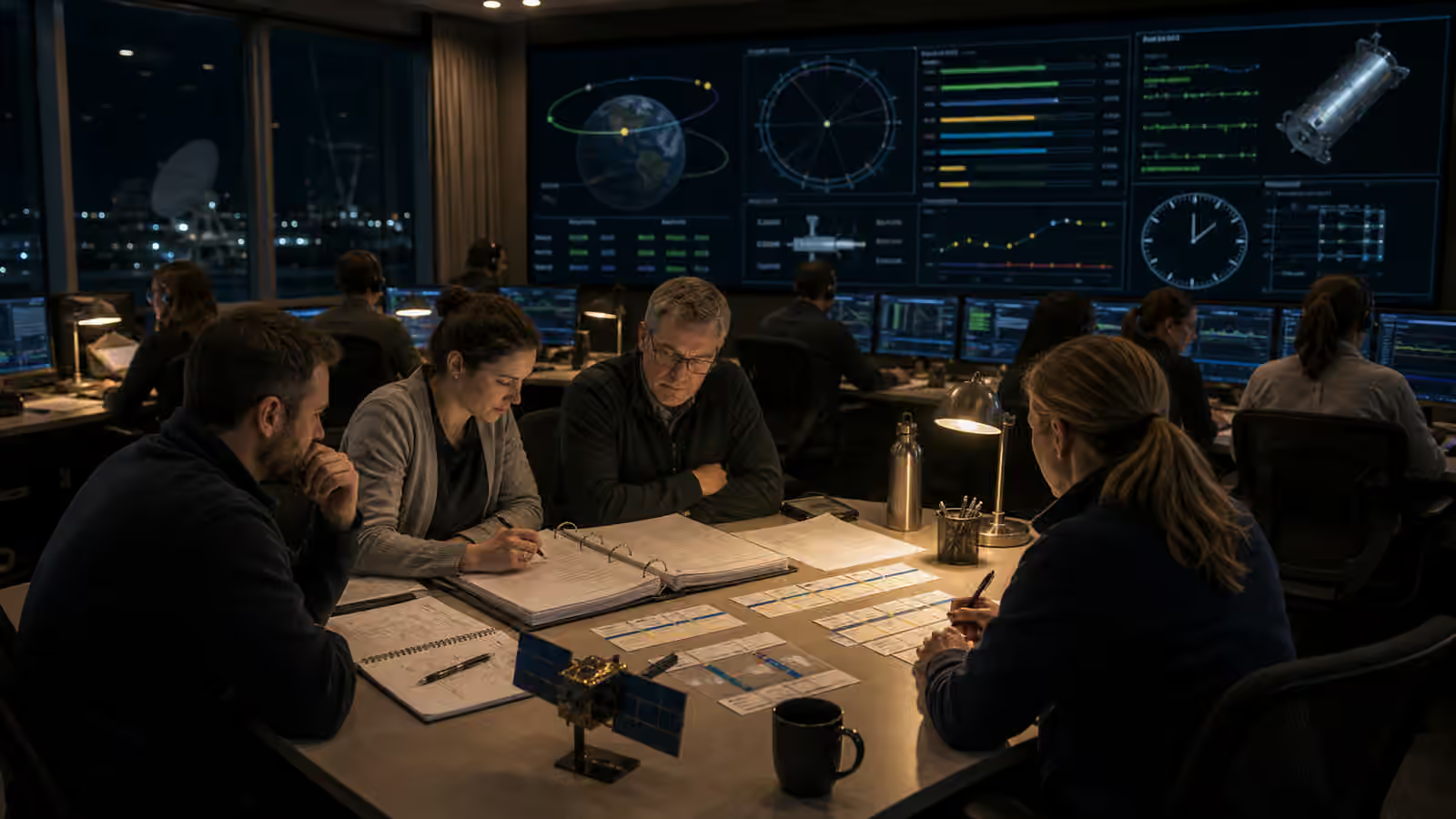
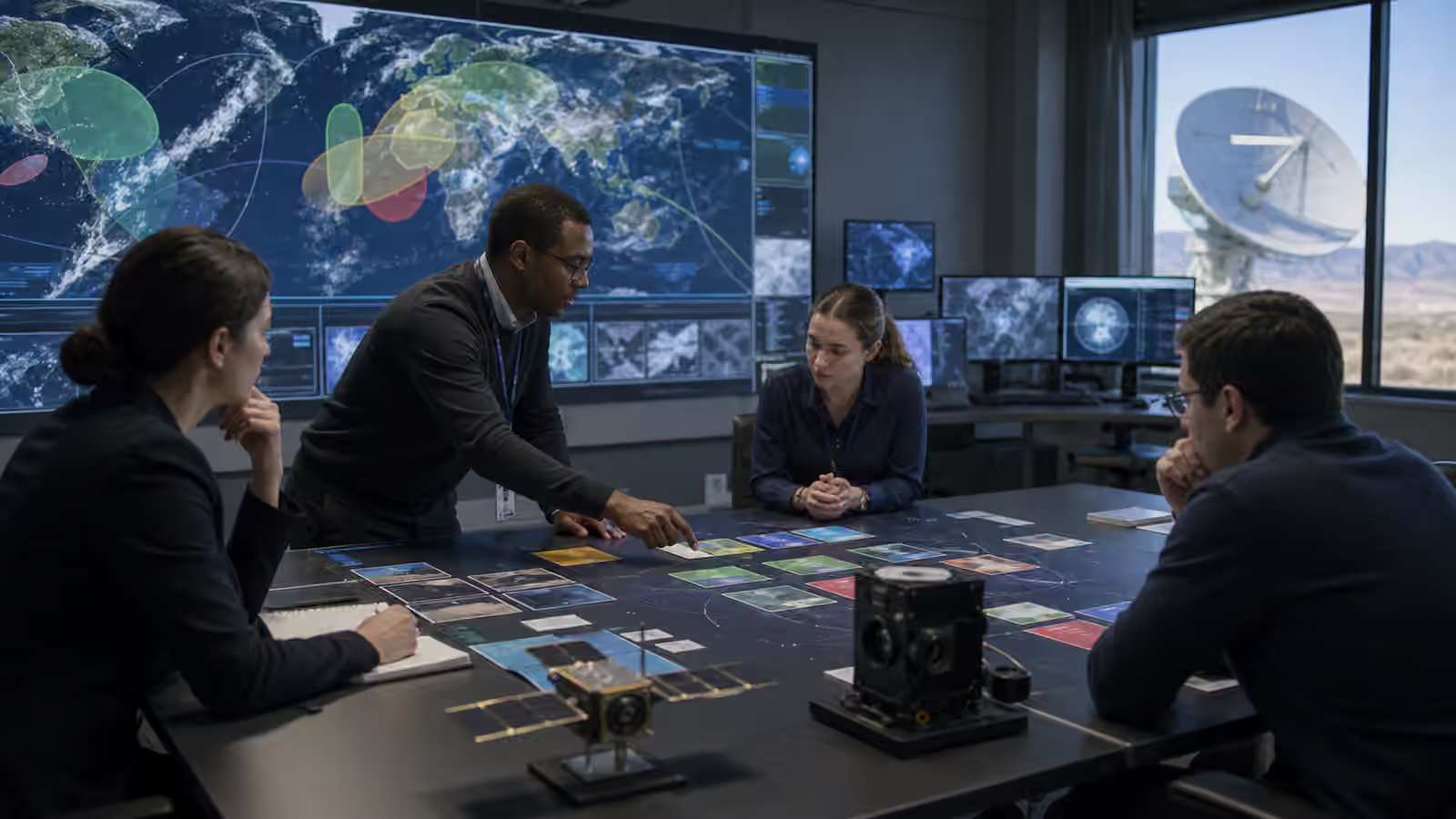
A satellite is not simply placed into orbit and then treated as if it were pinned to a perfect invisible rail. It is moving through a changing gravitational field, sunlight pressure, traces of atmosphere, thermal flexing, control-system limits, and the practical uncertainty of measurement. The spacecraft may be healthy, powered, and communicating, but the mission still depends on a quieter question: where is it really, and where will it be when the next decision matters?
Flight dynamics is the discipline that keeps that question from remaining poetic. It turns tracking observations, spacecraft telemetry, force models, maneuver plans, and uncertainty into usable knowledge about motion. Orbital Regimes and Mission Design explains why different orbits create different mission behavior. Flight dynamics explains how a real spacecraft in one of those orbits is measured, predicted, corrected, and trusted over time.
Tracking Is Not the Same as Knowing
The first surprise is that a spacecraft’s location is usually an estimate rather than a perfect fact. Ground radars, optical telescopes, onboard navigation receivers, inter-satellite measurements, range and Doppler data, and ground-station contacts can all contribute pieces of the answer. Each measurement has limits. A radar may measure range and direction under certain viewing conditions. A radio link may reveal Doppler shift. A satellite with a navigation receiver may know a great deal about its own state in some orbits and much less in others. A ground station pass may be brief, noisy, or unavailable when the spacecraft is over the wrong horizon.
Those measurements do not arrive as a tidy label that says “the satellite is here.” They arrive with timing, geometry, calibration, and uncertainty attached. A point measured from one location may be weaker than a sequence of measurements from several places. A good observation can still be less useful if its timestamp is wrong, its reference frame is misunderstood, or the spacecraft performed a maneuver that the estimator did not expect.
This is why Ground Stations are part of the flight dynamics story. A station does not merely pass commands and data. It can also help locate the spacecraft through the behavior of the link itself. The earthside network becomes a measuring instrument, and its schedule can decide when fresh knowledge is available.
An Orbit Is a Prediction With a Memory
Orbit determination is the work of combining measurements with a model of motion. The model includes gravity, atmospheric drag for lower orbits, solar radiation pressure, planned maneuvers, and sometimes small effects that only matter because the mission needs precision. The output may be an ephemeris, a predicted path of where the spacecraft is expected to be at future times, along with an estimate of uncertainty around that path.
The memory matters because motion has history. If a satellite has been slowly dragged lower by the atmosphere, that trend changes the next prediction. If a reaction wheel desaturation used thrusters, that small impulse may shift the orbit. If solar activity heats the upper atmosphere, drag can become stronger than yesterday’s model expected. If the spacecraft’s shape or attitude changes, the way sunlight or drag pushes it can change too.
The phrase orbit determination can make the work sound finished once a calculation is complete. In practice, it is an ongoing conversation between prediction and observation. The team predicts where the spacecraft should be. New tracking data arrives. The difference between prediction and observation teaches the team something. The model is updated, the uncertainty narrows or widens, and the next prediction becomes more useful.
That loop is especially important for missions that need accurate pointing, timed contacts, close approaches, or repeat ground tracks. An Earth observation satellite must know where it was when an image was taken. A communications satellite must keep service geometry inside acceptable limits. A rendezvous vehicle must know relative motion with care. A spacecraft preparing for disposal must be predictable enough that its ending reduces risk rather than adding it.
Uncertainty Is Operational, Not Embarrassing
Good flight dynamics does not pretend uncertainty has vanished. It describes uncertainty well enough that operators can make disciplined decisions. A predicted location is useful only when the team also understands how much confidence belongs to it. A narrow uncertainty region can support precise pointing, a close approach decision, or a carefully timed burn. A wider region may call for more tracking, conservative operations, or a delay.
This is one reason conjunction assessment is not as simple as asking whether two objects will collide. Space is large, but objects move fast, tracking is imperfect, and many cataloged objects have uncertain paths. A warning may show a close approach with a probability attached, yet that probability depends on the quality of both orbit estimates. Better tracking can sometimes reduce concern without a maneuver. In other cases, a small maneuver is the prudent choice because uncertainty and consequence combine badly.
Space Debris and Orbital Traffic describes the shared orbital neighborhood. Flight dynamics is one of the ways that neighborhood becomes manageable. It turns a vague warning into a sequence of questions. How reliable is the tracking? How close is the predicted approach? Can the spacecraft maneuver safely? What service interruption would the maneuver cause? Will the maneuver create new geometry problems later? Is there enough time to plan, command, execute, and confirm the result?
The answer is rarely a single dramatic calculation. It is a chain of evidence and judgment.
Maneuvers Begin Before Any Thruster Fires
A spacecraft maneuver is a physical event, but flight dynamics begins it long before propellant moves. The team has to decide what change is needed, how large it should be, when it should occur, which direction the spacecraft must point, how much propellant or power it will cost, and what the orbit should look like afterward. Then operators need commands that the spacecraft can execute within power, thermal, communications, and attitude constraints.
Satellite Propulsion and Stationkeeping explains why small burns can preserve service, manage drag, avoid conjunctions, maintain slots, and support final disposal. Flight dynamics gives those burns their timing and geometry. A burn that is correct in size but wrong in direction can waste margin. A burn executed at the wrong time can miss the desired orbit. A burn that is planned without enough tracking afterward may leave the team less certain than expected.
Post-maneuver orbit determination is therefore part of the maneuver. The mission does not simply trust that the spacecraft did exactly what was commanded. It measures the result. Thrusters have performance variation. Attitude can differ slightly. Timing can shift. A valve, plume interaction, or calibration assumption may leave a small difference between planned and achieved motion. That difference is not only a bookkeeping problem. It may affect the next contact, the next image, the next collision assessment, or the fuel budget remaining for the end of life.
For low-thrust systems, the problem becomes even more gradual. Electric propulsion can change an orbit over days or weeks, so the boundary between ordinary operations and maneuvering is less sharp. The spacecraft may be thrusting, coasting, communicating, charging batteries, and staying thermally safe while the target orbit slowly approaches. Flight dynamics has to keep the long arc honest.
Timing Connects the Sky to the Ground
Flight dynamics also shapes the daily schedule. A ground station cannot contact a low-orbit satellite whenever it wants. It needs to know when the spacecraft will rise, where the antenna should point, how long the pass will last, and whether the geometry supports the desired data rate. If the orbit estimate is stale, a station can lose time acquiring the signal or miss a contact entirely.
The same timing affects payload work. An imaging satellite may need to point at a target at a specific moment, with the right lighting, angle, and ground track. A communications constellation may need handovers to occur cleanly as satellites move relative to users and gateways. A space weather mission may need its measurements connected to position and time so the data can be interpreted. Satellite Data Pipelines depend on this context. A measurement without trustworthy position and time is weaker evidence.
Launch Windows and Mission Timing shows how timing begins at the pad. Flight dynamics carries that timing discipline through the rest of the mission. The launch moment sets the initial geometry, but every later prediction, burn, contact, and operational plan keeps refining the relationship between clock and orbit.
Constellations Turn Motion Into a Fleet Problem
A single satellite needs a good orbit estimate. A constellation needs many good estimates that make sense together. Satellites may need to keep spacing within orbital planes, maintain coverage patterns, avoid crowding during orbit raising, hand off users, route data through inter-satellite links, and retire in a way that does not disturb the rest of the system. A small drift in one spacecraft can be routine. The same drift across many spacecraft can become service degradation or traffic risk.
Satellite Constellation Design explains fleet geometry as an architectural choice. Flight dynamics makes the geometry operational. It watches how atmospheric drag, solar activity, maneuvers, failures, launch injection errors, and replenishment affect the pattern. It helps decide when one spacecraft should correct itself, when a spare should move, and when service can tolerate a gap.
Large fleets also make coordination more important. Operators need dependable ephemerides for their own planning and often need to share information with others. A spacecraft that can maneuver but does not communicate its plan clearly may increase uncertainty for neighbors. Responsible operations includes making motion understandable, not only making motion possible.
The Best Calculations Leave a Trail
Flight dynamics work should leave evidence behind. Which observations were used? Which force model was applied? Which maneuver was assumed? Which tracking data was rejected and why? Which ephemeris was delivered to operations? What uncertainty remained when a conjunction decision was made? These records can look dry until an anomaly occurs or a later team needs to understand why a spacecraft behaved the way it did.
This connects directly to Satellite Operations After Launch . Operators do not need a mystical sense of where the spacecraft is. They need a disciplined process that keeps predictions, commands, telemetry, and evidence aligned. When the process works, ground stations point smoothly, maneuvers are measured, collision warnings are handled with context, and payload data arrives with trustworthy location and time.
Flight dynamics is easy to overlook because it rarely appears in launch footage. It does not have the visual drama of ignition or deployment. Yet it is one of the reasons space can become infrastructure instead of spectacle. Infrastructure needs repeatable knowledge. It needs to know where assets are, when they will be useful, how they will move, and how uncertain the answer remains.
An orbit is motion under constraint. Flight dynamics is the practice of making that motion knowable enough to operate.