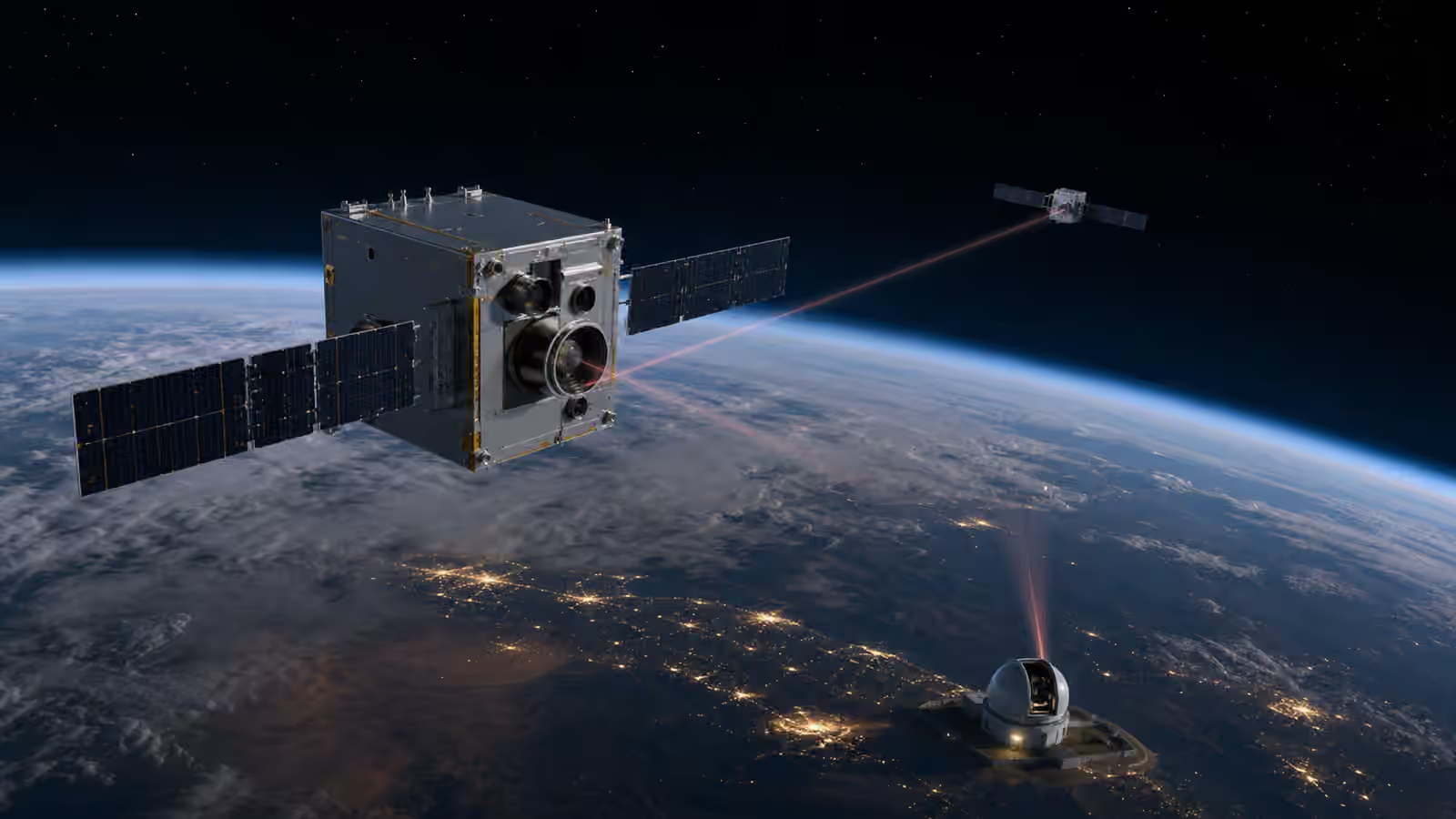
Deep-space communication is the art of keeping a conversation alive after distance has made every easy habit fail. Near Earth, a satellite may pass over ground stations several times a day, use familiar timing, and recover quickly from a missed contact. Beyond the Moon, signals weaken dramatically, round-trip delay becomes part of operations, and a single ground contact can be a scarce mission resource. The spacecraft may be healthy, but the link can still be fragile because space is quiet in the most demanding way.
Cislunar Communications and Navigation explains the network problem between Earth and the Moon. Deep-space communications extend that problem into a larger, slower, fainter domain. The central question is no longer only whether a mission can talk through changing geometry. It is how to preserve trust when the spacecraft is far enough away that commands, telemetry, tracking, and science data all move through a narrow scheduling window.
Weak signals shape everything
A radio signal spreads as it travels. By the time a spacecraft signal reaches Earth from interplanetary distance, it can be extraordinarily faint. The receiving antenna has to collect as much energy as practical, the electronics have to add as little noise as possible, and the signal processing has to distinguish the spacecraft from the background. This is why deep-space antennas are large, carefully located, and treated as shared infrastructure rather than ordinary dishes.
The spacecraft has the same problem in reverse. It has limited power, limited antenna size, and other duties competing for energy. Deep-Space Power Systems explains why far missions cannot treat communications as a casual load. Transmitting data may mean choosing a power mode, pointing a high-gain antenna, warming equipment, pausing another activity, or waiting for geometry that makes the link more efficient.
Data rate is a consequence of that link budget. A mission may collect beautiful science faster than it can send it home. Operators then have to decide what to compress, what to prioritize, what to store, what to repeat, and what can wait. A deep-space network is not only a pipe. It is a discipline for deciding which bits matter when every bit is expensive.
Big antennas are shared instruments
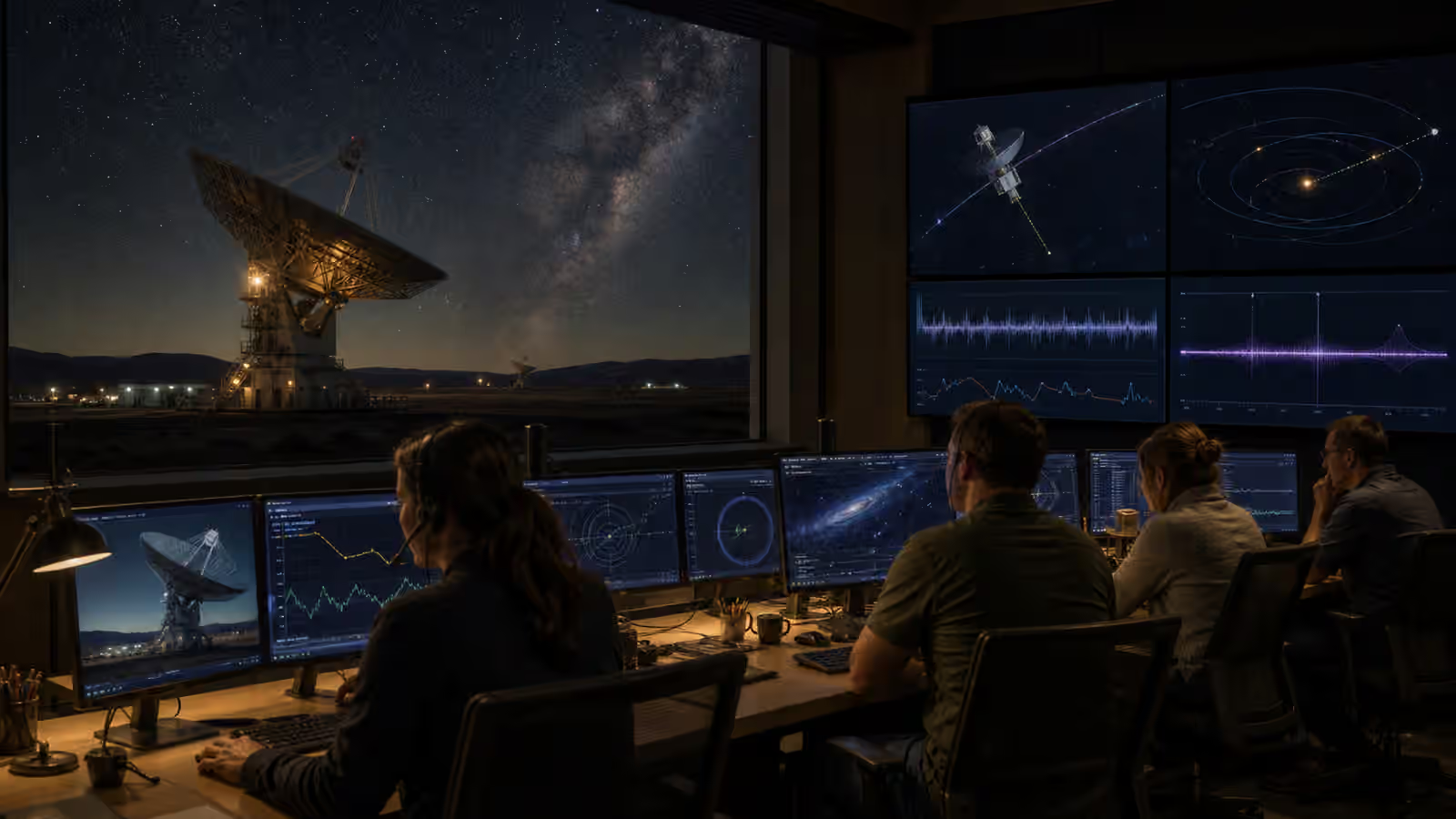
Deep-space ground networks usually rely on large antennas distributed around Earth so that at least one site can see a spacecraft as the planet rotates. A single site cannot watch the whole sky continuously. Weather, maintenance, local interference, geography, and Earth rotation all matter. The network turns several antennas into a relay of attention.
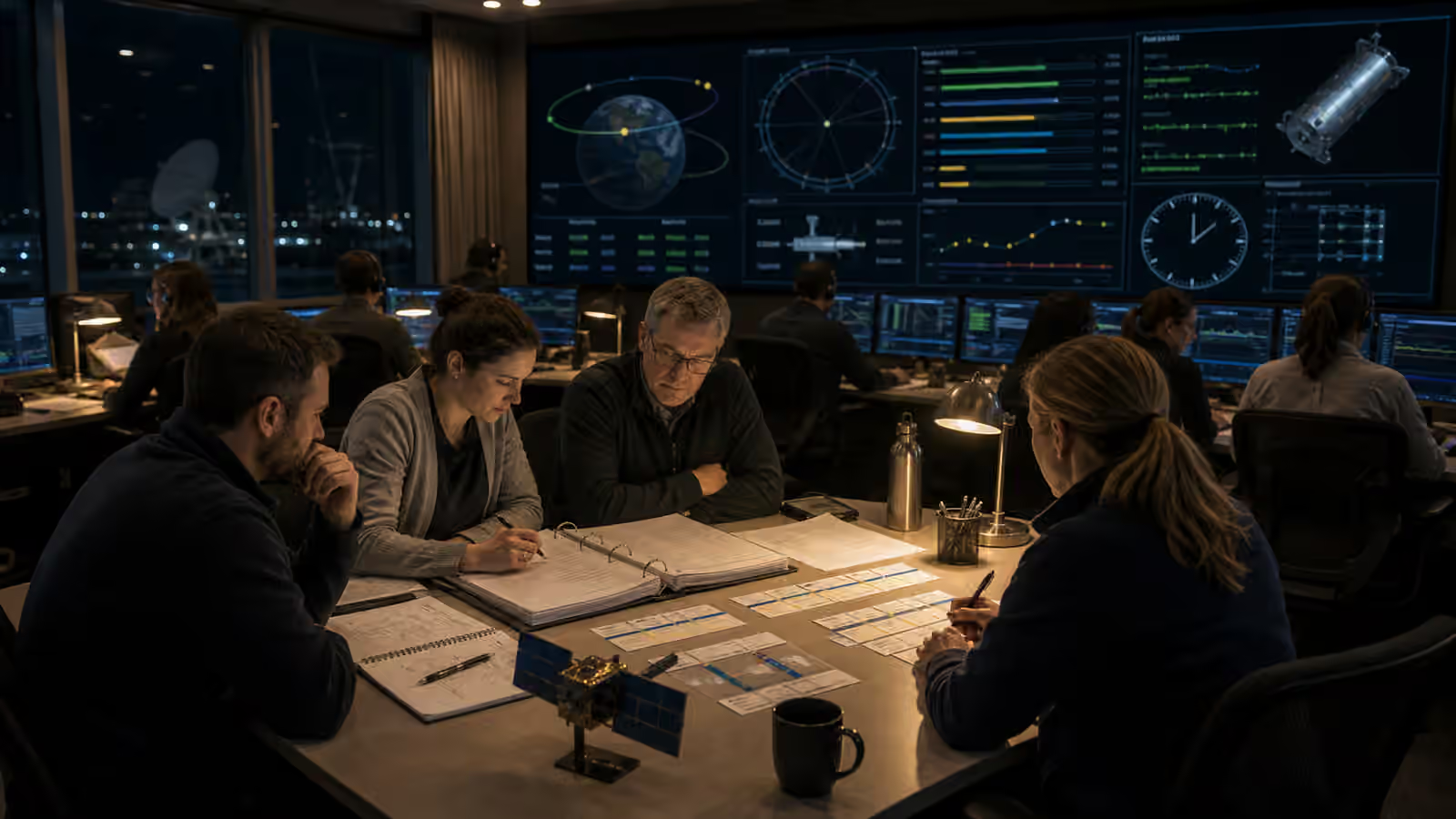
This attention is scheduled. A Mars orbiter, an outer-planet probe, a solar mission, a lunar spacecraft, and a newly launched interplanetary vehicle may all need contact. The antenna time has to be allocated, sometimes months in advance and sometimes under anomaly pressure. A routine tracking pass can become a higher priority if a spacecraft enters safe mode. A science downlink can be delayed if another mission needs urgent commanding. This is a traffic problem, but the traffic is measured in antenna hours, spacecraft geometry, and mission risk.
Ground Stations describes the earthside half of satellite infrastructure. Deep-space antennas are the more extreme version of that idea. They do not simply receive data. They support navigation, command delivery, telemetry collection, radio science, ranging, and sometimes emergency recovery. The dish is a scientific and operational instrument at the same time.
Delay changes command behavior
Delay is one of the most important differences between near-Earth operations and deep-space operations. A command sent to a distant spacecraft may take minutes or hours to arrive, depending on where the mission is. The response then takes the same kind of time to return. Operators cannot treat the spacecraft like a remote machine being driven in real time. They have to prepare sequences, check them carefully, and trust the spacecraft to execute within defined limits.
This makes Spacecraft Command, Telemetry, and Tracking feel different. A command is not a quick exchange. It is an instruction released into delay. The team must know the spacecraft state at the time the command will arrive, not merely the state shown in the last telemetry display. If the spacecraft is rotating, warming, cooling, charging, or moving through a planned event, old information can be misleading.
Autonomy becomes more important as delay grows. Satellite Fault Protection and Autonomy explains how spacecraft keep small problems from becoming mission-ending. In deep space, safe modes and onboard rules are not conveniences. They are the first responders. The spacecraft has to protect power, attitude, thermal state, and communication orientation before Earth can understand what happened.
Pointing is part of the conversation
A deep-space spacecraft often uses a high-gain antenna to send data home. That antenna may need to be pointed toward Earth with care. Pointing the antenna can conflict with pointing instruments, solar arrays, radiators, or propulsion systems. A mission may have to choose between collecting data and sending data, or between a thermal attitude and a communication attitude. The link is therefore not only a communications question. It is a spacecraft operations question.
Tracking data also helps determine where the spacecraft is. Radio signals can reveal range and velocity through timing and Doppler measurements. Those measurements feed navigation, maneuver planning, and future contact predictions. Flight Dynamics and Orbit Determination is usually discussed for satellites near Earth, but the habit of turning observations into a trusted trajectory becomes even more important far away. If the predicted position drifts too much, the antenna may look in the wrong place, and the next contact becomes harder.
The mission also has to know where Earth is in its own sky. That sounds obvious until a spacecraft is tumbling, recovering from an anomaly, or operating with limited sensors. Communication can depend on star trackers, Sun sensors, gyros, safe attitude rules, and antenna search patterns. A signal is never just a signal. It is evidence that the spacecraft still knows how to orient itself.
Science data competes with health data
Deep-space missions often carry instruments that produce valuable data in short windows. A flyby, orbit insertion, landing attempt, atmospheric pass, or plume crossing may generate more data than the spacecraft can transmit immediately. The onboard recorder becomes a mission vault. Satellite Onboard Computers and Data Handling explains storage and priority in Earth orbit. Deep-space missions make the stakes sharper because replacement opportunities may not exist.
Health telemetry competes with science data for link time. Engineers need temperatures, voltages, currents, fault logs, pointing data, memory status, propulsion readings, and event records. Scientists want images, spectra, particle counts, fields, or other measurements. A well-run mission does not treat these as enemies. It builds a priority structure that preserves enough engineering evidence to keep the spacecraft alive while returning the data that justified the journey.
Compression, packetization, error correction, and retransmission policies matter. A corrupted image is disappointing. A missing engineering log during an anomaly can be worse. The communications plan must decide how much protection each data type deserves. That decision is partly technical and partly mission judgment.
Redundancy is broader than backup hardware
Deep-space communications need redundancy, but redundancy is not only a second transmitter or another antenna. It can include multiple ground sites, different frequencies, lower-rate emergency modes, stored command sequences, autonomous fault responses, alternative pointing strategies, extra power margin, and procedures that let operators recover a spacecraft with limited information. A mission that can only communicate in its best mode is brittle.
Mission Simulation and Digital Twins fits naturally here. Operators rehearse missed contacts, low-power states, antenna mispointing, bad ephemerides, corrupted sequences, and slow anomaly recovery because they cannot count on improvisation during delay. The rehearsal does not remove surprise. It gives the team a practiced way to think when telemetry arrives late and incomplete.
The value of a patient network
Deep-space communication is easy to admire for its scale, but its real value is patience. The ground network listens carefully for faint evidence. The spacecraft stores data until the path home opens. The operations team sends commands that may not be confirmed for a long time. The navigation team turns small frequency shifts into trajectory knowledge. The science team waits for measurements gathered far beyond ordinary reach.
Space infrastructure near Earth often tries to disappear into daily service. Deep-space infrastructure is different. It reminds us that spaceflight can also be a long correspondence with a machine we built and then sent beyond quick help. The network is the thread that keeps that machine inside human care. Without it, a probe is only hardware moving silently through the solar system. With it, distance becomes difficult, but not mute.