The space between Earth and the Moon can look empty in illustrations, but for missions it is full of questions. Where is the spacecraft, exactly? Can it hear Earth? Can Earth hear it? Is the antenna pointed correctly? How long will the signal take to arrive? What happens when the Moon blocks line of sight? How does a rover know where it is when there is no familiar blue dot service overhead?
Cislunar communications and navigation are the network layer for activity around the Moon. Lunar Infrastructure explains power, dust, landing pads, habitats, cargo, rovers, and local logistics. None of that becomes dependable without links that carry commands, telemetry, science data, positioning, timing, and warnings through a geometry that keeps changing.
Distance Changes the Feel of Operations
Low-Earth orbit operations can already be difficult, but the Moon adds distance in a way operators feel immediately. Radio signals travel at the speed of light, which is fast but not instant. A command sent from Earth takes a little over a second to reach the Moon, and a response takes a little over a second to come back. That round-trip delay is not extreme compared with Mars, but it is enough to change how teams think about driving rovers, landing spacecraft, handling emergencies, and closing control loops.
The delay is only part of the problem. Signals weaken with distance. Antennas need to point more carefully. Data rates may be limited by power, antenna size, frequency, ground-station availability, and spacecraft orientation. A lander on the surface may have a small antenna and strict power limits. A rover may be blocked by terrain. A spacecraft behind the Moon may have no direct view of Earth at all.
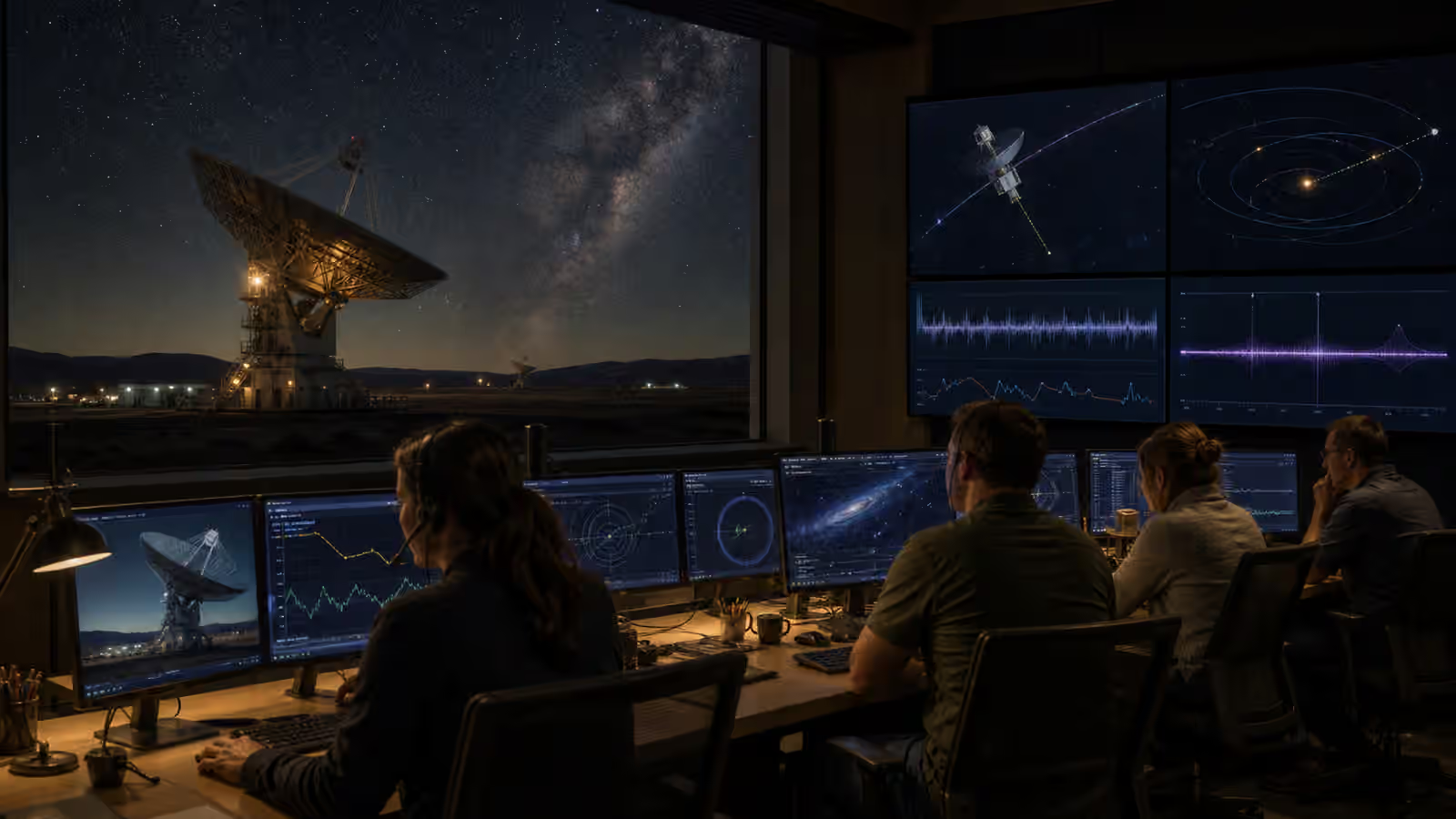
Ground Stations describes the earthside half of space infrastructure. In cislunar space, that earthside half often needs large dishes, precise timing, careful scheduling, and coordination among missions. The Moon may be nearby by astronomical standards, but it is far enough that communications becomes a scarce operational resource.
Line of Sight Is a Design Constraint
Radio links usually need geometry that allows the transmitter and receiver to see each other, or at least a relay that can bridge the gap. A spacecraft on the near side of the Moon may talk directly to Earth when its antenna, power, and schedule allow. A lander near the lunar south pole may have partial Earth visibility depending on terrain, local horizon, and site geometry. A spacecraft on the far side cannot talk directly through the Moon.
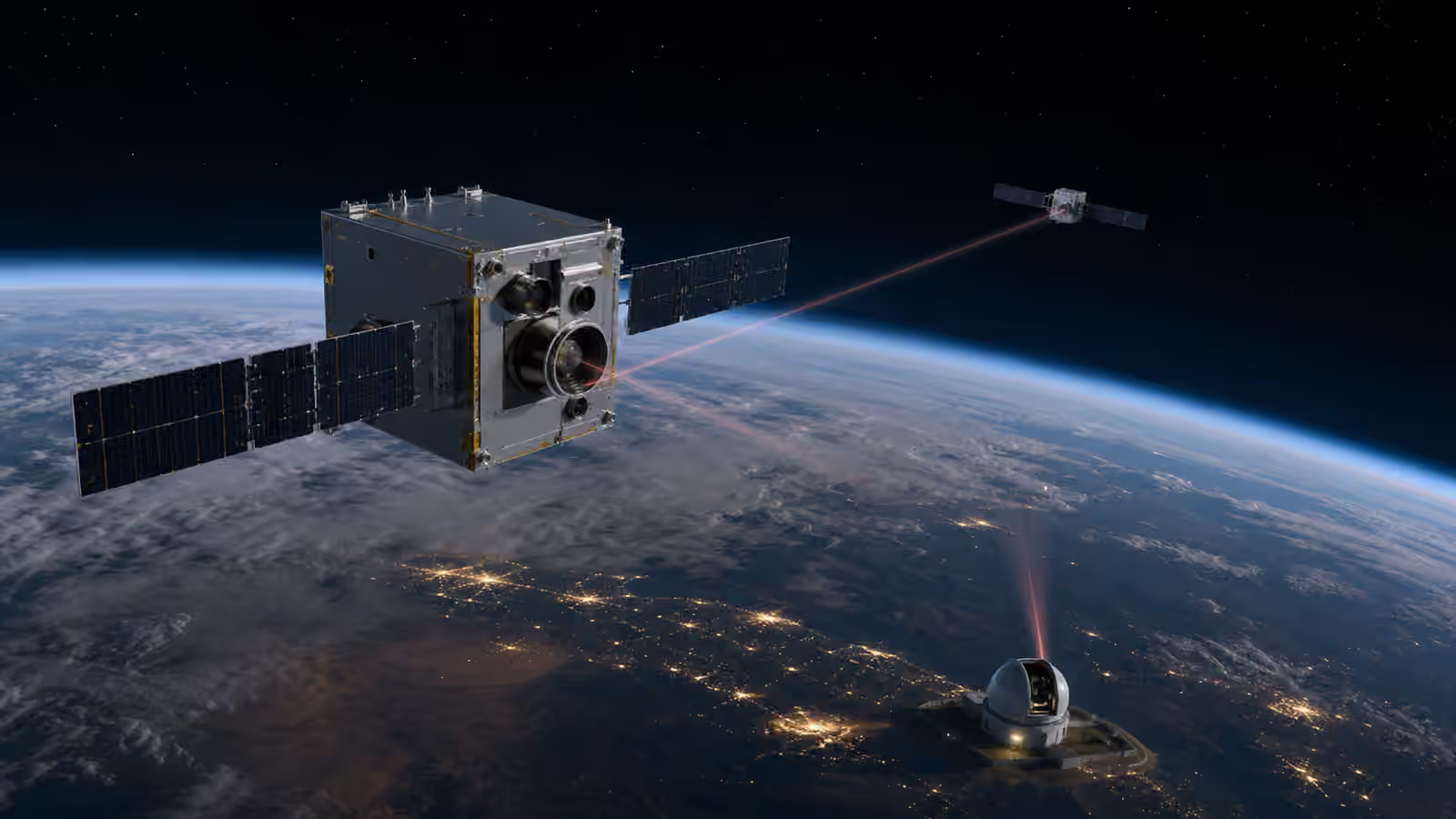
This is why relay satellites become important. A relay in lunar orbit or a related cislunar orbit can receive data from a surface asset or spacecraft and forward it to Earth when the geometry works. It can also carry commands from Earth back to the mission. Relays turn isolated missions into networked missions, especially for far-side science, polar exploration, surface mobility, and operations where terrain blocks direct links.
Relay design is not just a matter of placing one satellite somewhere near the Moon. The orbit must provide useful coverage, manageable stationkeeping, acceptable communication angles, power stability, thermal conditions, and contact opportunities with Earth. A relay that sees the rover but rarely sees Earth may not solve the full problem. A relay that sees Earth but has poor surface coverage may leave users waiting.
Navigation Is More Than Knowing a Position
On Earth, many people experience satellite navigation as a map dot. In space operations, navigation is a chain of measurements, timing, models, and decisions. A cislunar spacecraft needs to know its trajectory well enough to perform burns, enter orbit, avoid hazards, point antennas, and arrive at a landing corridor if that is the mission. A surface rover needs enough position knowledge to plan routes, return to a lander, meet a depot, or align an antenna.
Traditional tracking can use radio measurements from Earth, such as range and Doppler, to estimate a spacecraft’s path. Optical navigation can use images of Earth, the Moon, stars, landmarks, or other bodies. Inertial sensors help between external measurements. Future cislunar systems may use navigation beacons, relay-based timing signals, crosslinks, or local reference networks to improve autonomy and reduce dependence on constant Earth support.
Satellite Navigation and Timing explains how positioning, navigation, and timing support life on Earth. The cislunar version is less mature and more mission-specific, but the principle is similar: useful infrastructure needs trusted time and location. A surface operation that cannot locate assets reliably wastes energy, time, and safety margin. A spacecraft that cannot estimate its trajectory accurately spends more propellant correcting uncertainty.
Timing Holds the Network Together
Communication networks depend on time even when users do not notice it. Signals need synchronization. Data packets need ordering. Navigation measurements depend on clocks. A relay network needs to know when a spacecraft is expected, when antennas should point, when a handover should happen, and when a command is valid.
The Moon complicates timekeeping because missions may involve Earth-based clocks, spacecraft clocks, surface clocks, relay clocks, and operational schedules tied to sunlight, thermal conditions, and power. A lunar night, a polar shadow, an eclipse, or a terrain-blocked pass can shape the calendar. Time is not only a number in a computer. It is how the system decides when to listen, when to transmit, when to sleep, and when to act.
Good timing also protects safety. Commands should not be executed out of sequence because a delayed packet arrived late. A rover should not assume a stale navigation solution is fresh. A relay should not point away during a planned critical event. As the number of cislunar missions grows, shared timing standards and clear coordination will matter more.
Surface Networks Have Local Problems
Lunar surface communication is not simply deep-space communication with dust on it. The surface has terrain, shadows, temperature extremes, abrasive dust, limited power, and moving assets. A lander may serve as a local hub for rovers, instruments, suits, cameras, and experiments. Those local links may use different frequencies, antenna types, and power levels than the Earth link.
A rover behind a ridge may lose direct contact with its lander. A habitat may need local wireless coverage but also shielded or wired links for critical systems. A science instrument may need to wake only during certain power conditions. A landing plume may coat surfaces and change antenna performance. Equipment has to survive thermal cycles and dust without easy repair.
This is where communications connects back to physical infrastructure. A landing pad can reduce dust. A power system can keep radios warm. A mast can improve line of sight. A relay can remove the need for every asset to carry a large Earth-pointing antenna. A network is not separate from the base. It is one of the base’s utilities.
Bandwidth Shapes What Missions Can Promise
A mission can only return what its links can carry. High-resolution imagery, radar data, video, scientific measurements, health telemetry, software updates, and operational logs all compete for bandwidth. If the link is narrow or intermittent, the mission must prioritize. Critical telemetry may outrank raw science data. A compressed preview may come down before a full data set. Commands may wait for a scheduled contact.
Satellite Data Pipelines describes how orbital measurements become trusted products. Around the Moon, the pipeline begins with scarce links and long operational chains. Data may move from rover to lander, lander to relay, relay to Earth station, Earth station to mission network, and then into processing and archives. Every handoff needs metadata, timing, error checking, and responsibility.
Bandwidth limits also influence instrument design. A camera that produces beautiful data may not be useful if it overwhelms storage and downlink. A surface mission may need onboard processing to select important observations. A relay network may make more ambitious science possible by giving missions a dependable path home.
The Network Will Need Governance
As more actors operate near the Moon, communication and navigation become shared concerns. Frequencies must be coordinated. Interference must be avoided. Relay services need access rules. Navigation references need trust. Surface assets need to know which signals are authoritative. Emergency or contingency support may require cooperation among missions that were not designed as one program.
Space Law and Orbital Governance covers the broader responsibility problem. Cislunar networking adds practical details. A relay satellite may serve several customers. A navigation beacon may affect landing safety. A spectrum conflict may harm a science mission. A failed relay may strand data at a bad moment. These are infrastructure questions, not only engineering puzzles.
The goal is not to make cislunar space feel like Earth orbit overnight. The geometry, distance, and environment are different. The goal is to build enough shared communication and navigation capability that missions do not each have to invent a fragile private network from scratch.
The Moon Needs an Earthside Memory
The Moon will not become useful because hardware lands there once. It becomes useful if missions can return, coordinate, learn, and build on what came before. Communications and navigation are how that memory forms. Telemetry shows what survived. Images show what changed. Timing records explain what happened first. Navigation traces reveal where assets moved. Commands and software updates let teams adapt.
Without a network, each mission is a lonely expedition. With a network, a lander can support a rover, a relay can support a far-side telescope, a surface beacon can support later arrivals, and a ground team can understand the state of a place it cannot touch. That is why cislunar communications and navigation deserve attention alongside rockets, habitats, and power systems.
The quiet promise is continuity. A signal path turns a machine on the Moon from a distant object into part of an operating system. The network does not make lunar work easy. It makes lunar work possible to repeat.