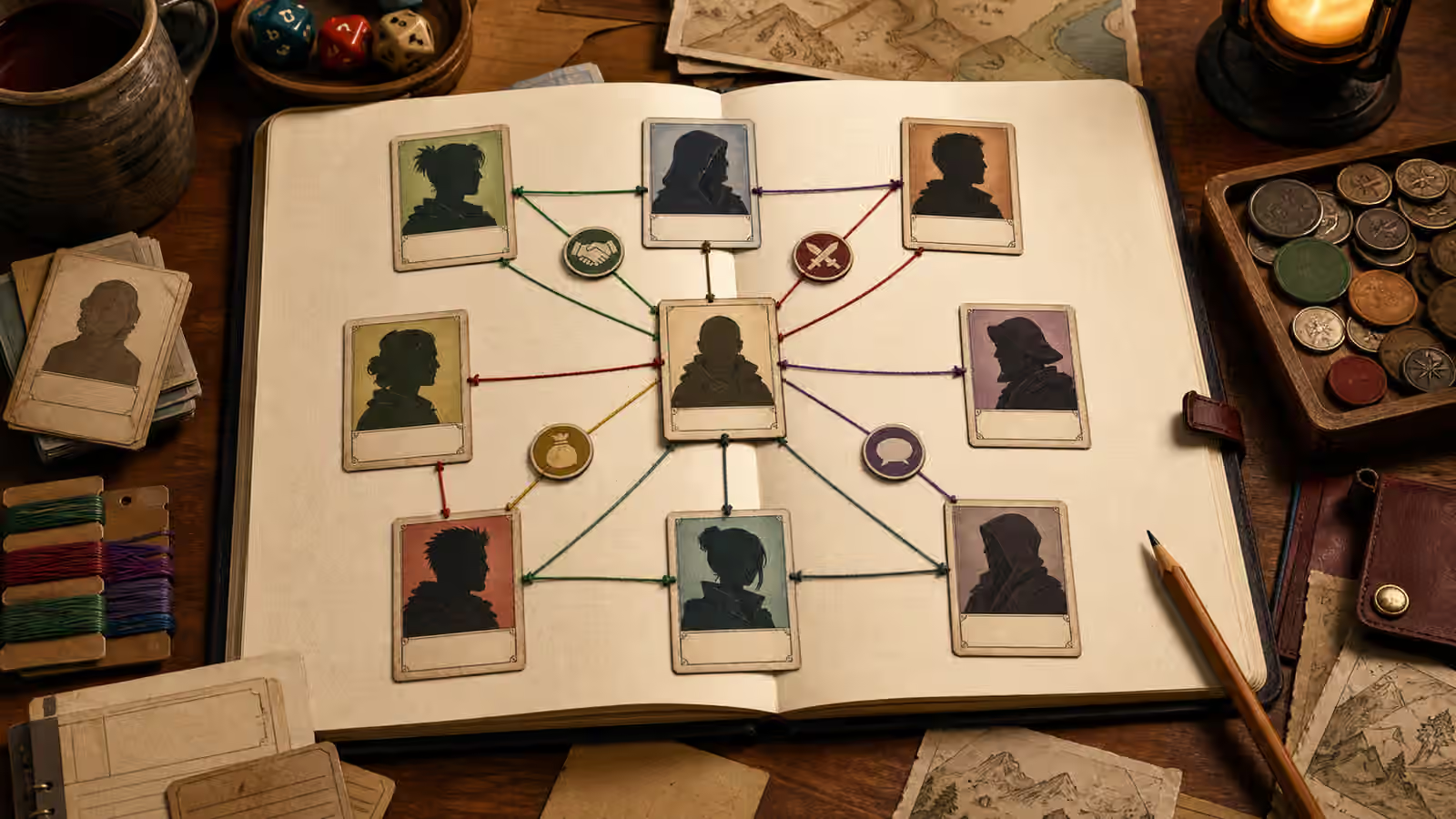
A map legend is a promise to future you. It says that a triangle means danger, a circle means rest, a star means clue, a slash means blocked path, and a dotted line means uncertain route. Without a legend, old maps become decorative confusion.
Solo maps have a special problem: nobody else is holding the continuity for you. If you return after three days, the pencil mark that felt obvious during play may have become a mystery. Was that dot a resource, a rumor, a waypoint, or a place you meant to revisit? A small legend keeps the map useful after the mood of the session has faded.
The point is not to make professional cartography. The point is to make a private retrieval system. A good symbol lets you glance at a messy page and know where danger is, where a route is blocked, what still needs investigation, and where play can begin again.
Start With Seven Symbols
Use one symbol each for danger, rest, clue, locked path, resource, rumor, and unresolved mystery. Keep them simple. Shape should carry meaning even if color is unavailable. For example, danger can be a triangle, rest a circle, clue a star, locked path a bar, resource a square, rumor a wavy line, and mystery a question mark shape without text.
Do not build a huge legend before play. Add symbols only when the map needs them.
Here is a practical starter legend:
| Meaning | Simple shape | When to mark it |
|---|---|---|
| Danger | Triangle | Threat, trap, unstable ground, hostile attention, unsafe route |
| Rest | Circle | Safe room, camp, inn, quiet corner, pause point |
| Clue | Star | Evidence, answer, pattern, map hint, witness detail |
| Locked path | Bar or slash | Door, bridge, route, rule, permission, missing tool |
| Resource | Square | Supplies, water, tool, ally, shelter, useful vantage |
| Rumor | Wavy line | Unverified story, overheard clue, local warning |
| Mystery | Question mark shape | Unanswered symbol, unexplored branch, strange event |
Those seven cover most solo maps. They work for dungeon rooms, hexcrawls, pointcrawls, town webs, mystery boards, and campaign notebooks. You can add more later, but the first job is consistency.
Avoid using too many meanings for one symbol. If a star sometimes means clue, sometimes treasure, and sometimes “cool thing,” future you will stop trusting the map. One symbol can have broad interpretation, but it should keep one job.
Give Each Symbol a Table Job
A symbol should do something at the table. It should not only decorate the map. Before adding a symbol, ask what decision it will help.
Danger symbols help you choose a route, prepare a tool, slow down, or avoid a place. Rest symbols help you pause, save state, recover, or start the next session. Clue symbols help you connect evidence. Locked-path symbols tell you what needs a key, favor, rule, route, or later return. Resource symbols remind you where help exists. Rumor symbols separate possibility from fact. Mystery symbols keep the campaign from forgetting its own open doors.
If a mark does not change recall or choice, write it as flavor instead of adding it to the legend. A map with fewer meaningful symbols is easier to use than a map covered in private icons you have to decode every time.
Pair Shape and Color
Color helps scanning, but color alone can fail under poor light or for color-blind readers. Pair color with shape, position, or texture. Use high contrast if you will return to the map later.
If drawing small symbols is hard, use stickers, stamps, tokens, or index-card markers.
Shape should carry the core meaning. Color can add urgency. A red triangle might be immediate danger, while an uncolored triangle might be known risk. A blue circle might be rest with water nearby, while a plain circle might simply be safe enough to pause. Use color as a second layer, not the only layer.
Position can add meaning too. A symbol above a route can describe travel pressure. A symbol inside a room can describe what is in the room. A symbol beside a page margin can mean “review later.” These conventions matter more than artistic skill.
If fine drawing is hard, choose symbols that tolerate rough marks. A triangle can be wobbly and still readable. A dot in a square can be a resource. A slash across a line can block a route. Stickers, tokens, paper clips, washi tape, stamps, or index cards can all serve as map symbols when drawing is not the best tool.
Test the legend in bad conditions: dim light, tired eyes, a smaller notebook, or after a break. If you cannot read it then, simplify it now.
Add Symbols Only After the Map Asks
The temptation is to build a perfect twenty-symbol legend before the first session. That feels productive, but it often creates clutter. Most solo maps need fewer marks than expected. Start small and let play reveal the missing categories.
Add a new symbol when the same kind of note appears three times. If you keep writing “needs rope,” “needs passphrase,” and “needs winter route,” maybe you need a “requires condition” mark. If you keep writing “heard from someone, not confirmed,” maybe rumor deserves its own symbol. If you keep writing “safe but temporary,” maybe rest needs a variant.
Use a simple promotion rule:
- First time: write the note in words.
- Second time: repeat the wording.
- Third time: create a symbol if it would save future effort.
This keeps the legend from becoming a private language before it has a job.
Keep a Legend Card
Do not trust memory alone. Put the current legend on an index card, notebook flap, inside cover, or front page. If the campaign has several maps, the legend card should travel with them. If a symbol changes meaning, update the card immediately.
For a tiny notebook, use one line per symbol:
| Symbol name | Private meaning |
|---|---|
| Triangle | Known danger or pressure |
| Circle | Safe pause or rest point |
| Star | Clue or evidence |
| Bar | Blocked until a condition changes |
| Square | Useful resource |
| Wave | Rumor or unverified lead |
| Question | Open mystery or unresolved branch |
You do not need to draw perfect sample symbols in public text. In your own notebook, draw the mark exactly as you use it. The legend card should match your hand, not an ideal icon set.
If you change notebooks or move from paper to digital notes, migrate the legend first. A map without its legend loses half its memory.
Use Symbols During Play, Not Only After
Symbols are strongest when they guide decisions during the session. Mark the map as soon as the meaning appears. Do not wait for a perfect recap. If a corridor becomes unsafe, mark danger now. If a route is blocked, mark it before you forget why you turned away. If a room becomes a rest point, circle it when you decide it is safe enough.
At the same time, avoid interrupting every scene for map polish. A rough mark now is better than a neat mark later that never happens. The legend should make play lighter, not turn the session into administration.
A useful rhythm is:
- During play: mark only the decision-critical symbols.
- At pause: clean up unclear marks.
- At session end: update the legend card and next-action cue.
This mirrors the advice in Campaign Notebook Setup : continuity should not depend on beautiful prose or perfect pages. It should depend on the few notes that make return easy.
Example: Dungeon Map Legend
For a solo dungeon, the legend should answer route and risk questions quickly.
| Mark type | Use it for |
|---|---|
| Danger | Trap, unstable ceiling, patrol route, noisy floor, hostile room |
| Locked path | Door, gate, collapsed tunnel, sealed stair, missing key |
| Clue | Mural, footprint, code, repeated symbol, overheard detail |
| Resource | Rope, dry torch, tool, hiding place, water, safe ledge |
| Rest | Barricaded room, quiet alcove, known exit, cleared campsite |
| Mystery | Unreadable mark, sound behind wall, impossible draft, missing route |
Do not mark every decorative feature. A cracked statue only needs a symbol if it gives a clue, hides a resource, blocks a route, or changes risk. Let prose handle mood. Let symbols handle decisions.
The expanded Dungeon Room Prompts guide uses the same idea: rooms need jobs. Symbols are a way to keep those jobs visible after the room description fades.
Example: Travel or Pointcrawl Legend
For travel maps, symbols should clarify routes rather than decorate geography.
Use danger for exposed ridges, storm paths, patrol roads, washed-out crossings, or places where supplies run low. Use resource for shelter, water, repair, trade, safe camp, or a reliable guide. Use rumor for unconfirmed shortcuts, local warnings, missing caravans, or advice from someone whose motives are unclear. Use mystery for landmarks that do not match the map.
Route marks matter as much as location marks. A dotted line can mean uncertain route. A double line can mean fast but exposed. A broken line can mean closed unless a condition changes. A small square beside a path can mean the route costs a resource.
Do not add a symbol for every hill, road bend, or weather note. Travel symbols should help you choose: take the safe road, risk the ridge, return to the shelter, investigate the rumor, or spend the resource to open a route.
Example: Mystery Board Legend
For mysteries, the legend should separate fact from possibility. This is where solo notes can get tangled. A clue, rumor, theory, contradiction, and unresolved question are not the same thing.
Use:
- Star for confirmed clue.
- Wavy line for rumor or testimony.
- Question mark shape for open question.
- Slash through a mark for disproven lead.
- Square for physical evidence or object.
- Circle for person or place that can be revisited safely.
Keep theories in words, not symbols, unless the theory has become a recurring category. A symbol can show that a lead is unconfirmed. It should not pretend the lead is true.
This distinction protects solo play from accidental certainty. When you are both author and player, the notebook can make a guess feel official too soon. The legend helps preserve doubt.
Keep Symbols Original
It is fine to be inspired by general map practice, but avoid copying proprietary icons, official setting marks, or published game symbols. Personal shorthand is enough. If you share a map, make sure it does not reveal copied scenario content.
General shapes are fine. Triangles, circles, squares, stars, bars, dots, and lines are not tied to one game. Problems begin when you copy a specific game’s map key, faction mark, scenario symbol, official icon style, or hidden legend.
Private notes can be more detailed because they are part of your own play. Public sharing needs care. If your map is based on a published dungeon, campaign, mystery, or hexcrawl, avoid showing keyed locations, secret routes, hidden symbols, puzzle answers, or copied map art. Share the method instead: “I use a triangle for risk and a square for resources” is safer than posting a marked copy of a protected scenario map.
If you make a downloadable legend template, keep it generic. Blank shapes, empty boxes, and original examples are enough.
Use the Legend During Review
At session end, add or update symbols before writing a long recap. The map can remember danger, open paths, and clues faster than paragraphs can.
The legend is not an art standard. It is a retrieval system.
Review in this order:
- Circle the current location or next starting point.
- Mark any newly blocked or opened paths.
- Add symbols for clues, resources, and unresolved mysteries.
- Cross-check the legend card for new meanings.
- Write one next action in words.
That last step matters. Symbols make the map scannable, but a next action makes it playable. “Return to the locked east stair with rope” is better than a beautiful set of marks with no restart cue.
If the map has too many symbols, clean it by priority. Keep the marks that affect future choices. Move flavor into the notebook if needed. A messy map is fine. An unreadable map is not.
Know When Words Are Better
Some details do not deserve symbols. Use words when the information is unique, emotional, or too specific to compress. “The innkeeper lied about the bridge” is better as a note than as a custom innkeeper-lie symbol. “This room felt safe until the music stopped” is probably a sentence. “Only opens after rain” can be a phrase beside the locked-path mark.
Symbols and words should cooperate. Symbols let you find the category quickly. Words preserve the exact reason it matters.
The best legend is small enough to remember, visible enough to scan, and flexible enough to grow only when play demands it.