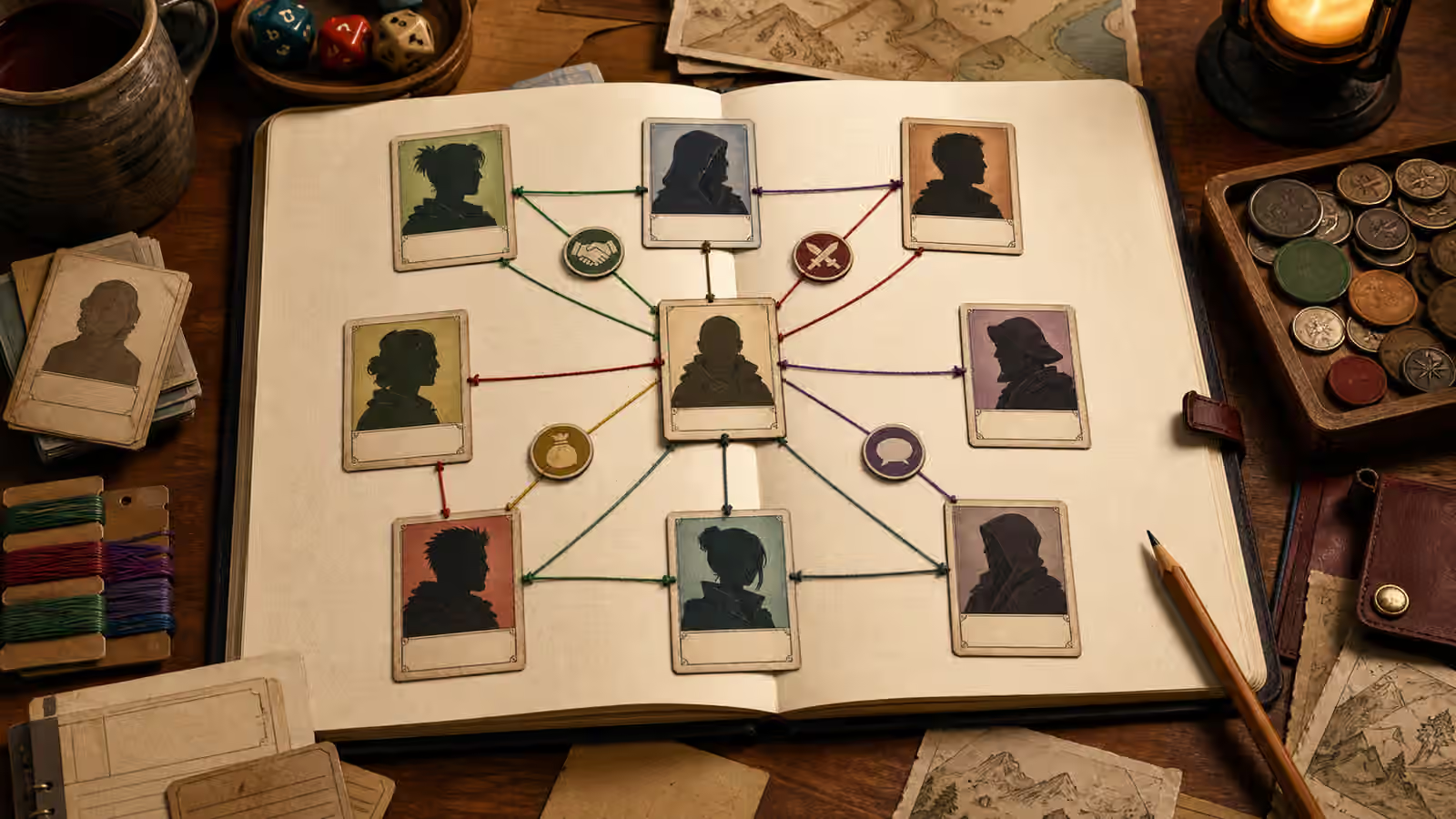
Solo maps are working memory made visible. They do not have to become finished art. A map can be boxes, lines, arrows, symbols, and a few notes. If it helps you choose a route, remember a danger, place a clue, or restart next week, it is doing its job.
The best solo map is usually plainer than the map you imagined before play. It shows what you need to decide, what you need to remember, and what has changed because of your choices. It does not need a perfect coastline, a beautiful room grid, or a full atlas of places you may never visit.
Draw to support the next move. If the next move is choosing a door, draw doors. If the next move is choosing a travel route, draw routes. If the next move is untangling a mystery, draw clues, witnesses, and contradictions. A map should answer the pressure of the current session, not every possible future session.
Choose the Map’s Job
Before drawing, name the job: room layout, travel route, region memory, relationship web, resource path, or mystery site. A room map needs doors and zones. A route map needs choices and costs. A region map needs landmarks and travel pressure. A mystery map needs clues and sightlines.
Do not draw more detail than the job requires.
Use this quick chooser:
| If you need to decide… | Draw… | Keep visible… |
|---|---|---|
| Which door, room, or zone matters | Room map | Entrances, exits, risks, clues, cover |
| Which route to risk | Route map | Costs, landmarks, shortcuts, blocked paths |
| Where the campaign has been | Region map | Known places, travel pressure, unresolved sites |
| Who is connected to whom | Relationship web | People, factions, promises, debts, suspicions |
| What evidence means | Mystery board | Clues, rumors, theories, contradictions |
| What resources support a plan | Resource path | Supplies, help, rest points, required tools |
This choice prevents overmapping. A relationship web does not need exact street geography. A dungeon room does not need regional borders. A travel route does not need furniture unless the furniture changes the route. When the map has one clear job, you can stop sooner and play more.
Pick a Scale You Can Maintain
Scale is not only measurement. It is how much attention each mark demands. A room-scale map asks what a character can reach, see, open, hide behind, or cross. A route-scale map asks how long travel takes and what it costs. A region-scale map asks how places relate over time.
Choose the smallest scale that answers the current decision. If the scene is “cross the old bridge,” you may need the bridge, riverbank, broken planks, guard post, and safe approach. You do not need the whole valley. If the scene is “find a safer way around the river,” zoom out to roads, ferries, ridge paths, and settlements.
A useful rule:
- Room scale for immediate tactics and search.
- Site scale for dungeons, buildings, camps, ships, and neighborhoods.
- Route scale for travel choices.
- Region scale for campaign memory.
- Web scale for people, factions, clues, and obligations.
You can redraw at a different scale later. A small room map can become one dot on a region map. A region route can zoom into a detailed crossing when it finally matters. Solo maps are allowed to change format as attention changes.
Start With Shapes
Use circles for places, lines for routes, squares for rooms, triangles for danger, stars for clues, and dots for resources. Build a legend if you reuse symbols. If drawing is difficult, use stickers, tokens, stamps, or index cards arranged as a map.
High contrast matters more than decoration. Future you needs to read the map under normal light.
Start with low-commitment marks. Pencil, index cards, sticky notes, movable tokens, or a rough digital canvas all make it easier to revise. Ink can come later if you want a permanent version. During play, the map should stay flexible.
A good first pass might be only:
- Three room boxes and two doors.
- Four route nodes and one unsafe crossing.
- A town circle, a forest edge, a ridge, and a missing road.
- Three clue cards and two suspects.
- A camp, a water source, a blocked path, and a question mark.
That is enough if it lets you choose. Add detail when a place receives pressure, not because blank space feels embarrassing.
Make a Legend Before You Need It
If you reuse symbols, write a tiny legend. A triangle for danger, square for resource, star for clue, circle for rest, slash for blocked, wavy line for rumor, and question mark shape for mystery can cover most solo maps.
Do not rely on color alone. A red mark may be clear tonight and muddy under different light next week. Pair color with shape, placement, or texture. The expanded Map Legend Symbols guide goes deeper, but the short version is simple: symbols should help future you recover meaning without rereading a full recap.
Place the legend where it travels with the map: inside the notebook cover, on an index card, at the top of the page, or on the back of the map sheet. If the legend is separate, it will eventually separate itself from the map exactly when you need it.
Use Lines to Show Decisions
Lines are not just roads. They are decisions. A solid line can mean known route. A dotted line can mean uncertain route. A broken line can mean blocked route. A double line can mean fast but exposed. An arrow can mean one-way movement, pressure, pursuit, or flow.
Before drawing another place, check whether the existing places have meaningful connections. Two interesting nodes with no route choice can feel static. One simple fork with different costs can create play.
For route maps, label lines by cost rather than distance:
| Route mark | Useful meaning |
|---|---|
| Solid line | Known and ordinary |
| Dotted line | Rumored or uncertain |
| Broken line | Blocked until something changes |
| Arrow | One-way, current, or pressure direction |
| Thick line | Main road or obvious route |
| Thin line | Minor path, shortcut, or fragile route |
These are private conventions, not universal rules. The key is consistency inside one campaign.
Let the Map Change
Solo maps can be provisional. Cross out roads, add weather, mark locked doors, draw new exits, and write question marks. A clean map is less useful than a living map.
If you are using a published map, respect the creator’s rights. Keep private notes private and avoid reposting copyrighted maps or scenario spoilers.
Change is one of the main reasons to map during play instead of only before play. A locked door becomes opened. A safe route becomes watched. A known road washes out. A rumor gets disproven. A clue points back to a room you ignored. The map should show those changes without requiring a full redraw every time.
Use visible state marks:
- Circle a current location.
- Cross a blocked path once, not five times.
- Add a date or session number beside major changes.
- Put a question mark near unresolved details.
- Use a small arrow to show where pressure is moving.
- Put spent resources or known dangers beside the route they affect.
If the page gets too crowded, make a clean copy only of the current decision layer. Keep the old map as history if it still matters. A rewrite is useful when it reduces friction; it is a trap when it becomes a way to avoid playing.
Map Memory, Not Only Space
Solo maps often need to remember more than geography. They can remember mood, ownership, promises, suspicion, safe return points, and emotional weight. A plain room box can carry a note like “felt safe until music stopped” or “owed a favor here.” A route can carry “fast, but I was seen.” A town can carry “do not return at night.”
This is where maps and campaign logs meet. The map should show where memory attaches. The log can explain the memory in words. If everything lives only in prose, you may not find it while choosing a route. If everything lives only as symbols, you may forget why it mattered.
Use short map notes:
| Note type | Example |
|---|---|
| State | Gate locked from inside |
| Feeling | Quiet but wrong |
| Promise | Bring medicine back |
| Risk | Patrol hears metal |
| Return cue | Start here with weather roll |
Keep the note close to the place it affects. Future you should not have to search a notebook page for the reason a route feels unsafe.
Keep the Map Playable on a Small Table
A map that requires a full dining table may not serve ordinary solo play. Fold large maps into active regions, use cards as map tiles, or keep a small “current area” map beside a larger campaign map. The tiny active map is often the one you actually use.
For small surfaces:
- Keep the current decision map on one page or card.
- Put the larger region map in the notebook or side tray.
- Use tokens for current position instead of redrawing.
- Store old maps behind the current one.
- Avoid spreading every map at once.
The Tiny Table Layouts habit applies here: the active surface should show only the current decision. The archive can wait nearby.
Use Accessible Marking Tools
Readable maps beat pretty maps. Use dark pencils, thick pens, high-contrast paper, larger grids, stickers, stamps, tactile markers, or movable cards if they make the map easier to use. If drawing hurts, use tokens and index cards. If writing is hard, use symbols and a short audio recap. If tiny grids strain your eyes, make fewer, larger spaces.
Accessibility choices are not special exceptions. They are table design. The map is a tool for the player at the table, not an audition for someone else’s idea of mapmaking.
Test your map from normal play distance. If you have to lean in every turn, the map is too dense or too faint. If two symbols look similar under room light, change one. If a route line disappears under tokens, thicken it or move the tokens.
Close With a Return Cue
At session end, mark where play will resume. Put a token on the location, circle the route, or write the next question. The map should hold the handoff between sessions.
The most useful map is often the one you are willing to make quickly.
Use one visible return cue:
- “Start here” mark at the current place.
- Arrow to the next route choice.
- Star beside the unresolved clue.
- Token on the active room.
- Notebook tab on the current map.
- One sentence below the map: “Next: test the north door before the patrol returns.”
Do this before the table clears. A map without a return cue can still be interesting, but a map with a return cue is playable.
Share Maps Carefully
Private maps can be detailed. Public maps need caution. Published adventures, campaign boxes, mystery games, and hexcrawls often hide route information, keyed rooms, puzzle layouts, or surprise locations. Do not post copied maps, marked scenario pages, hidden keys, or spoiler-heavy diagrams unless permission clearly allows it.
If you want to share the habit, redraw a generic example. Show blank rooms, abstract routes, or made-up symbols. Explain the method rather than exposing the protected map. Credit creators and link to official sources when discussing a published game.
For original maps, avoid making them look like official setting maps or copied game boards. Simple private geometry is enough.