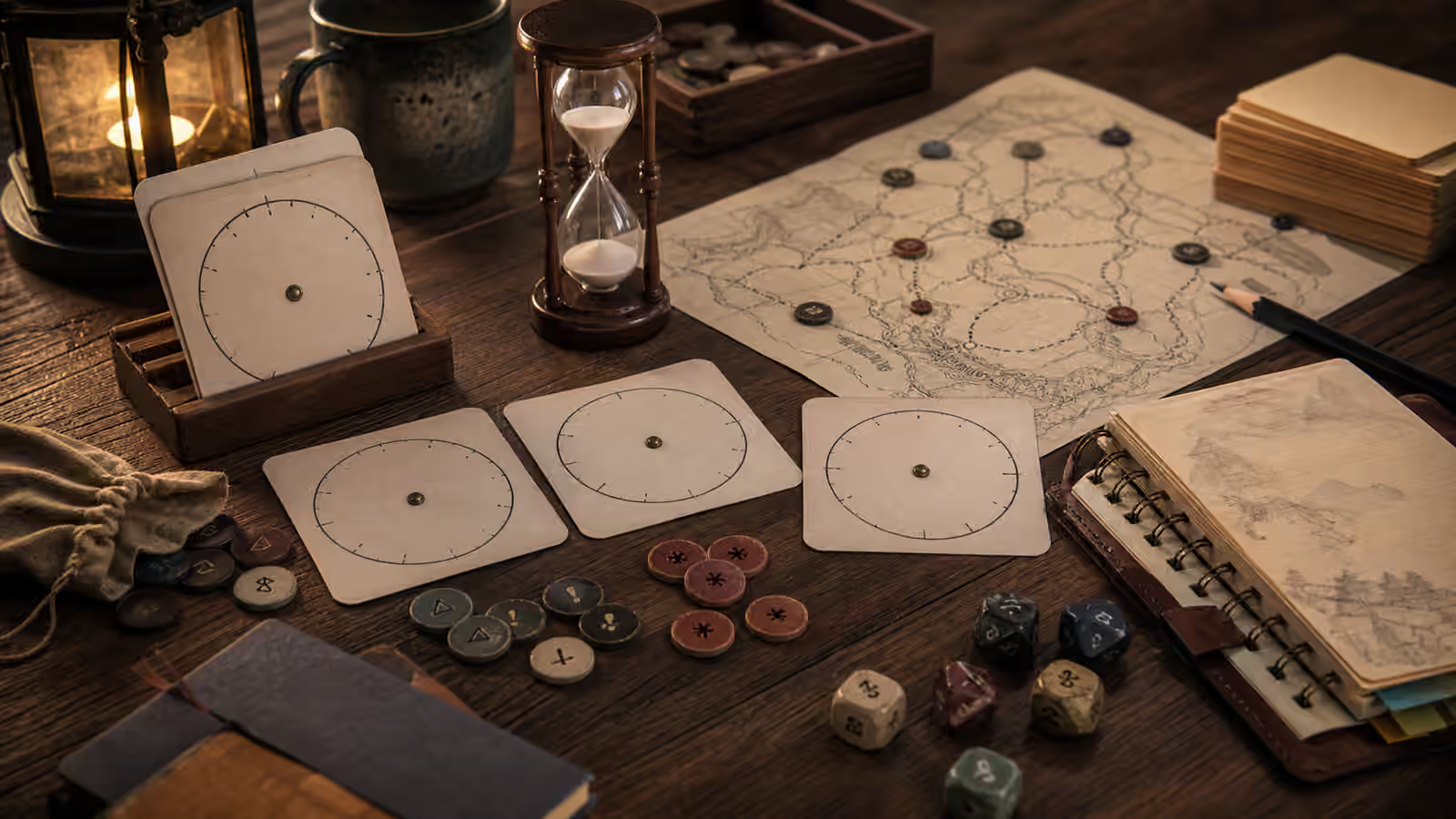
Dice systems shape the feeling of a solo session. They decide how often surprise appears, how swingy outcomes feel, and how easy it is to read the table. You do not need to master probability to choose well, but it helps to know what each randomizer invites.
The useful question is not “Which dice are best?” It is “What kind of uncertainty does this scene need?” A single d6 can make play fast and grounded. A d20 can make every roll feel wide open. A 2d6 curve can make common outcomes feel common. A full polyhedral set can add texture, but it can also slow the table if every die asks you to check a chart.
For solo play, dice should support authorship. They create friction, surprise, rhythm, and pressure. They should not turn every choice into a procedure.
Start With the Decision You Need
Before reaching for dice, name the decision. The die should answer a question that matters right now.
Good dice questions include:
- Does this risky action work cleanly, work with cost, or fail forward?
- How much pressure enters the scene?
- Which table result becomes active?
- How severe is the complication?
- Does the situation stay stable or shift?
- Which open thread returns?
Weak dice questions are often avoidance in disguise:
- What should I do?
- Is this scene interesting?
- Does the campaign matter?
- Should I keep playing?
Those are usually better answered by choice, mood, or a session boundary. Dice are strongest when they resolve uncertainty inside a scene, not when they make all creative decisions for you.
Use this quick test:
| If the roll would… | Then… |
|---|---|
| Change the next decision | Roll |
| Add useful pressure | Roll |
| Reveal a bounded detail | Roll |
| Replace a choice you already want to make | Choose directly |
| Require several lookups for one tiny answer | Simplify |
| Break the session tone or boundary | Reroll, soften, or choose |
That test keeps dice in their proper role: useful interruption, not table boss.
d6 Is Fast and Familiar
A single d6 is easy to find, easy to read, and strong for small tables. It works for yes/no variants, travel checks, weather, simple danger, and quick prompts. Its weakness is range. Six outcomes can feel repetitive if the table needs detail.
Multiple d6 create a curve. With 2d6, middle results happen more often than extremes. That is useful when ordinary outcomes should be common and dramatic events should feel rare.
The d6 is a strong default because it is boring in a useful way. It rolls quickly, fits tiny tables, and is readable for many players. If you are building a first solo kit, one d6 can carry more play than a full set you keep checking.
Use a single d6 for:
- Yes/no with mixed answers.
- Six-room, six-scene, or six-weather tables.
- Quick danger checks.
- Simple resource pressure.
- Random prompt selection.
- Choosing among a few active threads.
A beginner yes/no d6 can look like this:
| d6 | Answer |
|---|---|
| 1 | No, and a cost appears |
| 2 | No |
| 3 | No, but something useful remains |
| 4 | Yes, but with a limit |
| 5 | Yes |
| 6 | Yes, and with an advantage |
This is more useful than a coin when a plain yes or no would stall the scene. The mixed results keep movement alive.
The weakness of a d6 is repetition. If you roll on the same six-entry table all night, the table can start to feel small. Solve that by interpreting results through context before making the table bigger. “Delay” can mean fog, a locked gate, a cautious official, a missing part, or a tired character depending on the scene.
Use 2d6 When Ordinary Should Be Ordinary
Two six-sided dice do something a single die does not: they create a curve. Results in the middle are more common than results at the edges. That makes 2d6 useful when you want the session to feel stable most of the time, with rare extremes.
Use 2d6 for:
- Reactions where neutral or mixed answers should be common.
- Weather where ordinary conditions should dominate.
- Travel events where severe turns should be rare.
- Risk checks where only extreme results change everything.
- Tone tables where the campaign has a normal baseline.
A simple 2d6 pressure table:
| 2d6 | Result |
|---|---|
| 2 | Major reversal |
| 3-4 | Serious cost |
| 5-6 | Delay or friction |
| 7 | Mixed signal |
| 8-9 | Minor opening |
| 10-11 | Clear advantage |
| 12 | Breakthrough |
This table feels different from a d6 because “mixed signal” appears often and the extremes are rare. That can make solo play feel less chaotic. It is useful when you want the world to have inertia instead of spinning wildly every time you roll.
The tradeoff is arithmetic and lookup. 2d6 is still simple, but it asks you to add. If addition interrupts flow or accessibility, use a single d6 or card draw instead.
d20 Is Swingy and Spacious
A d20 gives room for many results and dramatic single-roll swings. It can make a scene feel adventurous because rare high and low results appear with the same chance as ordinary ones. That can be exciting or exhausting depending on the game.
Use d20 tables when variety matters. Use smaller dice when you want a calmer rhythm.
The d20 is flat. Every number has the same chance. That means a 1, a 10, and a 20 are equally likely. This creates a feeling of openness and swing. It is excellent for big prompt lists, wide travel tables, colorful discoveries, and games where a single roll is meant to feel risky.
Use a d20 for:
- Large inspiration lists.
- Encounter or discovery prompts.
- Rumor, object, location, or sensory detail tables.
- Swingy tests where every outcome should feel possible.
- Selecting from many campaign threads.
Avoid d20 when:
- You only need two or three possible answers.
- The table is hard to scan.
- Every result requires a paragraph of interpretation.
- Frequent extremes would make the session exhausting.
One common d20 mistake is using all twenty rows before the table has earned them. A d20 table with vague filler is worse than a sharp d6 table. If rows 13 through 20 are only there because the die has twenty sides, shrink the table.
If you like the feel of a d20 but want less lookup, use bands:
| d20 | Band |
|---|---|
| 1-3 | Strong setback |
| 4-8 | Cost |
| 9-12 | Mixed result |
| 13-17 | Progress |
| 18-20 | Strong opening |
Bands give you the satisfying physical roll while keeping interpretation fast.
Polyhedral Sets Add Texture
d4 can feel sharp and small. d8 and d10 are good mid-size tables. d12 gives a satisfying calendar or region feel. Percentile dice are useful for large lists but can slow play if every result requires lookup.
Choose dice you can read comfortably. High contrast, larger dice, dice trays, or digital rollers can be access tools.
A polyhedral set is useful when different dice carry different jobs. It becomes cluttered when every die exists only because the set is available.
Think of each die by table feel:
| Die | Table feel | Useful for |
|---|---|---|
| d4 | Tight, sharp, limited | Severity, direction, simple costs |
| d6 | Fast, familiar, compact | Core oracle, small tables, pressure |
| d8 | Slightly wider but still readable | Scene prompts, route options, factions |
| d10 | Decimal, clean, expandable | Clocks, resources, ranked intensity |
| d12 | Spacious but not huge | Months, regions, signs, travel color |
| d20 | Wide and swingy | Discovery, encounter, big prompt lists |
| d100 | Granular and slow | Large catalogs, rare events, archives |
You do not need all of them in one session. Pick one core die and one support die. For example:
- d6 for yes/no and basic pressure.
- d12 for weather, region, or calendar flavor.
or:
- 2d6 for reaction and risk.
- d20 for discovery prompts.
This gives the session texture without turning the table into a sorting task.
Match Dice to Roll Frequency
How often you roll matters as much as which die you roll. A complex die system can feel good if it appears twice in a session. The same system can feel heavy if it appears every three minutes.
Use lighter dice for frequent checks:
| Roll frequency | Better fit |
|---|---|
| Many times per scene | d6, coin, simple token |
| Once per scene | d6, 2d6, d10 |
| Once per location | d12, d20, card draw |
| Once per session | larger table, d100, multi-step prompt |
If a solo game feels slow, count the number of rolls between meaningful choices. If you roll five times before you decide anything, the dice may be doing too much. Combine rolls, choose directly, or turn several checks into one consequence roll.
Example:
Instead of rolling for weather, road quality, encounter, mood, and complication before traveling, ask one question:
What is the main pressure on this journey?
Then roll once on a d6 pressure table. Interpret the result through weather, road, people, or resources. You get movement without pre-session paperwork.
Understand Swing, Curve, and Granularity
You do not need advanced probability to choose dice well. Three plain-language ideas are enough.
Swing is how wild a roll feels. A flat d20 is swingy because every number is equally likely. A 2d6 curve is less swingy because middle results appear more often.
Curve is how the dice favor some results over others. 2d6 favors the middle. A single d6 does not. Curves are good when the world should usually behave normally.
Granularity is how many small distinctions the system can express. A d100 has high granularity. A coin has almost none. More granularity is not automatically better. It only helps when the distinctions matter.
Use this rule of thumb:
- Need speed: use fewer sides.
- Need variety: use more sides.
- Need ordinary outcomes: use a curve.
- Need high drama: use a flat die with broad stakes.
- Need access and low friction: use the easiest readable tool.
Make Dice Results Actionable
Dice results should lead to an action, not a foggy mood. A result like “mystery” may be evocative, but it often asks for another roll. A result like “a familiar mark appears in the wrong place” gives you something to do.
Compare:
| Vague result | Actionable result |
|---|---|
| Danger | The safe route is watched |
| Help | Someone offers aid with a condition |
| Delay | The next step takes extra time or supply |
| Strange | A normal object behaves out of place |
| Clue | A detail connects to an open question |
When building tables, write rows as changes, costs, openings, or questions. That way the dice result immediately enters play.
A compact d6 scene-friction table:
| d6 | Result |
|---|---|
| 1 | The direct route is blocked |
| 2 | A resource is strained |
| 3 | Someone notices the attempt |
| 4 | A clue points to an open thread |
| 5 | An offer appears with a condition |
| 6 | The scene ends faster than expected |
Every row changes the next decision.
Keep Readability and Sound in the Design
Dice are physical tools. Their shape, contrast, sound, and size matter.
Access-friendly choices include:
- High-contrast numbers.
- Larger dice.
- Dice with clear, simple fonts.
- A dice tray or felt surface for quieter rolls.
- A lidded box or padded tray to prevent dice from scattering.
- Digital rollers when physical dice are hard to read, lift, or hear.
- Fewer dice on the table at once.
Quiet play matters in shared-wall apartments, late-night sessions, libraries, hospitals, dorms, and homes where someone else is resting. A soft tray can make dice feel better and sound gentler. If rolling is still disruptive, use cards, tokens, or a digital roller.
Small dice and small tokens also need child-safe storage around young children. Put tools away when the session ends. The best randomizer is not just exciting; it is usable in the room where you actually play.
Avoid Dice Status Games
No dice family is more legitimate than another. A solo RPG with one d6 is not lesser than a table with a full polyhedral set. A board game that uses custom dice is not more serious than a notebook game using a coin. Fit matters more than status.
Use the die that makes the session readable, playable, and easy to return to. If you enjoy beautiful dice, enjoy them. If you prefer plain dice because they are readable and cheap, that is good design. If digital rolling makes the table accessible, use it without apology.
The same goes for custom dice. Custom symbols can reduce reading load when they are clear. They can also become confusing if you must constantly translate icons. If a symbol die creates more lookup than a numbered die, it is not helping.
Build a Small Dice Kit
A practical solo dice kit can be smaller than most people expect:
Core: one high-contrast d6
Curve: two matching d6
Variety: one d20
Texture: one d10 or d12
Support: soft tray, pencil, and one table card
That kit can handle most beginner solo sessions. Add the rest of the polyhedral set only when a game calls for it or when you have a clear job for each die.
Put a small reference card in the kit:
d6: quick oracle and pressure
2d6: reactions and ordinary outcomes
d20: discovery and variety
d10/d12: clocks, regions, or calendar flavor
Roll only when the answer changes a decision.
The reference card prevents tool drift. It reminds you why each die is present.
Roll Only When It Helps
Too many rolls can make the session feel like paperwork. Before rolling, ask: will this answer change a decision, add useful pressure, reveal a detail, or resolve uncertainty? If not, choose directly.
Solo play works best when chance and choice take turns. Roll for friction. Choose for authorship.
After a roll, make one move before rolling again. Move a token, write a sentence, mark a resource, add a clue, close a scene, choose a route, or update the campaign log. This prevents the common solo trap of consulting dice endlessly while play stands still.
If a result feels wrong, you have options:
- Reroll once.
- Use the gentler version.
- Apply the result to a smaller part of the scene.
- Convert the result into a cost instead of a reversal.
- Choose directly and keep going.
That is not cheating. It is authorship. The dice are a tool for play, not a contract to accept every result at full intensity.
Choose by Session Mood
Different nights need different dice.
For a calm journaling session, use one d6 and a sensory table. For a tactical puzzle, use the dice the rules require and keep extra oracles away from the table. For a travel scene, 2d6 can create ordinary roads with rare trouble. For a discovery-heavy night, a d20 table can provide variety. For a tired session, choose directly more often and roll only when the next move is unclear.
Here is a quick match:
| Session need | Useful dice choice |
|---|---|
| Gentle uncertainty | d6 with yes/no-but answers |
| Stable world | 2d6 curve |
| Big variety | d20 |
| Short list | d4 or d6 |
| Calendar, region, or season | d12 |
| Resource track | d10 |
| Rare events | d100, used sparingly |
| Quiet or low dexterity play | cards, tokens, or digital roller |
The best choice is the one that gets you back to the next decision with energy left.
A Beginner Dice System That Works
If you want one simple setup, use this:
When uncertain:
Roll d6.
1 No, and a cost appears.
2 No.
3 No, but something useful remains.
4 Yes, but with a limit.
5 Yes.
6 Yes, and an advantage appears.

When pressure should be ordinary:
Roll 2d6.
2 major reversal.
3-4 serious cost.
5-6 delay.
7 mixed signal.
8-9 minor opening.
10-11 clear advantage.
12 breakthrough.

When you need variety:
Roll d20 on a short prompt list.
If the list feels padded, shrink it.
That is enough to start. You can add specialized dice later when a campaign asks for them.