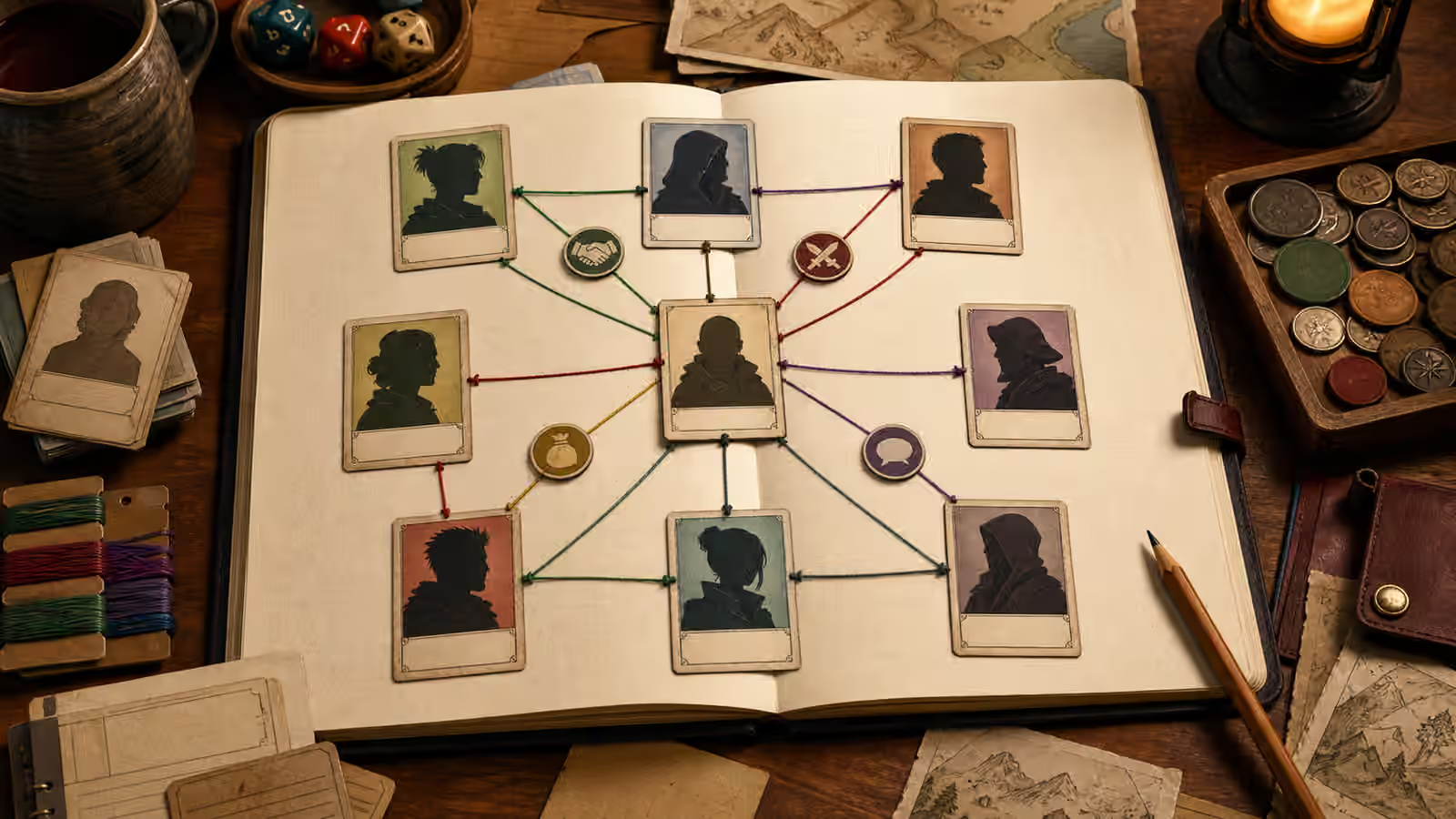
A solo campaign notebook is a return tool. It should answer the question future you will ask: where was I, what changed, what is still open, and how do I begin again? It does not need to become a scrapbook, archive, or public proof of play.
The notebook is strongest when it stays humble. It does not have to capture every sentence, every card draw, every sketch, or every clever thought. It has to hold the few details that make the next session easier to start. In solo play, that matters because there is no tablemate carrying the other half of the memory. The notebook becomes the quiet partner that reminds you where the game was headed.
A good campaign notebook is also allowed to be incomplete. Some pages will be tidy. Some will be crossed out. Some sessions will get four lines and a date. That is fine. The standard is usefulness, not presentation.
Choose a Format You Will Actually Touch
Start with the format that lowers friction. A beautiful bound notebook is not better than index cards if the bound notebook stays on the shelf. A digital note is not worse than paper if it is the thing you can open while the table is live.
Common formats all have tradeoffs:
| Format | Best for | Watch out for |
|---|---|---|
| Bound notebook | One campaign with a clear order | Harder to rearrange old sections |
| Ring binder | Long campaigns and printable aids | Can become bulky fast |
| Index cards | Scenes, NPCs, clues, and quick changes | Easy to scatter without a box |
| Folder plus loose sheets | Board game campaigns with official records | Needs a clear front page |
| Plain text note | Voice dictation, search, backup | Can drift away from the table |
Pick one primary format and one backup method. For example, a paper notebook can be primary while a private photo records complex save states. A plain text file can be primary while an index card sits in the game box with the next setup cue. The system should not require five containers before the first scene begins.
If you are tempted to buy supplies, play one short session first with what you already have. The first session will reveal whether you need tabs, bigger pages, card sleeves, a binder, or less structure.
Start With Five Sections
Use sections for character, rules reminders, open threads, map and places, and session log. Keep each section short at first. If you overbuild the notebook before play, it can become the project instead of supporting the project.
For rules reminders, summarize in your own words. Do not copy long rulebook passages into public files or shared templates unless the creator permits it.
The five sections work because they separate different kinds of memory:
| Section | Job | First page prompt |
|---|---|---|
| Character | Who is acting and what changed them | “What do they want now?” |
| Rules reminders | Procedures you keep needing | “What rule do I forget?” |
| Open threads | Questions, promises, threats, and clues | “What still has energy?” |
| Map and places | Locations, routes, hazards, and changes | “Where can play move next?” |
| Session log | What happened, changed, opened, and starts next | “What does future me need?” |
Do not add all possible subsections on day one. Leave space. Let the campaign teach the notebook what it needs.
Character
The character section should hold playable identity, not a biography you feel obligated to maintain. Use it for current motive, important relationship, inventory that changes decisions, scars or consequences, and the next character-facing choice.
A small character page might use:
Name or role:
Current want:
Useful strength:
Costly habit:
Important connection:
Changed last session:
Next character choice:
If the game has an official character sheet, use it as intended. Your notebook can sit beside it with motives, promises, and memory in your own words. Do not copy or publish official forms unless the creator’s license allows that.
Rules Reminders
The rules section is not a replacement rulebook. It is a memory aid for the procedures that interrupt your sessions. Keep it short and write reminders in your own language.
Good reminders are action-shaped:
- “Enemy phase happens before cleanup.”
- “Travel costs one supply unless road is marked safe.”
- “Draw event after weather, not before.”
- “On a tie, choose the result that changes the scene.”
Avoid copying long rules text. If a rule needs exact wording, write the page number or use a bookmark. The notebook should guide you back to the source, not become an unauthorized duplicate of it.
Open Threads
Open threads are the notebook’s engine. They are the questions, promises, debts, threats, clues, and unresolved choices that make the next session feel alive.
Use short labels:
| Mark | Meaning | Example |
|---|---|---|
| Q | Question | “Q: Who repaired the gate?” |
| P | Promise | “P: Return the charm before winter” |
| T | Threat | “T: Storm reaches town after two scenes” |
| C | Clue | “C: Blue wax appears on both letters” |
| B | Boundary | “B: Keep grief offstage this arc” |
The boundary mark is useful for consent and age-rating notes. Solo play still benefits from clear limits. If a topic is too intense for the room, the day, or anyone nearby, mark it plainly and choose a different route.
Map and Places
The map section does not need beautiful cartography. It needs location memory. Track places by what changed there and what choices remain.
For each important place, write:
Place:
Why it matters:
Changed:
Unresolved:
Routes:
Return cue:
If you draw maps, keep the legend simple and consistent. A symbol that means danger on one page should not mean treasure on another unless you write a clear note. If drawing is not comfortable, use a route list: town to bridge, bridge to quarry, quarry to sealed road. A list can carry play just as well as a map.
Session Log
The session log should be the easiest section to fill while tired. Use the same closing prompts every time: happened, changed, open, next.
A one-session entry can be this short:
Happened:
Changed:
Open:
Next:
That structure connects directly to Campaign Log Review . Long prose is welcome when you want it, but continuity should not depend on the energy to write a full recap.
Put Current State Up Front
The first page should hold current state: character status, resources, active location, immediate goal, open danger, and next session hook. Older logs can live behind it. This prevents the common problem of rereading ten pages before moving one token.
If the game has official save sheets, use them. Your notebook fills the human memory gaps around them.
Treat the first page as a dashboard, not a table of contents. It should answer the return question in one glance. If the first page gets stale, the whole notebook starts lying.
Use a front-page template like this:
Campaign:
Current status:
Active character or side:
Location:
Resources or state:
Open danger:
Main question:
Next action:
Content note:
Official save location:
Last updated:
The “official save location” line matters for board game campaigns. It can say “official sheet in box,” “app saved after reward step,” “deck order preserved in sleeve,” or “scenario envelope on top.” The notebook should point at the real state instead of pretending to contain everything.
Update the front page after each session before writing anything decorative. If you only have energy for one page, update this one. Older logs can be messy, but the front page should stay readable.
Give Every Page a Job
A campaign notebook becomes hard to use when pages have unclear jobs. One page contains character notes, map fragments, a rule reminder, half a clue list, and a shopping plan. That may feel efficient while writing, but it makes return harder.
Use page labels even if they are plain:
- Current State
- Character
- Open Threads
- Place
- Session Log
- Rules Reminder
- Archive
The labels can be written in pencil, on tabs, or at the top of a digital note. They tell future-you how to scan. If a page changes job, cross out the old label and rename it. The notebook is a tool, not an exhibit.
For loose sheets or index cards, add a campaign name or short code on each card. Cards are useful because they move, but that also means they can migrate. A tiny code in the corner can save a mystery later.
Use Thread Lists Instead of Perfect Chronology
Chronological logs are natural, but they are not always the fastest way to resume. If you need to know what happened on session four, chronology helps. If you need to know what questions are still active, a thread list helps more.
Keep one page for active threads. Each line should be short:
Q: Who sent the blank invitation?
T: Road tax doubles after next market day.
P: Return the compass to Mara.
C: Same blue wax on two letters.
B: Keep body horror out of this arc.
At the end of a session, update the thread list:
- Answered threads get checked off.
- Dormant threads move to archive.
- New threads get one clear line.
- Threads that no longer interest you can be closed.
Closing a thread is allowed. Solo campaigns do not need to honor every loose end forever. If a question no longer creates useful play, mark it resolved, fold it into the background, or let it disappear.
Make It Easy to Resume
Use tabs, sticky flags, index cards, or colored edges. If handwriting is difficult, use short typed notes, voice notes, or photos for private reference. If photos are not welcome, write object lists instead: “three cards in hand, lantern spent, bridge locked.”
Accessibility supports are part of the notebook design.
Make the notebook physically easy to return to. Put the current page behind the cover. Use one visible tab for active state. Keep a pencil or pen with the kit. If the notebook lives away from the game box, put a cue in the box that says where the notebook is.
A restart setup can be very small:
- Open notebook to current state.
- Read the next action.
- Pull only the components named there.
- Check one rules reminder if needed.
- Begin with the stated move.
This matters because resuming is often the hardest part. Once the first move happens, play usually starts carrying itself again.
If visual scanning is difficult, use larger headings and fewer fields. If handwriting is painful, use checkboxes, voice notes, typed entries, or a small set of repeatable marks. If memory is the challenge, keep the front page more explicit. If space is the challenge, use cards instead of a large notebook.
Accessibility is not extra polish. It is the difference between a campaign that can be resumed and one that becomes too costly to touch.
Keep Private Notes and Shareable Notes Apart
A campaign notebook can include spoilers, uncertain rulings, private reactions, copied page references, and messy state. That does not mean all of it is safe to share.
Use a simple boundary:
- Private notebook: exact state, spoilers, hidden details, personal reactions.
- Shareable recap: your own words, spoiler warnings, no copied scenario text.
This protects both creators and future players. If you post about a campaign, avoid hidden card text, puzzle answers, locked content, paid prompts, and photos that reveal protected material. Link to creators when appropriate, but do not make your notebook a substitute for the original game.
The boundary also makes the notebook more useful. When every line feels public, you may start writing for an audience. The working notebook should be allowed to be plain, partial, and honest.
Maintain the Notebook in Two Minutes
Maintenance should be small enough to do after a real session. Use a two-minute reset:
- Update current state.
- Add or close open threads.
- Write happened, changed, open, next.
- Move any loose card or note to its section.
- Put the restart cue on top.
Do not reorganize the whole notebook at the end of play. That turns closure into administration. If the notebook needs larger cleanup, mark a future maintenance page and stop.
Every few sessions, do a ten-minute review:
- Remove fields you never use.
- Rewrite one confusing rule reminder.
- Move old threads to archive.
- Refresh the front page.
- Check whether the campaign still feels active, paused, or complete.
That is enough. The notebook should improve gradually through use.
Close Every Session
Use the same closing lines: happened, changed, open, next. That is enough. A long journal entry is welcome when you want it, but continuity should not depend on beautiful prose.
End with one physical restart cue: open to map page, place blue token on bridge, read clue card, roll weather. Future you needs a handle.
Write the restart cue as an action, not a mood:
- “Open to the quarry map and roll weather.”
- “Resolve the wound check before drawing a new event.”
- “Ask whether the stranger recognizes the seal.”
- “Set up scenario three and place the active deck beside the board.”
- “Read the next prompt, then answer what the town remembers.”
Avoid “continue,” “pick up story,” or “figure out next scene.” Those are not cues. They are assignments.
If you stop mid-scene, write what has already happened in the procedure. “Enemy acted; player turn next” is better than “mid-fight.” “Reward not read yet” is better than “after victory.” The next session should not begin by guessing whether you already resolved a step.
Build a Starter Template
Here is a compact starter setup for a paper notebook, binder, or digital note:
FRONT PAGE
Campaign:
Status:
Location:
State:
Open danger:
Main question:
Next action:
Content note:
Official save:

CHARACTER
Name or role:
Current want:
Important connection:
Changed:
Next character choice:

RULES REMINDERS
Page:
Reminder in my words:
When it comes up:

OPEN THREADS
Q:
P:
T:
C:
B:

PLACE
Place:
Why it matters:
Changed:
Routes:
Return cue:

SESSION LOG
Date:
Happened:
Changed:
Open:
Next:
Use it as a draft, not a command. Delete fields that do not earn their space. Add fields only after repeated need. If a field stays blank for three sessions, it probably does not belong in the active template.
A Filled Example
A useful campaign notebook entry might look like this:
FRONT PAGE
Campaign: Road to the Watchtower
Status: Active
Location: River bridge
State: Lantern spent, supply 2, event deck order saved
Open danger: Rain reaches valley next scene
Main question: Who repaired the blue gate?
Next action: Ask the ferryman about the gate before choosing a route
Content note: Keep grief offstage this arc
Official save: Character sheet updated, active deck sleeved in box

SESSION LOG
Happened: Reached the bridge after the storm road failed.
Changed: River path marked unsafe; one favor owed to Mara.
Open: Q: Who paid the ferryman before I arrived?
Next: Open to bridge map, place token at ferry, roll weather.
This entry is not long, but it is playable. It preserves exact state, emotional direction, open questions, a boundary, and a first move. That is the work of the notebook.
Let the Notebook Stay Plain
Decoration is welcome if it gives you pleasure. It should not become the ticket price for continuing the campaign. A plain page with honest state is better than a perfect spread you avoid updating.
The notebook may become attractive over time because it has been used. Corners bend. Tabs move. Lines get crossed out. Old threads close. The front page changes. That use is the point.
Set up the notebook so the next session can begin with less resistance than the last one ended. If it does that, it is working.