
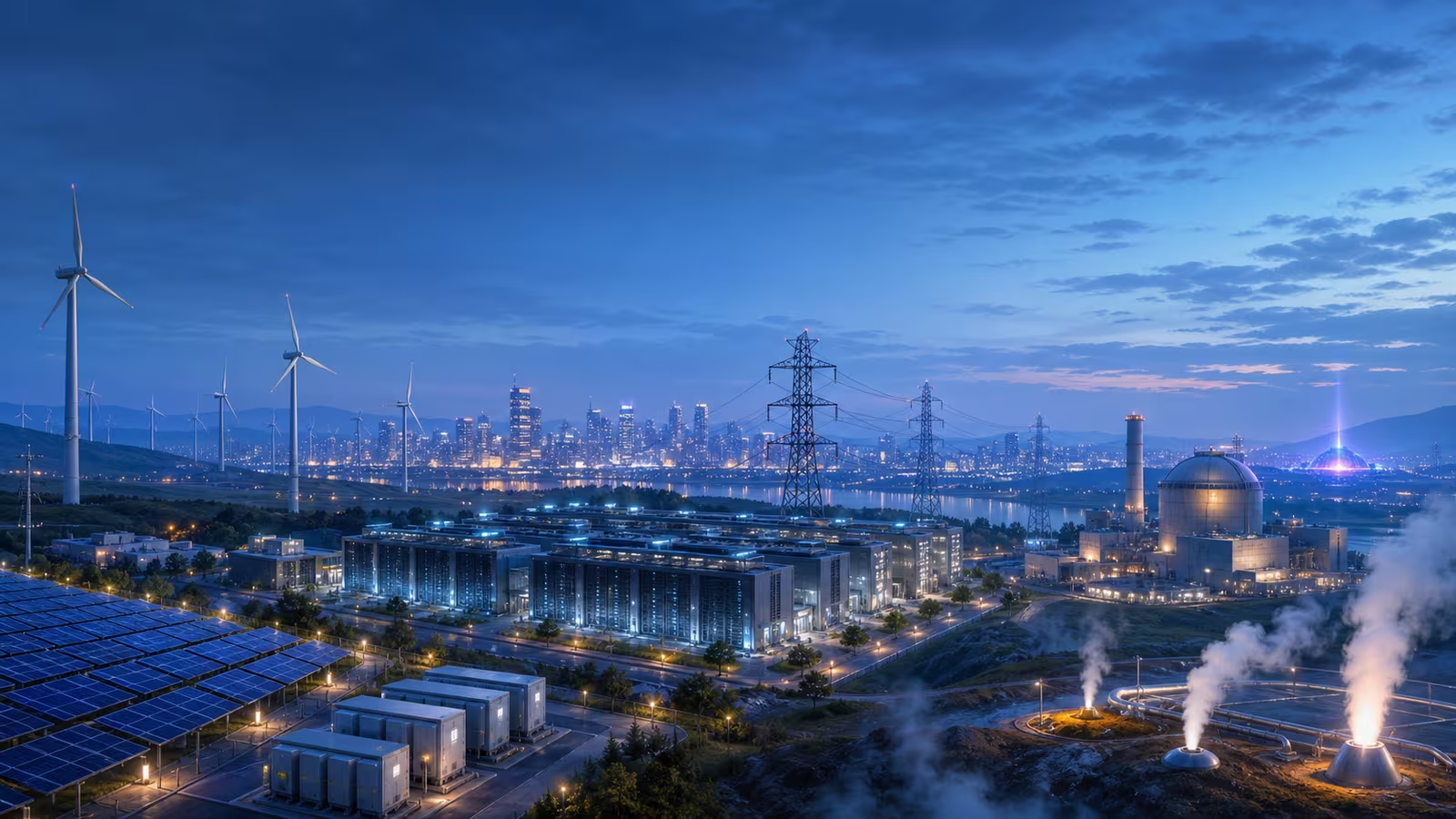
The phrase “AI runs in the cloud” is useful until you picture an actual cloud. Then it becomes misleading. AI runs in buildings. Those buildings are filled with chips, cables, cooling systems, backup equipment, security gates, substations, and people who care very much whether the power stays on. Every search, training run, video model, recommendation system, and business workflow sits on top of a physical energy system. The future of AI is partly a software story, but it is also a power story.
This is why energy has moved from background topic to front page. A data center can be a large new customer for a local grid. A cluster of data centers can change regional electricity planning. Add electric vehicles, heat pumps, new factories, air-conditioning demand, and climate goals, and the question becomes larger than one industry. What powers the AI age is really a question about how quickly societies can build reliable, clean, affordable electricity systems.
The grid is not a battery
The first idea to understand is that electricity is unusually impatient. You can store coal in a pile, gas in a tank, oil in a ship, and water behind a dam. Electricity wants to be balanced in real time. The grid is a giant coordination machine that keeps supply and demand matched second by second. When demand rises, something has to respond. When a power plant trips, something else has to fill the gap. When solar output falls at sunset, the system still has to serve dinner, lights, servers, trains, factories, and hospitals.
That makes the future energy challenge feel less like choosing a favorite fuel and more like running a restaurant kitchen during a rush. Solar and wind can be excellent cooks when the sun and wind show up. Batteries can carry prepared dishes across the busiest hour. Gas, hydro, nuclear, geothermal, and eventually perhaps fusion can provide steadier heat. Transmission lines are the hallways that move food from kitchen to tables. If one hallway is blocked, the whole restaurant slows down even if the kitchen is full of ingredients.
Data centers change the timing
AI data centers matter because they are large, concentrated, and often need high reliability. A neighborhood grows gradually. A factory can be planned around a specific industrial process. A data center campus may arrive with a power request that looks like a small city or a major industrial load. It may want electricity all day and all night, because servers do not sleep when the sun sets.
This does not mean data centers are bad. They can support useful services, jobs, scientific tools, medical research, weather forecasting, security, and business productivity. But their electricity demand is not imaginary. If a region signs up for huge new compute load without new generation, storage, transmission, or demand flexibility, the pressure shows up somewhere: prices, queues, diesel backup, delayed connections, or tougher planning fights.
The useful question is not whether AI should use energy. Every important technology uses energy. The useful question is what kind of energy system AI helps create. Does it push regions toward cleaner firm power, better grid planning, smarter demand response, and faster transmission? Or does it simply compete for whatever electricity is already available?
The big buckets
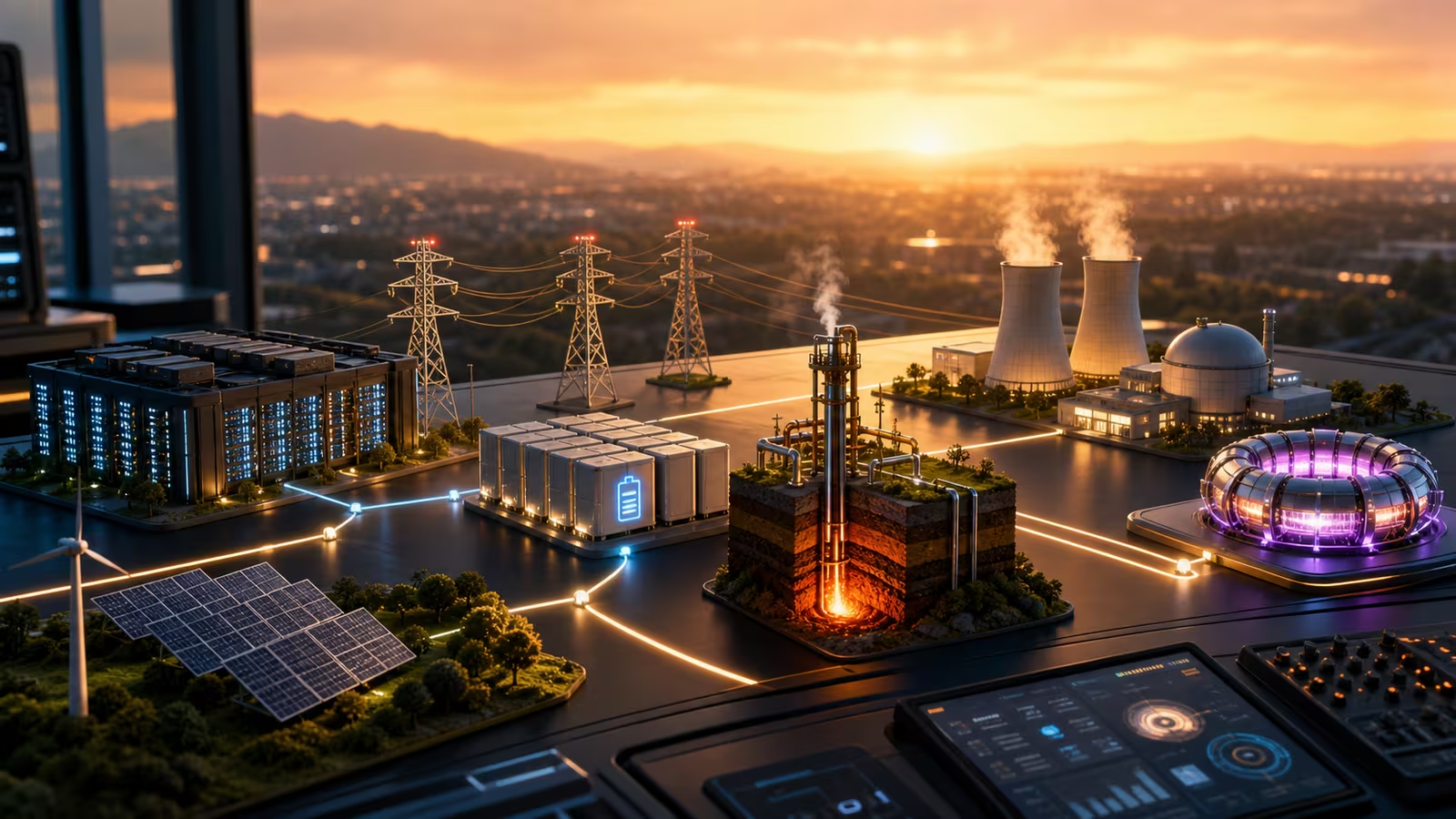
Future energy tools fall into a few plain categories. There is generation, which makes electricity. Solar, wind, hydro, nuclear, gas, geothermal, and fusion all belong here. There is storage, which moves electricity across time. Lithium-ion batteries handle short periods well. Other approaches, such as flow batteries, thermal storage, compressed air, pumped hydro, hydrogen, and iron-air systems, aim at longer gaps. There is transmission and distribution, the wires and substations that move electricity from where it is made to where it is used. There is demand flexibility, which means shifting some electricity use to better times. Finally, there is efficiency, which reduces how much work the system must do.
No single bucket can solve the whole problem. Building more solar without wires can strand power. Building batteries without enough generation gives you a very nice empty tank. Building firm power without transmission can trap it in the wrong place. Building data centers without flexibility can make peak demand harder. The system matters.
Firm power is the stubborn prize
A lot of future energy conversation revolves around firm power: electricity that can be available when needed, not only when weather cooperates. Existing nuclear plants provide firm low-carbon power. Geothermal can do something similar where the resource and drilling work. Hydropower is firm in some places but limited by water and geography. Gas plants are firm but emit carbon unless paired with effective carbon management, which remains difficult and site-specific. Fusion is the dream of firm power with abundant fuel, but it still has to prove commercial operation.
Small modular reactors and advanced geothermal are interesting because they aim to provide steady power in smaller, more repeatable forms. Fusion is interesting because the upside is enormous if it becomes practical. But all three share a hard truth: energy technologies are not adopted by beautiful diagrams. They must be permitted, financed, built, connected, operated, insured, maintained, and trusted.
Storage is not one thing
Batteries have become central because they help with the daily rhythm of renewables. They can charge when solar is abundant and discharge during evening peaks. They can respond quickly when the grid wobbles. They can delay some grid upgrades and make renewable projects more valuable. But lithium-ion batteries are usually not meant to cover a cloudy, windless week for an entire region.
That is where long-duration storage enters the story. The phrase sounds dry, but the analogy is simple: a phone battery gets you through the day, while a pantry gets you through a storm. Grid batteries are often the phone battery. Long-duration storage is trying to become part of the pantry. The system may need both.
Wires decide speed
Transmission is the least glamorous part of future energy and one of the most important. The best wind resources are not always near cities. The best solar resources are not always near factories. Geothermal may be where drilling works. Nuclear may be accepted in some places and fought in others. Data centers may want to locate near fiber, land, water, tax incentives, and power. None of that matters if the grid cannot move electricity where it needs to go.
Transmission projects can take years because they cross land, jurisdictions, regulators, utilities, environmental reviews, and local concerns. That does not mean permitting should be careless. It means planning has to start early and treat wires as infrastructure, not an afterthought.
Why this matters
The AI age will be shaped by chips and models, but also by substations and steel towers. If clean electricity grows slowly, every new load becomes a fight. If grids are planned well, AI demand could help pay for cleaner firm power, better storage, stronger transmission, and more efficient operations. The difference is not automatic. It depends on choices.
For a normal person, the takeaway is not that you must memorize every technology. It is that energy claims should be judged by system fit. Ask what problem the technology solves, when it delivers power, how it connects to the grid, how quickly it can be built, what it costs, who benefits, and what tradeoffs it brings. The future will not be powered by one magic answer. It will be powered by a portfolio that is built, connected, and operated well enough to make the word “future” feel ordinary.


