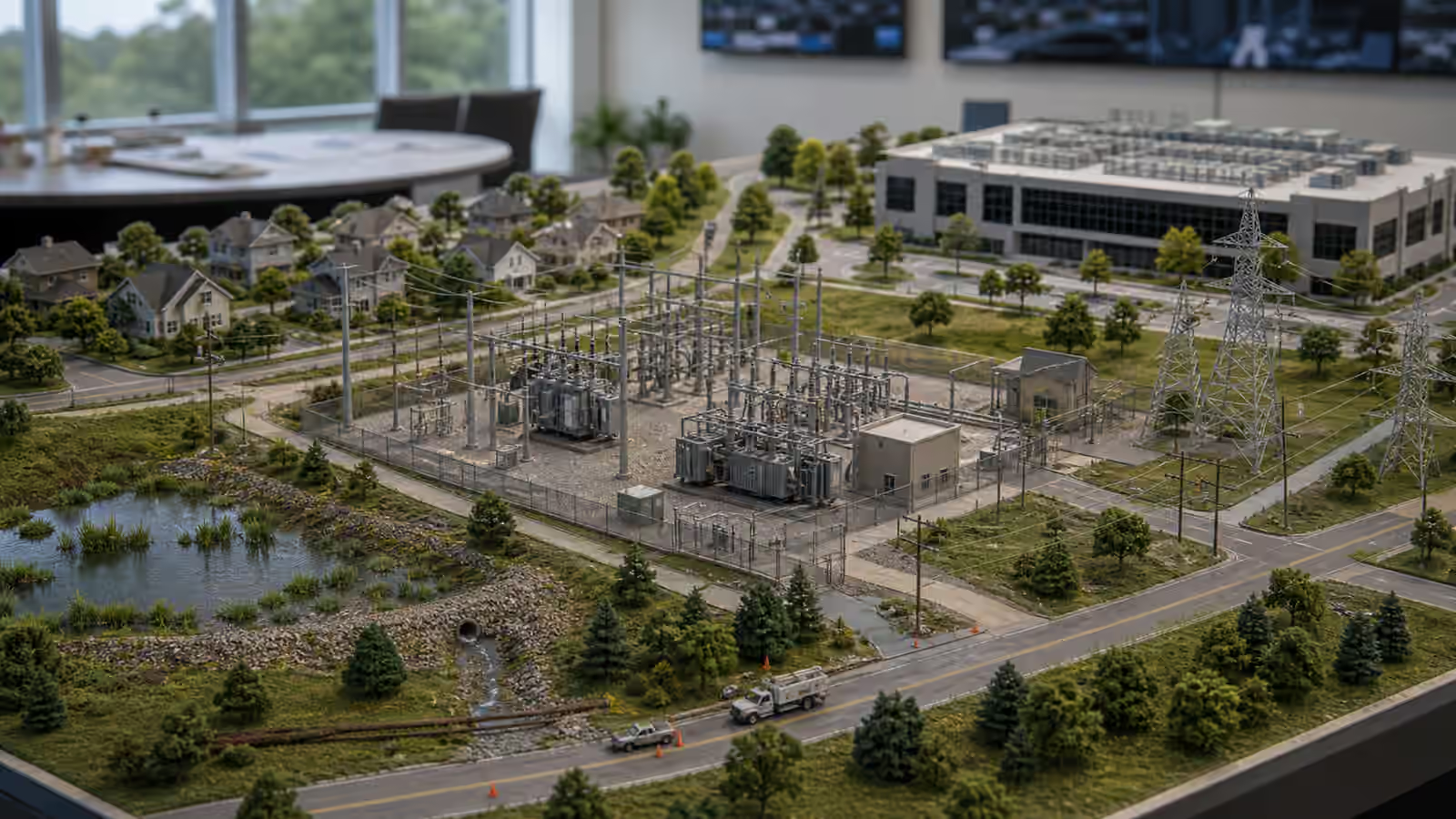
A large new electricity customer does not simply arrive with a plug. A data center campus, factory, charging depot, electrolyzer, rail facility, or industrial heat project can ask for enough power to change the planning assumptions around a substation, transmission corridor, or local distribution network. The request may be expressed as a number of megawatts, but the grid hears a longer question: where will that demand connect, when will it appear, how steady will it be, what equipment must carry it, and what happens when the system is already stressed?
That is the work of large load interconnection. It is the load-side cousin of the project queues described in Interconnection Queues , but the pressure point is different. A solar or wind project asks how it can inject power into the grid. A large load asks how it can draw power from the grid without crowding out other customers, degrading reliability, or forcing unplanned upgrades onto everyone else. Both require studies, contracts, equipment, schedules, and trust.
The first answer is rarely the final answer
The earliest conversation often sounds deceptively simple. A developer says it needs a certain amount of capacity by a certain date. A utility looks at nearby lines, substations, transformers, feeders, available voltage levels, and planned upgrades. If there is obvious spare capacity, the path may be straightforward. More often, the first answer is conditional. The site might connect at a smaller size, connect later, require a new substation, need transmission reinforcement, accept operating limits, or coordinate with other projects in the same area.
The difficulty is that load is not only size. A steady 200-megawatt industrial process behaves differently from a charging depot that peaks at certain hours, a data center that runs continuously with strict uptime expectations, or an electrolyzer that can ramp down when power is tight. The same nameplate demand can create very different grid obligations depending on timing, flexibility, local equipment, and reliability requirements.
Load Forecasting explains why future demand has to become an hourly and local planning assumption before the grid can be built around it. Large load interconnection is where that forecast becomes a site-specific negotiation. It asks whether a particular load can be served from a particular part of the network, not merely whether a region has enough energy over the year.
Substations become the front door
For many large loads, the substation is the front door to the grid. It transforms voltage, routes circuits, houses protective equipment, and gives operators a controllable point of connection. If the existing substation has enough transformer capacity, breaker positions, space, protection margin, and upstream supply, the customer may be able to connect with limited work. If not, the project may need a new transformer bank, new feeders, relay studies, land, civil work, communications, control systems, and sometimes a new or expanded substation.
That is why Transformers and Grid Hardware is not a side story. Large transformers are heavy, specialized, and slow to procure. Switchgear, breakers, underground cable, control houses, and protection systems all have their own lead times. A project can look ready on a slide while its practical schedule is governed by a transformer order, a land parcel, a road crossing, an outage window, or a protection setting that must be checked before energization.
The front door also has neighbors. A substation may already serve homes, hospitals, commercial buildings, small industries, public facilities, and future electrification. Adding one large customer can consume capacity that local planners expected to use gradually. That does not make the customer wrong. It means the utility has to decide how to serve the new load without making the local grid brittle.
Transmission can be the hidden constraint
A large load may connect at distribution voltage, subtransmission voltage, or directly to the transmission system, but the effect does not stop at the point of interconnection. If the upstream transmission network is constrained, a local substation upgrade may not be enough. The load may need power imported through corridors that are already busy during peak hours. It may change flows on lines far from the campus. It may require reactive power support, voltage studies, or operating limits that are invisible from the customer fence line.
This is where the story connects to Transmission Bottlenecks . A region can have generation in one place and demand in another, but the delivery path decides whether that energy is useful. Large loads sharpen that problem because they can appear in clusters. If several data centers or factories target the same corridor, each project is no longer just its own request. It becomes part of a regional planning question.
The same is true of reliability. A large load may need redundant feeds, backup arrangements, or staged energization. The utility may need to plan for what happens if one line, transformer, or generator trips while the load is operating. That is not paperwork for its own sake. It is how planners avoid turning one customer’s growth into a wider reliability risk.
Flexibility changes the study
Some large loads are firm. They expect full service almost all the time and have limited ability to reduce demand when the grid is tight. Others can offer flexibility if the project is designed that way from the start. A data center may be able to shift some computing work, use on-site batteries for brief peaks, or coordinate cooling loads within strict reliability boundaries. An electrolyzer may ramp with power availability if the surrounding process can tolerate it. A charging depot may manage charging schedules if vehicles still leave with the required range. A factory may shift certain steps while keeping the core process stable.
Flexibility is useful only when it is real enough to model. A vague promise to be flexible will not help much in a utility study. Planners need to know how much demand can reduce, how fast, for how long, how often, under whose instruction, with what notice, and with what measurement. The answer affects whether the load is treated as a fixed obligation or as a partly controllable resource.
Demand Response covers the broader idea of flexible demand. Large load interconnection turns that idea into engineering terms. A flexible load can still need a strong grid connection, but it may reduce the size or urgency of some upgrades, improve local reliability during hard hours, and make the customer easier to integrate into Resource Adequacy planning.
Backup power is not a free pass
Large customers often point to backup systems. A data center may have batteries, generators, fuel contracts, redundant electrical rooms, and detailed operating procedures. A factory may have standby generation for critical processes. Those systems can improve site resilience, but they do not automatically solve grid interconnection.
The reason is simple. Backup power may be designed for rare outages, not everyday peak management. It may have emissions limits, fuel limits, maintenance needs, noise constraints, or reliability boundaries that make frequent dispatch inappropriate. It may protect the customer without helping the surrounding grid. It may even complicate protection studies because on-site generation can change fault behavior and power flows.
The more useful question is how the behind-the-fence system interacts with the public grid. Data Center Microgrids explains why local power systems can support resilience and flexibility, but also why they are not escape hatches. A well-coordinated campus can be a better grid citizen. A poorly coordinated one can concentrate demand, create sharp transitions, and leave the utility with a harder problem.
Cost allocation is part of trust
Large load interconnection also raises a public question: who pays for the upgrades? If a project needs a dedicated line, transformer, substation expansion, or upstream reinforcement, the answer affects utility customers, project economics, and local politics. Rules vary by utility, regulator, and region, but the principle is consistent enough to be evergreen. The cost conversation must distinguish between equipment needed only for one customer, network upgrades that benefit many users, and long-term investments the grid needed anyway.
When this is handled badly, communities may fear that one large customer is pushing costs onto households. Developers may fear that uncertain upgrade bills make projects impossible to finance. Utilities may fear that building ahead of signed commitments leaves ordinary customers paying for stranded infrastructure. Each concern can be legitimate. The interconnection process has to make responsibilities clear early enough that nobody is surprised after land is purchased, equipment is ordered, or public expectations are set.
This is also why Energy Permitting and Community Trust belongs in the large load story. A substation expansion or new power line is not only an engineering drawing. It is a project in a community. The more legible the decision, the easier it is to discuss real tradeoffs instead of fighting over rumors.
The best projects start before the request
Large load interconnection works better when the customer, utility, local government, and regional planner talk before the schedule is desperate. Early conversations can reveal stronger sites, weaker corridors, better voltage levels, available land for substations, possible phasing, and realistic service dates. They can also reveal when a project should be smaller at first, more flexible, located near stronger infrastructure, or paired with local grid support.
This does not mean every large load should be welcomed without limits. It means the decision should be made with the grid in view. The energy transition will add big new demands as well as big new supplies. AI data centers, electrified industry, ports, rail, fast charging, heat pumps, and clean fuel production all ask the power system to do more work. The grid can handle more when the work is planned, sequenced, and shared honestly.
For a normal reader, the useful habit is to listen for the path between a power announcement and actual energization. A press release may mention hundreds of megawatts. The interconnection story asks where those megawatts will travel, which equipment carries them, which customers are affected, which upgrades are funded, and what the load can do when the grid is under stress. That is where future demand becomes real.