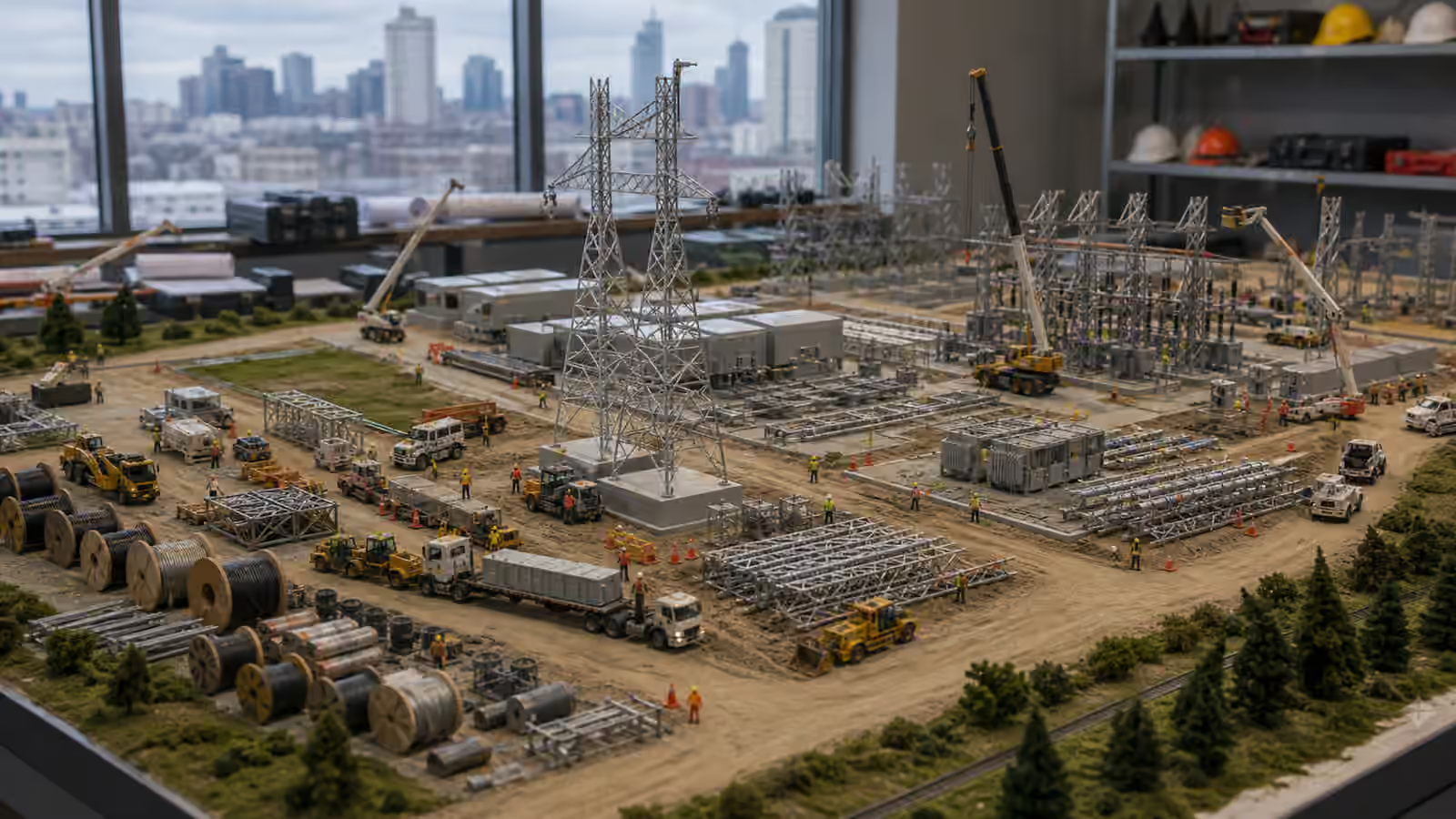
High-voltage direct current sounds like a narrow engineering detail until the grid starts needing power from farther away, across tougher routes, and between systems that do not naturally move in step. Then HVDC becomes one of the most practical tools in the transmission conversation. It is not a new source of electricity, and it does not make siting, permitting, cost allocation, or community trust disappear. It is a way to move large blocks of power with more control than ordinary alternating-current transmission can provide in some settings.
The modern grid is mostly an alternating-current system. AC became the backbone of electric networks because transformers make it practical to raise voltage for efficient long-distance movement and lower it again for local use. That basic architecture still matters. A city, factory, data center, neighborhood feeder, and household outlet all depend on the AC grid around them. But some future energy problems ask for a different kind of link. Remote wind, distant solar, offshore generation, hydropower imports, underground urban corridors, island grids, and neighboring regions that are not synchronized can all make direct current attractive.
The easiest way to think about HVDC is as a controlled bridge. On one side, electricity may come from an AC grid, a wind project, a hydropower region, or a large renewable zone. At the converter station, power electronics convert that AC into direct current. The electricity then travels along overhead lines, underground cables, or submarine cables. At the far end, another converter station changes it back into AC so the local grid can use it. The converter stations are expensive and complex, but they also give operators precise control over how much power crosses the link.
That control is one reason HVDC belongs beside Transmission Bottlenecks in the Powering Tomorrow library. A conventional AC line becomes part of the surrounding synchronized network. Power flows according to physics across many paths, not only along the route planners draw on a map. HVDC is different. Operators can schedule a specific transfer over the link, almost like opening a controllable valve between regions. That does not remove the need for strong AC networks on either end, but it can make long-distance transfers more predictable.
Why direct current helps over distance
Every transmission line has losses. The point of high voltage is to reduce those losses by moving the same amount of power with lower current. AC lines and DC lines can both move large amounts of energy, but they behave differently as distance grows. Over long overhead corridors, HVDC can become attractive because the line losses and right-of-way needs can compare favorably with AC alternatives, especially when the project is meant to move power point-to-point rather than strengthen every intermediate part of the network.
The case becomes even clearer for submarine and long underground cables. AC cables have charging currents that grow with length. In plain language, the cable itself starts acting like an electrical object that must be energized, not only like a simple path for useful power. Beyond certain distances, that behavior can make AC cable links difficult or inefficient. DC cables avoid much of that problem, which is why HVDC often appears in discussions of offshore wind connections, island interties, and underground links through dense areas where overhead corridors are hard to build.
This does not mean HVDC is always better. The converter stations at both ends are major capital projects. They require land, specialized equipment, filters, cooling systems, controls, protection schemes, spare parts, and people who know how to operate them. For shorter lines or ordinary network reinforcements, AC may be simpler and cheaper. The point is not to rank one technology above the other. The point is to choose the right tool for the grid problem.
Converter stations are the price of control
The most visible parts of an HVDC project may be the line or cable, but the converter stations are where much of the engineering lives. They are the translation layer between the AC grid and the DC link. Older HVDC systems often used line-commutated converters, which depend strongly on the AC systems around them. Many newer projects use voltage-source converters, which can offer more flexible control and can help with voltage support in some circumstances. The exact design depends on the project, the connected grids, the amount of power, the cable or line route, and the reliability requirements.
Converter stations make HVDC powerful, but also less casual than a simple wire. A station has to handle high power, switch current precisely, manage heat, limit harmonics, protect equipment during faults, communicate with grid operators, and coordinate with the local protection system. It can affect voltage and power quality around the connection point. That is why an HVDC project is not only a real-estate project and not only a line project. It is a grid integration project.
This connects naturally to Power Quality and Voltage Support . Future grids will have more power electronics, not fewer. Solar farms, batteries, wind turbines, data-center power supplies, industrial drives, and HVDC converters all shape electricity through electronic controls. Those controls can be useful and fast, but they need engineering discipline. A converter station that is well designed for one grid may need different settings, studies, or equipment in another.
The offshore wind example
Offshore wind makes HVDC easy to visualize. A wind area far from shore may need to move power through seabed cables to coastal substations and then into the inland grid. For a near-shore project, AC export cables may be reasonable. As distance and project size grow, HVDC can become more attractive because long submarine AC links become harder to manage. An offshore converter platform or a shore-based arrangement can collect power, convert it, and send a controlled flow toward the onshore grid.
The same logic can apply beyond wind. A remote renewable zone may have excellent sun or wind but weak local demand. A hydropower-rich region may be able to export firm energy to a distant load center. A desert solar corridor may need to serve a coastal city. A large data-center region may want access to more diverse generation than the local grid can provide. In each case, HVDC can turn geography from a hard wall into a difficult but solvable design question.
It still cannot skip the public path. A direct-current line may need fewer conductors for a given transfer than some AC alternatives, and a cable may fit where overhead construction does not. But land, water, views, ecosystems, construction traffic, fishing activity, tribal concerns, local benefits, and cost allocation remain real. Energy Permitting and Community Trust matters for HVDC as much as for any other infrastructure. A technically elegant corridor can still fail if people experience it as something imposed on them for someone else’s benefit.
Connecting grids that do not move together
One of HVDC’s most useful roles is connecting AC grids that are not synchronized. Two neighboring regions may operate at the same nominal frequency but not as one electrical machine. They may have different control areas, different reliability rules, different market structures, or physical reasons not to synchronize. An HVDC link can move power between them without forcing the two AC systems to become one synchronized grid.
This is valuable because regional diversity is a reliability resource. Weather patterns differ. Demand peaks differ. Wind can be strong in one place when another is calm. Solar can fade in one region while another still has daylight. Hydropower, geothermal, nuclear, batteries, demand response, and clean fuels all have different operating patterns. A controllable link between regions can help share those differences without pretending every region should be wired into a single simple network.
That does not mean imports are a substitute for local planning. Resource Adequacy still asks whether a region has enough deliverable capacity during the hardest hours. An HVDC tie can improve that answer if the power is actually available, the link is not already committed, and the receiving grid can handle the flow. It can disappoint if every region assumes the same neighbor will rescue it during the same weather event. The link is a tool inside a portfolio, not a guarantee.
HVDC and curtailment
Curtailment happens when useful clean power is available but cannot be moved, stored, or used in the relevant hour. HVDC can reduce that problem when it connects stranded generation to demand or creates a controlled export path out of a congested region. If a windy area repeatedly turns down turbines because the AC network leaving the area is full, a new long-distance link may let more of that energy reach customers. If a solar-heavy region has frequent midday surplus, a controllable tie to another region may help absorb some of it.
But HVDC is not a vacuum cleaner for every surplus megawatt. The sending-side grid must deliver power to the converter station. The receiving-side grid must be able to accept it. The link has a rating. The converter station may be unavailable for maintenance. The economics must justify the investment. If the surplus lasts for only a few rare hours, storage, local demand flexibility, grid-enhancing technologies, or ordinary AC upgrades may be better. If the surplus is persistent and geographically stranded, HVDC deserves serious attention.
This is why Curtailment is a useful companion to HVDC. Curtailment asks what the grid lacked at a specific place and hour. Sometimes the missing piece is storage duration. Sometimes it is flexible demand. Sometimes it is a local transformer, substation, or protection upgrade. Sometimes it is a long path to another region. HVDC is one possible long path, especially when the route is underwater, underground, very long, or between unsynchronized grids.
What readers should watch for
When an energy plan mentions HVDC, the useful question is not whether the term sounds advanced. The useful question is what job the link is supposed to do. Is it moving remote generation to load? Is it connecting offshore wind? Is it linking regions that cannot synchronize? Is it improving resilience by creating another controlled import path? Is it reducing curtailment? Is it avoiding an overhead corridor through a dense area by using underground cable? The project should be judged against that job.
The next question is what happens at both ends. A clean-energy corridor can still fail if the sending area cannot collect power reliably or the receiving area lacks substation capacity. A link to a data-center corridor may still need local transformers, switchgear, backup coordination, cooling power, and distribution upgrades. A line that looks clean on a regional map can still push costs or land impacts onto communities that do not see direct benefits. HVDC makes some grid problems easier to control, but it does not make them weightless.
There is a useful humility in that. Future energy systems will need more than new plants. They will need AC transmission, DC links, converter stations, substations, distribution upgrades, storage, demand flexibility, interconnection reform, careful markets, and public trust. HVDC is one of the more important tools because it can move large amounts of power across hard boundaries. It helps the grid reach farther and connect more deliberately. Used well, it turns distance into an engineering problem instead of an automatic dead end.