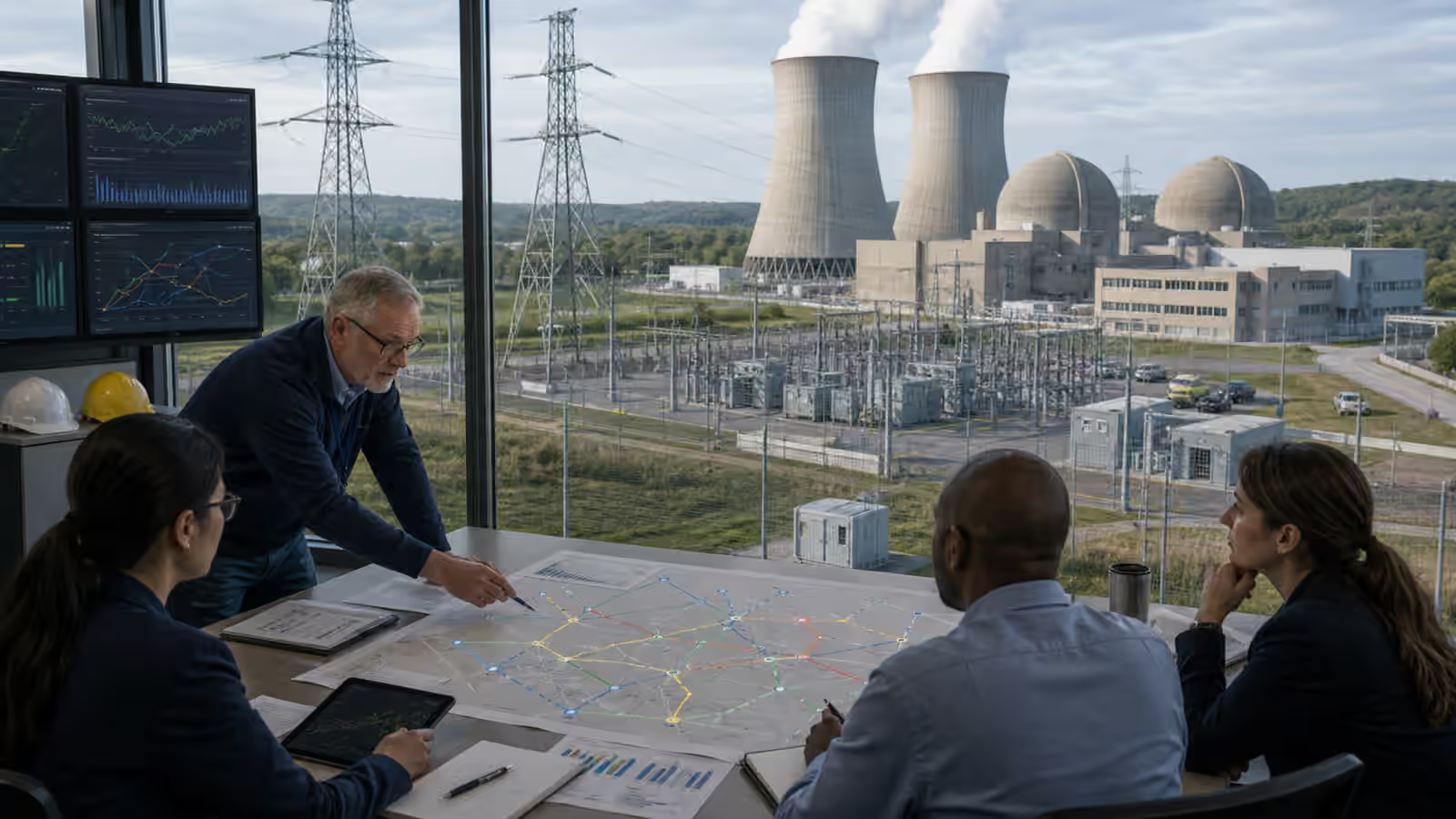
Closing an old power plant can sound like a single decision. A unit reaches the end of its economic life. A company announces a retirement date. A regulator approves a plan. A community prepares for the loss of jobs and tax base. Environmental advocates may welcome the emissions reduction. Local customers may wonder whether reliability will suffer. The headline is simple, but the grid question is not: what replaces the plant’s jobs, and when are those replacements actually ready?
A generator does more than produce annual energy. Depending on the plant, it may provide capacity during hard hours, voltage support, inertia, frequency response, fuel security, local reliability, black-start capability, heat for a district system, or a familiar operating point for a constrained part of the network. Some of those services can be replaced by new tools. Some may no longer be needed in the same way. Some are easy to miss until a study shows that the old plant was quietly supporting a local pocket of the grid.
The future energy portfolio guide explains why no single technology does every job. Generator retirements are where that lesson becomes concrete. The question is not whether old plants should run forever. They should not. The question is how to close them in a sequence that reduces emissions, respects communities, and keeps the grid strong enough during the transition.
The retirement date is not the only date that matters
The public retirement date can hide several other clocks. A replacement solar project may have a construction date, an interconnection date, and a transmission upgrade date. A battery may be installed but waiting for a final operating agreement. A new line may be permitted but years from energization. A demand response program may be approved but not yet enrolled enough customers. A clean firm resource may be planned but not financed. A retiring plant may need maintenance decisions long before the final year because owners will not invest heavily in a unit they expect to close.
Reliability depends on the overlap between those clocks. If replacement resources arrive before retirement, the system can transition with room to learn. If they arrive after, planners may need a bridge plan. That bridge might include short-term contracts, transmission re-dispatch, temporary operation of an older unit, accelerated storage, targeted efficiency, demand response, or local grid upgrades. None of those choices is automatically ideal. The point is to avoid discovering the gap only after the plant has stopped maintaining the equipment needed to run.
Resource adequacy is the planning lens for this problem. It asks whether enough dependable, deliverable capacity exists for the hardest hours. A retirement should be tested against those hours, not against average annual energy. If the retiring plant rarely runs, it may still matter during a cold still evening, a heat wave after sunset, a drought year, a transmission outage, or a fuel disruption elsewhere.
Replacement capacity is not just nameplate capacity
It is easy to compare a retiring 500 megawatt plant with 500 megawatts of new resources and declare the problem solved. The grid cannot use that shortcut. A 500 megawatt solar farm does not provide the same service at midnight as a 500 megawatt thermal unit. A 500 megawatt battery may be extremely valuable for several hours but not for a week of low renewable output unless it can recharge. A 500 megawatt demand response portfolio may depend on customer behavior, weather, notice time, and measurement. A 500 megawatt transmission import may be limited by congestion or by neighboring system stress.
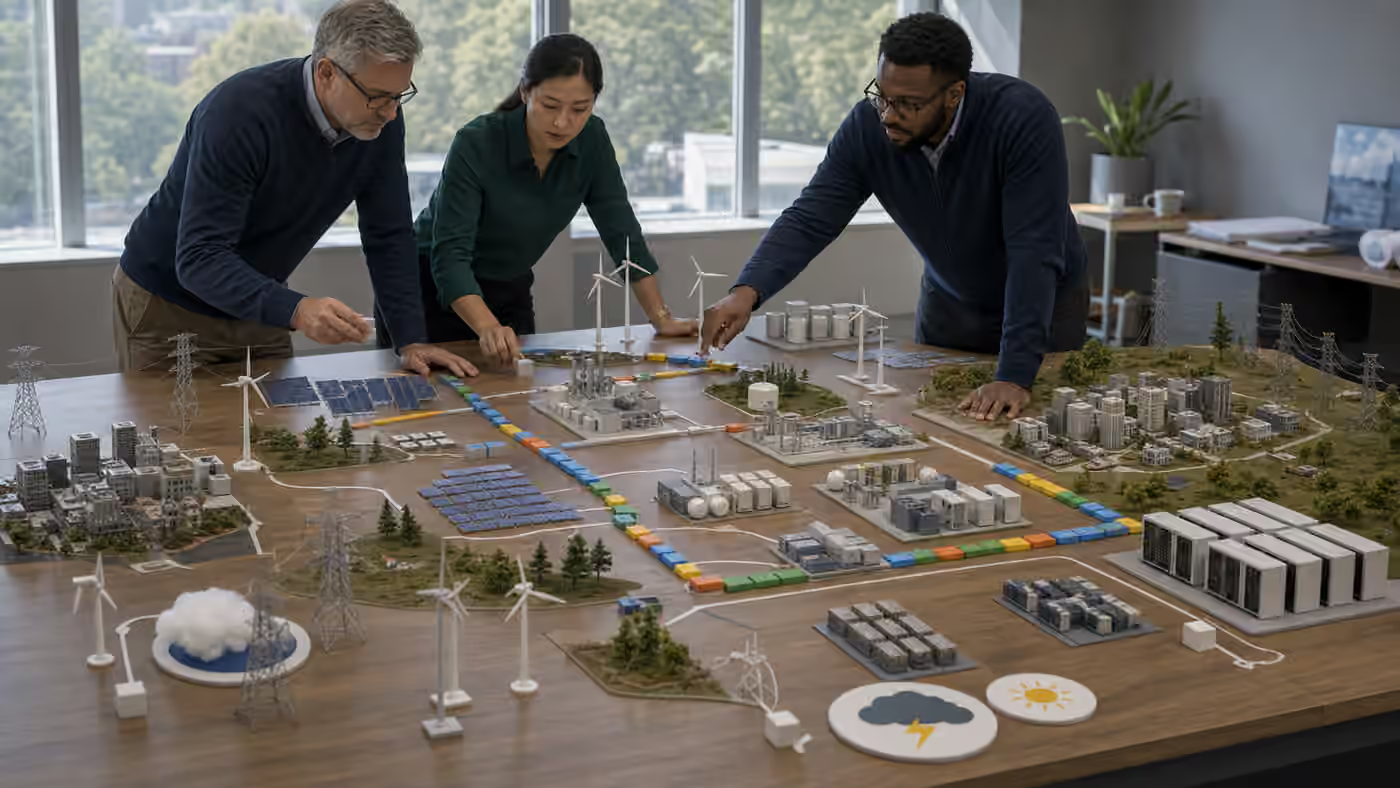
This does not make clean resources weak. It means capacity is a job description, not only a number. Solar can provide abundant low-cost energy during many hours. Wind can complement solar in some regions. Batteries can cover peaks and fast disturbances. Grid-forming inverters can provide stability services when specified and tested. Demand response can reduce the amount of supply needed during tight periods. Clean fuels for the hardest grid hours may help with rare long gaps if the fuel chain is real. Replacement capacity often comes from a package, not one like-for-like machine.
The package has to be evaluated by time and place. A coastal city with limited import paths faces a different retirement problem than a region with strong interties and diverse resources. A plant near a major load center may support local voltage even if its annual energy is modest. A plant at the end of a constrained transmission path may be hard to replace with remote generation until wires are upgraded. The retirement study has to see the grid, not only the plant.
Local reliability can keep old plants around
Some older plants continue running because of local reliability constraints. The issue may be voltage support, transmission security, fault current, thermal limits, or the need to serve load if a nearby line or transformer is unavailable. From a climate or economics perspective, the plant may look ready to retire. From the local grid’s perspective, it may still be covering a weakness.
That situation can be frustrating because it turns a plant into a symptom. Keeping the plant open may be expensive and polluting, but closing it without fixing the local constraint could create reliability risk. The durable answer is to solve the constraint directly. That may mean a new substation, reconductored lines, reactive power equipment, synchronous condensers, grid-forming batteries, protection upgrades, targeted demand response, local generation, or a transmission project. The right tool depends on the constraint.
Power quality and voltage support and grid protection and relays both belong in this conversation. A retiring plant may have been part of the local electrical behavior that protection settings and voltage plans assumed. Replacing energy is not enough if the local network also needs fault response, reactive power, or stable voltage during disturbances.
Communities need a transition, not only a dispatch model
Power plants sit in places. They employ operators, mechanics, technicians, security staff, contractors, cleaners, and suppliers. They pay taxes. They occupy land and sometimes waterfront, rail, pipeline, or transmission access. They can also impose pollution, noise, traffic, health burdens, and industrial risk. Retirement planning has to hold those facts together.
A community that hosted a plant for decades may reasonably ask what comes next. A battery project may reuse the interconnection but employ fewer people. A clean industrial site may need remediation, workforce training, and new investment. A plant site may become valuable for grid equipment because the transmission connection already exists. In some cases, redevelopment can turn a retirement into a local asset. In others, the site may sit idle unless planning begins early.
The grid model will not answer these questions alone. Energy permitting and community trust applies to closures as well as new construction. A retirement plan that celebrates lower emissions while ignoring local economic loss will feel imposed. A plan that protects jobs by delaying every closure without solving pollution or replacement needs will also fail. The stronger approach is to connect reliability sequencing with community redevelopment, workforce pathways, tax planning, and environmental cleanup.
Old plants can create false comfort
Keeping old plants available as insurance may sound prudent, and sometimes a short bridge is exactly what reliability requires. But indefinite dependence on aging plants can create false comfort. A plant that exists on paper may be unreliable if maintenance has been deferred, fuel arrangements are weak, operators are leaving, parts are scarce, or environmental constraints limit operation. Capacity that cannot perform during the hard hour is not a real safety margin.
There is also an investment risk. If the system assumes an old plant will stay, cleaner replacement projects may be delayed. If the plant then fails or retires suddenly, the grid faces a sharper gap. Good retirement planning should make bridge resources explicit, time limited, and tested. It should not let an aging unit become an excuse for avoiding the upgrades needed to close it well.
This is where load forecasting becomes important. A retirement that looked safe under flat demand may become risky if data centers, heat pumps, EV charging, or industrial electrification grow faster than expected. A plan that looked expensive under high demand may be unnecessary if efficiency and flexible load reduce the peak. Forecast uncertainty does not justify paralysis. It just means retirement decisions should be revisited as the actual grid changes.
Clean replacement needs operating proof
The replacement portfolio has to prove itself operationally. A battery should be dispatched and tested in the conditions it is meant to cover. Demand response should demonstrate performance without relying on optimistic enrollment numbers. New renewable projects should have deliverable transmission and realistic curtailment assumptions. Inverter-based resources should have clear ride-through, voltage, and frequency behavior. New transmission should be in service, not merely announced.
Electricity markets and dispatch explains how operating rules shape what resources do hour by hour. Generator retirements test whether those rules value the right services before the old plant exits. If the market rewards energy but not readiness, the replacement portfolio may look cheap until scarcity arrives. If local reliability needs are hidden, the wrong resources may be built in the wrong place. If performance penalties are weak, paper capacity may replace physical capability.
The best retirement sequence creates learning time. Operators gain experience with the new resources before the old unit disappears. Protection engineers review settings. Planners update models. Market rules adjust if a service is missing. Customers and communities see visible progress instead of only receiving a notice that a plant is closing.
Closing carefully is not the same as slowing down forever
There is a real danger in using reliability as a vague argument against change. Every infrastructure transition creates uncertainty, and some incumbents benefit from stretching that uncertainty into delay. A careful retirement plan should be specific enough to avoid that trap. It should identify the reliability need, the replacement project, the milestone, the accountable party, and the date when the old unit is no longer needed. Without that discipline, “not yet” can become a permanent policy.
There is also a danger in treating retirement as a moral declaration rather than an engineering sequence. A plant may be dirty and still locally important until a substation upgrade is complete. A clean replacement may be desirable and still not deliverable before a line is energized. The grid rewards neither denial nor impatience. It rewards work that lines up equipment, permits, contracts, operators, communities, and hard-hour performance.
For a reader, the useful question is direct: what job does the retiring plant perform, and what verified resource will perform that job next? If the answer is annual energy, the replacement may be straightforward. If the answer is winter capacity, local voltage, black start, fuel diversity, or a constrained load pocket, the replacement plan needs more detail. Closing old plants is part of powering tomorrow. Closing them well is how the transition earns reliability while it reduces emissions.