New nuclear technologies attract attention because they promise a different future: smaller reactors, factory manufacturing, advanced fuels, new safety features, and possible fit with data centers or industrial sites. Those questions matter, and the guide to small modular nuclear reactors covers many of them. But future energy planning also has to face a less glamorous fact. Existing nuclear plants already produce large amounts of firm, low-carbon electricity in the regions where they operate.
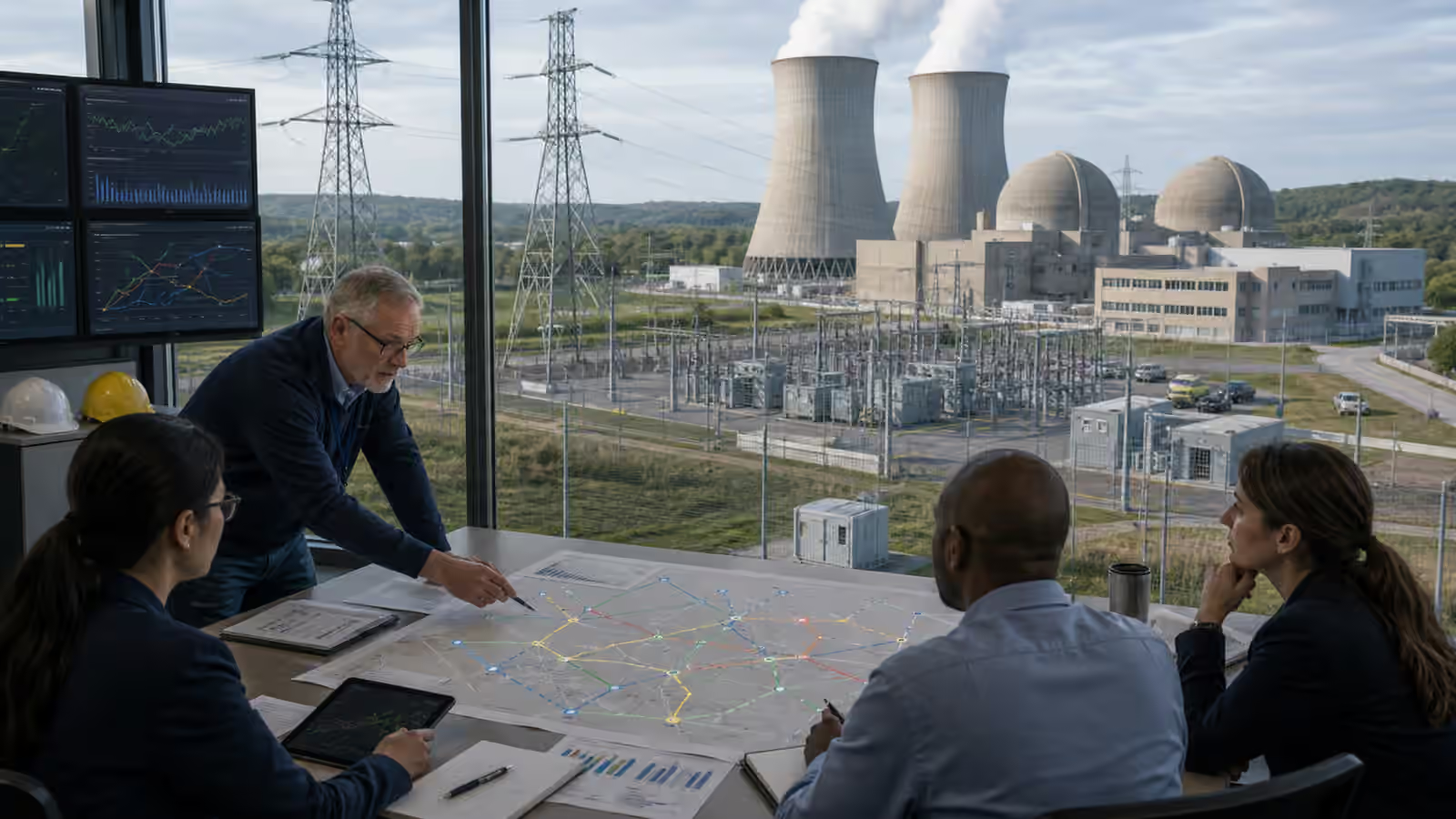
That makes the current fleet part of the transition question. A nuclear plant is not a concept waiting for commercialization. It is a staffed industrial site with licenses, turbines, cooling systems, fuel supply, security, waste obligations, maintenance plans, switchyards, transmission connections, and communities around it. Keeping such a plant running safely is hard work. Closing one is also a major grid event. Either path deserves more care than a slogan.
The guide to generator retirements and replacement capacity explains why closing old plants requires sequencing. Existing nuclear plants are a sharp example because they often provide steady energy, capacity, voltage support through associated equipment, local jobs, and large blocks of carbon-free generation. Replacing the annual energy may be easier than replacing the hourly and local role.
Firm power is not only an accounting category
A nuclear plant usually runs at high output for long periods between refueling outages. It is not perfectly available, and it is not flexible in the same way as a battery or fast gas turbine, but it can provide a stable foundation of electricity. That stability has value in grids with growing variable renewable generation, electrification, and large new loads.
Firm power is sometimes discussed as if it were simply a label. In operations, it has texture. A plant has planned outages, forced outages, ramping limits, maintenance schedules, cooling constraints, staffing needs, and transmission dependencies. During a refueling outage, the grid has to replace the output. During a heat wave, cooling water or ambient conditions may matter. During a transmission constraint, the plant’s location can become important. The plant is firm, but it is still a physical machine tied to a place.
This is why the guide to resource adequacy matters. Adequacy studies ask whether enough deliverable capacity exists during hard hours. A nuclear retirement can change that answer. The replacement portfolio may include wind, solar, batteries, transmission, demand response, geothermal, hydropower, efficiency, or gas capacity with emissions constraints. The right mix depends on the region. What cannot be skipped is the hour-by-hour reliability test.
Lifetime extensions are engineering and trust decisions
Many existing plants were licensed and built in earlier eras. Extending operation requires inspections, maintenance, equipment replacements, regulatory review, safety analysis, and public trust. Large components age. Concrete, cables, pumps, valves, turbines, control systems, and cooling equipment all need attention. A plant can run for a long time only if aging is understood and managed.
This work can be less visible than building something new, but it may be highly valuable. A well-maintained existing plant may avoid the need to replace a large block of firm clean power quickly. It can give a region time to build transmission, storage, renewables, demand flexibility, and other resources in a more orderly way. On the other hand, an extension that ignores cost, safety, waste, local concerns, or unresolved reliability issues can lose legitimacy.
Trust is central because nuclear energy carries public concerns that cannot be waved away. Safety, spent fuel, security, emergency planning, water use, cost overruns, and institutional competence all matter. The evergreen lesson is not that every plant should run forever. It is that decisions should compare real options, real risks, and real replacement plans rather than treating retirement or extension as an identity test.
Uprates and flexibility have limits
Some existing plants can increase output through uprates, turbine improvements, better thermal performance, or equipment upgrades. These changes can add clean energy without building an entirely new generating station. They still require careful analysis because a nuclear plant is an integrated system. More output may affect turbines, cooling, safety margins, licensing, maintenance, and transmission capacity.
Flexibility is also a nuanced question. Some nuclear plants can maneuver output within limits, and some regions use nuclear generation more flexibly than others. But a plant optimized for steady operation may not be the best tool for frequent cycling. If a grid has more solar and wind, operators may need resources that ramp quickly, absorb surplus, or reduce load. Batteries, hydropower, demand response, transmission, and market design may provide that flexibility while nuclear plants provide steady energy.
The guide to ancillary services explains why energy is only one product. Nuclear plants may contribute to reliability in several ways, but a future grid still has to procure fast response, reserves, voltage support, and restoration capability explicitly. Existing nuclear is not a substitute for that operating work.
Closure is a community transition too
If a nuclear plant retires, the effect is not only electrical. Workers, tax bases, local contractors, schools, and public services may be tied to the site. Decommissioning can last years. Spent fuel management remains. The switchyard and transmission connection may still have value for replacement resources, but reusing the site requires planning. Nearby communities may support or oppose different futures for the property.
This is where energy planning overlaps with public planning. A region that decides to close a plant should be able to explain what replaces the capacity and energy, how local reliability is handled, what happens to workers, how the tax base is affected, and how the site will be managed. The guide to energy permitting and community trust applies here as much as it applies to new wires or battery yards. People are more likely to trust decisions when tradeoffs are visible.
The same is true when a plant continues operating. Communities need credible safety oversight, emergency communication, environmental monitoring, and economic clarity. Existing infrastructure is not automatically accepted just because it is already there.
The current fleet buys time, but not an excuse
Existing nuclear plants can buy time for a cleaner, more reliable grid. They can reduce the pressure to replace firm energy during the same years when data centers, EV charging, heat pumps, and industrial electrification may raise demand. They can help keep emissions lower while transmission and storage projects move through slow development paths.
But time is useful only if it is used. If a region keeps a plant open, it should still build the rest of the future grid: renewables, transmission, demand flexibility, storage, efficiency, and better planning. If a region closes a plant, it should have a replacement plan that works in actual hard hours, not only in annual energy totals. Existing nuclear plants are neither a magic answer nor a footnote. They are large, real machines already embedded in the power system, and that makes them one of the most practical topics in future energy.