
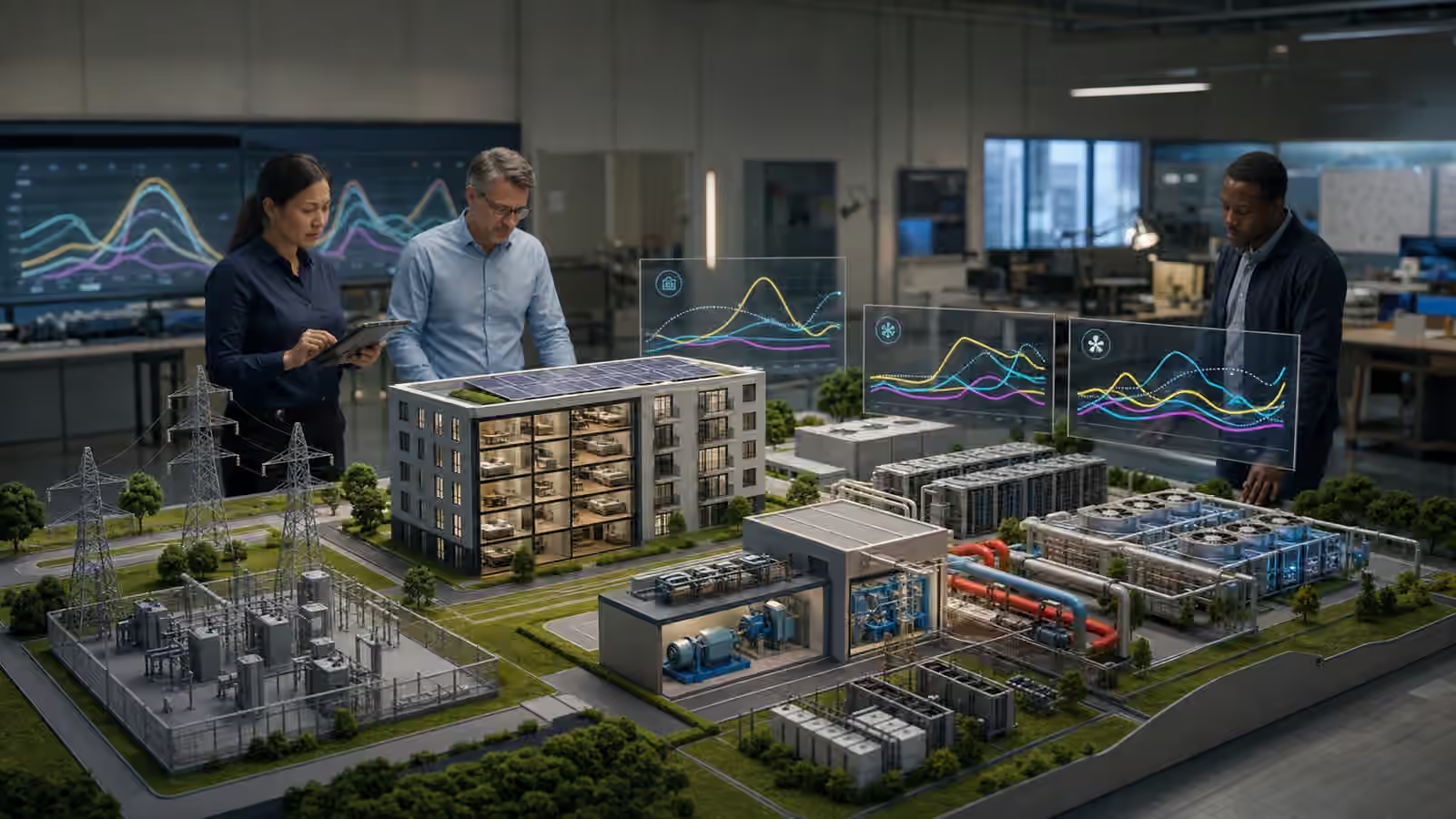
Energy efficiency is easy to understate because it does not look like a power plant. There is no skyline silhouette, no field of panels, no cooling tower, no spinning turbine, no battery container lined up behind a fence. A more efficient building, pump, motor, chip, compressor, chiller, furnace, or control system usually looks like ordinary infrastructure doing its job with less waste. Yet that quiet reduction can change the size, timing, and cost of the grid that has to serve it.
The future energy conversation often begins with supply. How much solar can be built? How much wind can connect? Which firm power sources can run through the hardest hours? How many batteries will be needed? Those are real questions, and the future energy portfolio guide explains why the answer is a mix rather than a single favorite technology. Efficiency changes the same portfolio from the demand side. If a load needs less electricity to do the same useful work, every upstream resource has less work to do. The wires carry less. Transformers heat less. Batteries stretch further. Backup systems face fewer extreme hours. Planners get a little more room to breathe.
That does not mean efficiency is a magic substitute for generation, storage, or transmission. A growing economy can become more efficient and still use more electricity overall, especially as transport, buildings, industry, and computing move toward electric systems. The point is narrower and more practical: demand has a shape, and good efficiency changes that shape before the grid has to serve it.
Useful work is the real target
Electricity is not valuable because electrons moved through a meter. It is valuable because something useful happened. A room stayed comfortable. A server completed a computation. A motor moved air or water. A heat pump lifted heat from one place to another. A factory held a process at the right temperature. A charger put enough energy into a vehicle for the next trip. Efficiency begins by asking how much electricity is needed for that useful work, not merely how much electricity was bought.
This distinction matters because waste hides in support systems. A data center may spend electricity on computing, but also on fans, pumps, chillers, power conversion, humidity control, lighting, and backup systems. A factory may use electricity for motors, compressed air, refrigeration, heat, pumping, and controls. A home may use it for heating, cooling, cooking, water heating, electronics, and charging. Each use has its own losses and operating habits. The best first move is often not a new energy source, but a better understanding of where the energy actually goes.
The AI data-center power demand guide makes this concrete. Chips matter, but the building around the chips also matters. Efficient power supplies, better rack utilization, liquid cooling where it is appropriate, cleaner airflow paths, right-sized pumps, and less wasteful software can all reduce the power required for a unit of computing. None of those choices makes AI infrastructure free. They do decide whether a new campus asks the grid for a little less capacity every hour of its life.
Peak demand is where efficiency becomes capacity
The grid is built for difficult moments, not average afternoons. A region with a high summer peak needs enough generation, transmission, substations, transformers, and operating reserves for the hottest hours. A region with electric heating may face winter peaks during cold snaps. A neighborhood with many chargers and heat pumps may stress a local feeder during the evening even if annual electricity use looks manageable.
Efficiency becomes especially valuable when it lowers those peaks. Better insulation can reduce heating demand during cold weather. High-performance windows can reduce cooling load during hot afternoons. Efficient motors and variable-speed drives can reduce industrial demand while improving control. A well-designed data-center cooling system can reduce the difference between a normal hour and a stressed hour. Efficient lighting is now familiar, but the same principle applies to pumps, fans, compressors, refrigeration, and process equipment.
The link to resource adequacy is direct. Adequacy planners care about whether the system can serve load during the hardest hours. If efficiency trims those hours, it can reduce the amount of capacity that must be built or kept available for rare stress events. That does not make efficiency identical to a dispatchable plant. It cannot be called on like a generator unless paired with controls or programs. But permanent load reduction changes the planning baseline. The hard hour is still hard, just smaller.
Load shape matters as much as annual savings
Two efficiency projects can save the same annual energy and have very different grid value. One may reduce load at noon when solar is plentiful and the grid is comfortable. Another may reduce load at the winter morning peak when heating demand is high and power imports are tight. The annual savings could look similar in a report, but the second project may help reliability more.
This is why load shape belongs beside efficiency. Load shape describes when electricity is used across the day, week, and season. A building retrofit that reduces evening cooling demand changes one shape. A better industrial compressed-air system that runs steadily rather than cycling wastefully changes another. A data center that improves utilization may reduce constant baseload demand. A heat pump water heater with a smart tank may shift some work away from peak hours while still delivering hot water when people need it.
Demand response changes load shape through active control. Efficiency changes load shape through better equipment, envelopes, processes, and defaults. The two are strongest when designed together. A well-insulated building can pre-cool or coast through a short demand response event with less discomfort. An efficient water heater or thermal storage system has more room to shift timing. A factory that has fixed leaks, tuned controls, and stabilized processes may be better able to offer limited flexibility without damaging production.
Buildings are slow-moving grid assets
Buildings are often discussed as private property, but their energy behavior becomes public infrastructure at scale. Millions of walls, roofs, windows, ducts, thermostats, water heaters, and heat pumps shape the peaks that utilities must plan for. A poorly insulated building with an undersized or poorly installed heat pump may lean on backup heat during cold snaps, exactly when the grid is stressed. A better envelope can turn the same electrification project into a steadier load.
The home electrification and grid flexibility guide covers this from the household side. The same idea applies to apartments, offices, schools, warehouses, hospitals, and stores. Air sealing, insulation, commissioning, efficient ventilation, controls, and maintenance are not glamorous, but they decide how much electricity a building needs before anyone starts debating new power plants. Good building efficiency also protects comfort. A home that loses heat slowly is more resilient during outages and easier to manage during demand events than one that leaks heat immediately.
For distribution planners, those differences add up. Distribution grid upgrades are driven by local load growth, not national averages. If a feeder adds EV charging, heat pumps, rooftop solar, and new buildings, the utility has to decide whether wires, transformers, regulators, and protection settings are still adequate. Efficiency cannot remove all of that work, but it can slow the climb and sometimes avoid the most awkward upgrades.
Industry has hidden efficiency before electrification
Industrial electrification is often framed as replacing a fossil fuel burner with an electric technology. Sometimes that is the right project. Often the better first question is where the process wastes heat, pressure, motion, or cold. Steam leaks, uninsulated piping, oversized pumps, throttled valves, poorly controlled fans, compressed-air leaks, old motors, fouled heat exchangers, and rejected heat streams can all create demand that no clean power source needed to serve in the first place.
The industrial electrification guide notes that a credible factory plan begins with a heat map of the site. Efficiency is part of that map. A heat pump may work better after waste heat is recovered and temperatures are understood. An electric boiler may need less grid capacity after steam losses are repaired. A variable-speed drive may reduce both energy use and mechanical stress. Better controls may smooth ramping, which can help power quality and voltage support as much as energy bills.
Industrial efficiency also changes how much firm power is needed. A factory that lowers its peak process demand may need a smaller transformer, smaller backup system, smaller interconnection request, or less costly substation work. Those savings are site-specific, but the principle is general. The cleanest retrofit is often the one that avoids oversizing every piece of electrical infrastructure downstream.
Efficiency needs measurement, not slogans
Efficiency programs can become vague when they are described only as virtue. Serious efficiency is measured. Engineers compare before and after performance, normalize for weather and production where needed, and check whether savings persist. Building commissioning verifies that equipment operates as intended. Industrial energy audits trace real loads. Data-center operators watch useful computing work, cooling energy, water constraints, and power conversion losses. Utilities need credible methods before they can count efficiency in planning.
The measurement does not have to be perfect to be useful, but it has to be honest about uncertainty. A thermostat setting changed by a tenant is different from a permanent insulation upgrade. A motor replacement has one kind of persistence; a behavior campaign has another. A software optimization may save energy until workloads change. A building retrofit may underperform if installation quality is poor. Treating all claimed savings as identical can create false confidence.
This is one reason efficiency deserves a place in grid planning rather than only in consumer advice. When utilities, regulators, builders, equipment vendors, and large customers can see when and where savings occur, efficiency becomes more than an annual total. It becomes an input to capacity planning, local grid upgrades, emissions accounting, and customer programs.
The quiet resource still has limits
Efficiency has rebound effects, split incentives, upfront costs, contractor constraints, and uneven access. A landlord may not pay for improvements when tenants pay the utility bill. A factory may delay a retrofit during a production crunch. A homeowner may not know whether a contractor’s proposal is sound. A data center may improve efficiency and still expand total load because demand for computing grows faster. These limits are real, and they are why efficiency cannot carry the future grid alone.
Still, ignoring efficiency makes every other problem larger. More generation must be built. More transmission must be permitted. More storage must cover peaks. More transformers must be ordered. More fuel or firm capacity must be ready for rare events. Efficiency is not dramatic because its best result is absence: a peak that did not grow, a substation upgrade that could wait, a battery that lasted longer, a data-center campus that asked for fewer megawatts, a factory that electrified without overwhelming its connection.
The future grid will need new supply, stronger wires, storage, firm resources, flexible demand, and better controls. It will also need a habit of asking what useful work is being served and how much waste can be removed before the buildout begins. Energy efficiency is not the whole story of powering tomorrow. It is the discipline that keeps the rest of the story from becoming larger than necessary.


