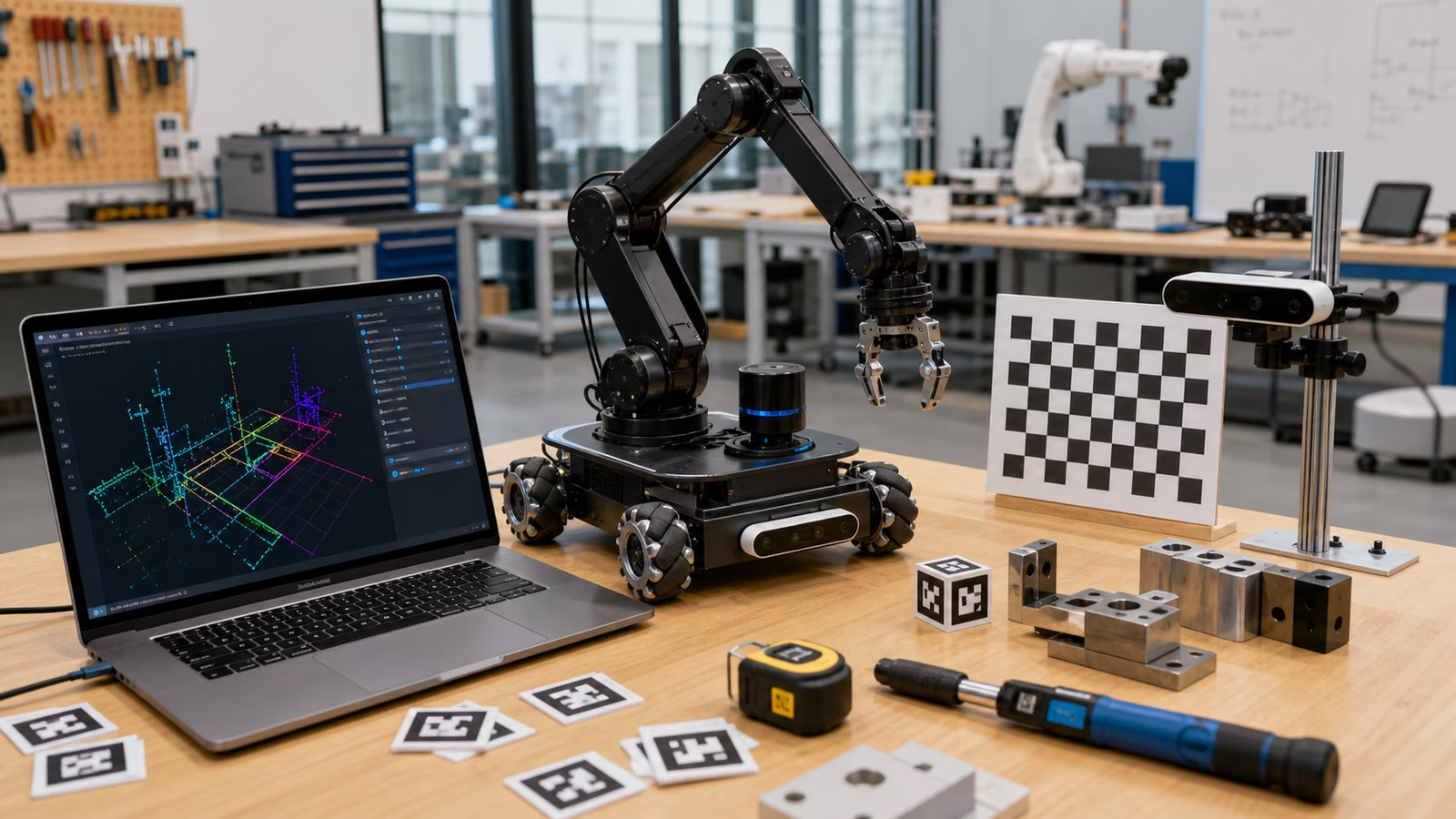
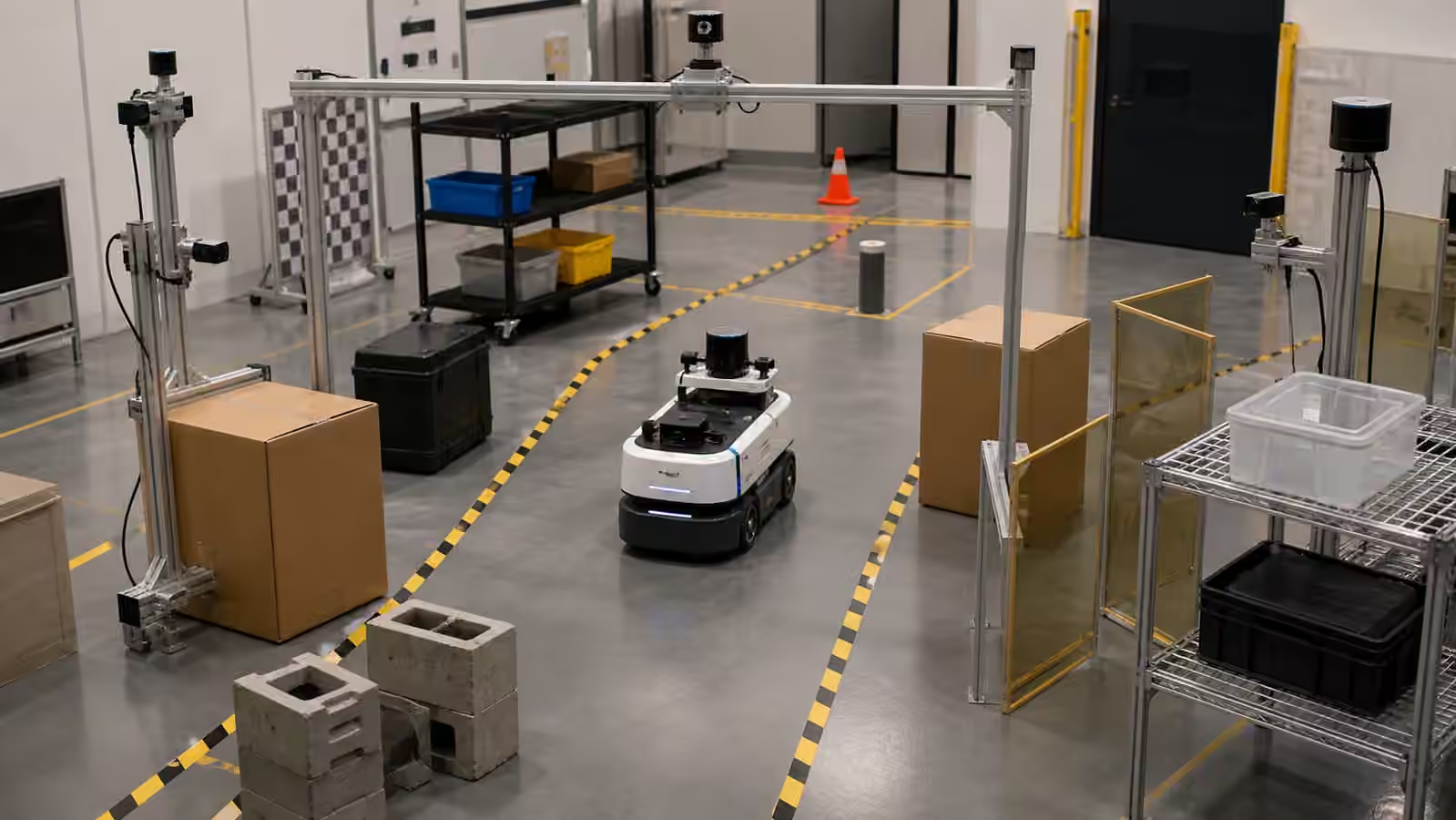
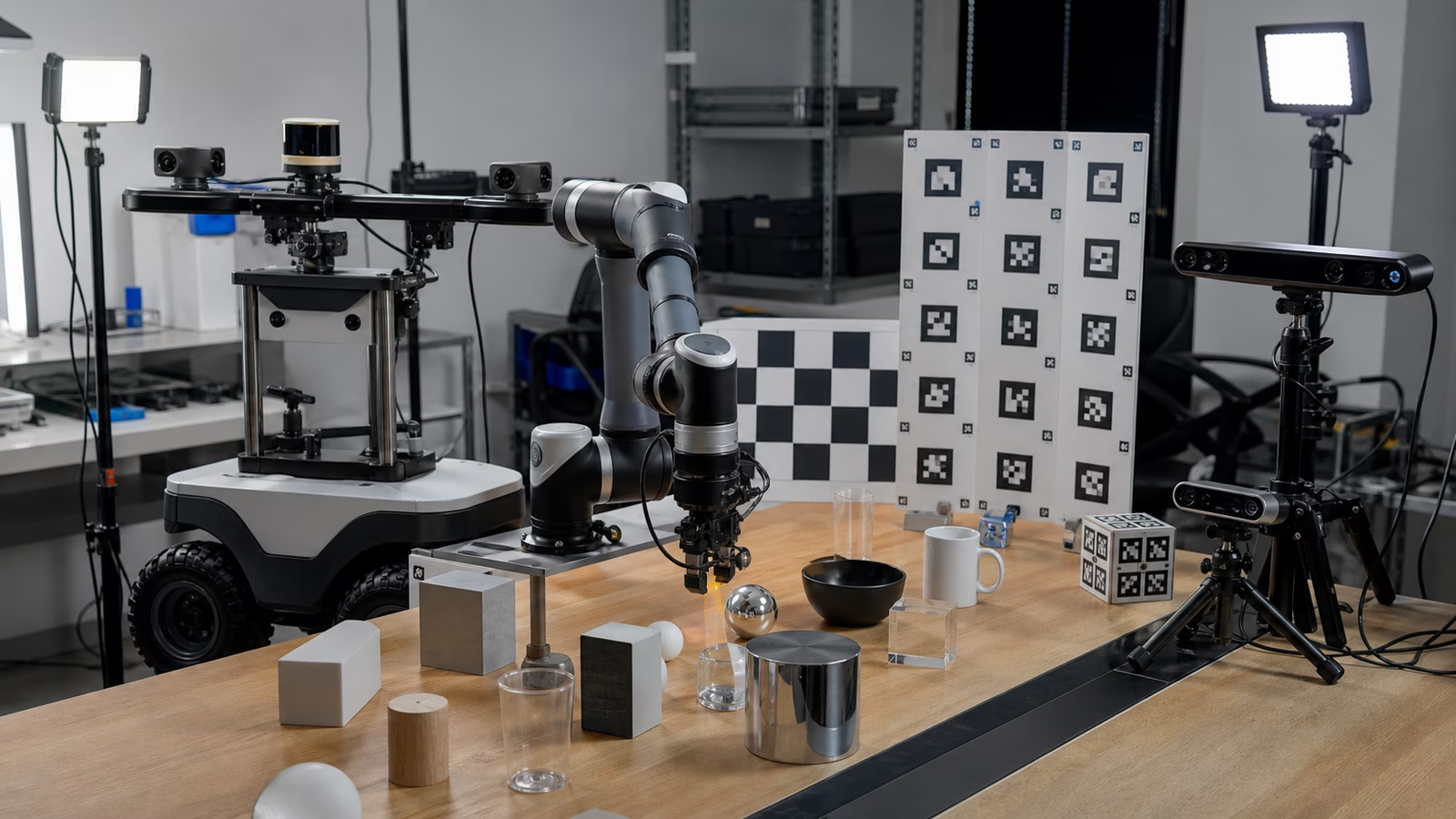
A robot rarely sees one clean version of the world.
The camera notices a bright edge on a box. The depth sensor reports a surface that is partly missing because the material is glossy. The lidar sees a clean obstacle outline but not the thing sitting on top of it. Wheel encoders say the robot moved a little farther than the floor markers suggest. The IMU reports a bump that looks like a quick tilt. A force sensor says the gripper touched something before the vision system expected contact. None of those signals is the whole truth. Each is a partial measurement made from a particular place, at a particular time, with its own failure habits.
Sensor fusion is the discipline of turning those partial measurements into a usable belief. It sits between Robot Perception and action. Perception asks what the robot can observe. Fusion asks how much to trust each observation, how to combine it with the others, and when the combined story is still too uncertain for motion.
This matters because robots act with mass, speed, tools, and deadlines. A small mistake in a picture may be harmless on a website. A small mistake in a robot’s estimated pose can make a gripper miss a handle, a mobile base clip a cart, or an arm press into a fixture. Physical AI needs estimates that are not only plausible, but calibrated enough to support cautious behavior.
Agreement Is Not Guaranteed
Many robotics demos look as if sensors agree by default. They do not. Sensors disagree because they observe different physics. Cameras respond to light, texture, exposure, glare, and shadows. Lidar responds to distance and reflectance. Depth cameras can struggle with sunlight, black surfaces, glass, and thin edges. IMUs feel acceleration and rotation but drift over time. Encoders measure wheel or joint motion, not the whole truth of floor slip, backlash, or compliance. Force sensors notice contact, but contact may arrive after the robot has already made a poor assumption.
The useful question is not which sensor is best. The useful question is what each sensor is allowed to prove. A camera may classify an object, while lidar helps locate the free space around it. Encoders may provide smooth short-term motion, while external landmarks correct drift. A wrist force sensor may confirm that a grasp actually touched the object, while vision estimates where the object was before contact. Fusion is less like voting and more like careful testimony. Each witness has a field of view, a bias, and a known way of being wrong.
Good systems make those limits explicit. They avoid treating a single confident output as reality. They attach uncertainty to position, velocity, object pose, map alignment, contact state, and classification. The robot does not simply know where the shelf is. It has an estimate of where the shelf is, how recent that estimate is, and how badly the estimate could hurt the task if it is wrong.
Time Is Part Of The Measurement
Robots move while they measure. That makes timing as important as geometry. A camera frame captured fifty milliseconds before a lidar scan may not describe the same scene if the robot is turning, the object is moving, or a person walks through the field of view. A force reading may belong to a joint position from a fraction of a second earlier. A map update may arrive after a planner has already committed to a path.
This is why sensor fusion often begins with clocks. Timestamps, synchronization, buffering, and latency compensation are not implementation details to be left until the end. They decide whether measurements can be meaningfully compared. A clean calibration target will not fix a system that combines old camera images with current odometry and delayed motor state.
Robot Calibration and Alignment explains the geometry behind reliable motion. Fusion adds the time dimension to that geometry. The robot needs to know not only where a camera is mounted, but when its frame was captured relative to the robot’s motion. It needs to know not only where the gripper is, but whether the force reading corresponds to the current pose or an earlier one. In fast or contact-rich tasks, stale truth can be as dangerous as false truth.
Confidence Should Change Behavior
Uncertainty is useful only if it changes what the robot does. A system that computes confidence but moves the same way regardless has not gained much. The point is to let the robot slow down, seek another view, ask for help, choose a safer grasp, widen its clearance, retry localization, or decline a task when the belief is not good enough.
This connection between belief and action is where fusion becomes operational. A mobile robot that is highly confident in an open corridor can move differently from a robot that is unsure near a reflective doorway. A robot arm that sees an object clearly can use a direct motion, while one that is unsure may approach more slowly and rely on contact sensing near the end. A home robot that cannot distinguish a toy from a cable should not pretend the ambiguity is harmless. It should act as if uncertainty is part of the scene.
Confidence also affects human trust. If a robot simply stops and reports an error, the operator sees failure. If it reports that localization confidence dropped near a known trouble area, the event becomes easier to interpret. Robot Operator Interfaces is relevant here because the interface should not expose raw uncertainty as mathematical clutter. It should translate uncertainty into practical state: safe to approach, waiting for route clearance, needs relocalization, grasp uncertain, or human review requested.
Fusion Can Hide Bad Assumptions
Fusion sounds like it should make systems more robust, but it can also hide mistakes. If one sensor is badly calibrated, the fused estimate may look smooth while being wrong. If the system trusts a map too strongly, fresh sensor evidence may be ignored. If the training data never included certain lighting, surface, or contact conditions, a learned fusion model may be confident in places where it should hesitate.
This is especially important in field deployments. A robot may work well in a lab lane and slowly become worse as sensors drift, wheels wear, cameras get dusty, fixtures move, or software settings change. The fused output can continue looking reasonable until a task fails in a way that is hard to diagnose. The problem may not be perception alone, or localization alone, or control alone. It may be the way the system reconciled them.
Robot Observability and Field Logs becomes essential when fusion is involved. Logs should preserve enough raw and intermediate evidence to explain why the robot believed what it believed. If only the final fused state is saved, the team loses the trail. Field support needs to know whether the camera was confused, the lidar was blocked, the odometry slipped, the clock drifted, or the fusion logic overruled a warning signal.
Contact Completes The Picture
Robots that manipulate objects eventually learn that vision is only the beginning. The object may move during approach. The handle may flex. The gripper pad may touch a corner instead of a face. A suction cup may seal poorly. A cloth may deform. A cable may snag. Once physical contact begins, cameras and depth sensors may be occluded by the robot’s own hand.
Contact signals give the robot a different kind of evidence. Force, torque, tactile arrays, motor current, pressure, and compliance can reveal whether the world is pushing back as expected. Robot Contact Sensing and Force Control covers that touch layer in depth. Fusion is how the robot connects it with the rest of the scene. A planned grasp becomes more trustworthy when vision, joint state, and contact all support the same story. It becomes suspect when the wrist feels resistance before the expected surface, or when the gripper closes farther than it should.
The same idea applies to mobile robots. A wheel slip event, sudden vibration, bumper touch, or unexpected tilt can contradict a clean map. The robot should not treat those signals as noise by default. Sometimes the body discovers what the sensors missed: a floor lip, soft mat, pallet strap, loose cable, or load shift.
The Practical Test Is Graceful Doubt
A strong fusion system is not one that always sounds certain. It is one that doubts gracefully. It can combine sensors when they support each other, separate them when they disagree, preserve evidence for later review, and let uncertainty shape motion. It knows that a clean estimate is not the same as a safe estimate. It treats timing, calibration, and field drift as part of perception rather than afterthoughts.
When evaluating a robot, ask what happens when the sensors disagree. Does the robot slow down? Does it seek a better view? Does it ask for human help in plain operational terms? Does it log the disagreement? Can support staff see the raw evidence behind the fused belief? Does the autonomy stack know the difference between confident action and convenient assumption?
Physical AI becomes more useful when robots can act on imperfect information without pretending it is perfect. Sensor fusion is the craft of living with that imperfection. The robot does not need omniscience. It needs enough grounded belief to move carefully, recover honestly, and learn from the moments when the world did not match the model.