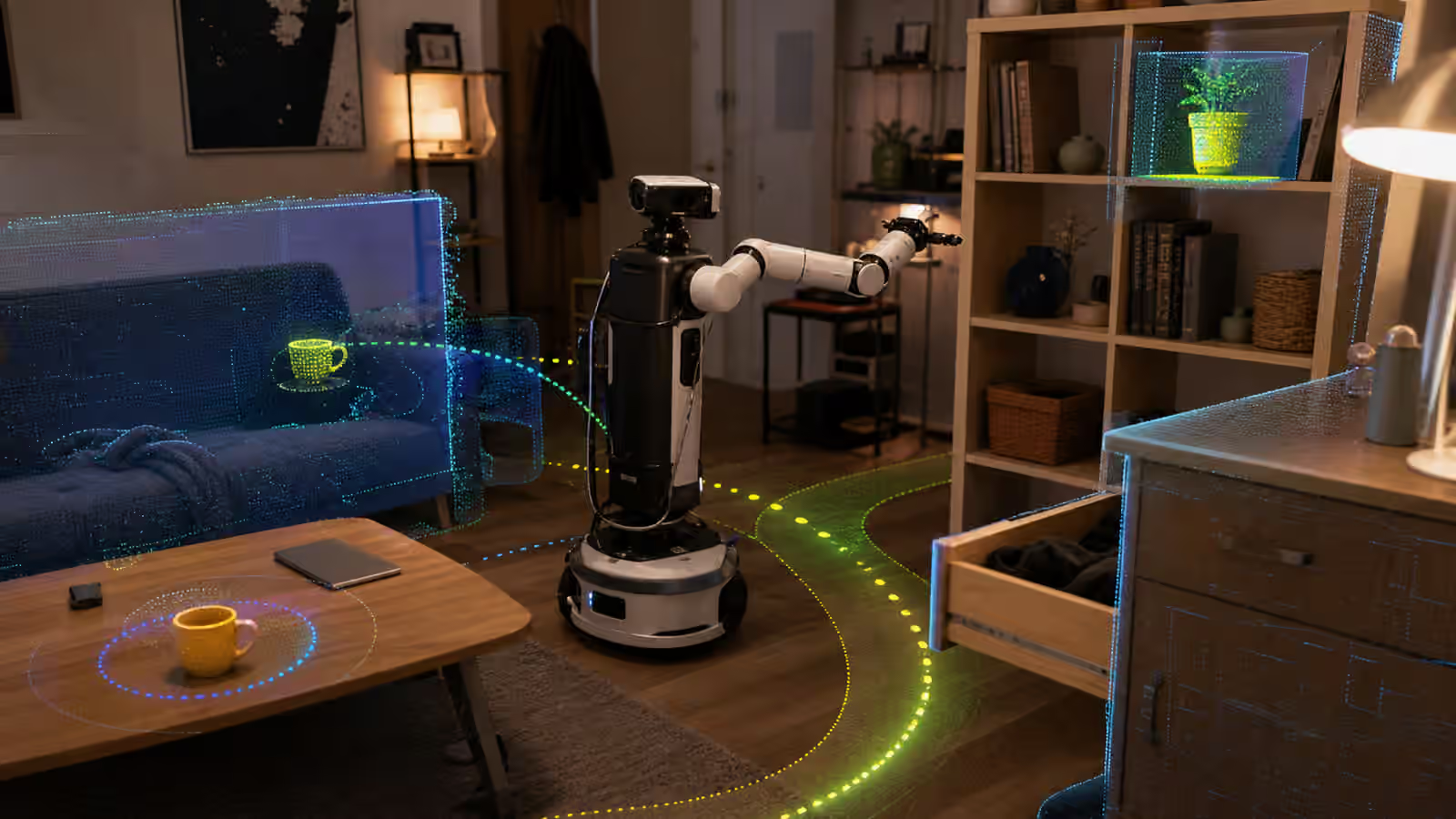
A robot can look directly at a mug, turn away, and then lose the mug as a useful fact.
That sounds strange because people do not experience rooms as fresh images. We remember that the mug is probably still on the table, that the drawer is open because we opened it, that the toy under the chair may block the vacuum later, and that a person who just walked into the kitchen might return through the same doorway. We are often wrong, but we carry a working belief about the world between glances. Robots need a version of that ability if they are going to do more than react to the latest sensor frame.
Scene memory is the robot’s record of what it has observed, where it believes things are, how confident those beliefs are, and what changed after it acted. Object permanence is the narrower idea that objects can continue to exist when they are out of view. These ideas sit between Robot Perception and Robot Task Planning and World Models . Perception supplies observations. Task planning needs a working world. Scene memory keeps the two from collapsing into a single moment.
A Fresh Frame Is Not Enough
Robots often begin with frame-level perception because it is easier to measure. The camera sees an object. The model labels it. The system estimates a pose. That is useful, but it is not the same as understanding a changing room. A single frame may hide the back of an object, miss a shelf behind a person, confuse a reflection, or fail to see a cable under a chair. If the robot forgets everything outside the current frame, it becomes easily surprised by ordinary life.
Homes make this obvious. A person sets keys on a table, moves a chair, closes a door, opens a cabinet, drops a towel, and walks away. The robot may not see every action. It may only see the aftermath. Robot Perception in Messy Homes explains why ordinary rooms are difficult; scene memory explains how the robot can avoid treating every occlusion as ignorance and every old observation as truth.
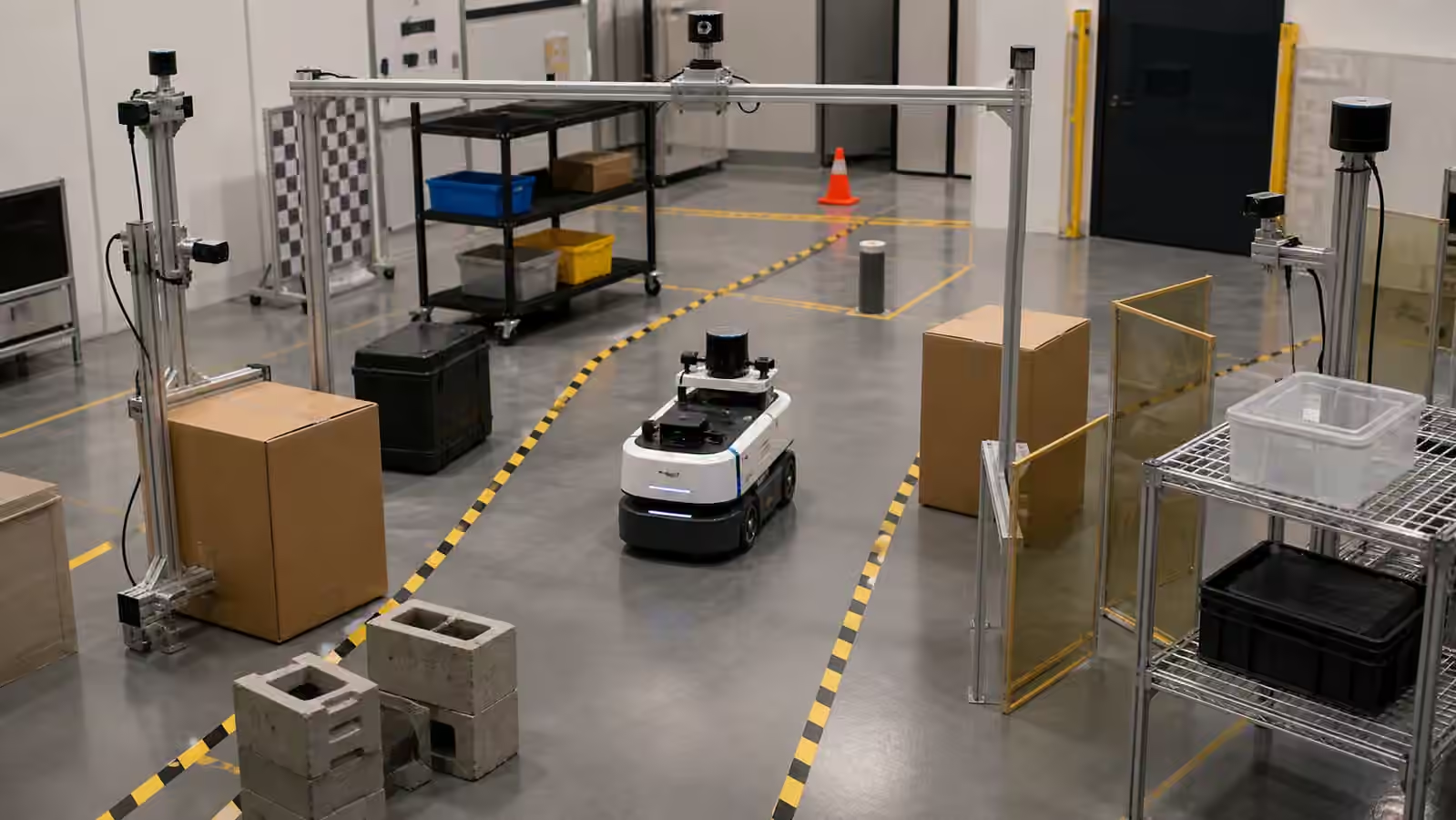
Warehouses and labs have the same problem in a more structured form. A tote may be scanned at receiving, moved to a staging rack, picked by a person, then placed in a lane. A mobile robot that saw the tote earlier should not assume it remains there forever. It should know that the observation has aged, that other actors can move objects, and that some locations are more reliable than others.
Memory Needs Confidence
Scene memory fails when it becomes too certain. A robot that remembers a box on a shelf without remembering the age of the observation may reach into empty space. A robot that assumes a hallway remains clear because it was clear ten seconds ago may drive into a newly parked cart. A home robot that remembers a pet bowl location without noticing that the bowl moved may make a mess.
Useful memory carries confidence. The robot can treat a fixed wall differently from a chair, a chair differently from a toy, and a toy differently from a person. It can decay confidence over time, mark objects that were last seen under occlusion, and prefer fresh observations before contact. It can distinguish a known empty space from an unseen space. That distinction matters because the safest action may be to move the sensor, not the gripper.
Robot Sensor Fusion and Uncertainty gives the broader uncertainty vocabulary. Scene memory applies it over time. The robot is not simply asking what it sees. It is asking what it believes, why it believes it, how old the belief is, and what action would be risky if the belief is wrong.
Actions Must Update The Room
A robot changes the scene by acting. If it pushes a drawer open, the drawer state should change in memory. If it picks up a cup, the cup should move from the table to the gripper. If the grasp fails, the cup may still be on the table, tipped over, partly hidden, or on the floor. A planner that does not update state after action becomes a script pretending to be autonomy.
This is especially important for manipulation. Robot Grasping in Real Homes describes the difficulty of picking ordinary objects. Scene memory gives grasping a history. The robot can remember which approach failed, which object shifted, whether the surface is now cluttered, and whether a second attempt would repeat the same mistake. Without that memory, recovery becomes repetitive rather than intelligent.
The same logic applies to navigation. A mobile robot that reroutes around a blocked corridor should remember the blockage long enough to avoid sending the next robot into the same frustration. A fleet system may hold the shared memory, but the principle is the same: observations and actions should leave traces that improve the next decision.
Hidden Objects Are Not Empty Space
Occlusion is where object permanence becomes practical. A cereal box behind another box is not gone. A cable under a towel is not safe floor. A person behind a cart may step out. A drawer hides objects the robot may or may not be allowed to handle. Treating hidden areas as empty creates avoidable contact and poor task choices.
Robots can handle occlusion cautiously by representing what is known to be visible, what is known to be hidden, and what is only guessed. A mobile manipulator may choose a better viewpoint before reaching. A home robot may refuse to grab an object if a fragile item might be behind it. A warehouse robot may slow near a blind corner because the current scan does not prove the corner is clear.
Robot Sensor Placement and Blind Spots covers what sensors cannot see from their mounting points. Scene memory is the software consequence of those blind spots. It should prevent the robot from confusing unseen with safe.
Places Have Habits
Scene memory can also learn the habits of a place without turning them into brittle assumptions. A charging dock is likely to remain in one area. A trash bin may move slightly but usually stays near a station. A kitchen counter collects cups. A receiving lane becomes crowded at certain times. These patterns can help a robot search and plan, but they should not be treated as guarantees.
This is where memory becomes operational rather than magical. If a robot often finds obstacles near a doorway, that pattern may belong in site design. If objects frequently arrive in the wrong staging pose, the fix may be Robot Object Presentation and Staging rather than a cleverer perception model. Memory can reveal that the world is asking the robot to solve an avoidable problem every shift.
The best systems keep pattern knowledge connected to evidence. They know which observations came from the robot, which came from a facility system, which came from a human update, and which are inferred. A remembered scene should be inspectable enough that people can understand why the robot is behaving cautiously.
Privacy Is Part Of Remembering
Remembering physical scenes creates privacy questions. A home robot may remember room layout, object locations, visitors, routines, and sensitive areas. A workplace robot may remember inventory, workflows, worker movement, and restricted zones. More memory is not automatically better. The robot should remember what it needs for safe, useful work and protect that memory with appropriate access and retention.
Robot Privacy and Data Governance covers the broader policy surface. Scene memory is where it becomes concrete. The robot may need a durable map but not a permanent image stream. It may need to know that a room is prohibited without storing why. It may need short-lived object state for a task and longer-lived fixture state for navigation. Good memory design is selective.
Forgetting Can Be A Feature
A robot that never forgets becomes stale in a different way. It may preserve clutter that was cleaned, blocked routes that reopened, object poses that changed, or permissions that expired. Forgetting should be designed, not accidental. Some facts should decay quickly. Some should require revalidation after a site change. Some should be cleared when a task ends. Some should persist because they describe the fixed environment.
This connects to Robot Site Change Management . When furniture, routes, docks, fixtures, or storage patterns change, scene memory has to learn the new normal without silently mixing it with the old one. Map updates and object memory should not become a pile of contradictory history.
Scene memory is valuable because the world does not pause between frames. It lets a robot act with continuity, humility, and caution. It helps the machine ask for a better view, avoid repeating failed actions, remember that hidden things may still exist, and explain why an old belief is no longer strong enough for contact. A useful robot is not the one that remembers everything. It is the one that remembers enough, with the right uncertainty, for the next physical action.