A robot purchase should be a decision about evidence, not excitement. The excitement is understandable. A machine moves through a space, responds to commands, handles objects, avoids people, and appears to turn software into useful work. That moment can be impressive. It can also be misleading if the buyer has not defined what the robot must prove, what support it will need, and what ordinary failure will cost the site after the demonstration team leaves.
Robot Demo Evaluation teaches the habit of looking past a polished clip. A procurement pilot adds responsibility to that habit. The question is no longer only what the robot appears able to do. The question is what evidence would justify a deployment decision in a real site, with real people, real exceptions, real maintenance, and a clear path for saying no, not yet, or only within a narrower task.
A Pilot Should Answer A Decision
Some pilots fail before the robot arrives because no one knows what decision the pilot is meant to support. A vague pilot asks whether the technology is promising. That can produce interesting meetings, but it rarely produces a disciplined buying decision. A stronger pilot asks a narrower question: can this robot perform this defined task, in this operating environment, with this support model, well enough to justify the next step?
The next step may be a larger rollout, a second pilot, a different task, a request for product changes, or a stop. All of those outcomes can be rational. The pilot is not a ceremonial bridge to purchase. It is a controlled way to reduce uncertainty. If the organization treats stopping as embarrassment, the pilot will be pressured to protect the original story. If stopping is an acceptable evidence-based outcome, the pilot can tell the truth.
That truth should be written before enthusiasm has a chance to blur it. The site should know what success means, what failure means, which metrics matter, who owns the result, and what assumptions are being tested. The robot vendor should know the same thing. A pilot without that shared frame can become a performance, with everyone selecting favorable moments and no one learning enough to make a durable decision.
The Task Boundary Comes First
The most important procurement document is often not a contract or a feature list. It is a task boundary. The boundary says what object, route, station, timing, payload, supervision, safety rule, and completion proof the robot is expected to handle. It also says what is outside scope. Without that boundary, a buyer may compare robots against a fantasy task that no machine has actually been asked to perform.
Robot Task Design and Acceptance Tests is the natural companion here. It explains why a task needs start states, end states, failure cases, and measured evidence. Procurement uses those ideas to keep vendor claims comparable. If two vendors both say they can handle material transport, the buyer still needs to know the route length, station geometry, loading method, blocked-path behavior, battery schedule, intervention rules, and integration requirements behind each claim.
The task boundary should also prevent accidental expansion during the pilot. Once a robot works on one route, people may ask it to try another. Once it carries one tote, someone may ask whether it can carry a heavier, damaged, or oddly shaped item. Exploration is useful, but it should not replace the original test. A pilot can have side experiments, but the decision should remain anchored to the task it was designed to evaluate.
Vendor Claims Need Comparable Evidence
Vendor material often uses confident language because it has to introduce the product quickly. Procurement needs slower evidence. A useful evaluation asks how many attempts produced the stated result, how interventions were counted, what environment was used, what supervision was present, what version of the software ran, and what happened when the robot failed.
Comparable evidence is more valuable than broad feature claims. A robot that honestly reports its intervention rate on a narrow task may be easier to evaluate than a robot that promises general autonomy without a clear denominator. A vendor that can show logs, replay failures, describe support procedures, and explain limits may be more credible than one that treats every limitation as a future update. Physical AI is young enough that honesty about boundaries is a technical strength, not a weakness.
The buyer should also separate product capability from deployment labor. A robot may be capable, but only after the site adds fixtures, improves network coverage, changes workflow timing, trains operators, and updates exception procedures. That does not make the robot bad. It means the procurement decision should include the work required around it. Robot Site Readiness is often where that hidden work first becomes visible.
The Site Has To Show Its Work Too
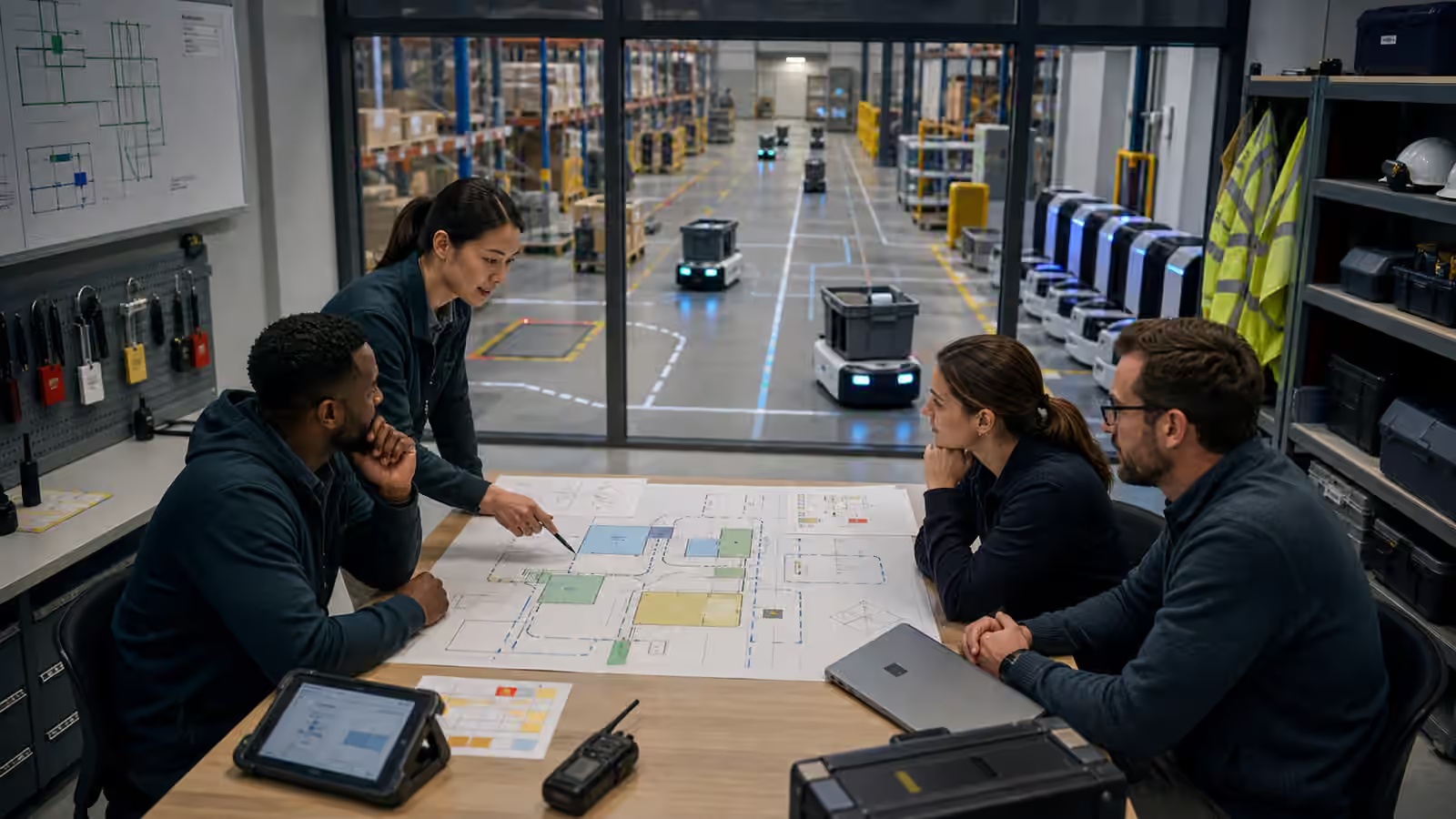
It is easy to treat a pilot as a test of the vendor alone. The site is being tested as well. Floors, doorways, maps, docks, lighting, wireless coverage, charging access, station layout, cleaning routines, operator habits, and management attention all shape the result. A robot that fails in a chaotic site may still be the wrong robot for that site, but the buyer should understand what kind of failure occurred.
Site preparation should be honest rather than theatrical. The goal is not to make a fake world where the robot can succeed. The goal is to make the real task legible enough that the pilot tests the intended question. If the task requires clear floor lanes, then the site should mark and protect the lanes. If the task requires stable stations, then the stations should be stable. If the site cannot maintain those conditions, that is evidence too.
Robot Commissioning and Ramp-Up belongs after this stage, but its lessons should influence the pilot. The first days of installation reveal whether the vendor, site, and robot can form an operating routine. If every minor adjustment requires a heroic support call, that is procurement evidence. If ordinary staff can learn the controls, recover common faults, and understand the robot’s status, that is evidence as well.
Total Work Is Larger Than Robot Motion
A pilot can look successful while moving labor to less visible places. The robot may complete its route, but someone may spend extra time preparing totes. The dashboard may be watched constantly. A worker may clear the robot’s path every few minutes. A supervisor may manually reconcile job records. Maintenance may clean sensors more often than expected. These tasks should count because they are part of the deployment burden.
The same is true for time. A robot’s cycle time should not be measured only from first motion to last motion if the workflow also requires queueing, loading, scanning, recovery, charging, and human confirmation. A robot that moves quickly but creates awkward waits at the handoff point may be less useful than a slower robot that fits the workflow. Robot Handoffs and Human Workflows explains why the person at the boundary is part of the system, not an afterthought.
The buyer should therefore evaluate total work, not only robot motion. That includes changed human tasks, training, maintenance, support, integration, floor space, charging, supervision, and exception handling. The result may still be favorable. Many narrow robots are useful exactly because they remove repetitive work while leaving people in control of judgment and exceptions. The point is to count the whole pattern honestly.
Failure Behavior Belongs In The Score
Every robot pilot should include failure behavior because deployment includes failure behavior. A blocked route, missed scan, low battery, uncertain object, dirty sensor, changed map, full station, or interrupted network is not a freak event. It is part of the operating environment. A robot that fails clearly, safely, and recoverably may be a better candidate than one that looks smoother until it meets a case it cannot handle.
Robot Failure Recovery gives the operational frame. Procurement turns it into scoring. Does the robot stop in a useful place? Does it explain what it needs? Does it preserve the task state? Can trained local staff recover it? Does the vendor receive enough evidence to diagnose the problem? Does the failure create new hazards, blocked work, or mystery for people nearby?
The score should also distinguish between failures the robot should solve and failures the site should prevent. If a route is blocked every hour because pallets are stored in the wrong lane, buying a more clever robot may be less effective than fixing the lane discipline. If the robot regularly loses localization because the map changes without review, the issue may be change control. Procurement is not only choosing a machine. It is choosing whether the whole operating model is ready.
Support, Data, And Exit Paths Matter
The practical life of a robot depends on support. Who responds when the robot is stuck? What can be handled remotely? What requires local staff? Which spare parts are expected? How are software updates staged? What evidence does the vendor need before a support case is useful? How long can the site tolerate a robot being down? These questions may feel less exciting than capability demonstrations, but they decide whether the deployment survives ordinary wear.
Data boundaries matter too. A pilot may collect maps, images, logs, operator actions, route histories, object records, and failure replays. The site should know what is collected, where it goes, who can inspect it, and what happens when the pilot ends. Robot Security and Access Control is important because a pilot often creates temporary access, temporary dashboards, and temporary habits that should not quietly become permanent without review.
Exit paths are part of serious procurement. If the pilot ends, what happens to maps, data, fixtures, mounts, chargers, accounts, integrations, and unfinished support records? If the robot succeeds only partially, can it be redeployed to a narrower task? If the vendor changes direction, can the site maintain the equipment safely? Robot Lifecycle and Decommissioning looks further down the road, but pilot decisions create many of those later obligations.
The Best Decision Is Usually Specific
The cleanest procurement outcome is rarely a sweeping statement that robots are ready or not ready. It is usually specific. This robot is ready for this route under these conditions. This manipulation task needs a better fixture before purchase. This vendor is strong technically but requires more support than the site can provide. This pilot should expand to another shift but not another object class. This idea is promising, but the current task boundary does not justify deployment.
Specific decisions are easier to defend because they preserve the evidence. They also make expansion healthier. A successful first deployment can grow through measured additions: another route, another station, another object class, another shift, another robot. Robot Fleet Management becomes relevant when that expansion changes the system from one supervised machine into shared infrastructure.
Buying a robot is not only buying hardware or software. It is buying a working relationship among a machine, a site, a vendor, a support process, and the people who will live with the machine after the pilot. A good procurement process respects that relationship before money and momentum make it hard to see. It asks for evidence, keeps the task narrow enough to measure, counts the hidden work, and treats failure behavior as part of the product. That discipline does not make robotics less ambitious. It gives ambition a place to stand.