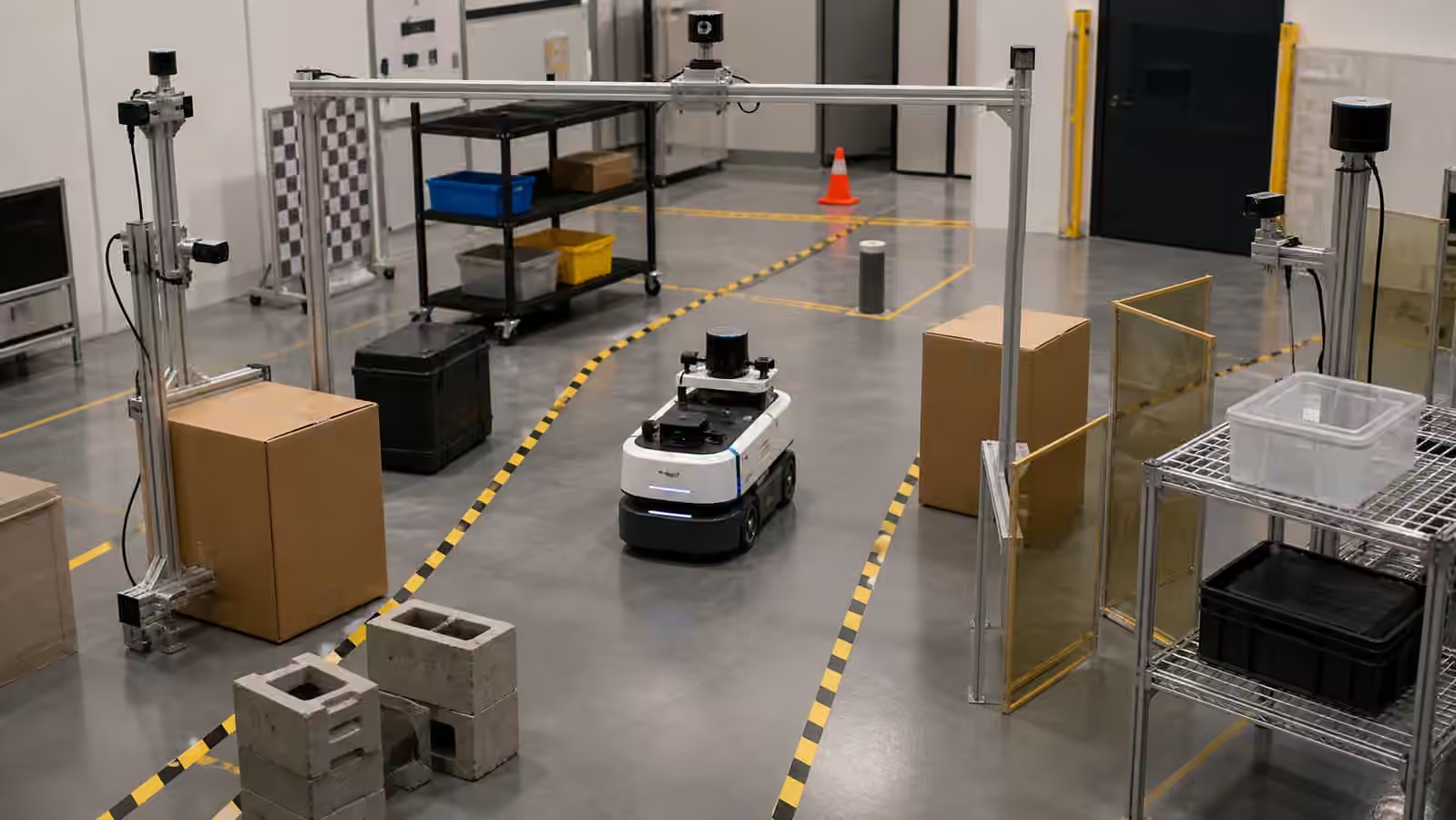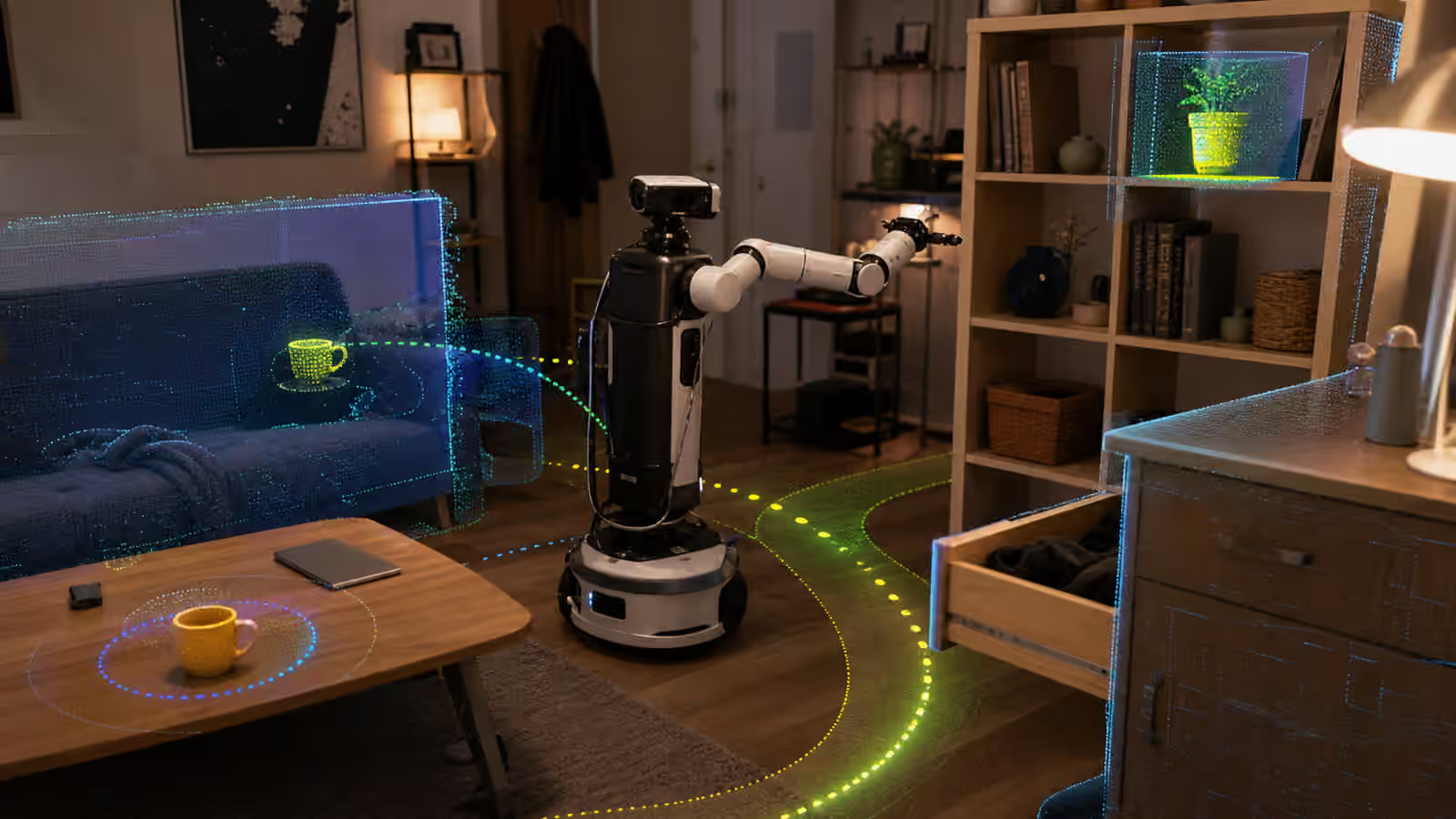
Robot perception begins with a humbling fact: the robot does not see the room. It receives measurements.
A camera gives pixels. A depth camera estimates distance. Lidar returns points. Wheel encoders report rotation. An inertial sensor reports acceleration and angular motion. Force sensors notice contact after the world has already pushed back. None of these signals is the room itself. Each is a partial, noisy, delayed, calibrated, failure-prone slice of the room.
People often treat perception as the easy half of robotics because image recognition has become familiar. A phone can identify a dog, blur a background, or translate a sign. A robot needs something less decorative and more consequential. It needs to know where the floor is, whether the glass is really there, how far the table edge sits from its gripper, which object can be touched, which person is moving, and when it is uncertain enough to stop. Recognition is useful. Physical action requires geometry, timing, and doubt.
This is why perception sits underneath almost every guidebook in this shelf. The autonomy stack depends on localization, maps, obstacle detection, and object state. Robot hands and manipulation depend on pose estimates, contact cues, and shape assumptions. Robot safety depends on knowing where people, tools, payloads, and protected zones are. If perception is wrong, the rest of the system can look intelligent while acting on a false world.
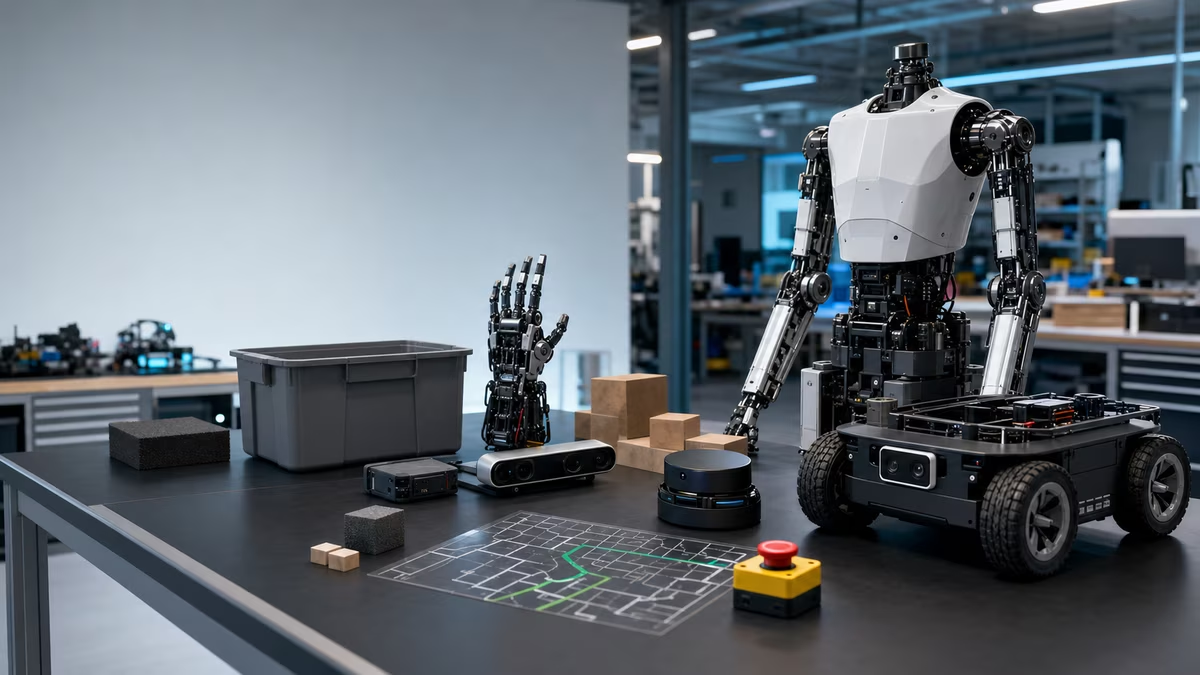
Seeing Is Not Understanding
The first layer of perception is sensing. A robot may use ordinary RGB cameras for color and texture, stereo cameras for depth, structured-light or time-of-flight sensors for distance, lidar for geometry, radar for motion and range in difficult conditions, microphones for sound, tactile pads for pressure, and joint sensors for its own body. A mobile robot may also use wheel odometry, an IMU, floor markers, beacons, or a building map. A manipulation system may add wrist cameras, force-torque sensors, fingertip sensors, and tool encoders.
More sensors do not automatically make the robot smarter. They create more evidence, more calibration, more bandwidth, more power draw, more failure modes, and more software that must agree about time and space. A camera mounted one centimeter off from its assumed position can make a grasp miss. A depth sensor that reports a glossy black bowl as farther away than it is can make an arm drive into the object. A lidar that sees glass poorly can produce a map with a doorway where there is a wall. The robot may be rich in data and still poor in understanding.
Understanding begins when measurements become useful estimates. The system asks where the robot is, what objects are present, how those objects are shaped, which surfaces are navigable, which areas are forbidden, what changed since the last pass, and how confident it should be. The answer is not a single picture. It is a working model that the robot can act on before the world changes again.
Geometry Matters
A robot that only names objects is like a person giving directions with nouns and no distances. It may know that there is a mug, a table, and a person, but action needs spatial relationships. The mug is ten centimeters from the table edge. The handle points away from the gripper. The person is moving toward the aisle. The shelf lip is high enough to catch the wheel. The cable is thin, dark, and exactly where the robot wants to drive.
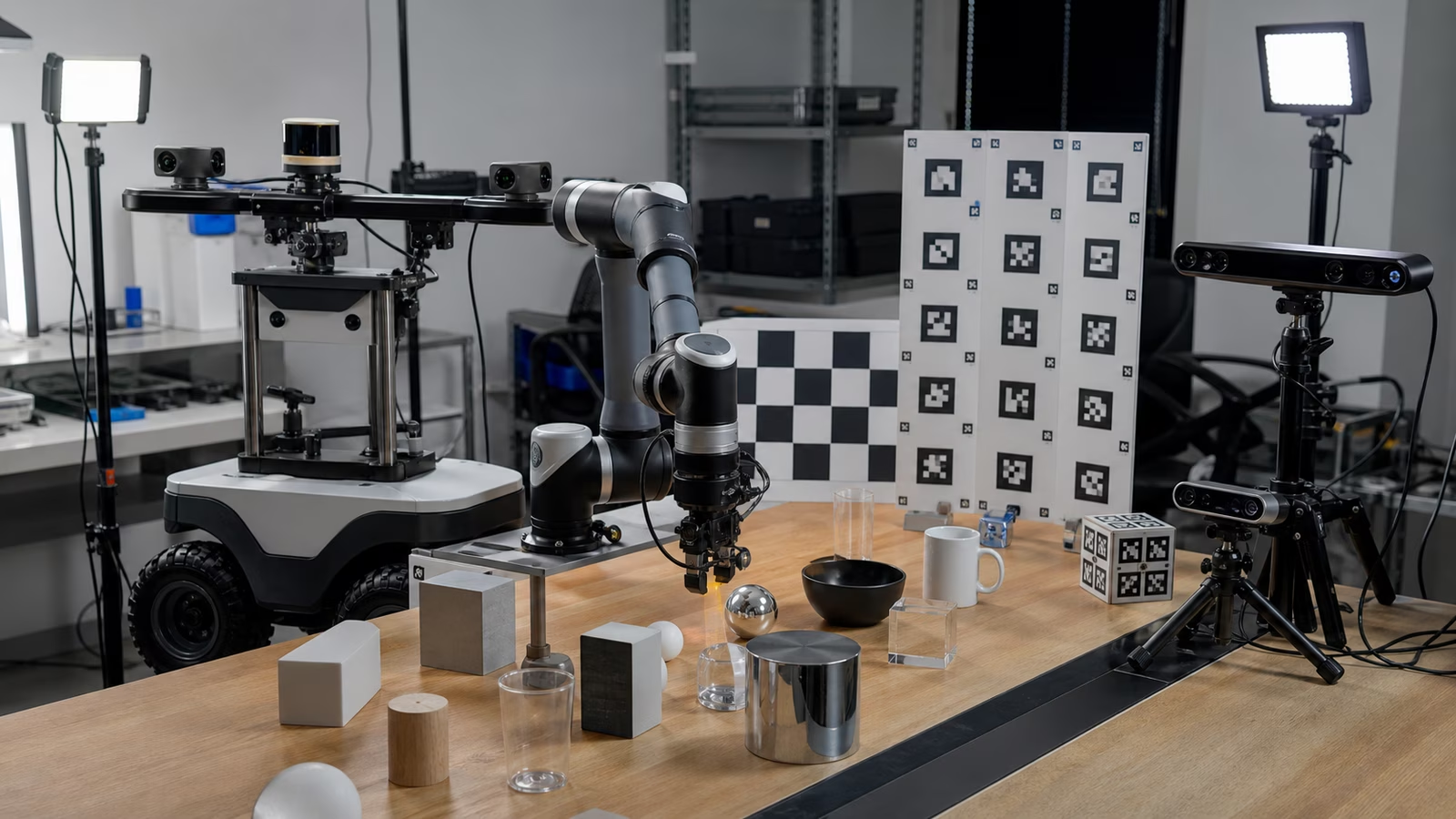
Geometry is why depth matters so much. A two-dimensional image can be visually clear while physically ambiguous. Transparent cups, shiny metal, dark fabrics, mirrors, glossy packaging, and thin cables can all confuse depth systems. Even matte objects become difficult when they overlap, cast shadows, or sit in clutter. The robot has to estimate not only what a thing is, but where it is in three-dimensional space and what parts of it are reachable.
This becomes painfully visible in manipulation. A gripper may need the object’s center, edges, friction, weight distribution, and collision-free approach. If the robot sees the front face of a box but not the hidden side, it must infer enough shape to choose a grasp. If it sees a towel, it may not know where the actual graspable edge is. If it sees a clear glass, the background may leak through the object and mislead the detector. The world is full of objects that refuse to be clean silhouettes.
Calibration Is Quiet Infrastructure
Calibration is the unglamorous work that lets a robot trust its own measurements. The system needs to know where each sensor sits relative to the robot body, how the lens distorts the image, how depth readings behave at different ranges, how clocks align, how joints report their angles, and how the map frame relates to the floor. A calibration board on a lab bench may look like a prop, but it represents the difference between a robot that reaches where it thinks it is reaching and a robot that misses by a few millimeters until someone notices.
Calibration also ages. A camera mount can flex. A mobile base can take a bump. A gripper fingertip can wear down. A lens can collect dust. A robot arm can warm up and shift slightly. A warehouse rack can move. A home can change overnight when someone drags a chair across the room. Perception is therefore not only a model trained once. It is an operational practice of checking whether the robot’s instruments still describe the place where the robot is working.
Good teams build calibration and validation into the workflow. They do not wait for a viral failure to discover that a sensor was loose. They log perception confidence, compare expected and observed contact, watch for repeated misses, and treat small geometry errors as early warning signs. When a robot fails in the physical world, the cause may look like bad planning or weak intelligence, but the root may be a stale transform, a shifted camera, or a depth reading that was trusted too much.
Sensor Fusion Is Negotiation
Sensor fusion sounds like combining data until the truth appears. In practice, it is negotiation among imperfect witnesses. A camera sees texture and color but struggles with darkness, glare, and distance. Lidar gives clean geometry for many hard surfaces but may miss small, transparent, or absorbent objects. Radar can be robust in dust, fog, or rain, but it is usually coarse for fine manipulation. Odometry is smooth until wheels slip. An IMU is fast but drifts. Tactile sensing is reliable about contact, but it arrives only after the robot has touched something.
The fusion system has to decide which witness to trust, when, and how much. It may use a camera to recognize a box, lidar to place that box in the map, wheel odometry to estimate motion between scans, and force sensing to confirm that the grasp actually happened. It may lower confidence when sensors disagree. It may refuse to act when evidence is too thin. The mature behavior is not pretending uncertainty vanished. It is carrying uncertainty through the decision.
This point is easy to miss when watching a polished demo. A robot that pauses before grasping may not be slow because its model is weak. It may be checking whether two sensor estimates are consistent. A robot that asks for human approval may not be less advanced than one that guesses. It may be better designed for the cost of being wrong. The robot demo evaluation habit applies here: ask what the robot sees, how often it sees correctly, and what it does when its evidence conflicts.
Perception Fails In Physical Ways
Perception failures often begin with ordinary details. Sunlight moves across a floor. A black cable lies on a black mat. A reflective bowl shows the ceiling. A person carries a glass door open. A pallet wrap shines like a mirror. A chair leg hides behind another chair leg. A child leaves a toy in the robot’s path. A box has new packaging that the detector has never seen. A table is the same color as the object on it.
These details matter because robots act with limited margins. A warehouse AMR can stop before an obstacle if it detects the obstacle early enough. A home robot can avoid a pet bowl if the bowl looks different from the floor. A robot arm can place an object if it knows the surface height. A humanoid can step safely if the floor estimate is right. Perception does not need to be philosophically perfect, but it must be reliable enough for the action that follows.
The allowed error depends on the job. A delivery robot can tolerate a coarse map if it keeps distance from people and obstacles. A robot inserting a plug needs sub-centimeter precision and force feedback. A sorting robot can sometimes retry a failed pick. A surgical or industrial robot may have far stricter constraints, specialized sensors, fixtures, and safety controls. The same perception system that is adequate for one task may be reckless for another.
Learned Perception Meets Embodied Experience
Modern robots increasingly use learned perception models. They can detect objects, segment scenes, estimate depth, caption images, track motion, and connect language to visible things. These tools are powerful, especially when paired with the broader ideas in Embodied AI . A robot can use learned models to understand that a handle is a graspable part of a mug, that a drawer front implies a pull direction, or that a pile of laundry is not a single rigid object.
But learned perception can be overconfident. A model trained on images may label the world well while misunderstanding action. It may recognize a transparent cup without estimating its rim accurately. It may identify a door handle without knowing whether the latch is stiff. It may segment a cable but fail to judge whether the wheel will catch it. Physical AI needs perception that is tied to consequences. The question is not only “What is this?” It is “What can the robot safely do with this, from here, with this body?”
That is where experience matters. A robot learns more when perception is connected to action outcomes. If a grasp slips, the system can compare what it thought it saw with what contact revealed. If a mobile robot repeatedly stops at the same reflective wall, engineers can inspect the sensor logs and update the model or the environment. If a simulated policy fails on real hardware, the perception mismatch becomes part of the sim-to-real lesson. Reality keeps teaching the model which visual cues mattered and which were decorative.
Designing Around Perception
The practical response to perception difficulty is not despair. It is design. Good robotics projects shape the task so perception has a fair chance. Warehouses add known bins, labels, lighting, maps, restricted zones, and repeatable workflows. Factories use fixtures, jigs, fiducials, trays, and guarded cells. Home robots rely on conservative speeds, repeated mapping, user-defined no-go zones, and narrow tasks. A robot is often more useful when the environment gives it stable facts.
This does not make the system less intelligent. It makes the intelligence usable. A human worker also benefits from good lighting, clear labels, organized tools, and safe walkways. Robots simply reveal the cost of ambiguity more sharply. If a site refuses to control lighting, object placement, floor clutter, and maintenance, it is choosing to spend more complexity inside the robot.
The right design question is where the complexity should live. Sometimes it belongs in better sensors. Sometimes it belongs in learned models. Sometimes it belongs in maps, fixtures, operator interfaces, or safer fallback behavior. The strongest systems do not romanticize perception as a single magic module. They distribute responsibility across hardware, software, environment, and operations.
The Discipline Of Knowing When Not To Act
The most important perception output may be uncertainty. A robot that can say, in effect, “I do not know enough to continue,” is easier to trust than a robot that always converts weak evidence into action. Uncertainty can trigger a slower speed, a different viewpoint, a second sensor check, a human review, or a safe stop. It can also tell engineers where the system needs better data.
This is where perception connects directly to safety and autonomy. A robot that sees poorly but behaves conservatively may still be useful inside a narrow envelope. A robot that sees impressively but acts as if every estimate is certain can become dangerous. For physical systems, the ability to hesitate is not a lack of intelligence. It is part of intelligence.
Robot perception is therefore not only computer vision attached to wheels or arms. It is the craft of turning imperfect measurements into action-ready beliefs, then wrapping those beliefs in enough caution that the robot can work without pretending the world is cleaner than it is. When that craft is done well, the robot seems calm. It moves through clutter without drama, grasps without crushing, stops before trouble, and asks for help before a guess becomes damage. The quietness is the point. Perception has succeeded when the rest of the robot can stop fighting the room and start doing the job.