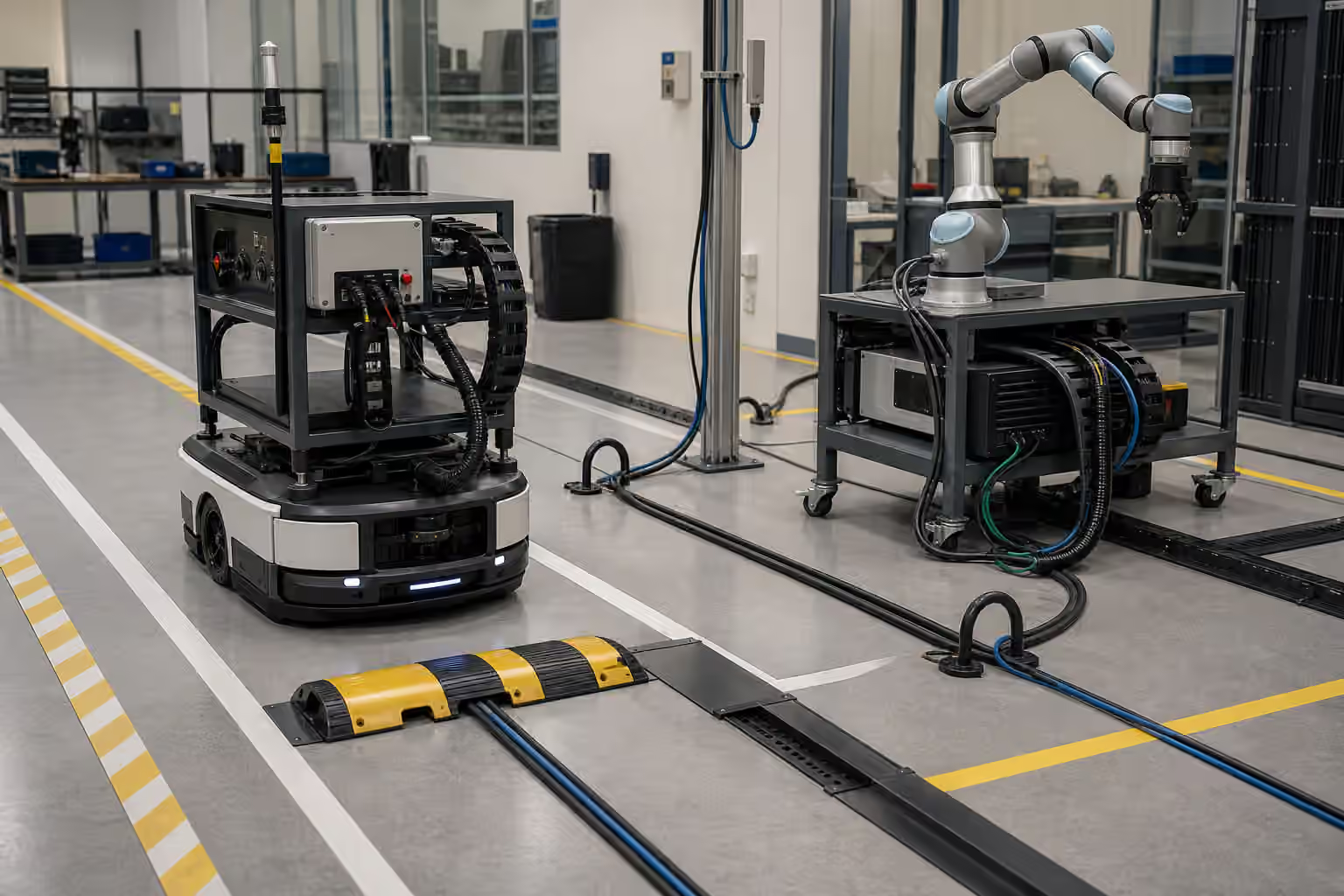
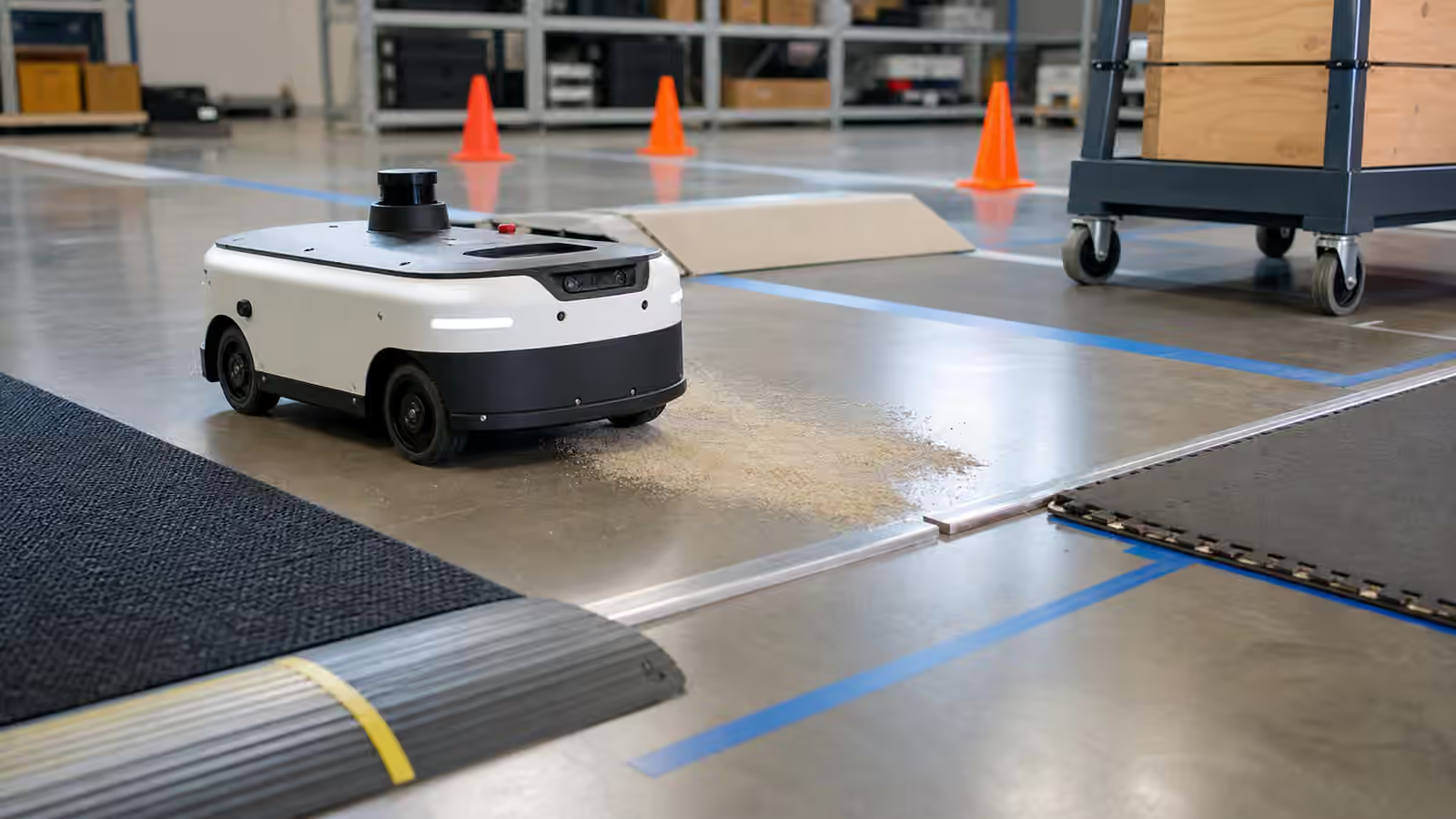
A robot that can move is not automatically a robot that can carry useful weight.
Payload looks simple in a specification table. A mobile base may list a rated load. A robot arm may list a maximum payload at the wrist. A lift module may promise a certain number of kilograms. Those numbers matter, but they are only the opening sentence. Real load handling depends on where the weight sits, how it moves, how the robot accelerates, what the floor is like, how the object is packaged, whether people work nearby, and what happens when the task is interrupted halfway through.
This is why payload belongs inside the practical study of physical AI rather than in a footnote. The robot has to translate a clean task command into forces on wheels, joints, brakes, grippers, shelves, carts, totes, and floors. The autonomy stack may choose a route, and Robot Mobility Platforms may explain how the base moves, but the payload decides whether that motion remains stable and useful under load.
Rated Payload Is A Boundary, Not A Job Description
A rated payload is usually measured under defined conditions. The load may be centered, rigid, secured, evenly distributed, and carried at a known speed. A deployment rarely stays that tidy. A tote may be half full, with heavy parts on one side. A cart may have a high center of mass. A box may deform when lifted. A tray may slide because its bottom surface is dusty. A person may add one more item because the robot still appears to have room.
The useful question is not only whether the total mass is below the rating. It is whether the robot can carry that mass in the way the workflow actually presents it. A low, centered load on a flat floor is very different from a tall stack, a swinging bag, a liquid container, or a tote with shifting contents. The same weight can be easy or difficult depending on geometry.
This distinction matters for arms as well as mobile robots. A robot arm may handle a payload close to the base and struggle with the same mass extended far away. A gripper may hold an object securely at rest but lose it during a turn or stop. Robot Actuators and Motion Control explains why torque, acceleration, braking, and heat shape motion. Payload is one of the ways those limits become visible.
Center Of Mass Changes The Route
People often notice weight before balance. Robots notice balance through physics. A load with a high or offset center of mass changes traction, tipping margin, stopping distance, docking behavior, lift stability, and how aggressively the robot can turn. The robot may still move, but the safe route and speed profile are no longer the same as they were when empty.
For a mobile robot, center of mass affects more than stability in a dramatic tip-over sense. It changes how wheels load the floor, how suspension or casters behave, and how much margin the robot has when crossing thresholds, ramps, seams, or uneven surfaces. A route that is harmless when unloaded may become a poor route when the robot carries a tall cart or a tote filled unevenly with dense parts.
For a manipulation robot, center of mass controls how the object behaves after contact. A gripper may close on a box edge, but if the heavy contents are on the far side, the box can rotate, peel away from suction, or settle into a different pose during lift. A motion planner that treats the object as a rigid block with a simple center may miss the real load behavior. The result can look like bad grasping, when the deeper problem is that the load was never characterized well enough.
Packaging Is Part Of Payload
Payload is not only the thing being moved. It is the thing plus the way the site presents it. A clean plastic tote, a sagging cardboard carton, a wire basket, a fabric bag, a stack of trays, and a wheeled cart can all contain the same mass and create different robot problems. Handles flex. Lids shift. Bottoms bow. Labels peel. Surfaces collect dust. Objects inside the container rattle, slide, or settle.
In many deployments, better packaging can make a simpler robot useful. A tote with consistent dimensions, a stable base, and clear grasp or lift features may matter more than a more complex perception model. A cart with repeatable docking geometry can make handoffs easier. A tray that prevents parts from rolling can reduce both manipulation failures and payload uncertainty. This connects directly to Robot Workcell and Fixture Design , where the physical setup remembers details the robot should not have to solve from scratch on every cycle.
Poor packaging creates hidden labor. A worker has to repack the tote so the robot can carry it. A remote operator has to inspect a shifted stack. A technician has to clear a jam caused by a box corner that caught on a guide rail. Those costs may not appear in the payload rating, but they appear in the deployment.
Loads Need Evidence
A robot should know more than whether a job was assigned. It should have evidence about the load state. That evidence may be simple: a lift sensor confirming contact, a scale reading, a gripper position, vacuum pressure, wheel slip, motor current, tilt estimate, payload presence, or a docking sensor that confirms a cart is seated. The exact signals depend on the machine, but the need is stable. The robot needs enough evidence to decide whether the next motion is reasonable.
Without that evidence, the robot is left to assume. It may drive away without the tote fully seated. It may lift one edge of a container and drag the other. It may accept an overloaded cart because the job label says the route is routine. It may continue after contents shift because no signal told the autonomy layer that the physical situation changed.
Robot Contact Sensing and Force Control covers the touch side of this problem. Load handling broadens it to the whole carried system. The robot is not merely touching an object; it is becoming mechanically responsible for the object until the handoff is complete.
Speed, Stops, And Corners Are Payload Tests
Many payload failures do not happen at the moment the robot accepts the load. They happen during acceleration, braking, turning, docking, lift transitions, or route disturbances. A load that seems stable at rest may slide when the base starts. A tall cart may sway during a turn. A gripped object may shift when the arm decelerates near a placement pose. A tote may settle after a small bump, changing how it fits the station at the destination.
This is why load validation has to include the motion that the task will actually use. A slow straight-line carry through an empty test lane is useful, but it does not prove the robot can operate at shift speed near people, carts, docks, and route changes. If the production route includes turns, ramps, floor seams, stops for pedestrians, and docking alignment, the payload test should include those moments.
The robot may need different behavior when loaded. It may lower speed, widen turns, avoid certain routes, change following distance, reserve more braking room, or refuse a task if the load state is unknown. That is not weakness. It is physical honesty. A robot that pretends an empty route and a loaded route are identical is borrowing risk from the future.
Human Handoffs Decide Whether The Load Is Useful
A robot usually receives and releases payloads through a human workflow, a dock, a shelf, a conveyor, a cart, a fixture, or another robot. The load-handling task is not complete until the next actor can use the object without confusion. A tote delivered to the wrong orientation may still be technically delivered and practically useless. A cart left in a position that blocks a worker may turn automation into an obstacle. A robot arm that places a part accurately but forces a person to reach awkwardly has moved the load without improving the job.
Robot Handoffs and Human Workflows is important here because payloads are social objects inside a workplace. People need to know when the robot owns the load, when it is safe to touch, what a failed handoff looks like, and how to recover when the object is not where it should be. The payload is not only mass. It is an item in a workflow with meaning, timing, and responsibility.
Good load handling makes ownership visible. The robot shows whether it is waiting for loading, carrying, blocked, unloading, or asking for help. The station makes the correct placement obvious. The recovery procedure explains what to do if the load is missing, shifted, damaged, or too heavy. These details sound operational because they are. They are also what make the payload rating matter.
Safety Margins Are Operational Margins
Payload safety is not only about catastrophic failure. It includes dropped objects, crushed packaging, blocked aisles, unstable carts, damaged floors, overheated actuators, worn wheels, pinched fingers, bad lifting posture for workers, and emergency stops with loads still in motion. Robot Safety gives the broader risk frame. Payload gives that frame weight, momentum, and contact.
A conservative load policy can be more useful than an ambitious one. If the robot carries less than the absolute maximum but does so predictably, the deployment may run with fewer interventions and less damage. If the robot accepts every borderline case, the site may spend its time investigating faults that look random but are really load envelope violations.
The acceptance test should therefore describe the load envelope plainly. It should include the object range, packaging condition, center-of-mass assumptions, allowed routes, speed behavior, handoff positions, recovery states, and what counts as unacceptable damage or intervention. Robot Task Design and Acceptance Tests is the natural companion because payload claims only become meaningful when the task boundary is measurable.
The Load Is Part Of The Robot While It Moves
During a task, the load is not separate from the robot. It changes the robot’s body, balance, sensing, stopping behavior, and relationship to people. Treating it as cargo afterthought leads to fragile deployments. Treating it as part of the system creates better routes, better packaging, better handoffs, better logs, and more realistic safety margins.
The practical question is simple and demanding: can this robot move this load, from this start state to this end state, through this environment, with this packaging, at this pace, while failing in a way people can handle? A spec-sheet payload number can help answer that question, but it cannot answer it alone. The answer lives in the carried object, the route, the station, the workers, the controls, and the evidence the robot keeps while the weight is in its care.