A mobile robot’s first negotiation is with the floor.
The autonomy stack may choose a route, the perception system may recognize an obstacle, and the task planner may decide that a delivery should happen now. None of that matters if the base cannot move through the actual place with enough stability, traction, clearance, battery margin, and control to do useful work. Wheels compress. Tracks scrub. Legs slip. Casters chatter. Payloads shift. Small thresholds that people stop noticing can become daily failure points for a machine that has to repeat the same route for months.
Mobility is sometimes treated as a solved layer below the interesting intelligence. That is too simple. The body plan determines where the robot can go, how fast it can stop, how close it can approach a workstation, what it can carry, how much energy it spends, how badly it damages the floor, and how difficult recovery becomes when something goes wrong. Robot Actuators and Motion Control explains how motors, brakes, heat, compliance, and feedback shape motion. Mobility platforms are where those forces meet building geometry.
Movement Is A Hardware Contract
A mobile platform is a contract between the robot and the site. The robot promises to move in certain ways. The site quietly promises that the floor, ramps, lanes, thresholds, charging areas, and human habits will stay within the platform’s limits. When either side breaks the contract, the failure may look like poor autonomy even when the underlying problem is mechanical.
A navigation planner can draw a graceful path around a corner, but the robot still needs a turning radius that fits the aisle. A perception system can identify a cable, but the base still needs enough ground clearance or routing discipline to avoid catching it. A fleet manager can assign a delivery, but the platform still has to carry the load without tipping, overheating, or losing braking margin on a slope. The software can be correct and the motion still be wrong for the building.
This is why Robot Site Readiness belongs close to any mobility discussion. Floors are not neutral. Concrete dust changes traction. Rubber mats add rolling resistance. Grates, tile edges, elevator gaps, curled rugs, wet receiving areas, and poorly marked temporary storage all shape what the robot can safely attempt. A platform that works beautifully in one facility can become fragile in another because the ground has different habits.
Wheels Are Efficient Because Floors Are Engineered
Most useful indoor mobile robots use wheels because wheels are efficient, stable, compact, and mechanically understandable. A wheeled autonomous mobile robot can carry a payload for long periods on smooth floors without spending energy lifting its own body at every step. It can be designed with predictable braking, simple suspension, replaceable tires, and a low center of gravity. For warehouses, hospitals, labs, and offices with reasonably flat surfaces, wheels are usually the practical starting point.
That practicality does not make wheels trivial. Wheel choice affects traction, floor wear, noise, maintenance, odometry, and obstacle handling. A soft tire may grip well and roll quietly but wear faster. A hard wheel may last longer but slip on dust or polished surfaces. Small wheels make the base compact but struggle with thresholds and debris. Large wheels improve obstacle crossing but raise packaging and stability questions. The wheel is not just a part number. It is a statement about the terrain the robot is expected to survive.
Drive geometry matters too. Differential-drive robots are common because they are relatively simple and can turn in place, but they may scrub tires during rotation and need enough room around the base. Ackermann steering behaves more like a car, which can be efficient at speed but needs turning space. Omnidirectional bases can move sideways in tight areas, which is useful around workstations, but they add mechanical complexity and can be sensitive to floor conditions. A demo can hide those differences by placing the robot in a generous lane. Deployment reveals them in doorways, queues, docks, elevators, and crowded handoff points.
Tracks Buy Contact At A Cost
Tracked platforms spread contact over a larger area and can handle loose, uneven, or broken ground better than many wheeled bases. They are common in inspection, defense, disaster response, and rough industrial settings because they can climb over small obstacles, cross gravel, and tolerate surfaces where wheels would sink or lose traction. Tracks can make a compact machine look confident in environments that are not prepared for robotics.
The cost is real. Tracks scrub when they turn, which can mark floors, waste energy, and stress the drivetrain. They can be noisy, heavy, harder to clean, and more demanding to maintain than wheels. Debris can lodge in the mechanism. A track that helps outside may be unwelcome on a polished indoor floor. A tracked robot may cross a threshold that stops a wheeled base, then create a new problem by damaging the surface or requiring more clearance around its turns.
Tracks also complicate the relationship between localization and motion. Wheel odometry is never perfect, but track slip can be especially variable across surfaces. A tracked robot turning on smooth concrete may behave differently from the same robot turning on dust, rubber, mud, or carpet. Robot Mapping and Localization covers the way odometry, sensors, drift, and maps work together. The platform changes how trustworthy that motion estimate is from one meter to the next.
Legs Solve Access While Creating New Problems
Legged robots are attractive because human spaces were not designed only as flat navigation graphs. Stairs, curbs, uneven ground, cluttered floors, narrow passages, and human-height interfaces all favor bodies that can step, shift weight, and choose footholds. A legged platform may reach places that would require expensive site changes for a wheeled robot. That is the strongest argument for legs: access when the environment cannot or should not be made wheel-friendly.
The tradeoff is complexity. A legged robot has to manage balance, foot placement, impact, joint loads, body sway, recovery, and fall consequences. Every step is a small dynamic event. If the foot lands on a slippery patch, loose object, stair edge, or unexpected soft surface, the robot has less passive stability than a low wheeled base. The system may recover gracefully, but recovery is part of the platform’s real performance, not an extra feature to admire after the fact.
Legs also change safety and maintenance. A falling robot can damage itself, the site, or a nearby person. High joint torques and moving limbs create different pinch and strike risks than a slow platform with protected wheels. The maintenance burden can grow because joints, bearings, covers, feet, cables, and calibration all experience repeated impact and vibration. Humanoid Robots explains this in the context of human-shaped machines, but the same logic applies to smaller quadrupeds and other legged platforms. Legs should be chosen because the task needs them, not because they make the robot look more capable than the work requires.
Footprint And Approach Are Task Features
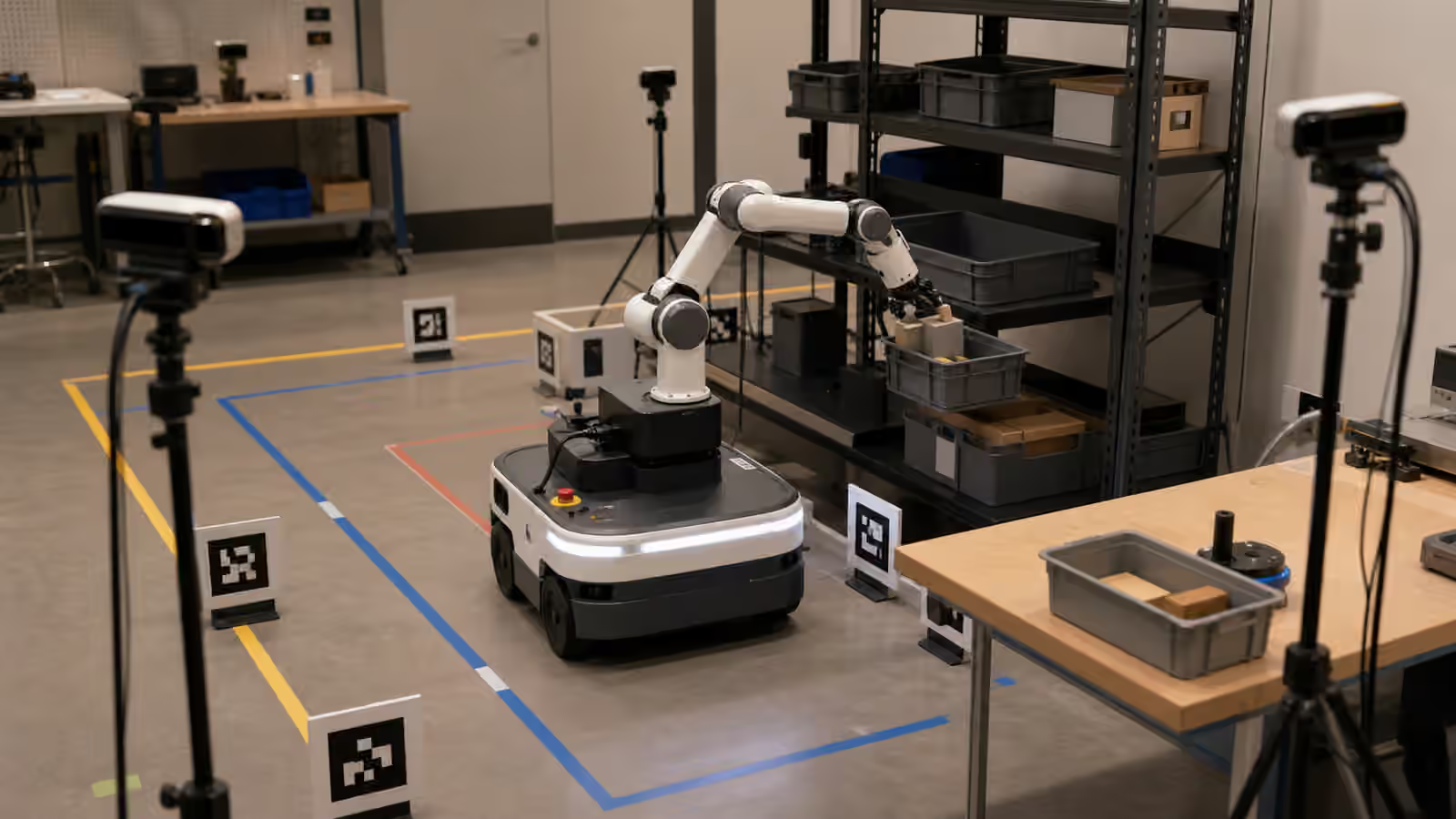
Mobility is not only about moving between places. It is also about arriving correctly. A robot that can travel through a building may still fail if it cannot approach the exact side of a rack, dock, machine, cart, door, or handoff station. Footprint, turning radius, sensor placement, bumper geometry, mast height, arm reach, and payload shape all decide whether arrival becomes useful work.
A small robot can move through narrow paths, but it may lack payload capacity, sensor height, or stability when carrying a load. A large robot may carry more and see farther, but it may block people, require wider aisles, and struggle to turn around after a handoff. A mobile manipulator may have enough arm reach only from one approach angle, which means the base must align more precisely than a simple delivery robot. In a warehouse, the difference between stopping near a station and stopping at the correct station pose can decide whether a worker trusts the robot or has to wrestle the workflow back into shape.
These approach details connect directly to Robot Handoffs and Human Workflows . People do not experience the robot as a path planner. They experience it as an object that arrives, waits, blocks, signals, and leaves. If the platform parks in the wrong orientation, exposes the wrong side of the payload, or requires a worker to walk around it every time, the mobility design has created labor instead of removing it.
Payload Changes The Robot
A mobile platform is never just moving itself. It is moving itself plus tools, batteries, sensors, covers, compute, manipulators, bins, totes, carts, or goods. Payload changes the center of gravity, braking distance, acceleration limits, suspension behavior, wheel loading, thermal load, and energy use. A base that feels stable when empty may become awkward when a tall payload is mounted above it. A robot that crosses a threshold cleanly with no load may scrape or tip when the suspension settles under weight.
Payload also changes what the robot should be allowed to do. A robot carrying fragile lab samples should not use the same motion profile as one carrying empty totes. A cart-towing robot should account for the trailer’s swing, stopping behavior, and jackknife risk. A mobile manipulator should understand how arm extension shifts the body. A legged robot carrying a package may need more conservative foot placement than the same robot walking unloaded.
Good mobility design therefore includes limits that are visible to the rest of the system. The task planner should know when a route is too steep for a loaded base. The fleet manager should know which robots can carry which payloads. The operator interface should explain when a robot refuses a move because load, slope, clearance, or stability is outside its authority. Robot Task Design and Acceptance Tests makes this broader point: a robot task needs start states, end states, and boundaries. Payload is one of those boundaries.
The Ground Is Also A Perception Problem
The robot’s mobility platform does not act on the ground directly. It acts on the ground as sensed and estimated. Cameras, lidar, depth sensors, tactile cues, wheel encoders, inertial measurements, motor current, and suspension feedback all contribute to the robot’s belief about where it is and what it can cross. That belief can be wrong in ways that matter physically.
A dark cable may look like a shadow until a wheel catches it. A transparent spill may look like clean floor until traction changes. A thin floor lip may be visible to a person and nearly invisible to the sensor arrangement. A ramp may be passable in theory but unsafe with a particular load. A pile of plastic wrap may be detected as an obstacle but not recognized as something that can wrap around a wheel. Robot Perception describes perception as action-ready belief rather than image recognition. Mobility makes that point concrete because the consequence of a bad belief is contact with the floor.
This is why mobility tests should include ordinary surface variation. The robot should be tested with dust, glare, low obstacles, thresholds, mats, ramps, common debris, dock approaches, elevator gaps if relevant, and realistic payloads. The question is not only whether it can drive across a clean lane. The question is whether it can decide when the ground is outside its working assumptions and stop before a minor obstacle becomes a recovery event.
Recovery Is Part Of The Platform
A mobility platform should be judged by what happens after it gets into trouble. Can it back away from a threshold without high-centering? Can it detect that a wheel is spinning without progress? Can it free itself from a gentle bumper contact without scraping along the wall? Can it enter a safe state if the suspension reports a strange load? Can a person move it manually without fighting locked brakes or hidden procedures? A platform that only works while nothing goes wrong is not ready for real operations.
Recovery also affects the people around the robot. A small stuck robot may be easy to lift, but that may be unsafe or forbidden when batteries, sharp edges, or pinch points are involved. A heavy robot may need tow points, manual release procedures, or a trained technician. A legged robot may need a recovery posture that prevents damage after a fall. A tracked robot may need a cleaning and inspection process after crossing debris. Robot Failure Recovery covers the operational side. The mobility platform decides how much of that recovery is simple, awkward, or dangerous.
The best recovery behavior is often boring. The robot notices loss of traction early. It stops before grinding a wheel against an obstacle. It reports what changed. It chooses a small reverse motion when that is safe. It asks for help before repeating a maneuver that is clearly failing. It leaves enough room around itself for people and other robots. This kind of restraint is not a lack of autonomy. It is physical judgment.
Choose Mobility By The Work
The right mobility platform is not the one that looks most advanced. It is the one whose limits fit the task, site, payload, safety case, maintenance plan, and human workflow. Wheels are usually the best answer when the floor can support them and the job rewards efficiency, uptime, and simplicity. Tracks make sense when ground contact and obstacle crossing matter more than floor friendliness and efficiency. Legs make sense when access to irregular or human-built spaces justifies the added complexity, risk, and care.
This choice should be made before believing the rest of the robot’s promise. A robot with strong perception and weak mobility will spend its intelligence avoiding situations the body cannot handle. A robot with elegant planning and poor braking will need conservative routes. A robot with a capable arm on the wrong base will arrive at tasks it cannot reach. Physical AI does not float above the machine. It inherits the machine’s contact with the world.
A useful mobility platform disappears into the work because it fits. It rolls through the route without drama, stops where people expect it, carries the load within margin, charges without blocking the aisle, recovers politely from small problems, and leaves evidence when the site asks too much of it. That quiet competence is not separate from autonomy. It is the ground under it.