
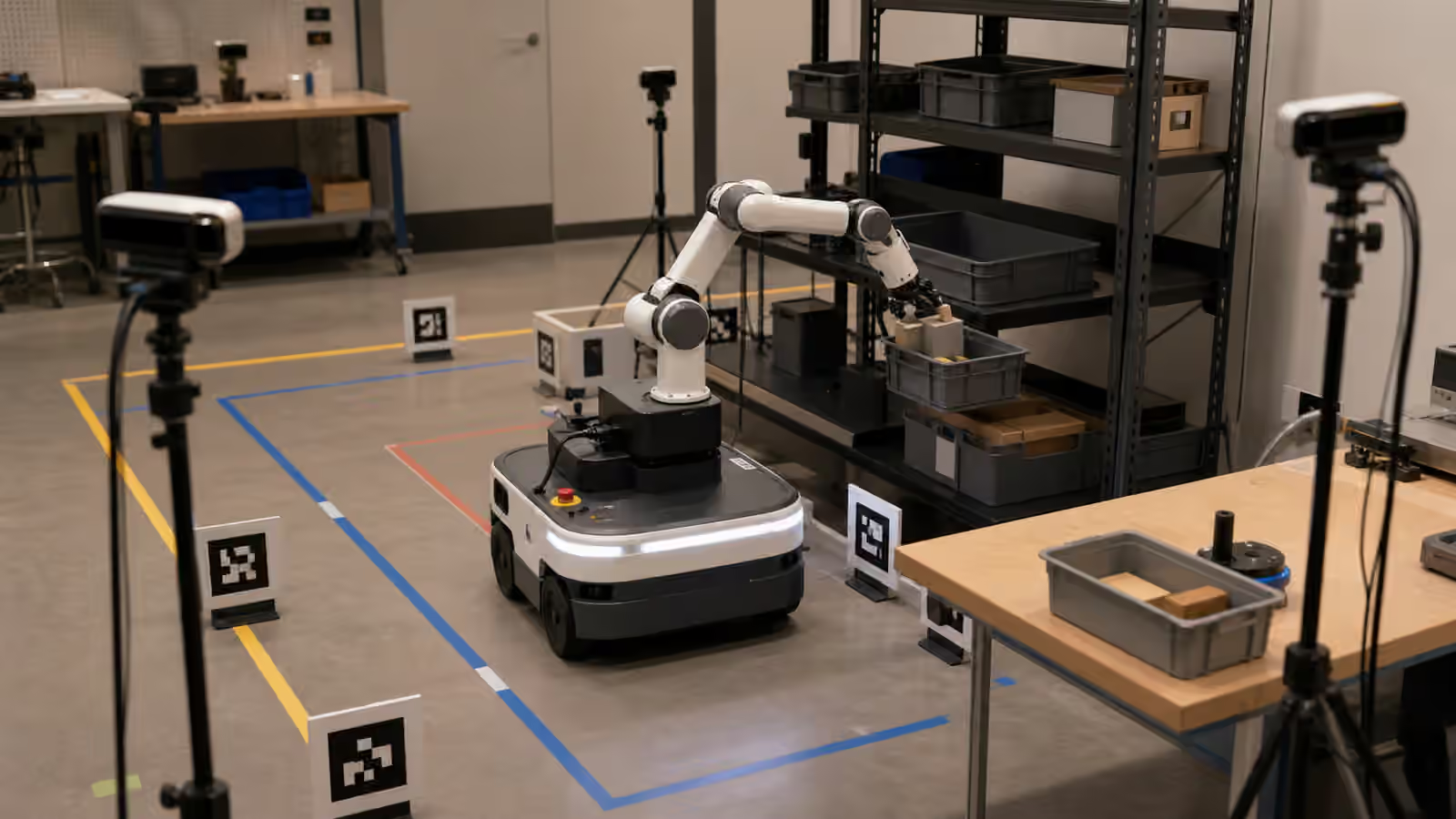
A mobile manipulator is not a mobile robot with an arm bolted on top. It is one machine trying to solve a task with a moving base, moving joints, a gripper, sensors, payload limits, and a scene that may change during the reach.
That distinction matters. A fixed robot arm can assume the table, fixture, and work envelope were designed around it. A simple mobile base can treat the payload as something it carries from one place to another. A mobile manipulator has to arrive at the right pose, stay stable, see enough of the scene, place its arm where it can work, avoid colliding with itself and the environment, and recover when the first reach is not enough.
The topic sits between Robot Mobility Platforms and Robot Hands and Dexterous Manipulation . Mobility gets the robot near the work. Manipulation changes the world. Coordination decides whether near is close enough, stable enough, visible enough, and safe enough for contact.
Arrival Is Part Of The Grasp
Many manipulation failures begin before the arm moves. The base stops a little too far from the shelf. The robot approaches from the wrong side of a tote. The gripper has reach, but only if the wrist bends into a poor angle. The camera can see the object, but the arm blocks the view during approach. The robot technically reaches the target, yet the pose leaves no room for recovery if the object slips.
For a mobile manipulator, base pose is a manipulation variable. A few centimeters can decide whether the arm works in a comfortable part of its range or near a joint limit. A small heading error can decide whether the gripper approaches along a stable axis or scrapes the object sideways. A poor parking position can turn a simple placement into a collision puzzle.
Robot Object Presentation and Staging explains how the world can be arranged to make work reachable. Mobile manipulation adds the robot’s own approach to that arrangement. The station, shelf, bin, base, arm, object, and human handoff position form one geometry problem.
The Arm Moves The Base Without Driving It
Even when the base is stationary, the arm changes the robot. Extending an arm shifts mass, changes stability, exposes new collision surfaces, and may flex the structure enough to affect precision. A payload held far from the base can create a different machine than the empty robot that drove down the aisle. If the base is small, the effect becomes more pronounced.
Robot Payload and Load Handling covers load behavior in general. Mobile manipulators make payload dynamic. The load changes as the arm reaches, lifts, retracts, and places. A task planner may need to avoid fast turns with an extended arm, lower the payload before moving, or choose a base pose that keeps the center of mass within a safe margin.
This is not only a hardware problem. Software has to expose the state. The planner should know whether the arm is stowed, extended, carrying, uncertain, or blocked. The fleet manager should not treat the robot like a compact base when it is occupying extra space with an arm. The operator interface should make it clear when a manual move is unsafe because the robot is holding something awkward.
Perception Changes During The Reach
A mobile manipulator often observes the scene from sensors mounted on the base, mast, wrist, or gripper. Each placement has tradeoffs. A mast camera can see the work area before the arm enters it, but it may miss occluded objects inside a bin. A wrist camera can inspect a grasp closely, but it moves with the arm and may lose the broader scene. A base sensor can protect navigation space, but it may not see fingers, tools, or shelf edges at arm height.
Coordination requires the robot to understand these changing viewpoints. The best observation may happen before reaching, during an approach pause, or after a small repositioning move. A failed grasp may call for a new view rather than a repeated motion. Robot Sensor Placement and Blind Spots is directly relevant because a mobile manipulator creates its own blind spots as it works.
The robot also has to manage occlusion caused by itself. The arm can hide the object from the camera. The gripper can hide the contact point. The payload can hide the shelf during placement. A planner that assumes perception remains constant through motion will be surprised by its own body.
Planning Should Be Whole-Body Planning
Some mobile manipulators split the task into drive, stop, reach, grasp, and drive away. That can work for simple stations, but it becomes brittle when geometry is tight. Whole-body planning treats the base and arm as connected parts of one action. The base may reposition slightly to improve reach. The arm may stay folded while the base approaches a narrow lane. The robot may choose a grasp that is not ideal in isolation because it leaves room to retract safely.
Robot Task Planning and World Models provides the software frame. A mobile manipulator’s world model needs more than object poses. It needs approach affordances, reachable regions, forbidden volumes, support surfaces, payload state, human zones, and the robot’s own swept volume. The question is not simply whether the gripper can touch the object. It is whether the complete action can be attempted and recovered within bounds.
This is why mobile manipulation demos can be misleading. A robot may succeed when the table is placed perfectly and the object is isolated. The same behavior may struggle when the shelf is deeper, the aisle is narrower, the object is partly hidden, or the base has to leave room for people. The gap is not always intelligence. Often it is coordination geometry.
Contact Needs Local Judgment
When a mobile manipulator makes contact, the base, arm, gripper, and object all participate. A light bump at the gripper may push the object. A larger contact may flex the arm. A contact while the base is not well braced may move the whole robot. If the object is stuck, the robot has to decide whether to pull, wiggle, retry, ask for help, or abandon the task.
Robot Contact Sensing and Force Control explains the touch side of the problem. Coordination adds the fact that force has a path through the entire machine. A compliant gripper may be safe for the object while the base still drifts. A stiff arm may place accurately but create higher contact forces. A robot working near people may need conservative force limits that change what grasps and placements are allowed.
Local judgment is valuable because contact events happen faster than high-level planning. The robot may need low-level limits that prevent dangerous pushing even when the task goal says to place the object. It may need to stop when force rises unexpectedly, preserve the scene, and report enough detail for recovery. A mobile manipulator that cannot distinguish useful contact from trouble will either be timid or rough.
Recovery Requires Room
A mobile manipulator should be judged by what happens after the first attempt fails. Can it back the arm out without knocking nearby objects? Can it move the base to a better pose without dragging the payload through a collision path? Can it put down an object safely if the route changes? Can a person approach it without entering a hidden pinch point? Can it stow itself before being towed or serviced?
Robot Failure Recovery matters here because recovery has to be physical. There must be space, state, and authority for the robot to do something other than repeat the same reach. A station that permits a grasp but leaves no recovery path has not really been designed for robotic work. It has been designed for a perfect attempt.
Recovery also affects human trust. A robot that pauses, retracts, and asks for help clearly is easier to live with than one that keeps nudging a shelf. A robot that abandons a task before creating a jam may be more valuable than one that completes more attempts in a clean test. Coordination quality shows up most clearly in these imperfect moments.
Mobile Manipulation Is A System Choice
The appeal of mobile manipulators is obvious. They promise useful physical action across many places instead of one fixed cell. The cost is that every task now depends on mobility, perception, planning, control, end-effector design, site layout, safety, and recovery working together. A weak link does not stay isolated. Poor base alignment becomes a grasp failure. Poor staging becomes a navigation problem. Poor recovery becomes a safety concern.
The practical question is not whether the robot has a base and an arm. It is whether the complete system can arrive, see, reach, touch, recover, and leave in the environment where the work actually happens. When that coordination is designed carefully, the machine seems almost modest. It parks well, moves the arm within comfortable limits, asks for a better view when needed, and avoids tasks that require geometry it does not have. That modesty is what makes mobile manipulation useful beyond the demo lane.


