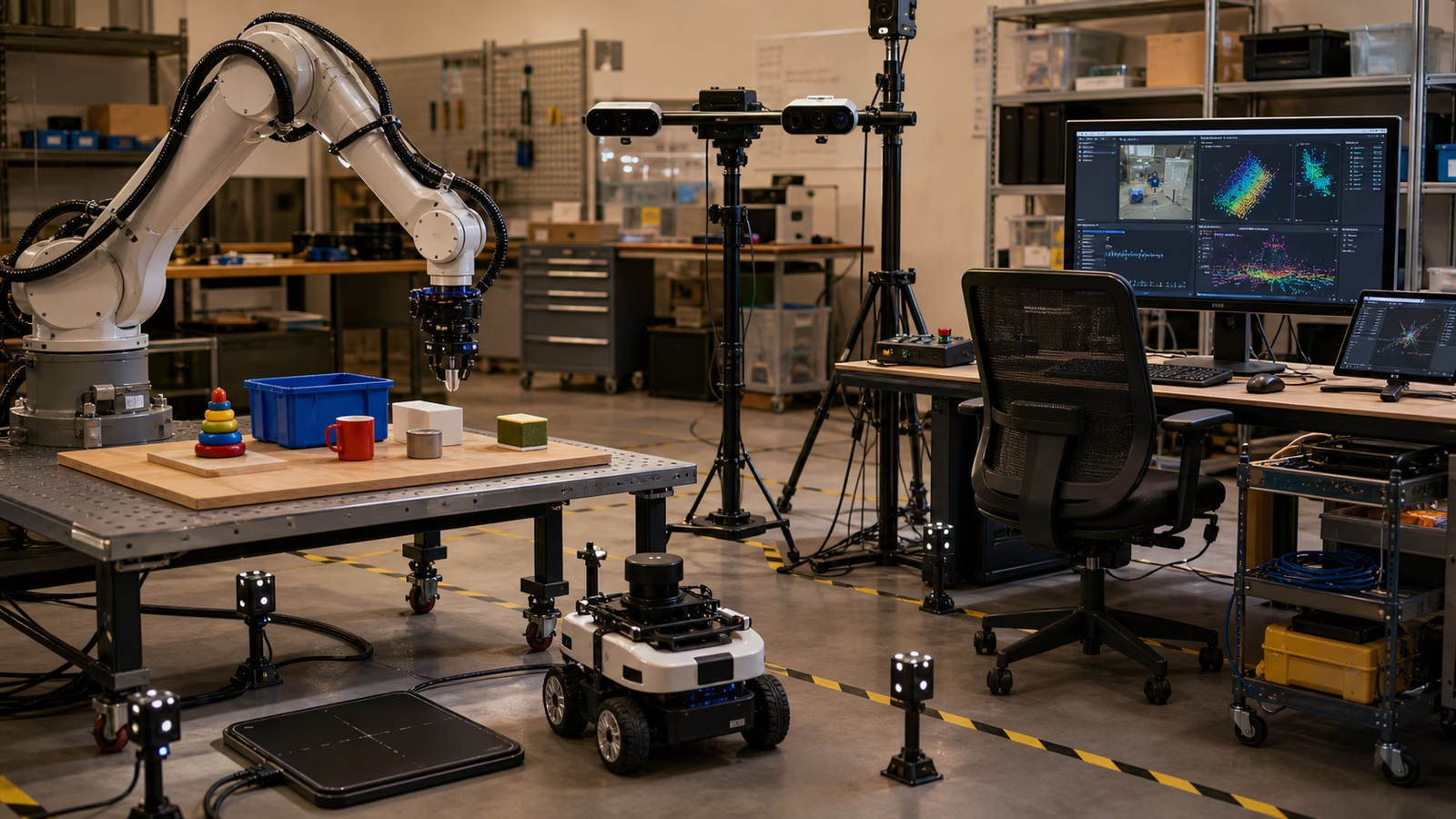
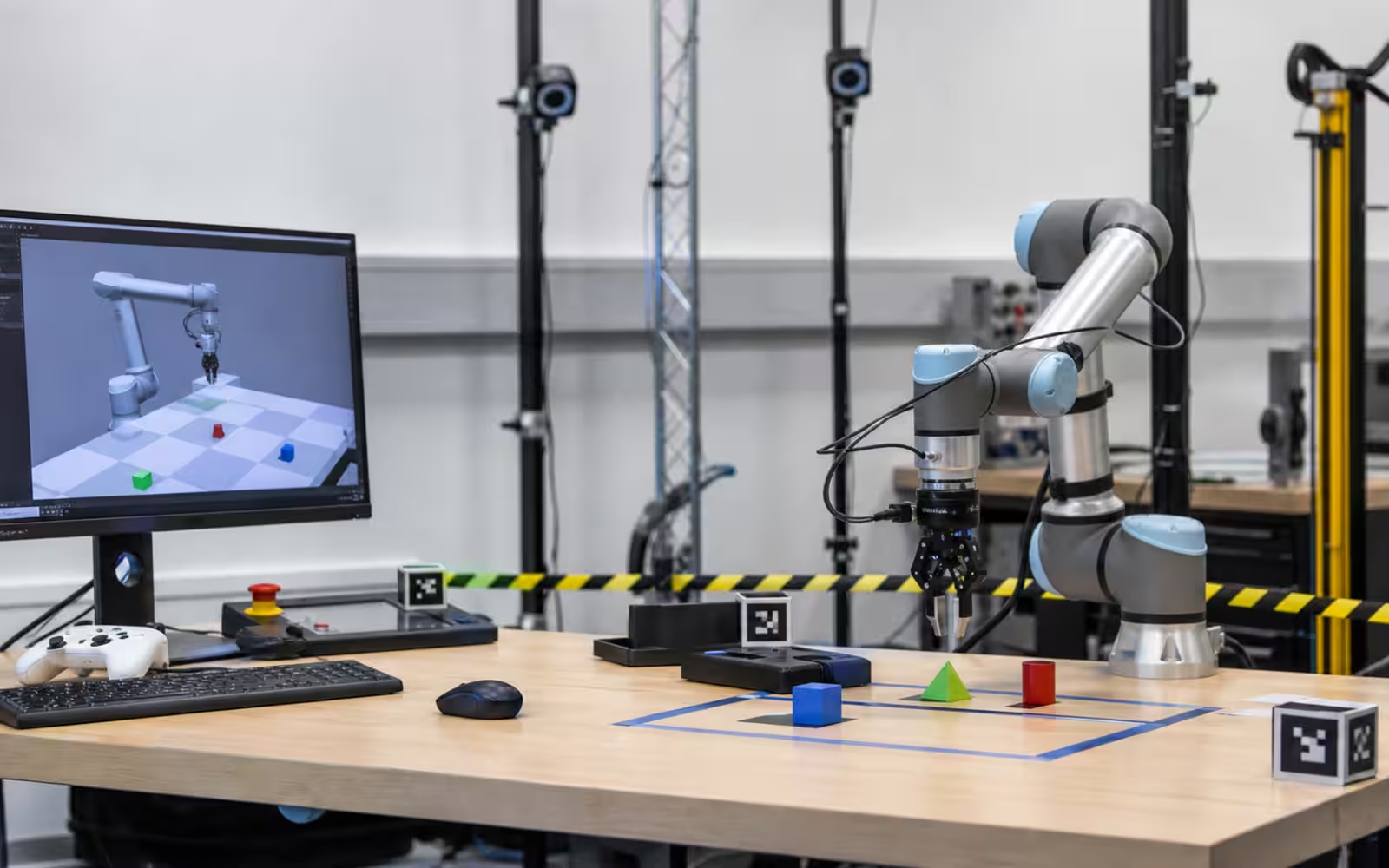
A robot can learn a great deal from being told what to do, but it often learns more from watching how the work is done.
That observation sits behind robot learning from demonstration. A person performs a task, guides a robot, corrects a motion, or recovers from a mistake, and the system turns those examples into a policy the robot can use later. The appeal is direct. Instead of writing every movement by hand, the team gives the robot evidence of useful behavior. The hard part is that human examples are not recipes. They are traces of judgment, timing, body mechanics, tools, sensors, and environment, all recorded through a particular robot at a particular moment.
This guide belongs between Robot Data Collection , Robot Teleoperation , Sim-to-Real Robot Learning , and Robot Task Design and Acceptance Tests . Data collection preserves the record. Teleoperation often creates the record. Simulation can multiply and stress the lessons. Task design says what the robot is actually supposed to learn. Learning from demonstration is the bridge that tries to turn those pieces into behavior.
Demonstration Is Not A Script
The simplest story says a person shows the robot an action and the robot repeats it. That works for very narrow cases, but it is too thin for most physical AI. A demonstration contains more than positions over time. It includes where the demonstrator looked, which object mattered, how fast the motion began, how force changed near contact, when the person hesitated, and how the scene was reset after something went wrong.
A human picking up a mug does not think in joint angles. The person sees the handle, notices the cup is near the table edge, reaches from a comfortable angle, adjusts grip as contact arrives, and lifts with enough clearance to avoid the bowl beside it. A robot arm watching that motion cannot simply copy the hand path. Its gripper may be shaped differently. Its camera may be mounted elsewhere. Its reach limits may force another approach. The policy has to learn what mattered about the demonstration, not merely where the demonstrator’s hand traveled.
This is why good demonstrations are tied to the robot’s own body. A video of a person doing a task can be useful context, but a teleoperated trace on the robot captures the action in the robot’s coordinates, through the robot’s sensors, with the robot’s delays and limits. The result is less glamorous than a broad video dataset, yet often more useful for a deployed machine. It shows what this robot can actually do from this workspace, with this gripper, under this control loop.
The Teacher Shapes The Dataset
Human demonstrations carry human habits. A skilled operator may make a difficult task look smooth by avoiding awkward object poses, correcting early, or using tiny motions that are hard for the learning system to interpret. A rushed operator may create inconsistent examples. A cautious operator may teach the robot to move slowly even when the task could safely tolerate more speed. A remote operator working through a camera feed may overuse viewpoints that are visible in the interface and underuse tactile cues the robot could learn from.
None of this makes demonstrations useless. It means the teacher is part of the dataset. If several operators teach the same task, their differences can reveal what is essential and what is style. If one operator always recovers a slipped grasp by lowering the object first, that recovery habit may be valuable. If another operator drags objects across the table because the interface makes lifting difficult, that behavior should probably not become the robot’s default.
The practical discipline is to record enough context that the team can read demonstrations critically. The policy needs the sensor stream, action stream, task state, object condition, robot mode, and outcome. The engineering team needs notes about setup, reset, operator role, and why a correction happened. Otherwise, a dataset can look large while mixing expert motion, emergency rescue, interface artifact, and accidental shortcut into one undifferentiated archive.
Corrections Are Often More Valuable Than Perfect Runs
A flawless demonstration has a seductive quality. It shows the task as the team hopes it will happen. The robot approaches, grasps, moves, places, and finishes. For training, though, the most useful moment may be the correction. The operator notices the gripper is off center and shifts before closing. The robot starts to drag a towel and the human lifts instead of pulling. A mobile manipulator approaches a shelf from a bad angle and the operator backs out before trying again.
Corrections teach boundaries. They show what the teacher considered unsafe, inefficient, or unlikely to work. They also connect perception to consequence. If the robot saw a scene, chose a poor action, and then a person corrected it, the learning system has a paired example: the state that produced trouble and the action a human preferred instead. This can be more informative than a clean success where the robot never approached the edge of failure.
The same idea appears in Robot Failure Recovery . A deployment-ready robot needs more than a happy path. It needs a way to notice when the path has become wrong and return to a safer state. Demonstration data can include that recovery behavior if the team chooses to save it rather than trimming every messy segment away.
Imitation Has A Drift Problem
Imitation learning often begins with supervised learning. The policy sees many examples of observations and human actions, then learns to predict the action a human would take in similar circumstances. That can work surprisingly well when the training data covers the states the robot will encounter. The trouble is that the robot’s own small mistakes create new states.
Imagine a demonstrated grasp where the gripper approaches a block from the center. During deployment, the learned policy comes in a little too far left. The next camera frame is now different from the demonstrations because the gripper has moved the scene into a less familiar state. The policy makes another slightly wrong choice, and the error compounds. A person would correct. A pure imitator may drift farther away from the examples that taught it.
This problem is not a philosophical objection. It is a daily robotics issue. Small pose errors, timing delays, lighting changes, wheel slip, object motion, and contact surprises push the robot off the clean demonstration path. Once it is off that path, it needs either training data from those off-path states, a controller that stabilizes the motion, a recovery policy, a request for help, or a task design that prevents the state from getting dangerous.
That is why demonstration learning is rarely a one-pass process. A team may train a first policy, run it under supervision, collect the places where it drifts, add human corrections, and train again. The loop is less like copying a dance and more like teaching a machine where mistakes begin.
The Task Must Be Narrow Enough To Learn
Demonstration data becomes weak when the task is too broad. “Clean the kitchen” is not one skill. It contains navigation, object recognition, grasping, wiping, trash decisions, privacy boundaries, spill handling, drawer use, and social judgment. A few demonstrations of kitchen cleanup may teach a model visual associations, but they will not make a general household worker.
A narrower task gives the examples structure. “Pick upright mugs from this tray and place them on the marked drying rack” is still physically interesting, but now the robot has a clearer start state, object range, success condition, and failure surface. The demonstrations can vary mug position, handle angle, lighting, clutter, and grip strategy while still teaching one family of behavior. The acceptance test can ask whether the learned policy handles that family reliably.
This is where Robot Task Design and Acceptance Tests protects the learning work. A model trained on vague demonstrations can appear capable in a friendly setting because nobody has stated what counts as the task. A model trained against a precise task can be judged honestly. It either completes the defined work, asks for help when it should, or exposes the next gap.
The Robot Learns From The Environment Too
Demonstrations are never only demonstrations of human intent. They are demonstrations inside a shaped environment. The tray keeps objects from rolling. The fixture aligns the part. The floor tape tells people where the robot will move. The lighting helps perception. The table height gives the arm a comfortable reach. The operator learns how to present objects so the robot can see them.
These environmental supports are not cheating. They are part of robotics. The question is whether the supports will exist in deployment and whether the learned policy depends on them more than the team realizes. A robot trained only on a pristine lab bench may fail when a cable crosses the table, a bin is rotated, or a shiny object reflects the light. A robot trained with realistic variation may still prefer the lab, but it has a better chance of recognizing the shape of the deployed world.
The lesson from Sim-to-Real Robot Learning applies here even when the training is physical. The gap is not only between simulation and reality. There is also a gap between one reality and another. A demonstration dataset describes the worlds that were actually shown. It does not automatically cover the worlds the product will meet later.
Labels Can Be Human Judgment, Not Just Object Names
When people hear “labeling,” they often think of drawing boxes around objects. Robot demonstration datasets may need that, but they also need labels about judgment. Was this attempt successful? Did the operator intervene because the object was occluded, because the grasp was unsafe, or because the robot exceeded its force limit? Was the second attempt a normal retry or a recovery after changing the scene? Did the operator slow down near a person, a fragile object, or an uncertain pose?
Those labels help the policy learn the difference between action and authority. A robot should not only learn how to move toward a handle. It should learn when the handle estimate is too weak, when a human approval step is required, when a slow guarded motion is appropriate, and when it should refuse. The action trace alone may not reveal those reasons. A slow motion could mean caution, latency, confusion, or an awkward control device. Context turns the motion into a lesson.
This also matters for Robot Safety . Demonstrations should not teach the robot that human success justifies any path that reaches the goal. A person may improvise safely because the person has senses, judgment, and liability the robot does not share. The learned policy needs safety constraints around the examples, not blind permission to imitate every motion.
Evaluation Has To Count The Unshown Cases
The easiest way to overrate learning from demonstration is to watch the best rollout. A trained policy completes the task once, perhaps several times, and the movement looks natural because it was shaped by human examples. The real question is how the policy behaves across the unchosen cases. Does it still work when the object is rotated, partly hidden, slightly heavier, or closer to the edge? Does it recover from a missed grasp? Does it pause when perception is uncertain? Does it degrade gracefully as the scene moves away from the training set?
Good evaluation separates memorization from skill. If the test objects, lighting, fixtures, camera angles, and operator resets are too close to training, the policy may be replaying a narrow habit. That habit can still be valuable if the deployed task is equally narrow, but it should be named honestly. If the claim is broader, the evaluation needs broader variation and a visible denominator.
The habits in Robot Demo Evaluation apply strongly here. Ask how many attempts were run, how failures were counted, how often a human intervened, whether the policy saw the test cases during training, and what happened after a mistake. A learned behavior that asks for help cleanly can be stronger than one that forces through uncertain states to protect an impressive success rate.
Demonstration Is A Beginning, Not A Finish
Learning from demonstration is powerful because it lets robots absorb practical knowledge that would be awkward to program line by line. It captures timing, recovery, object handling, and human judgment in the same physical loop where the robot will eventually act. It can make narrow skills appear sooner, reduce hand-coded behavior, and give teams a better starting point for embodied learning.
It is also easy to romanticize. Demonstrations are expensive, biased, incomplete, and tied to the robot and environment that produced them. They need curation, replay, correction, safety limits, and acceptance tests. They need enough failure data to show where the policy leaves the path. They need enough variation to keep the robot from confusing a lab habit with a deployable skill.
The strongest use of demonstration is therefore modest and iterative. Choose a real task. Define its boundaries. Record the robot doing the work under human guidance. Preserve the context. Train a policy. Run it under supervision. Collect the moments where it hesitates, drifts, or fails. Add corrections. Test against the task, not the highlight video. Over time, the human examples stop being a performance for the robot to copy and become a map of how useful behavior can be built, tested, and improved.