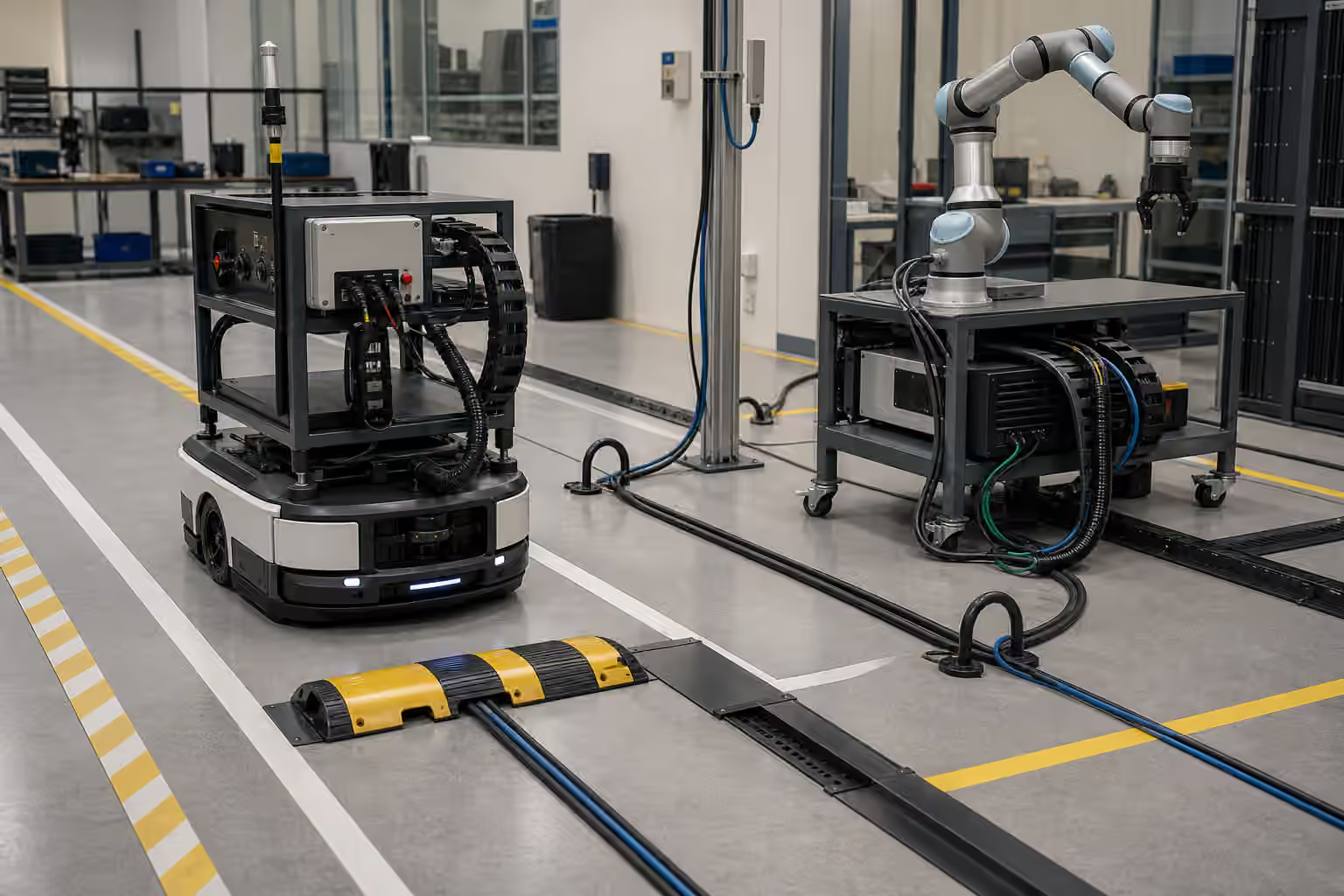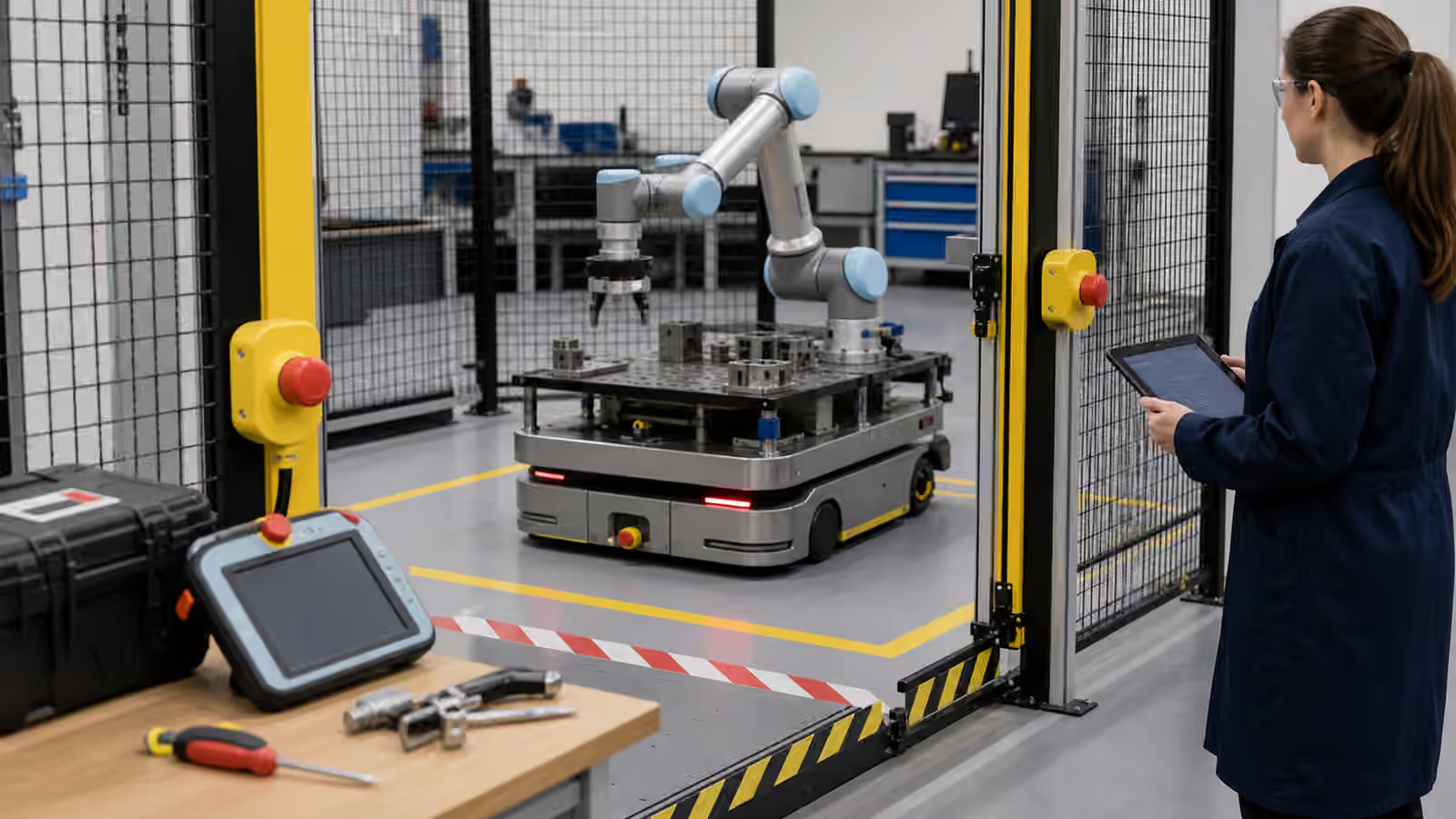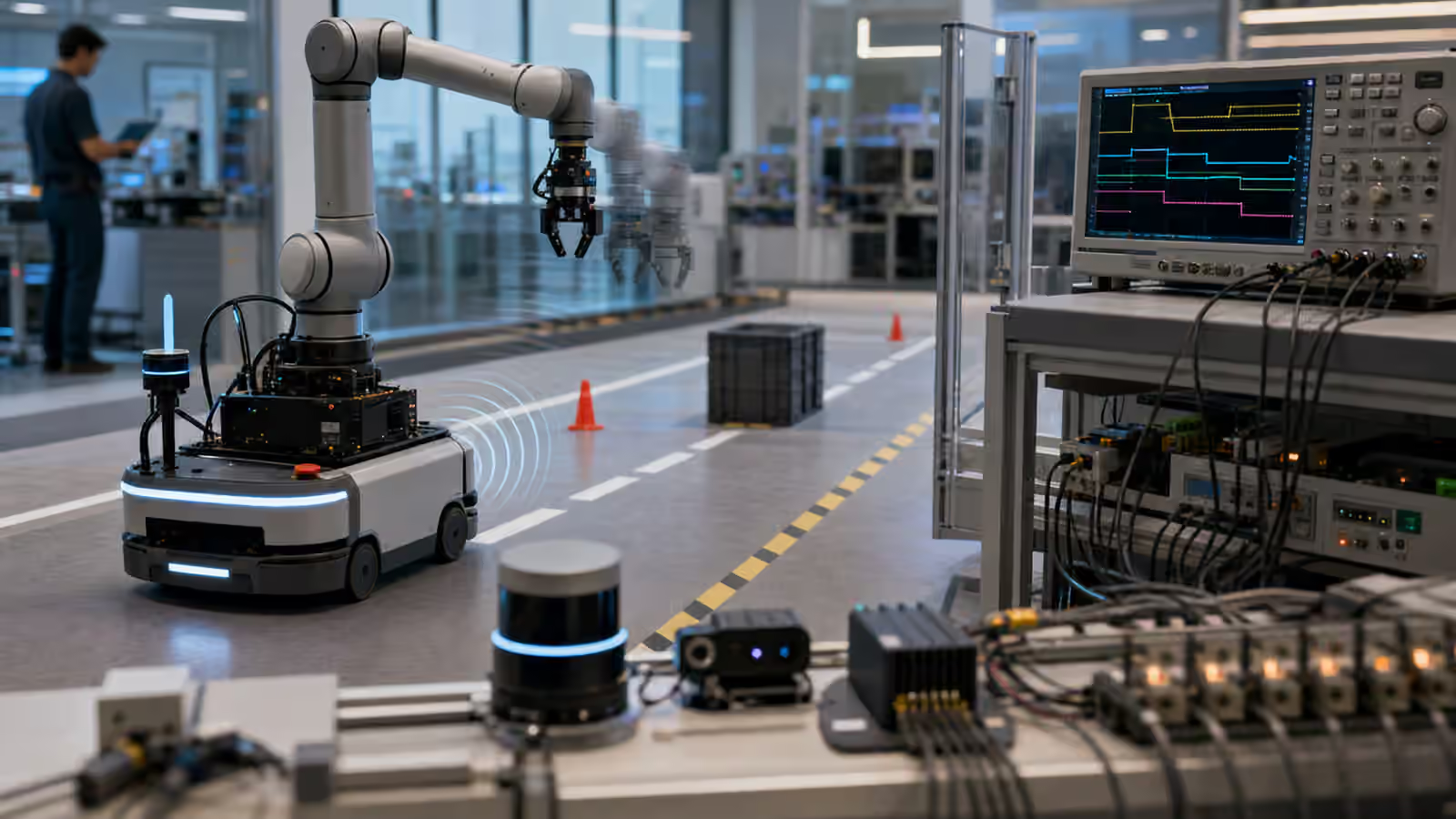
A robot does not only need to make the right decision. It needs to make that decision soon enough for the decision to matter.
A camera frame arrives after exposure, readout, transfer, processing, and interpretation. A lidar scan represents a slice of time that has already passed. A network command may arrive quickly most of the time and slowly at the worst possible moment. A motor controller receives a target, pushes current through a winding, waits for the joint or wheel to respond, and then reports what happened. By the time the autonomy stack decides to slow down, grasp, yield, or stop, the world may already have moved.
Latency is the delay between cause and effect inside the robot system. Real-time control is the discipline of making timing predictable enough that motion stays bounded. The two belong beside Robot Actuators and Motion Control because motors do not respond to intentions. They respond to timed commands, feedback loops, limits, and the physical inertia of the machine.
Timing Is A Physical Boundary
Software teams often discuss latency as a user experience problem. Robotics makes it a physical boundary. A delayed button click annoys a person. A delayed protective stop changes how far a loaded mobile base travels before it slows. A delayed gripper correction may crack a part or lose a grasp. A delayed localization update can make the robot choose a path from an old pose. When the machine moves through a shared space, delay becomes distance, force, heat, wear, and risk.
This is why a robot timing budget should be attached to the task, not only to the computer. A slow inspection robot in a fenced cell can tolerate different delay than an autonomous mobile robot crossing a busy corridor. A laboratory arm placing foam blocks can tolerate different delay than an arm carrying glassware. Robot Operational Design Domains draws the boundary around where a robot is meant to work. Timing is part of that boundary because speed, payload, surface, people nearby, and stopping behavior decide how much delay is acceptable.
The most important question is not whether the system feels fast in a demo. It is whether the worst likely delay has been measured, bounded, and included in safety and task design. A robot that averages a good response but occasionally pauses under load can be more troublesome than a slower robot with predictable behavior. Predictability gives engineers something to design around. Surprise consumes safety margin.
Sensors Report The Past
Every sensor reports the past. The delay may be tiny, but it is still there. Cameras have exposure time and frame rate. Depth sensors have their own capture cycles. Lidar scanners accumulate measurements across rotation or sweep. Tactile sensors filter signals to avoid noise. Inertial sensors drift and need fusion with other sources. A robot that treats all observations as immediate can become subtly overconfident.
The age of a measurement matters because robots use perception to act. If a person steps into an aisle after the last scan, the robot’s map is already stale. If a box slides during a grasp, the camera pose from a moment ago may no longer be enough. If a mobile manipulator extends an arm while the base creeps forward, object position, arm pose, and base pose must be understood as time-linked estimates rather than static facts.
Robot Sensor Fusion and Uncertainty covers the uncertainty side of this problem. Latency adds the time side. A fused state estimate should know when each piece of evidence was collected and how quickly it becomes stale. The robot may need to slow down when perception falls behind, choose a wider clearance path, pause for a fresher observation, or use local low-latency sensors for immediate contact and stop behavior.
Control Loops Need Different Clocks
Not every part of a robot needs the same timing. A motor current loop may run extremely fast because it controls electrical and mechanical stability. A joint position loop may run slower but still needs reliable cadence. A navigation planner may update less often because it reasons over paths and obstacles. A fleet manager may tolerate seconds of delay when assigning work. Treating all of these loops as one software service misunderstands the machine.
Layered control is useful because fast loops can protect the robot when slower loops are busy. A wheel controller can enforce acceleration limits even if the route planner is recalculating. A joint controller can resist a sudden load before a higher-level policy understands the task consequence. A safety controller can stop motion through a protected channel that does not depend on a dashboard, cloud service, or language model response.
This separation also keeps autonomy honest. Robot Autonomy explains the stack behind a demo. Timing helps decide which layer is allowed to do what. A high-level planner can choose a goal. It should not be the only thing preventing a joint from exceeding a safe force. A remote operator can assist a blocked robot. They should not be the only stop mechanism when the network is poor. A model can propose an action. It should not bypass the low-level timing constraints that make the action physically safe.
Jitter Is Often Worse Than Slowness
Latency is not only a number. It has shape. A steady delay can be modeled. Jitter, the variation in delay, is harder because the robot cannot know which moment will be late. A command stream that usually arrives every ten milliseconds but sometimes pauses for two hundred can create unstable motion, jerky stops, stale operator feedback, or confusing state transitions.
Jitter often comes from shared resources: operating system scheduling, overloaded compute, network congestion, garbage collection, logging bursts, thermal throttling, storage pauses, or competing perception workloads. Robot Compute and Connectivity matters here because the compute architecture decides which processes can interfere with one another. A machine learning model that runs beautifully on a quiet bench may steal timing margin from control and perception when the robot is doing real work.
Good systems isolate timing-critical paths. They make sure emergency and protective stops are not waiting on ordinary application code. They keep motor control close to the hardware. They degrade behavior when compute or network conditions become poor. They log timing misses so field teams can see whether problems are random stories or repeatable events.
Remote Control Has A Human Timing Budget
Teleoperation makes latency visible because the human feels it. A remote driver sees video from the past, sends a command into the future, and then waits for updated feedback. The more delay in that loop, the more conservative the operator must become. Fine manipulation becomes harder. Driving near people becomes less acceptable. Recovery maneuvers that are easy in person may become awkward through a delayed camera feed.
Robot Teleoperation explains why human supervision remains part of many useful systems. Timing defines what that supervision can responsibly do. A remote helper may be excellent for diagnosis, approving a route, selecting an object, or giving slow shared-control hints. The same helper may be a poor primary safety layer for fast motion or close human interaction if the network path is not bounded.
The right design gives the human honest feedback about delay and authority. If video is stale, the interface should not imply direct presence. If control is shared, the robot should enforce local limits. If the network drops, the robot should enter a known degraded mode rather than guessing that the operator is still in control. This connects latency to Robot Offline and Degraded Modes , where the machine’s behavior under thin support becomes part of the deployment design.
Timing Needs Field Evidence
A timing budget is only useful if the robot can prove what happened in the field. Logs should capture sensor timestamps, command times, controller state, dropped frames, network quality, compute load, protective stop triggers, and the software version that produced the behavior. Without those records, a delay problem becomes folklore. Someone says the robot hesitated. Someone else says the aisle was blocked. The machine needs enough evidence to settle the question.
Robot Observability and Field Logs is the natural companion here. Timing data should not be buried as raw noise. It should explain whether the robot was acting on fresh perception, whether a controller missed its cadence, whether a route command arrived late, and whether a safety stop behaved within the expected window. This evidence helps separate autonomy bugs from site conditions, hardware degradation, and network trouble.
Predictable Time Makes Autonomy Boring
The best latency work rarely looks dramatic. The robot simply moves at speeds that fit its sensing and stopping distance. It slows when perception quality drops. It keeps fast control local. It refuses tasks that require timing guarantees the site cannot provide. It logs missed deadlines before they become mysteries. It treats network assistance as assistance, not as a substitute for local safety.
That restraint is a form of competence. Physical AI will keep gaining better planners, models, hands, and perception. None of those remove the clock. A robot always acts after sensing, and it always stops after deciding to stop. The gap between those moments is where timing becomes engineering rather than optimism.