
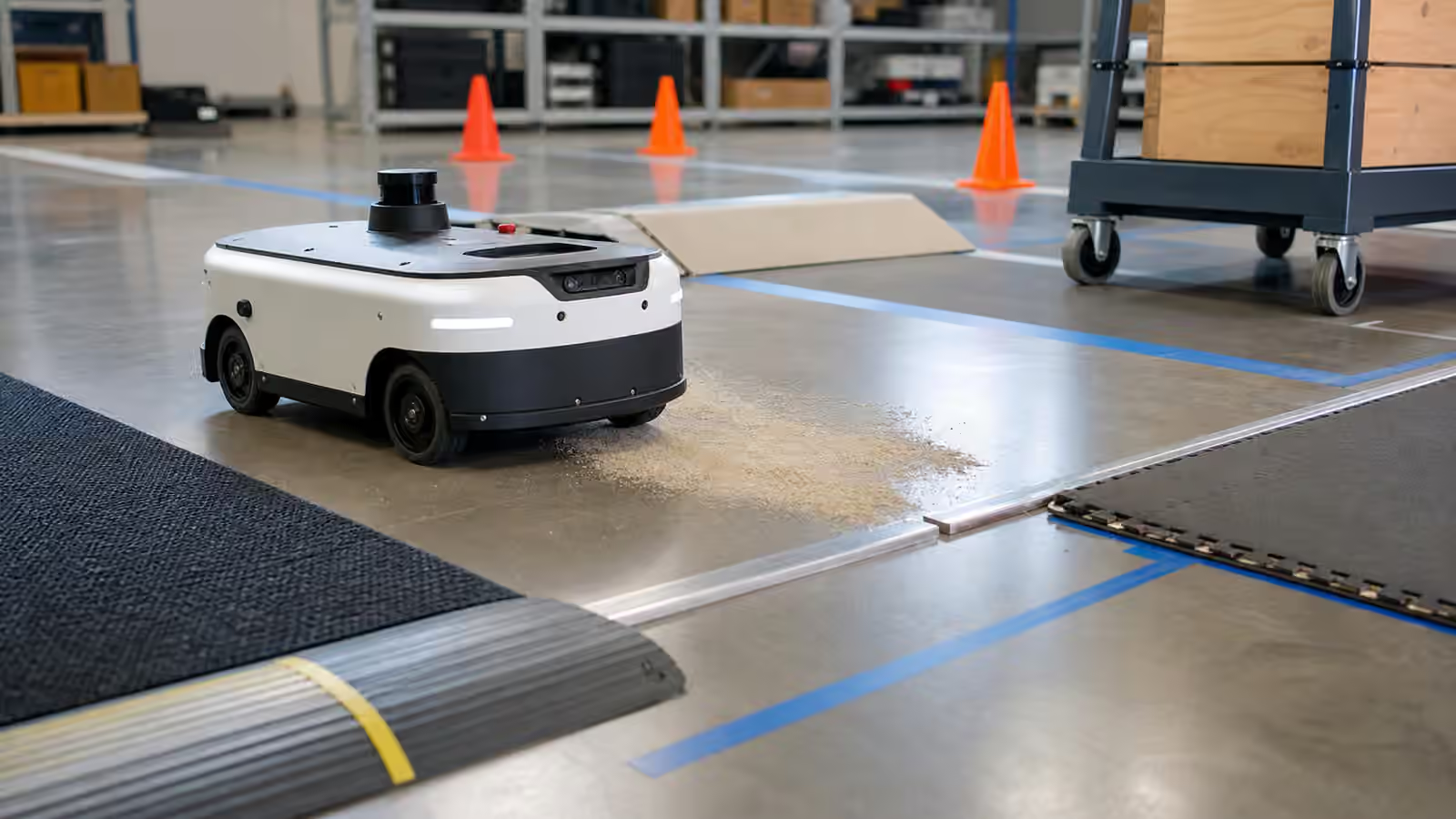
The route on a map is only the route the software imagines. The route on the floor is what the robot actually drives.
That floor has texture, slope, dust, polish, mats, thresholds, drains, expansion joints, cables, tape, wet spots, loose debris, cleaning residue, and the occasional object that should not be there. A person can step over many of these details without thinking. A mobile robot has wheels, casters, suspension, sensors, braking limits, payload stability, and localization assumptions that meet the floor every second.
Robot Site Readiness names floor conditions as part of deployment. This guide slows down on that one layer because ground truth is literal for mobile robots. A robot may have a strong autonomy stack, a useful fleet manager, and clear tasks, yet still become unreliable on the wrong surface.
Smooth Is Not Always Simple
A polished concrete floor can look ideal. It is flat, clean, and easy for people to walk on. For a robot, it may also be slippery when dusty, reflective under low sensors, or different after cleaning. A rubber mat can improve human comfort but catch a caster. A low threshold can be invisible to a person and meaningful to a small wheel. A cable cover can be acceptable in one direction and difficult at an angle.
The robot’s body plan changes the problem. A small indoor AMR may depend on smooth transitions and predictable friction. A heavier platform may tolerate rougher surfaces but require more stopping distance. A cart-towing robot may be limited less by its own wheels than by the trailer’s behavior. A humanoid can step, but floors still matter because balance, foot contact, fall risk, and recovery are expensive.
Robot Mobility Platforms explains why wheels, legs, tracks, and hybrid designs have different tradeoffs. Floor evaluation turns that design choice into site evidence. The question is not whether the robot can cross a sample surface once. It is whether it can do the job repeatedly, loaded, tired, dirty, and surrounded by normal traffic.
Traction Changes With Time
Traction is not a fixed property of a floor. Dust builds up. A floor is waxed. Cleaning chemicals leave residue. A loading bay brings in water. Cardboard fibers collect near packing stations. Metal shavings appear near a shop area. A mat shifts after being cleaned. A spill is wiped up but remains slick. Temperature and humidity can change how wheels and surfaces behave.
The robot may report these changes indirectly. Wheel slip increases. Localization drifts. Braking distances stretch. The base hesitates at a turn. A payload rocks. Docking retries rise. A safety stop appears near the same patch of floor. If the team sees these only as navigation bugs, it may miss the site condition that caused them.
Robot Observability and Field Logs helps because the robot should preserve evidence about where and when trouble appears. A slip event tied to map location, payload, speed, floor zone, and cleaning schedule is far more useful than a vague complaint that the robot “got confused.”
Thresholds Are Small Tests Of Honesty
Thresholds expose the difference between a demo floor and a real building. Door saddles, elevator gaps, ramp lips, floor drains, expansion joints, uneven tile, temporary plates, and cable protectors all ask whether the robot’s route is truly supported. A single threshold may be safe at low speed when empty and risky when carrying a tall payload. It may be easy in one direction and awkward in the other.
The robot’s response matters as much as crossing. It may need to slow down, approach straight, avoid the edge when loaded, choose another route, or refuse the job. If a threshold regularly forces a human rescue, then the route is not merely inconvenient. It is outside the robot’s practical operating domain.
Robot Operational Design Domains gives the language for that boundary. Floors and thresholds should be named as part of the domain, not discovered by accident during daily work. A robot that is approved for “indoor mapped routes” still needs a clearer statement about surface type, slope, transitions, debris, wet areas, and payload state.
Payloads Make Floors Matter More
An empty robot can hide floor problems. A loaded robot reveals them. Extra mass changes acceleration, braking, traction, wheel wear, battery draw, and the way the base responds to bumps. A tall load raises the center of mass. A liquid load may slosh. A cart may fishtail or push from behind during stops. A tote stack may shift when a caster catches a lip.
Robot Payload and Load Handling covers the carried object. Floor evaluation should test the payload with the route because the two form one physical system. A robot that can drive a route empty has not proved it can carry the actual load through the same route. A robot that can carry the load on clean concrete has not proved it can do so after the afternoon cleaning cycle or across the mat by the doorway.
This is where acceptance tests should be plain. The real route, real load, real speed profile, real stops, and real traffic matter. If the robot’s route includes an elevator gap, a turn near a ramp, and a busy handoff point, the test should include those conditions. A smooth lab loop is useful for development, but it does not replace the floor under the work.
Floor Markings Need Maintenance
Robots may use floor markings directly or indirectly. Some read visual markers. Some use lane tape for human coordination. Some rely on map features that include painted lines, dock zones, or staging boundaries. Even when the robot does not require markings for navigation, floor cues can protect shared workflow by showing where robots wait, where people should not store carts, and where handoffs occur.
Floor markings wear. Tape curls. Paint fades. A cleaning machine scuffs a dock outline. A temporary sign becomes permanent by habit. If the robot or the people around it rely on those markings, they become part of the deployment. Robot Worker Training and Floor Etiquette is easier when the physical floor teaches the same behavior as the training.
Markers should not compensate for poor route design. A line on the floor cannot make a narrow aisle safe if the robot and people do not have enough passing space. A dock outline cannot keep a charger clear if the site treats that area as storage. But good markings can reduce ambiguity when they are maintained and matched to robot behavior.
Cleaning Routines Are Route Changes
Cleaning is often scheduled outside robotics discussions, yet it can change the robot’s operating surface. A floor scrubber may leave moisture. Waxing may change friction. Dust collection may improve one zone and push debris into another. A mat may be lifted and replaced slightly crooked. A dock area may be cleaned with a product that leaves residue on contacts or floor tape.
The robot should not need a custom ceremony after every cleaning cycle, but the deployment should know which cleaning changes matter. If a route becomes unreliable after cleaning, that is a site process issue as much as a navigation issue. Robot Cleanability and Contamination Control focuses on the robot body; floor routines are the surrounding version of the same discipline.
Maintenance teams and operations teams need a shared language here. The robot may be able to tolerate ordinary cleaning, but not wet operation. It may handle dust, but not loose packaging straps. It may drive over mats, but not mats that curl at the edge. Those limits should be visible before they become repeated support tickets.
The Floor Is Part Of The System
It is tempting to treat floors as background because they are already there. Physical AI does not get that luxury. The floor shapes motion, sensing, stopping, energy use, payload stability, and trust. It also shapes human expectations. A robot that rolls smoothly and predictably invites calm cooperation. A robot that slips, jolts, or hesitates at ordinary transitions makes people watch it as a problem.
Good floor planning does not require a perfect building. It requires honest matching between robot and site. Some routes can be improved with small physical changes. Some need speed limits or payload rules. Some should be avoided. Some require a different platform. The strongest deployments make those decisions before the robot has taught the site through frustration.
A route is more than a line on a map. It is a physical promise between wheels, floor, load, people, and time. When that promise is tested and maintained, the robot can spend more of its intelligence doing the job and less of it recovering from the ground beneath it.


