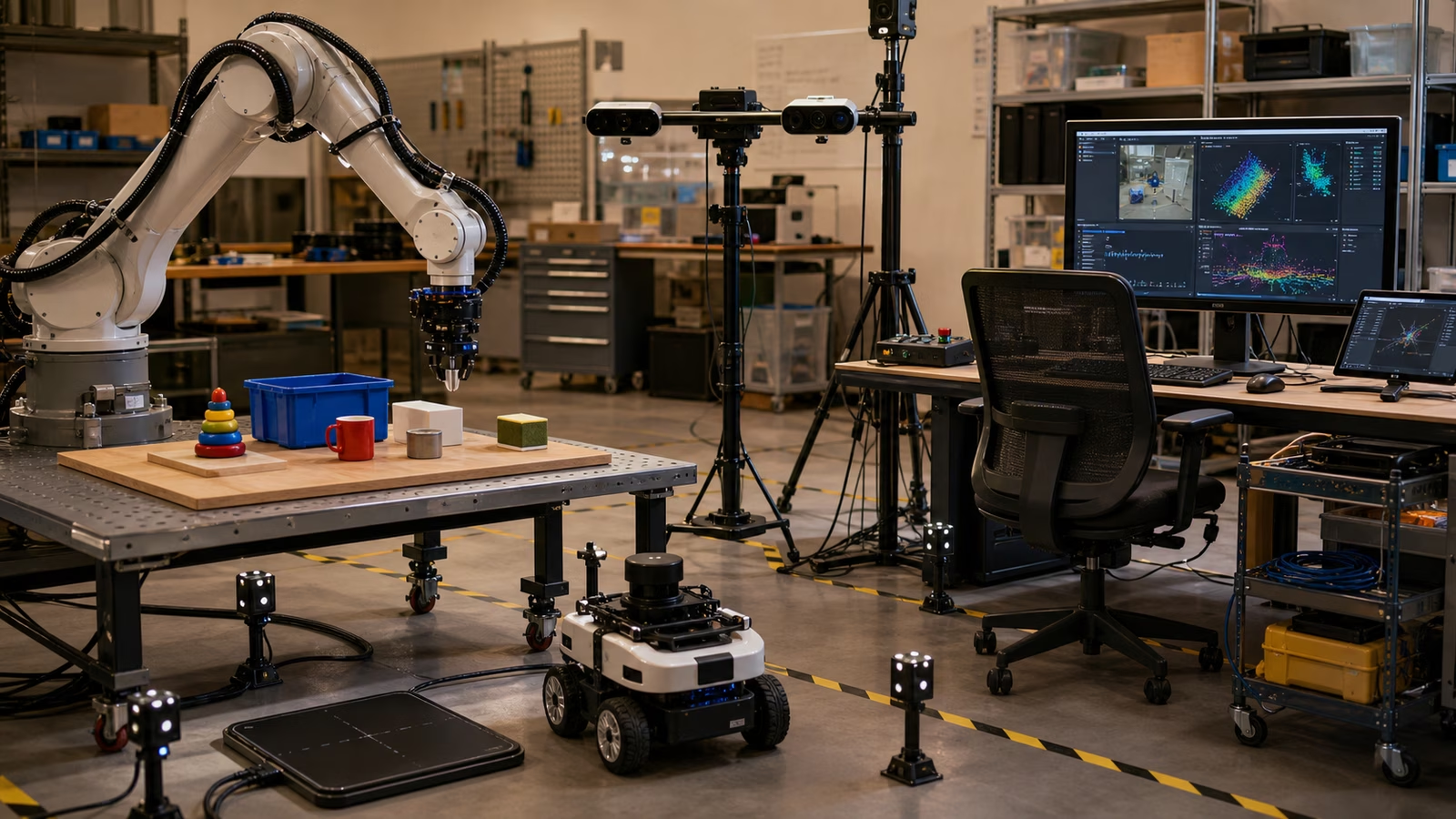
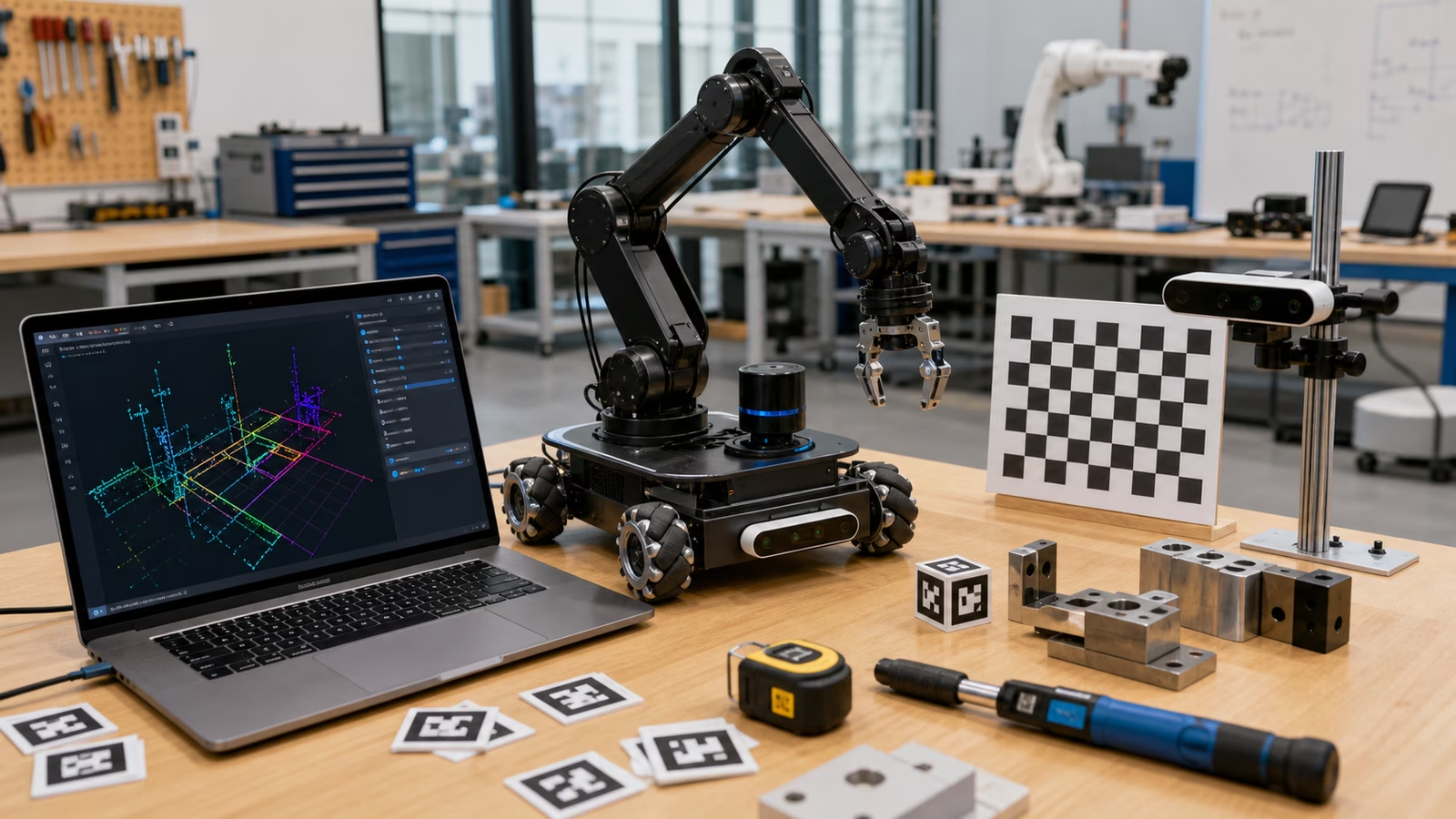
A robot dataset is not just a pile of recordings. It is a memory of what the robot was asked to do, what the world looked like, what the robot believed, what action followed, and what happened next. If that memory is messy, biased, unlabeled, or detached from the task, the learning system can become very good at repeating the wrong lesson.
That problem is easy to miss because data volume is visible and data quality is quiet. A team can count hours of video, terabytes of sensor logs, demonstrations, grasps, route miles, or teleoperation sessions. It is harder to see whether those examples include the awkward cases that matter, whether the labels mean the same thing across reviewers, whether failed attempts were preserved instead of discarded, and whether private or sensitive scenes were handled with enough restraint.
Robot Data Collection explains why physical AI needs experience from real work. Dataset curation is the next question. Once the robot has experience, someone has to decide what enters the training set, what is held out for evaluation, what needs human annotation, what must be protected, and what should be thrown away because it teaches a misleading pattern.
The Dataset Should Describe The Task
Good robot data begins with a task boundary. A warehouse picking dataset, a home navigation dataset, a manipulation demonstration set, and a fleet observability archive may all contain images, depth maps, poses, commands, and outcomes. They are not interchangeable. The right examples are the examples that describe the work the robot is expected to perform.
For manipulation, that may mean object pose, grasp attempt, contact signal, slip, tool state, damage outcome, and placement evidence. For mobile robots, it may mean route context, localization confidence, obstacle history, human traffic, floor condition, and recovery behavior. For a home robot, it may mean clutter, lighting, privacy boundaries, object uncertainty, and user intervention. A dataset that records the scene without the consequence may look rich while hiding the reason the robot succeeded or failed.
This is why curation belongs close to Robot Task Design and Acceptance Tests . A task definition tells the data team what matters. If the task says the robot must refuse uncertain glassware, the dataset needs uncertain glassware and refusal outcomes. If the task says a mobile robot must recover from blocked routes, the dataset needs blocked-route episodes, not only clean trips through empty corridors.
Annotation Is A Contract
Annotation sounds simple until the label changes the robot’s behavior. A box around an object, a segmentation mask, a grasp point, a traversable region, a failure reason, or a human correction is not only metadata. It is a contract about how the system should interpret the world.
That contract needs definitions. If one reviewer marks a cable as an obstacle and another marks it as clutter, the model learns from disagreement that the interface never made visible. If one reviewer labels a failed grasp as a perception miss and another calls it a tooling problem, the team may train the wrong subsystem. If a scene contains a person, a pet, a reflective surface, and a moving cart, the annotation policy has to say which facts matter for the task and which facts should be ignored or protected.
Annotation quality improves when reviewers can see enough context to make the same judgment a field engineer would make. A still image may not reveal that the object slipped after contact. A video clip may not reveal that the gripper was worn. A route screenshot may not reveal that the map changed the night before. Labels should be tied to event timelines, robot state, and outcome evidence whenever possible. Robot Observability and Field Logs gives the operational record that makes those labels less speculative.
Failed Examples Are Often The Most Valuable
Teams are tempted to keep successful demonstrations and discard ugly failures. That creates a dataset full of scenes where the robot already behaved well. The result may be a model that imitates the polished surface of the work while remaining weak at the moments where help is needed.
A failed grasp can reveal that the object presentation was poor, the gripper chose the wrong contact patch, the perception model missed a transparent edge, or the controller closed too quickly. A failed route can reveal glare, wheel slip, map drift, blocked line of sight, or a human workflow that keeps crossing the robot’s path. A failed handoff can reveal timing, signaling, reach, or responsibility confusion. These cases are not embarrassing leftovers. They are the evidence that shows where the boundary of autonomy really sits.
The trick is to preserve failure without letting it dominate blindly. A dataset made only of failures can teach the system that the world is more hostile than daily work. A dataset made only of successes can teach overconfidence. Curation is the balancing act. It asks which failures are common enough to matter, which are rare but severe, which were caused by a known bug that is now fixed, and which still represent the robot’s operating environment.
Diversity Is Not A Slogan
Robot data diversity has to be physical. It is not enough to collect many examples that look different on a spreadsheet. The dataset needs variation that changes action: lighting, object pose, surface friction, floor texture, sensor dirt, container damage, user timing, battery state, map age, payload, occlusion, and recovery path.
The right diversity depends on the deployment. A home robot needs ordinary clutter, rugs, thresholds, reflective appliances, pets, toys, and changing daylight. A warehouse robot needs carts, pallets, damaged boxes, seasonal aisle congestion, labels, dust, forklifts, and shift change traffic. A lab robot needs instrument geometry, plate presentation, cable routing, calibration age, and the mistakes people make when setting up a run. Generic variety is decorative. Task variety is useful.
Robot Perception describes why action-ready understanding is harder than object recognition. Dataset curation is where that principle becomes practical. If the robot must estimate whether a surface is safe to drive on, the dataset should include surfaces that confuse that decision. If the robot must grasp towels, it should include folds, partial occlusion, and ambiguous edges. If the robot must share space with people, it should include the timing and posture that make human movement predictable or uncertain.
Review Sets Need Protection
A training set teaches the robot. A review set keeps the team honest. If every difficult case is used for tuning, the system may start to look better without becoming more dependable. The team needs held-out scenes that represent the task and remain separate enough to reveal whether a change actually generalizes.
For robots, that separation can be tricky because physical environments repeat. A route segment from the same building may appear in many recordings. A bin with the same object set may produce many grasps that are not truly independent. A home scene may repeat the same room from slightly different angles. A careful review set avoids giving the model near-duplicates of the exam during training.
The review set should also include recovery behavior. It should ask how the robot handles uncertainty, not only whether it predicts the right label. A perception model that identifies an object correctly but with poor geometry may still fail the task. A planner that reaches a goal while cutting too close to people is not acceptable because the endpoint was right. Robot evaluation has to stay tied to physical outcomes, as described in Robot Demo Evaluation .
Privacy Shapes What Can Be Learned
Robots often collect data in places where people live or work. That makes privacy a design constraint, not a paperwork afterthought. The dataset should collect the minimum evidence needed for safety, reliability, learning, and support. It should define who can inspect sensitive examples, how long they are retained, how they are anonymized where practical, and when they should never leave the device or site.
This matters especially for homes, workplaces, and any setting with people who did not choose to become training material. A blurred face may not be enough if the map, voice, schedule, or room layout is identifying. A warehouse scene may reveal inventory, process details, or worker patterns. A lab scene may reveal proprietary equipment or experiments. Curation has to understand what the image shows and what the surrounding data implies.
Privacy-aware curation can improve learning because it forces clarity. If the task can be learned from local object crops, event summaries, or synthetic variations instead of full-room recordings, the dataset becomes easier to govern. If raw data is needed for a failure review, the reason can be documented and access can be limited. Good governance does not make the robot less capable. It makes the evidence usable without quietly consuming trust.
Annotation Workflows Should Teach The Team Too
The best annotation process does not only feed a model. It teaches the robotics team what the robot is actually facing. Reviewers notice that one object type causes many failures, that a certain route produces repeated occlusion, that lighting changes after lunch, that workers stage totes in a way the task definition never anticipated, or that the robot is collecting too many examples of easy work and too few examples of the hard boundary.
Those discoveries should flow back into the system. Some belong in training data. Some belong in fixtures, site changes, operator guidance, software updates, or narrower task definitions. A dataset is not a substitute for engineering. It is a way of seeing where engineering should happen.
This is the link to Robot Learning From Demonstration . Demonstrations can show useful behavior, but the examples need review. Was the human demonstrating the task the robot should perform, or compensating for weak hardware? Did the remote operator solve the case with visual clues the robot will not have later? Did the demonstration include recovery, or only the successful middle of the motion? Curation turns demonstrations from interesting recordings into teachable evidence.
The Goal Is A Trustworthy Memory
A robot does not learn from the world directly. It learns from the version of the world the team chooses to preserve, label, protect, and evaluate. That version can be honest, or it can be flattering. It can include failure, uncertainty, and edge cases, or it can quietly remove the moments that make deployment hard.
Dataset curation is therefore part of robot engineering. It sits between sensors and models, between field work and evaluation, between privacy and improvement. It asks what the robot experienced, what that experience means, and whether the next training run will make the machine more useful in the real task rather than merely better on a familiar archive.
The strongest datasets feel plain when inspected. The examples are tied to tasks. The labels have definitions. The failures are present. The review set is protected. Sensitive material is handled with restraint. The team can explain why the data belongs there. That plainness is valuable because physical AI needs memory it can trust before it can learn anything worth deploying.