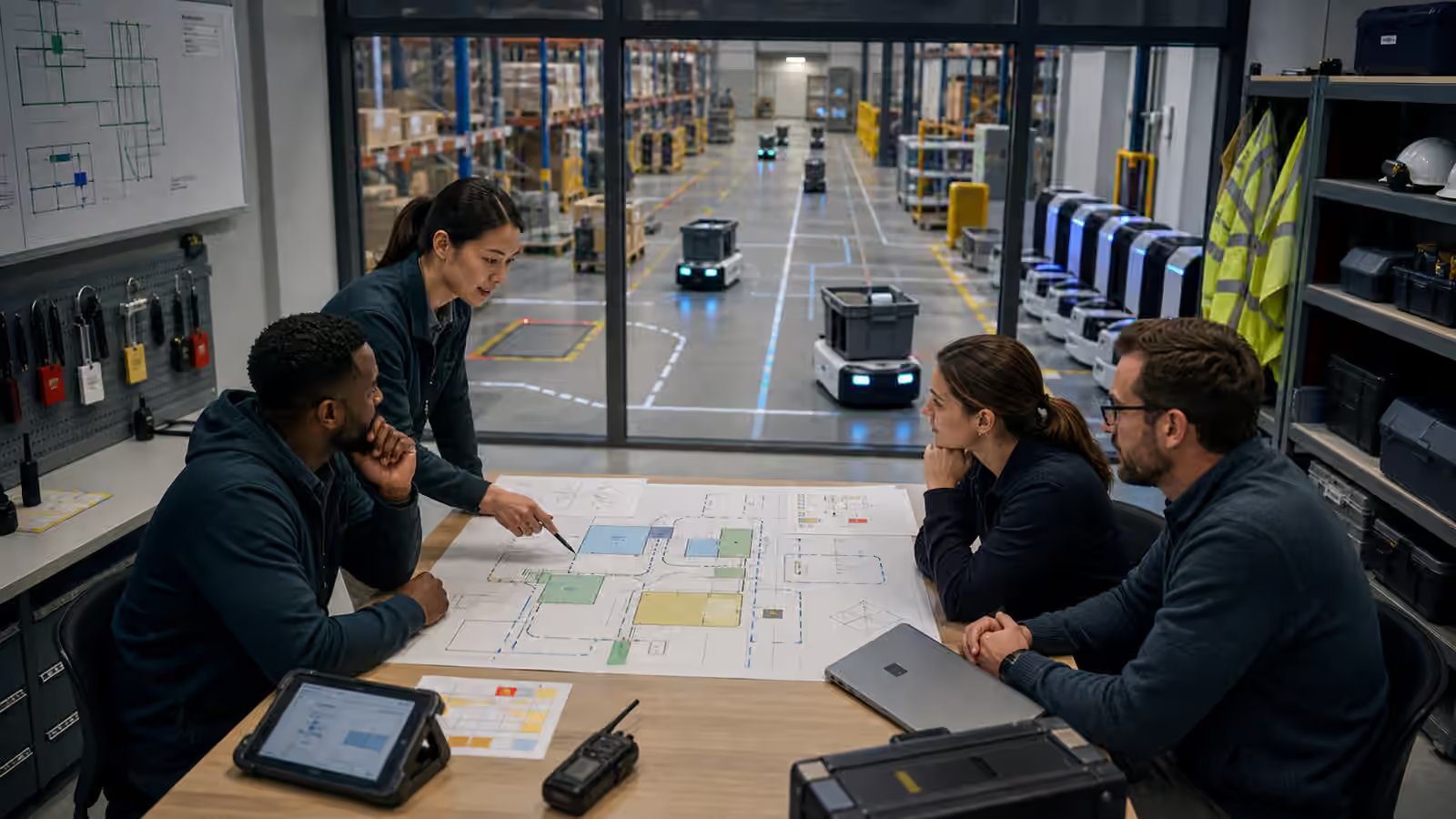
Commissioning is the moment a robot stops being a purchased machine and starts becoming part of a place.
The robot may have passed factory tests. It may have worked in a vendor lab. It may have appeared smooth in a demo video. None of that means it is ready for the building, the people, the routes, the objects, the network, the docks, the cleaning schedule, and the ordinary interruptions that define the actual job. Commissioning is the bridge between a capable robot and a useful deployment.
This phase is sometimes treated as a short checklist before real work begins. That is a mistake. The first week teaches the deployment team what the sales process could not: where the map disagrees with the floor, which operators need different training, which alerts are too vague, which tasks were defined too broadly, which routes are fragile, and which recovery procedures are still theoretical. A mature commissioning plan expects these discoveries. It does not treat every early problem as an embarrassment.
Site Readiness Becomes Site Evidence
Robot Site Readiness asks whether the building is prepared before the robot arrives. Commissioning answers what was actually true after the machine entered the space. The floor that looked smooth during a walkthrough may create vibration at speed. The dock that seemed conveniently placed may be blocked during shift change. The network coverage map may miss a dead spot near receiving. The workstation that looked clear may gather carts every afternoon.
The commissioning team should turn those observations into evidence, not rumors. A blocked route should be recorded with time, place, task, and recovery. A docking failure should be tied to battery state, floor condition, alignment, and human activity around the dock. A protective stop should be described in enough detail that safety and operations people can understand what happened without relying on memory.
This evidence matters because early deployment problems can be misassigned. A navigation fault may be a route design issue. A grasp failure may be a fixture issue. A low utilization metric may be a scheduling issue. A robot that appears unreliable may be encountering a building habit that nobody documented. Commissioning should slow the rush to blame the robot or the workers and instead make the real interaction visible.
The First Task Should Be Narrow
A robot should not begin by inheriting the broadest promise made about it. It should begin with a task narrow enough to test honestly. The start state should be known. The end state should be observable. The acceptable object range should be defined. The handoff should be clear. The failure states should be expected. The people nearby should know what the robot is trying to do.
Robot Task Design and Acceptance Tests is the guidebook that belongs on the commissioning table. A vague goal such as helping with internal transport is not enough. A useful first task says what the robot carries, between which stations, during which hours, through which routes, with what allowed delays, and with what recovery path when the route is blocked. For a manipulation cell, it says which objects are included, how they are presented, how placement is checked, and what damage or intervention makes a run unacceptable.
This narrowness is not a lack of ambition. It is how the team earns confidence. A robot that performs one defined task repeatedly gives the site a base from which to expand. A robot that starts with too many poorly bounded tasks can create a confusing first impression that is hard to repair.
Baselines Prevent Moving Targets
Commissioning should create a baseline for the robot and the site. That baseline includes software versions, maps, calibration state, dock location, task definitions, route rules, operator roles, alert behavior, maintenance checks, network assumptions, and the acceptance test results from the first stable runs. Without a baseline, every later comparison becomes slippery.
The baseline does not freeze the deployment forever. Robots need updates, routes change, fixtures improve, and operators discover better habits. The point is to know what changed. If the robot begins failing after a map edit, a dock relocation, a software update, a gripper pad replacement, or a new packaging format, the team needs enough records to connect the failure to the change. Otherwise the deployment becomes a debate among memories.
Robot Calibration and Alignment shows why geometry needs reference. Commissioning applies the same idea to operations. The site needs reference behavior, reference settings, and reference tests. When the robot later drifts, the team can ask whether the machine changed, the environment changed, the task changed, or the expectation changed.
Operators Learn Through Real Exceptions
Training before launch is necessary, but people learn most when the robot does something inconvenient. It stops near a doorway. It asks for help at a dock. It refuses a task because the load is not seated. It pauses because the map confidence is low. It finishes a delivery but ends in a position that slows a worker. Those moments reveal whether the operator interface and local procedures are clear enough.
Robot Operator Interfaces matters during commissioning because the interface is tested by confusion, not by a tour. The screen may look polished in a meeting and still fail to answer the question a worker has at the robot’s side. Is it safe to approach? Is the robot waiting or broken? Should the object be moved or left alone? Who owns this alert? Can the task be retried, or does a technician need to inspect it?
Commissioning should include ordinary staff, not only robotics specialists. The deployment will eventually live with people who have other jobs. If only experts can recover the robot, the deployment is not ready. If workers invent shortcuts because the official procedure is slow or unclear, the commissioning team should treat that as design feedback rather than defiance.
Ramp-Up Should Be Deliberate
The early period should usually increase scope gradually. A robot can start with limited hours, fewer routes, lower speeds, constrained payloads, a small object set, or a single station pair. As evidence improves, the site can add routes, tasks, hours, robots, and autonomy. This deliberate ramp-up protects trust because the robot earns responsibility instead of claiming it all at once.
The temptation is to accelerate as soon as the first runs look good. That can be reasonable when the task is simple, but physical AI often hides rare failures behind smooth early motion. The robot may need enough repetitions to see shift changes, cleaning cycles, lighting variation, worker congestion, battery aging, routine maintenance, and the first genuinely annoying exception. Robot Demo Evaluation warns against confusing a good clip with a deployment. Commissioning extends that warning to the first week: a good morning is not yet a stable service.
Ramp-up also gives the support team time to improve the product around the robot. Alerts can be clarified. Route rules can be adjusted. Dock markings can be changed. A fixture can be improved. A training note can be rewritten. These small changes are not signs that commissioning failed. They are the work commissioning exists to reveal.
Early Failures Need Calm Triage
The first deployment failures can create emotional pressure. Champions of the robot may minimize them. Skeptics may treat each one as proof that the project was misguided. A useful commissioning process resists both reactions. It sorts failures by cause, risk, frequency, recovery cost, and whether the task boundary needs to change.
A single failure in an extreme condition may become a boundary note. A repeated failure in normal work needs engineering attention. A failure that requires unsafe human recovery should pause the task until the recovery path changes. A failure that consumes too much operator time may destroy the value of the workflow even if the robot eventually completes the job.
Robot Failure Recovery is especially relevant here. The question is not only why the robot failed, but what happened next. Did it stop safely? Did it preserve useful logs? Did it ask the right person for help? Did recovery require hidden expertise? Did the site return to work cleanly? Commissioning should make those answers visible before the robot is scaled.
Fleet Thinking Starts With One Robot
Even one robot should be commissioned with future operations in mind. If the pilot succeeds, the site may add more robots, more routes, more docks, more shifts, and more operators. Decisions made casually during the first installation can become hard to change later. Naming conventions, map ownership, access roles, support channels, charging behavior, and maintenance records all scale better when they are sensible from the beginning.
Robot Fleet Management covers the multi-robot layer, but commissioning is where the first habits form. If every route edit depends on one vendor engineer, the site will feel that dependency later. If every alert is routed to the same overloaded person, scaling will make the problem worse. If dock placement barely works for one robot, it may fail for three.
The first robot is therefore both a machine and a rehearsal. The team is learning how the organization will own robots as infrastructure. That includes who can approve changes, who reviews logs, who trains new staff, who handles software updates, and who decides that a task is ready for expansion.
The Product Includes The Start
Commissioning is not the end of sales or the beginning of operations. It is part of the product experience. A robot that installs clearly, explains its state, reveals site problems, supports trained operators, records early failures, and ramps responsibly is more likely to become useful than a robot that arrives with a dramatic promise and a weak first week.
The strongest commissioning plans are practical and modest. They define a narrow first task. They create a baseline. They observe real exceptions. They train people through the work they will actually do. They let evidence guide expansion. They treat early failures as information while respecting safety and trust.
A robot deployment does not become real when the machine powers on. It becomes real when the site can run, recover, learn, and improve without depending on the excitement of installation day. The first week is where that reality begins to show.