A robot deployment does not fail only when the robot changes. It can fail when the work changes around it.
The package gets taller. The supplier adds glossy wrap. The tray changes color. A seasonal item arrives in a soft bag instead of a box. A fixture is replaced with a slightly different version. A label moves to the opposite side. A worker discovers a faster loading habit. The robot is still the same machine, but the task it learned, tested, and accepted has quietly shifted.
Changeover is the practice of moving from one approved form of work to another without pretending nothing changed. It belongs beside Robot Site Change Management , but it focuses on the product, object, fixture, packaging, and task variation inside the robot’s work. In factories, laboratories, warehouses, kitchens, and service settings, the question is not whether variation will arrive. It is whether the robot and the organization can recognize it before daily work becomes an experiment.
Variation Arrives Quietly
Product variation rarely announces itself as a robotics event. Purchasing approves a new supplier. Packaging is redesigned for shipping. A part revision changes a corner radius. A tray is replaced because the old one cracked. A new SKU shares a name with an old one but has different surface texture. Operations changes a packing sequence. The robot sees these as physical facts, not as business context.
For a person, many of these changes are small. A human worker can notice the new package, rotate it, press a flexible side, or ask a supervisor. A robot may interpret the same change as a perception failure, a grasp slip, a collision risk, a bad placement, or an object it cannot classify. The change may be easy for people and hard for the robot because people understand why it happened and the robot only sees the geometry.
This is why changeover should be part of the deployment plan rather than an emergency habit. If the site knows which changes matter to the robot, it can route them through a small validation process. If no one knows, the robot becomes the detector of last resort.
The Approved Task Has Boundaries
Robot Task Design and Acceptance Tests argues that a task needs start states, end states, allowed actions, failure cases, and success evidence. Changeover asks what happens when those boundaries move. A new object size may still fit the task. A new surface material may require a new gripper pad. A new package orientation may require a perception update. A new loading pattern may be outside the accepted task even if the task name stayed the same.
The site should avoid treating the task title as the task boundary. “Move cartons” is not enough when carton sizes, weights, stiffness, sealing methods, and destination evidence vary. “Pick lab tubes” is not enough when racks, caps, liquid levels, and barcode positions change. “Load trays” is not enough when tray pockets, tolerances, and residue patterns change.
Boundaries do not need to make the system brittle. They make expansion visible. If the robot is approved for one range and the work moves outside that range, the team can decide whether to adapt the presentation, update the model, change the gripper, add a fixture, adjust the acceptance test, or reject the change for robot handling.
Fixtures And Tools Need Versions
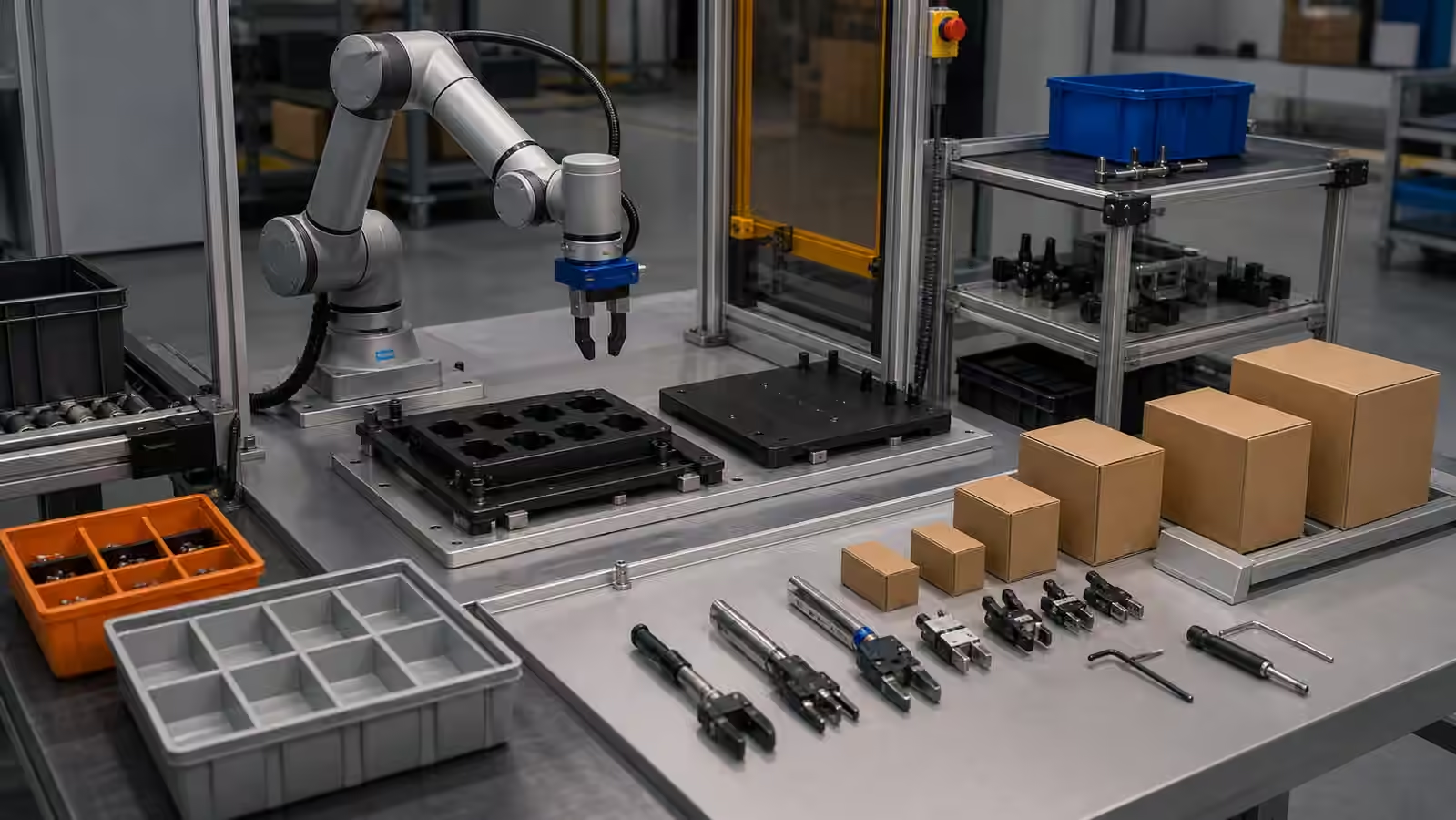
Changeover often touches the physical helpers around the robot. A fixture plate, tray insert, suction cup, gripper finger, guard, shelf spacer, or cart dock may work for one product and fail for another. If these helpers are not versioned in some practical way, the robot may run the right software against the wrong physical setup.
Robot Workcell and Fixture Design is useful because it treats the workcell as part of the system. Changeover adds time. Which fixture is installed today? Who installed it? Was it seated correctly? Is it clean? Has it worn enough to change the object pose? Is the matching robot configuration active? A cell can look ready while holding a mismatch that only appears during motion.
The versioning does not have to be elaborate. The important part is that the operator, robot, and support team share the same reality. A fixture can be keyed so it only fits one way. A tool can be recognized by the controller. A changeover checklist can be embedded in the interface without becoming a wall of text. A first-run validation can confirm that the robot sees and reaches the presented object before production resumes.
Packaging Is A Robotics Surface
Packaging is often designed for shipping, shelf appeal, cost, sustainability, or human handling. The robot experiences it as surface, shape, stiffness, reflectivity, friction, weight distribution, and damage tolerance. A package change can defeat a suction cup, confuse a classifier, hide a graspable edge, block a barcode, or shift the center of mass.
This is especially visible when a robot handles consumer goods or mixed inventory. A box with matte cardboard behaves differently from one with glossy film. A flexible bag may sag or wrinkle. A blister pack may reflect light. A shrink-wrapped bundle may grip the tray. A bottle may be transparent. A pouch may be too soft for a side grasp. These differences can matter even when the item name and dimensions look similar in a planning system.
Robot Object Presentation and Staging belongs close to changeover because presentation can absorb some variation. A tray insert can expose a stable edge. A divider can prevent soft items from tangling. A staging rule can keep glossy surfaces away from glare. But presentation is not magic. The robot should know when the packaging has moved beyond its tested range.
Data Must Follow The Change
Robot learning systems are vulnerable to stale evidence. A model trained or tuned on last month’s object set may continue to produce confident outputs after the product mix shifts. The site may see failures as random because the change was gradual. The robot may see new cases but not know they represent a new class of problem.
Robot Dataset Curation and Annotation gives the data side of this issue. Changeover events should be connected to examples. When a new package, fixture, lighting condition, or presentation rule is introduced, the robot’s data should mark that context. Otherwise the team cannot easily compare performance before and after the change.
This does not mean every product change requires a large machine-learning project. Sometimes the answer is a fixture adjustment, a narrower task rule, a new gripper pad, or an acceptance test. But when data is involved, the change should be recorded. Future engineers should not have to infer from a failure cluster that a product revision happened two weeks earlier.
Validation Should Be Small And Real
Changeover validation should be modest enough that people actually use it and real enough that it catches meaningful differences. A robot does not need a theatrical requalification for every minor variation. It does need a clear path between “nothing changed” and “we are running untested work.”
A useful validation might include a few representative objects, the actual fixture or tray, the real lighting and route, the expected payload, and the normal start and end evidence. The robot should perform the specific task, not a simplified gesture that misses the difficult part. If the variation affects grasping, the test should include contact. If it affects perception, the test should include occlusion and viewpoint. If it affects handoff, the test should include the human step.
Robot Commissioning and Ramp-Up applies after a change as well as at first deployment. A careful site may run the new variation at lower volume, watch interventions, compare cycle time, and keep rollback available. Ramp-up is not only for new robots. It is for new work.
Software Updates Are Not The Only Change
Robotics change control often focuses on software, and Robot Software Updates and Change Control is a necessary guide. Yet many field regressions come from physical and operational changes. The code stayed the same, but the task did not.
This creates a coordination problem. Engineering may ask whether the deployed version changed. Operations may answer no. Both may be telling the truth while missing the packaging revision, fixture replacement, loading habit, dock relocation, or supplier variation that changed the robot’s inputs. A good change process includes software, hardware, site, object, and workflow changes in the same operational memory.
The robot’s logs should help. If failures rise after a new product lot, the event record should make that timing visible. If a gripper slips only on a new surface, the cases should be searchable. If a map or fixture changed, the support team should see that context. Robot Observability and Field Logs turns changeover from rumor into evidence.
Changeover Is How Robots Grow Up
The point of changeover discipline is not to keep robots locked inside a tiny task forever. It is to let them expand without losing honesty. A deployment can begin with one object family, one fixture, one route, or one package type, then add variation deliberately. Each addition teaches the team what is reusable and what is new.
This is more durable than pretending generality has already arrived. A robot that handles five validated product variations may be less glamorous than one advertised as broadly flexible, but it gives the site a way to keep working. It also gives engineering a clearer path for improvement. The team can see whether the next expansion needs perception data, tool changes, presentation changes, task policy, or training.
Changeover is the moment when physical AI meets the ordinary churn of work. Products change, suppliers change, fixtures wear, packaging drifts, and people adapt. A useful robot deployment does not deny that churn. It gives change a doorway, a test, a record, and a way back if the new work is not ready.