A robot that works only for the average imagined user is not ready for shared space.
People move, see, hear, understand, and react in different ways. Some use wheelchairs, walkers, canes, crutches, service animals, carts, or mobility scooters. Some need more time to move through a doorway. Some cannot hear a tone, cannot see a small light, or cannot process a rapid voice prompt in a busy environment. Some are visitors who never received robot training. A robot that assumes one body, one pace, and one attention pattern will create friction that does not appear in a clean lab test.
Inclusive robot design is not a special feature added after deployment. It is a way of making physical AI less brittle. A robot that communicates through more than one channel, leaves enough space, respects slower motion, and avoids forcing people into narrow choices is usually better for everyone.
The Route Is A Human Space First
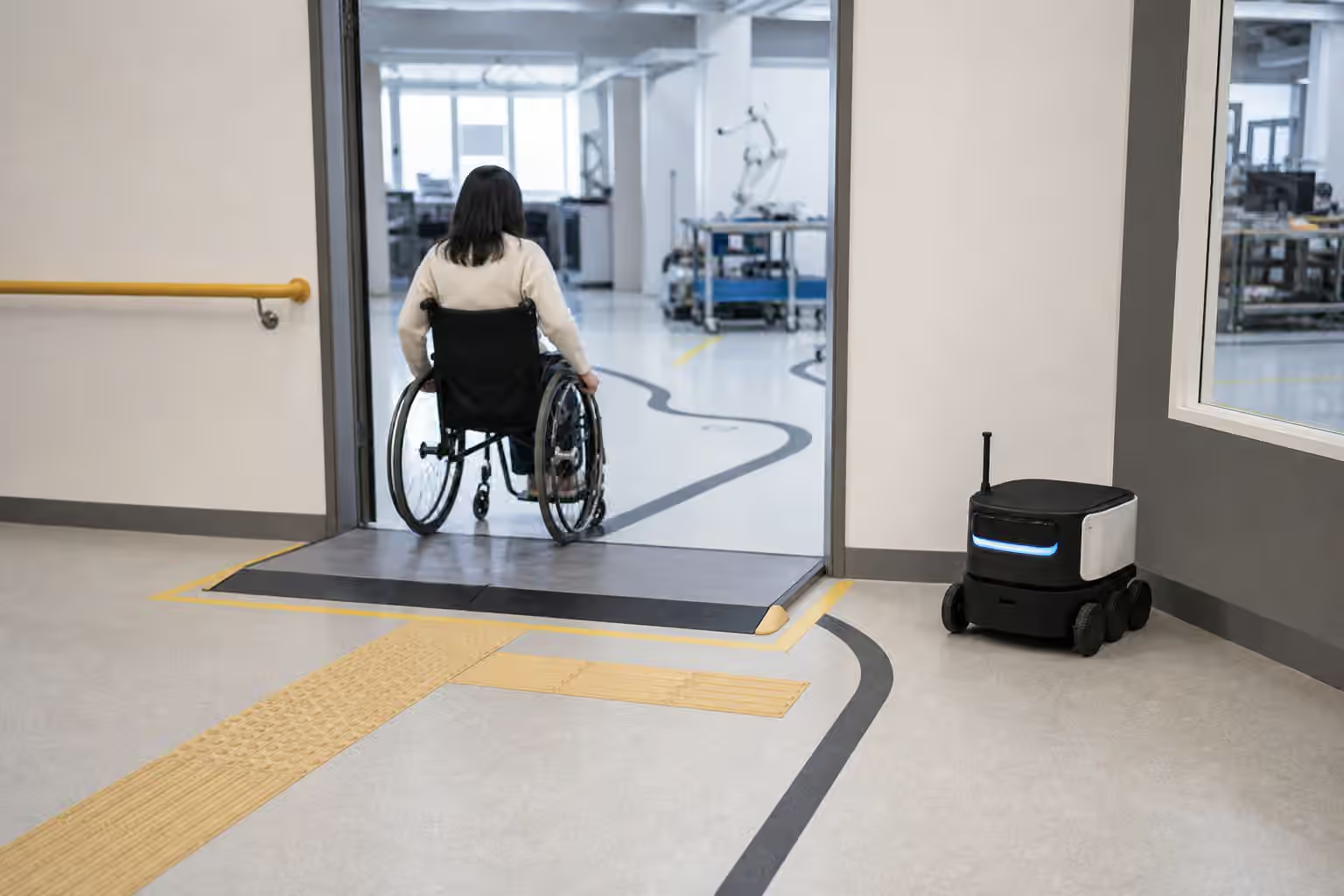
Mobile robots often treat routes as geometry: a path through a map with obstacles, widths, turns, and goals. People experience routes as social and bodily spaces. A hallway may be technically wide enough for the robot and still feel uncomfortable if the robot waits too close to a doorway, blocks a ramp, narrows a passage, or stops where a person using a mobility aid needs turning room.
Robot Shared-Space Traffic covers the general traffic problem. Accessibility adds a sharper question: who loses options when the robot takes space? A person without mobility constraints may step around a stopped robot. A person using a wheelchair may not have that option. A worker carrying a heavy object may not be able to retreat quickly. A visitor with low vision may not interpret the robot’s path until it is too close.
The route plan should protect human clearance, not merely robot clearance. Waiting zones should avoid ramps, door swings, elevator thresholds, restroom approaches, emergency paths, and narrow turns. Passing behavior should allow more margin than the robot needs for itself. If the robot cannot guarantee enough space, slowing down is not always sufficient. Sometimes the correct behavior is to wait before entering the constricted area.
Signals Need More Than One Channel
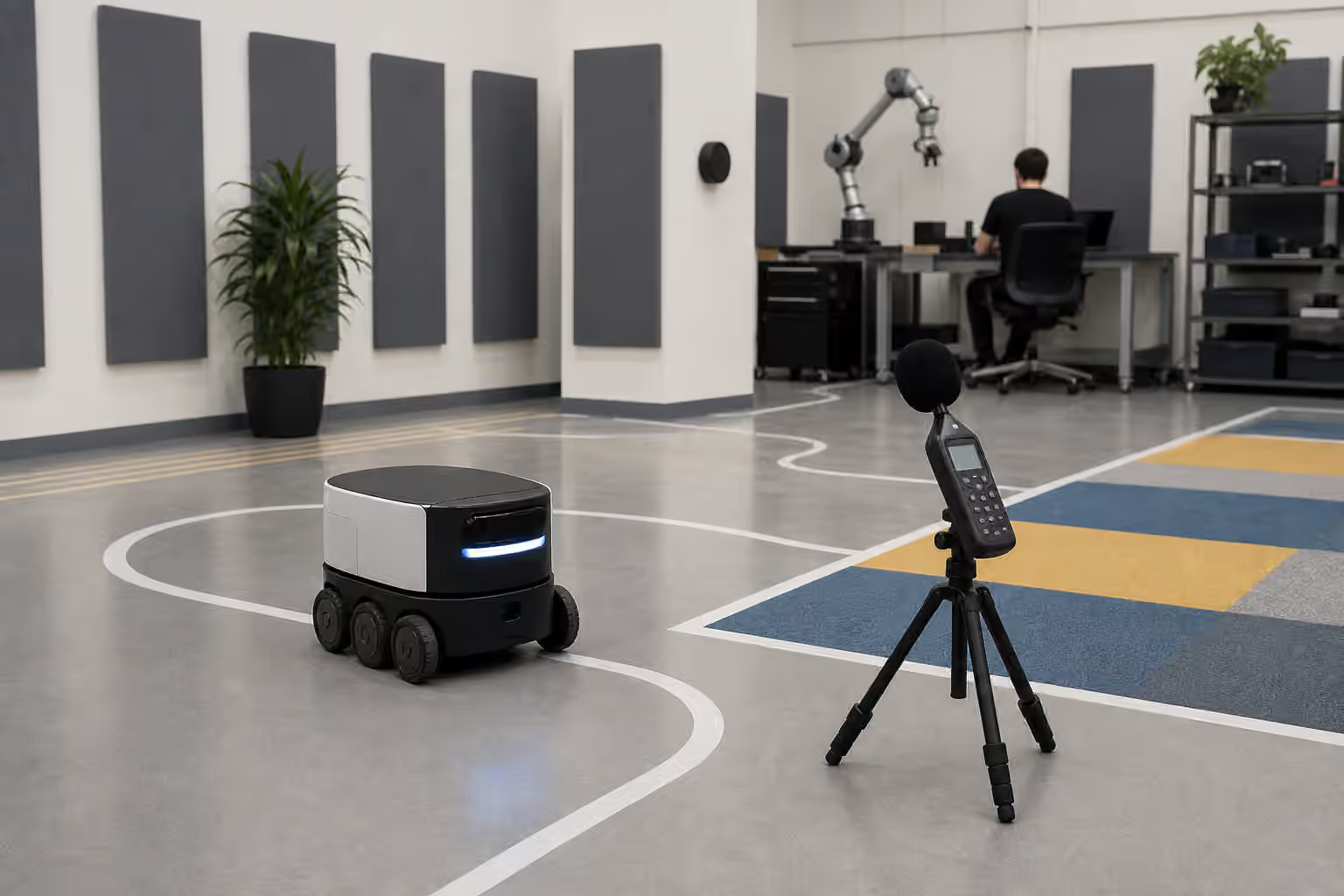
Robots often use lights, beeps, screens, speech, or motion cues to express state. Each channel excludes someone when used alone. A light may be missed by a blind person, a screen may be unreadable from a low angle, a beep may be missed by someone who cannot hear it or who works in a noisy area, and a voice prompt may be unclear for a nonnative speaker or someone with auditory processing difficulty.
Robot Status Signals and Floor Cues is the right starting point because it treats intent as a design problem. Inclusive design asks whether the signal survives human variety. A robot asking for a route to clear might combine slow posture, visible status, a restrained sound, and a clear position that leaves a person choices. A robot that relies only on a spoken instruction may be technically communicative and still inaccessible.
The message should also be simple enough to act on without reading a manual. People should be able to distinguish moving, waiting, yielding, requesting help, and unsafe-to-approach states. That distinction matters even more when a person cannot move quickly or cannot easily check a dashboard. The robot’s body and placement should communicate as much as its interface does.
Speed Is Not The Only Courtesy
Lower speed is often treated as the main courtesy around people. It helps, but it is not the whole problem. A slow robot can still crowd someone, block a path, linger in the wrong place, or create uncertainty about who should move first. Courtesy is about preserving human agency, not only reducing kinetic energy.
For example, a robot approaching a doorway may slow down but still occupy the center, forcing the person to decide whether to pass, wait, or step backward. A better behavior may be to stop earlier and visibly yield. In a corridor, the robot may need to choose a side early enough that people can read its path. Near a person using a walker or wheelchair, the robot should avoid sudden course corrections that consume the person’s available space.
Robot Operational Design Domains helps frame this. If a robot is validated only around trained workers in open aisles, it should not quietly inherit public-space assumptions. Shared areas with visitors, patients, shoppers, residents, or children may need a narrower operating domain, more conservative yielding, or different supervision. Inclusion is part of the domain, not a slogan attached to it.
Interfaces Should Respect Different Operators
Inclusive design also applies to the people who operate, maintain, and support robots. A floor worker clearing a fault, a remote support agent reviewing a scene, a technician servicing a sensor, and a home user changing a setting may need different interfaces. Those interfaces should not assume perfect vision, hearing, dexterity, language fluency, technical vocabulary, or available time.
Robot Operator Interfaces explains how machines ask for help. Accessibility asks whether help can be given by more than one kind of person. Controls should be reachable. Critical states should not depend on color alone. Text should be readable at realistic viewing distances. Touch targets should not require precision under stress. Voice prompts should not be the only path. Error messages should avoid jargon when the action belongs to a non-engineer.
Maintenance access matters too. A robot that requires a technician to kneel awkwardly, lift a heavy cover, or read a tiny indicator in a dark dock may exclude capable staff unnecessarily. Robot Ergonomics and Reach Zones covers the physical station side. Inclusive design extends that respect to a wider range of bodies and working conditions.
Data And Consent Are Part Of Inclusion
Robots in shared spaces often collect sensor data. Cameras, microphones, maps, object records, route histories, and remote support sessions can make people feel observed, especially when they cannot easily tell what the robot is capturing. Inclusive design should consider who understands the data behavior and who has practical control over it.
Robot Privacy and Data Governance covers the broader rules for what the machine is allowed to remember. Accessibility adds the communication layer. Notices, status indicators, and opt-out or privacy controls should not depend on small text or a single sensory channel. A person should not need technical confidence to know when a robot is recording, when remote support is active, or how to request help.
Consent also has a physical dimension. A robot should not pressure people into interaction by blocking their path, following too closely, or requiring a response to proceed through ordinary space. People with disabilities may already experience environments that ask them to adapt constantly. A robot should reduce that burden, not add one more system that expects the person to compensate.
Testing Should Include Real Variation
Inclusive design cannot be verified by imagining users around a table. The deployment team should test route behavior, signals, interfaces, and recovery with realistic variation in movement, attention, height, hearing, vision, language, and familiarity. This does not require turning every pilot into a formal accessibility certification project, but it does require humility. The average test participant is not the whole public.
Robot Task Design and Acceptance Tests can include inclusive cases. How does the robot behave when a person moves slowly through its path? What if someone cannot hear the alert? What if a user approaches from a lower seated height? What if a mobility aid is partly in the robot’s route? What if a visitor hesitates because the robot’s intent is unclear? These are not edge cases in shared spaces. They are ordinary human variation.
Near misses should also be reviewed with inclusion in mind. Robot Incident Review and Near Misses is not only for dramatic events. If people repeatedly step back, freeze, wave at the robot, or avoid an area, the robot may be communicating poorly. If a person using a mobility aid has fewer choices than others around the same machine, the route design needs attention.
Better For The Margins, Better For The Center
Inclusive robot design often improves the core deployment. Wider clearance reduces congestion. Multi-channel signals reduce confusion. Clearer interfaces reduce training burden. Earlier yielding reduces awkward standoffs. Better route discipline protects docks, doors, ramps, and handoff points. A robot that works for more bodies and more attention patterns is usually less fragile in the face of normal operations.
The physical AI lab should treat accessibility as evidence of maturity. The robot is not being asked to solve every human need. It is being asked to avoid designing around a narrow fiction. Shared spaces already contain human variety. Robots entering those spaces should be built, tested, and operated with that variety in view.