
Embodied AI is the idea that intelligence changes when it has a body.
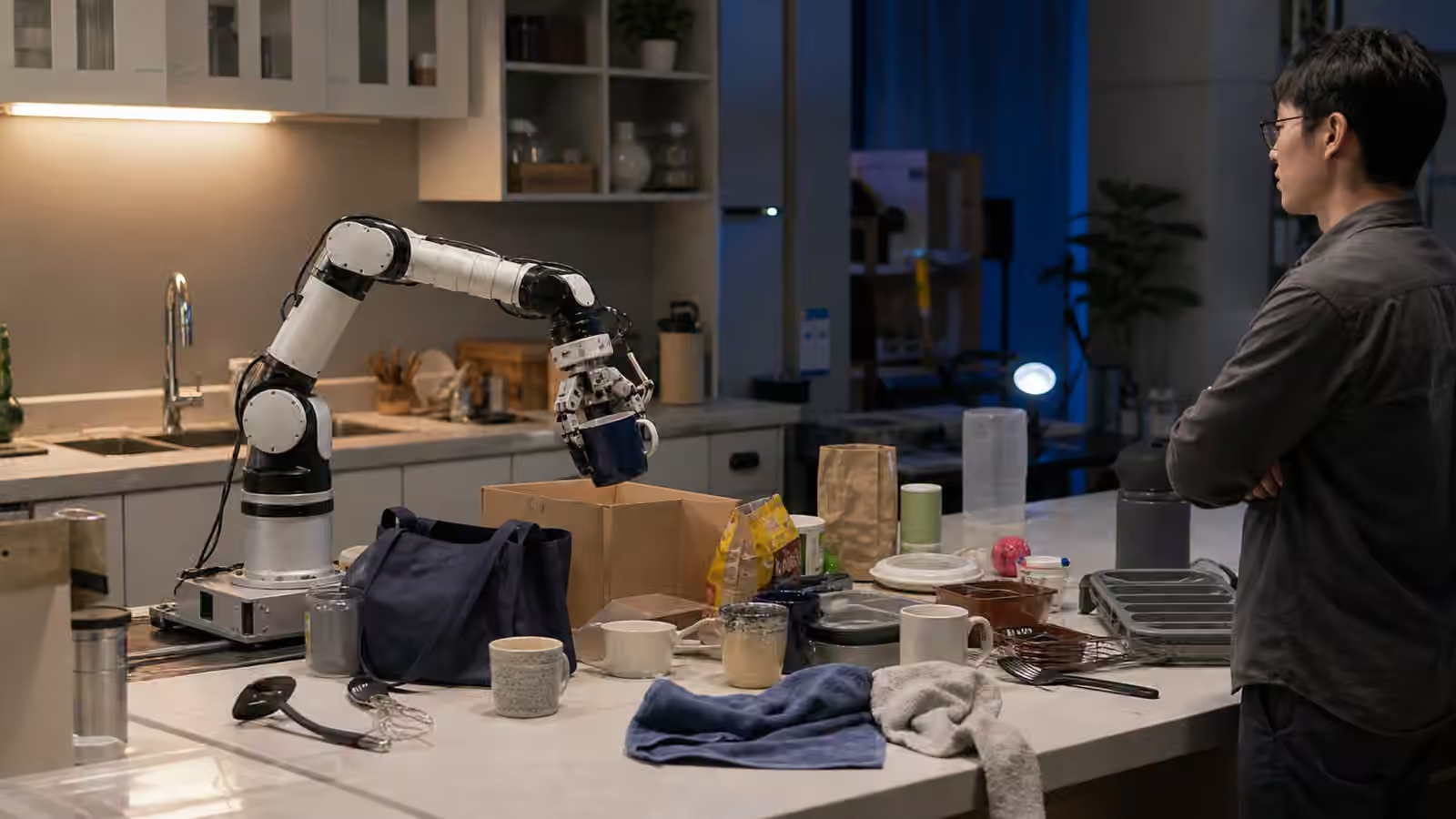
A chatbot can answer a question without touching the world. A robot has to perceive a scene, choose an action, move through physics, and live with the result. The cup slips. The floor reflects. The door is heavier than expected. The object is behind another object. The human steps into the path. The robot has to notice, adapt, and stay safe.
That is the embodied part.
What embodied AI includes
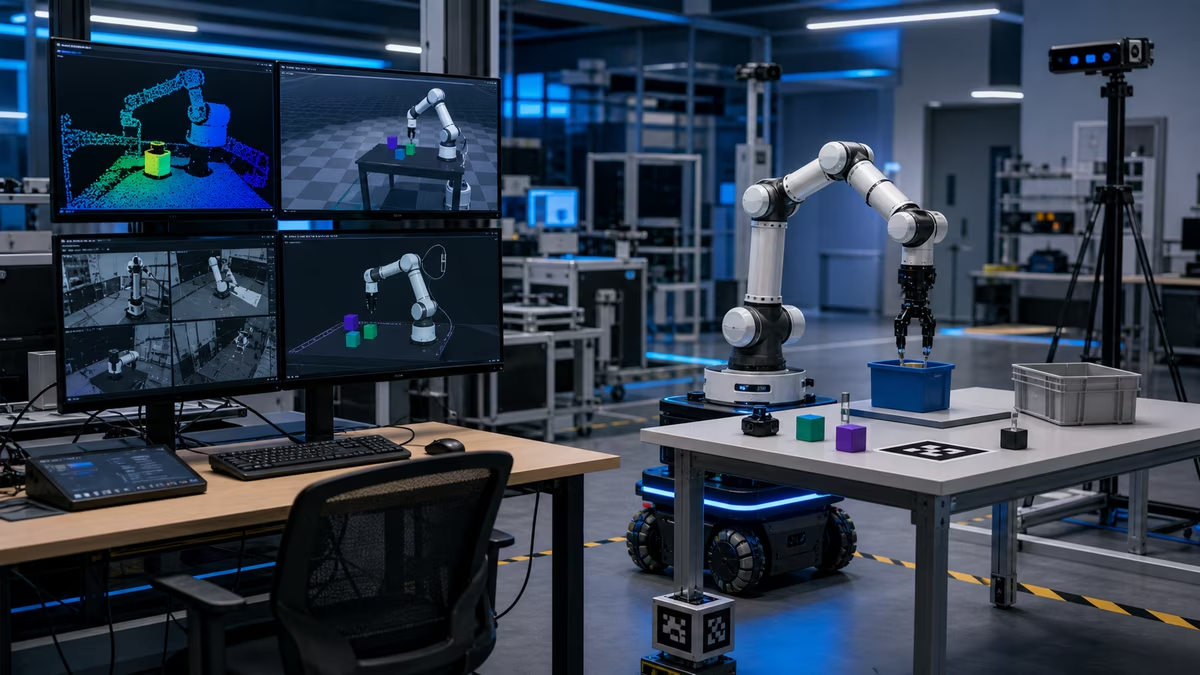
Embodied AI sits at the intersection of perception, language understanding, spatial reasoning, motion planning, control, tactile sensing, simulation, reinforcement learning, imitation learning, safety constraints, and robot hardware.
The model is only one part. A robot also needs sensors, actuators, calibration, timing, controllers, maps, task definitions, and fallback behavior.
Why physical data is different
Internet text is abundant. Good robot data is expensive.
Robot data may include camera feeds, depth images, joint positions, forces, gripper states, tactile readings, commands, failures, human corrections, and environment metadata. Collecting it requires hardware, time, supervision, and safety. A failed attempt may break an object or interrupt a facility.
That makes data quality central.
Useful robot datasets need clear task definitions, synchronized sensor streams, action labels, success and failure outcomes, object variety, environment variety, safety annotations, and calibration records.
From language to action
A useful embodied system often has several layers.
Task interpretation
The robot turns a human request into a goal. “Bring me the red mug” becomes a search and manipulation problem.
Scene understanding
The robot identifies objects, locations, obstacles, people, and possible interaction points.
Skill selection
The system chooses a skill: navigate, reach, grasp, open, pour, scan, push, pull, or ask for help.
Motion and control
Low-level controllers execute movements while respecting limits, contact, balance, and safety.
Feedback and recovery
The robot checks whether the action worked. If it failed, it retries, changes strategy, asks for help, or stops.
Foundation models for robots
Robot foundation models try to generalize across tasks, robots, and environments. They may connect language, images, video, and robot actions so a robot can learn skills from broader data.
The promise is real: fewer hand-coded behaviors, better generalization, and easier instruction.
The hard part is grounding. A phrase like “carefully place the glass on the counter” hides many physical details: grip force, orientation, path, surface friction, collision avoidance, and what “carefully” means near a person.
Simulation helps, but does not erase reality
Simulation is useful because it lets researchers generate many trials, test policies, vary scenes, and train without breaking hardware.
But simulation has a gap. Friction differs, lighting differs, sensors have noise, objects deform, contact physics is hard, real motors heat and wear, and people behave unpredictably.
Good sim-to-real work narrows the gap. It does not pretend the gap is gone.
Teleoperation and human demonstrations
Many robot learning systems begin with human demonstrations. A person teleoperates the robot or records actions, and the model learns patterns.
This can be powerful because humans provide common sense and recovery behavior. It also raises practical questions: whether demonstrations are diverse enough, whether failures are included, whether the robot can exceed the demonstrator, whether the policy knows when it is outside training, and whether the system can explain uncertainty.
Evaluation questions
Embodied AI should be evaluated on more than one successful video.
Ask how many trials were run, what the success rate was, which objects and environments were excluded, whether failures were counted, whether teleoperation was used, whether the robot recovered without help, how it handled people entering the scene, whether it damaged objects, and what safety constraints were active.
Practical use cases
Embodied AI is especially useful when a robot needs flexibility inside a bounded job: picking mixed goods from bins, learning new warehouse SKUs, following natural-language work instructions, mobile inspection with anomaly detection, household object search, service robot navigation and interaction, or flexible manufacturing tasks.
The sweet spot is not “do anything.” It is “adapt better within a known domain.”
Risks to watch
The big risks are overgeneralization, hidden teleoperation, weak recovery, unsafe language obedience, data leakage, and benchmark theater. In plain terms: the robot may treat a new situation as familiar, overstate its autonomy, act without graceful failure, obey a command that conflicts with physical safety, collect sensitive camera or map data, or perform well on tests that reward demos rather than deployment quality.
Next steps
Read Robot Autonomy for the full stack that wraps an embodied model, then What Robots Can Actually Do to keep the capability envelope honest.
Ground the idea in the physical world
Physical AI becomes serious when the robot meets friction, weight, light, dust, latency, humans, and maintenance. For Embodied AI: Models That Meet the World, the useful habit is to connect the concept to the workcell, room, warehouse, home, or field site where it would actually run. A demo can be clean while the deployment environment is messy.
Start with the task boundary. What object is moved, sensed, inspected, cleaned, delivered, opened, closed, lifted, or avoided? What counts as success, and what counts as a safe stop? The robot needs more than a goal. It needs limits that make sense when the world changes.
Then look for variability. Object shape, floor condition, lighting, wireless coverage, human traffic, payload, calibration drift, battery life, and cleaning routines can all decide whether a system works outside a video. Robustness is often built through boring details.
A good deployment leaves traces: logs, incidents, maintenance notes, operator feedback, and clear ownership. Without those traces, teams argue from memory. With them, the system can improve.
Embodied AI: Models That Meet the World should make the physical side harder to ignore and easier to manage. The future of robotics is not only intelligence. It is reliable behavior in places that refuse to be perfect.


