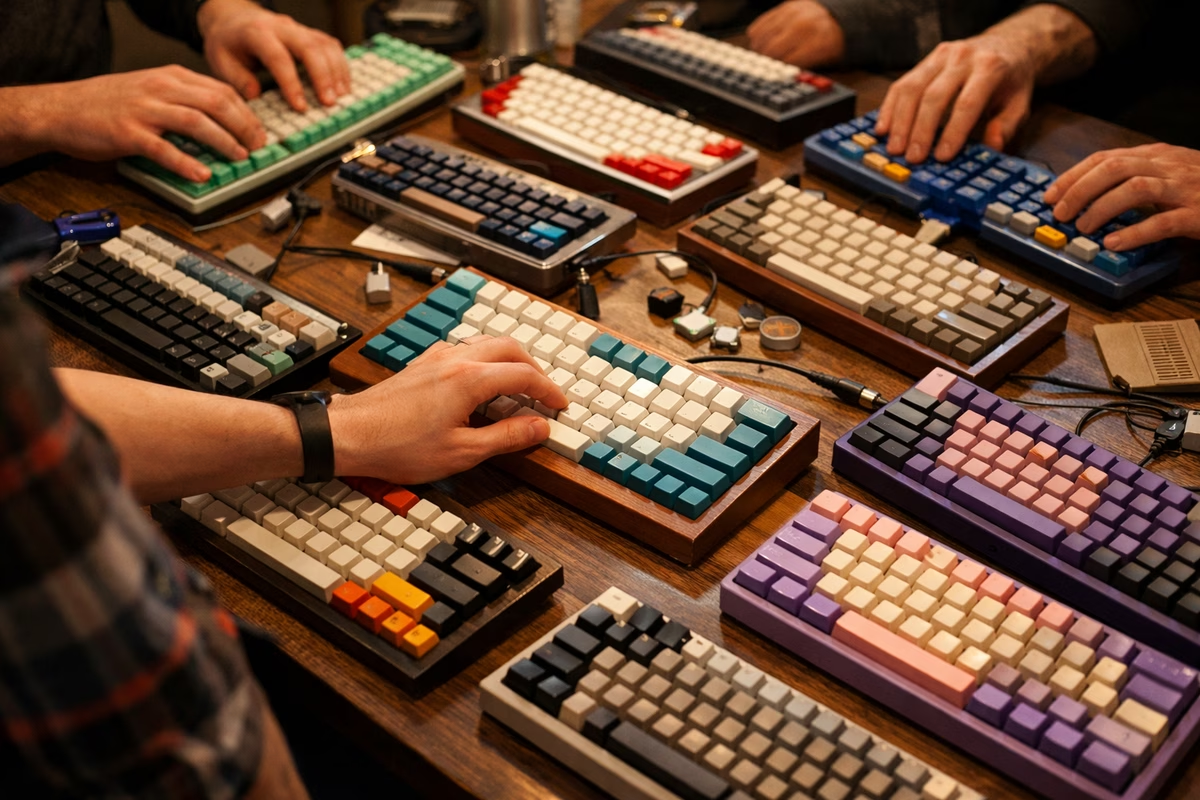
A mechanical keyboard group buy can feel like a shortcut to something special: an unusual layout, a carefully matched keycap set, a small-run case color, a plate material that is not offered in mass-market boards, or a design that only exists because enough people commit early. It can also be a long wait attached to changing timelines, imperfect renders, shifting factory details, and the ordinary risk of paying before a product is finished. The format is not automatically good or bad. It is a tool for making niche keyboard projects possible.
The hard part is judging the wait before it starts. A normal in-stock purchase asks whether the keyboard fits your needs now. A group buy asks a different question: does this project have enough evidence, structure, communication, and compatibility that waiting makes sense for you? The answer depends on the product, the vendor, the designer, your patience, and how much you would mind if the final board arrives later or slightly different from the render that caught your attention.
If you are still choosing your first board, start with the keyboard buying guide instead. Group buys are easier to evaluate once you already know which layouts, switches, keycaps, and firmware habits suit you.
What a group buy is really funding
In the keyboard world, a group buy usually means buyers place orders during a limited window so the organizer can fund production at a scale that makes the project viable. That may involve a custom keyboard kit, a keycap set, switches, desk mats, artisan caps, cables, cases, plates, or accessories. The exact structure varies, but the shared idea is commitment before final delivery.
That commitment changes the buyer’s job. You are not only choosing an object. You are evaluating a project. A polished render can show the design intent, but it cannot prove finish quality, acoustic behavior, keycap color accuracy, firmware maturity, packaging, or factory execution. A prototype is stronger evidence. A typing test is useful, though still limited by recording conditions. A vendor with a history of completed projects is easier to trust than one with only enthusiasm and a beautiful interest-check page.
This does not mean every first-time designer should be ignored. Keyboard culture grows because people run small projects. It does mean the evidence should match the complexity. A simple in-stock switch restock needs less proof than a custom wireless aluminum split keyboard with multiple plate options, many colors, and custom firmware. The more moving parts a project has, the more you should want to see prototypes, clear specifications, and grounded communication.
Renders are promises, not delivery
Keyboard projects often begin with renders because renders communicate shape, color, layout, and mood before production exists. Good renders are useful. They show the intended case lines, badge placement, bezels, keycap colors, desk-mat art, and kit combinations. The mistake is treating them as photographs of the final product.
Material changes everything. Anodized aluminum can shift color under different lighting. Polycarbonate can look clearer, milkier, warmer, or cooler depending on formulation and finish. Brass weights can patina. PVD coatings can vary. Keycap color matching is its own world because plastic, lighting, legends, and monitor calibration all affect perception. A render can describe the target, but samples and prototypes show how close the project is getting.
Ask what evidence exists beyond renders. A prototype photo matters. A photo in ordinary desk light matters even more. For keycaps, physical color samples or vendor updates about color matching matter. For a keyboard kit, prototype typing tests, internal photos, PCB photos, exploded views, and build streams all add confidence. None of this removes risk, but it replaces pure imagination with evidence.
The same caution applies to sound. A group-buy page may describe a board as deep, soft, clacky, muted, or lively, but sound depends on switches, keycaps, plate, foam, desk, microphone, room, and typing force. Treat sound tests as examples, not guarantees. If sound is your main reason for joining, read the keyboard sound profiles guide and look closely at the build configuration used in any recording.
Compatibility has to be checked before the order closes
Group buys can punish assumptions because the buying window may close before you notice a missing kit. A keyboard case might require a specific PCB. A PCB might offer solder only. A plate might support ANSI but not ISO. A keycap base kit might omit the short right Shift your 65 percent board needs. A spacebar kit might be separate. A wireless option might use a different PCB from the wired version. Once production begins, changing your order may be difficult or impossible.
Do the fit check while the project is still open. For keyboard kits, compare the PCB, plate, case, stabilizer support, mounting style, daughterboard, and firmware. For keycaps, compare the base kit, extension kits, spacebars, ISO support, Alice support, and row profile. For switches, confirm quantity, pin style, and whether they match the board you plan to use. The keycap compatibility guide is useful here because many group-buy regrets come from one missing key rather than from the overall theme.
Layout support deserves special attention. A project may show a beautiful render with split Backspace, stepped Caps Lock, and a 7u bottom row, but the default PCB or plate option may not support every version shown. A solder PCB can support many layouts while a hot-swap PCB may lock you into fewer choices. The PCB and hot-swap sockets guide explains why those differences are structural, not just preferences.
Firmware should be part of compatibility too. A compact board without reliable remapping support can become frustrating even if the case is beautiful. If the project mentions QMK, VIA, Vial, ZMK, or proprietary software, make sure that support applies to the exact PCB you are ordering. The QMK and VIA firmware guide can help you decide whether the claimed support matches the way you actually use layers and shortcuts.
Timelines are estimates with many dependencies
Keyboard projects move through design, prototype, revision, order collection, payment processing, manufacturing, quality control, freight, vendor sorting, packing, and fulfillment. Keycap projects add color sampling and legend checks. Wireless boards add battery, charging, and radio details. Each stage can slip. A responsible timeline is an estimate, not a guarantee.
The question is not whether a project can be delayed. It can. The question is how the organizer handles delay. Clear updates should explain what changed, what is waiting on whom, and what the next milestone is. Vague optimism for months at a time is less useful than a plain note that a prototype failed a tolerance check and needs revision. Silence is the hardest pattern to tolerate because buyers cannot distinguish normal manufacturing delay from deeper trouble.
Past behavior helps. Look for completed projects, update cadence, fulfillment photos, community feedback, and how the vendor handled mistakes. Every vendor will eventually face some problem: color mismatch, damaged shipment, missing parts, extra quality-control work, or logistics delay. The useful signal is not a perfect history. It is whether the vendor communicates clearly and resolves ordinary problems without turning every update into theater.
Small projects can be worth joining, but they deserve a smaller risk budget. If a new designer is running a first project through an established vendor, that may be a reasonable balance. If an unknown organizer is collecting money directly for a complex kit with no prototype and no fulfillment history, the project asks for more trust. Trust may still be earned, but it should not be assumed from a good render alone.
Budget for the whole keyboard, not just the headline price
The listed price of a keyboard kit is rarely the finished price of the keyboard. A barebones kit may need switches, stabilizers, keycaps, a cable, shipping, taxes, tools, lubricant, switch films, foam, carrying case, or alternate plates. A keycap group buy may need a base kit plus spacebars, novelties, international support, or an extension kit. Shipping can be significant, especially for heavy cases or international fulfillment.
This is where excitement distorts judgment. A case price may look manageable until you add the PCB option, brass weight, extra plate, stabilizers, switches, and a compatible keycap set. A keycap set may look affordable until the layout you use needs three kits. The cleanest way to think about the purchase is as a finished desk object. If you would not pay the full completed cost for the keyboard, the group-buy price is not the real deal it appears to be.
Also consider opportunity cost in a practical sense. If this will be your only keyboard for work, waiting many months may be less sensible than buying a reliable in-stock board now and treating the group buy as a future project. If you already have a good daily board, waiting may be easy. The right choice depends on your actual desk, not on the urgency of the order window.
Group buys often use scarcity as a background pressure because the window closes. That does not make every deadline manipulative; limited production needs real ordering windows. But urgency should not replace judgment. If a project does not fit your layout, budget, patience, or evidence threshold, missing it is better than owning a box of parts that makes you uneasy.
Understand what can change
Preorder projects can change between announcement and delivery. Minor changes may be harmless: a small packaging adjustment, a slightly revised plate file, a factory change that improves tolerances, or a new daughterboard supplier with the same behavior. Other changes affect the product more directly: color shifts, finish changes, sound changes, layout support changes, keycap legend revisions, missing compatibility, or a different fulfillment plan.
Read the project terms and updates carefully, but also think like a builder. If the exact shade of green is the only reason you want the case, color sampling matters a lot. If VIA support is essential to your compact layout, firmware uncertainty matters a lot. If you need ISO support, plate and keycap kitting matter more than a nice badge. Your non-negotiable details should be clear before you join.
It helps to decide what kind of variance you can accept. Some buyers are happy if the final keyboard keeps the general design spirit and works well. Others are buying for a precise color match, a layout need, or a collectible theme. Neither attitude is wrong, but they respond differently to production reality. The stricter your expectation, the more evidence you should require before ordering.
Community feedback is useful, but noisy
Keyboard communities are part of why group buys exist. Interest checks, forum threads, Discord servers, meetups, and review streams help small projects find enough buyers to be made. They also create hype, repetition, and social pressure. A project can feel validated because many people are excited, even before the evidence is strong.
Use community feedback for specific information, not only mood. Look for people asking practical questions about kitting, plate files, firmware, vendor history, prototype changes, and fulfillment. Notice whether the organizer answers clearly. Notice whether criticism is handled with details or brushed aside. Enthusiasm is pleasant, but the useful comments are often the boring ones.
Local meetups can give better evidence than online renders if prototypes are present. Holding a board, listening to it in a normal room, checking the finish, and seeing the underside can change your opinion quickly. The keyboard meetup story captures the social side of the hobby, but meetups are also practical inspection events. They let you notice weight, angle, texture, and layout in a way a page cannot.
Be careful with resale logic. Some buyers justify group buys by assuming the item can be sold later for the same price or more. Sometimes that happens. Sometimes the market moves, extras become available, tastes shift, quality disappoints, or shipping costs make resale unattractive. Buy because the project makes sense for you, not because a future stranger might rescue the decision.
In-stock extras are often the calmer path
Many vendors sell extras after group-buy fulfillment. Extras are leftover units, replacements, cancelled orders, or additional stock. They usually cost more than the original group-buy price, and selection may be narrower, but they offer a major advantage: the product exists. You can often see final photos, reviews, build streams, and actual owner feedback before buying.
Extras are not always available, and popular projects can sell out quickly. Still, they are worth considering if you dislike long waits or uncertain evidence. Paying a little more for an in-stock extra may be rational when it removes months of uncertainty. The same is true for in-stock keycaps, switches, and keyboard kits that borrow ideas from group-buy culture but ship normally.
This is especially true for a first serious board. A person who has never built a keyboard may learn more from an in-stock kit than from waiting a year for a dream design. After building and using one board, group-buy specifications become easier to judge. You will know whether you care about plate material, case height, bottom-row support, firmware, sound, and keycap profile because your hands will have evidence.
A calmer way to decide
Before joining, describe the project to yourself without the render. Name the layout, case material, PCB type, plate option, firmware support, included parts, missing parts, estimated wait, vendor history, and total finished cost. If the project still sounds appealing in plain language, it may be worth considering. If it only sounds exciting when wrapped in scarcity, renders, and community momentum, step back.
Then decide what would make the purchase feel successful when it arrives. If success means “I get a reliable 65 percent board with VIA support, a comfortable angle, and a finish I like,” the evidence is easier to inspect. If success means “this must be the perfect endgame board,” the project is carrying too much emotional weight. The endgame keyboard story is a useful reminder that taste keeps moving after the box arrives.
A good group buy is not just a beautiful object. It is a project with enough proof, communication, and compatibility that waiting feels reasonable. The best ones make small-run keyboard ideas possible without asking buyers to ignore basic judgment. When the prototype is real, the vendor is clear, the kitting fits, the budget is honest, and you can tolerate the timeline, a group buy can be a satisfying part of the hobby. When those pieces are missing, patience is not the problem. The project is asking for trust it has not earned yet.