Building Your First Custom Keyboard
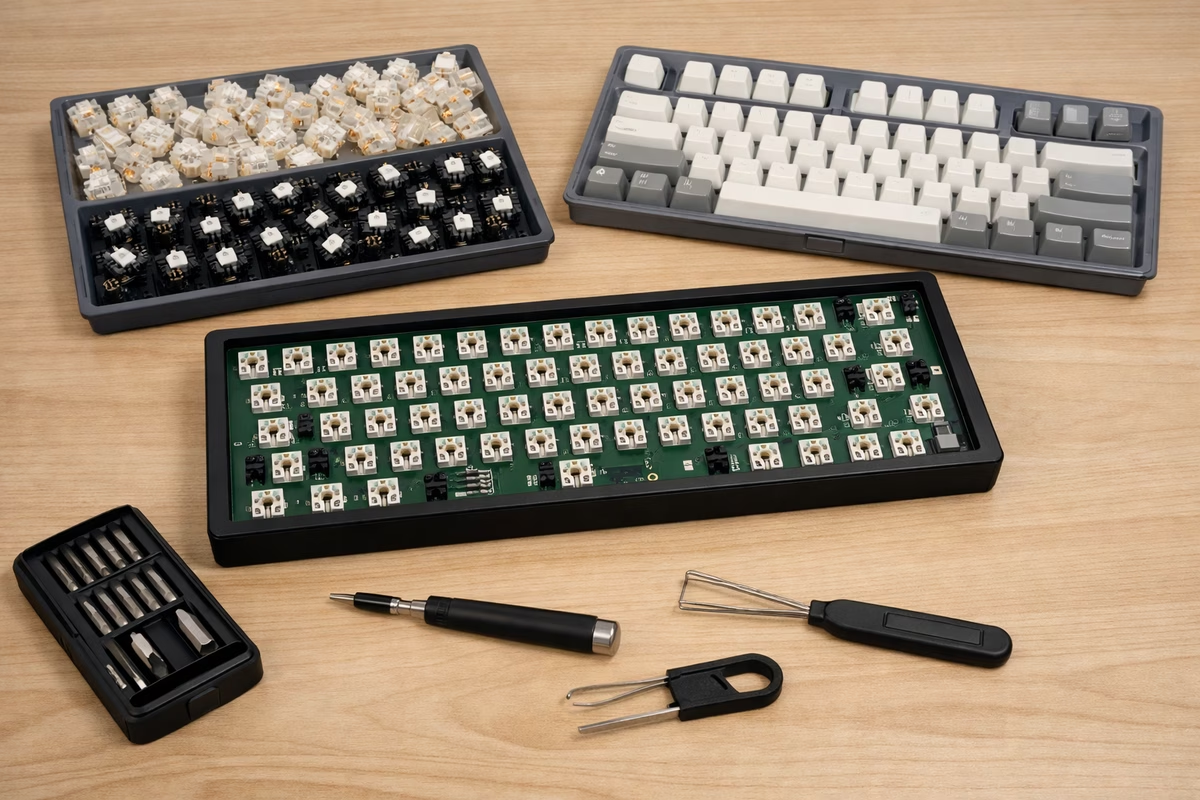
There’s a moment—somewhere between pressing the first switch into a fresh PCB and hearing that satisfying click as it seats—when it hits you: you’re building something that will live under your fingertips for thousands of hours. A custom keyboard is a small stack of choices you can feel. A softer mounting style can make long typing sessions easier on your hands. A different plate material can shift the “pitch” of the board from sharp and clacky to lower and round. Even the same switch can sound completely different depending on what it’s mounted into.
This guide is designed for a first build: what matters, what doesn’t, and how to get from a box of parts to a keyboard you’re proud to use—without turning the hobby into a research project. We’ll walk through every decision, every phase of assembly, and every rookie mistake worth dodging. Grab a coffee, clear your desk, and let’s get into it.
Why Build Custom?
Benefits of Custom Building
Custom building is popular for three reasons: control, comfort, and character. You choose the parts that define the experience—switch feel, keycap profile, layout, sound—and you can tune the board so it matches how you type rather than how a factory decided most people type. Think about it: when you buy a prebuilt keyboard, you’re accepting someone else’s compromise. They picked the switch weight, the keycap profile, the case acoustics—all optimized for the widest possible audience. Building custom flips that equation entirely. Every single component becomes a deliberate choice that reflects your preferences.
It’s also one of the few hobbies where “small” upgrades teach you something real. The first time you fix a rattly spacebar, you learn what stabilizers actually do. The first time you swap plates, you learn that stiffness changes both sound and fatigue. A keyboard becomes a set of cause-and-effect experiments you can run at your desk. There’s a wonderful feedback loop here: you change one thing, you type on it, you notice the difference, and suddenly you understand acoustics and ergonomics in a way no YouTube video could ever teach you.
Finally: a custom board is personal in a way most electronics aren’t. It can look minimal or loud, sound snappy or deep, and feel crisp or cushioned—without being “better,” just more yours. In a world of mass-produced gadgets, there’s something deeply satisfying about a tool you assembled with your own hands that sounds exactly the way you want it to.
Drawbacks
Let’s be honest about the trade-offs, because they’re real. A quality custom build often lands in the $200–$600 range, and premium builds can run higher once you add keycaps, switches, and tuning supplies. This isn’t a cheap hobby, and it’s easy to fall down a rabbit hole of “just one more upgrade” that turns a modest budget into a surprising credit card statement.
Time is the second cost: your first build usually takes a few focused hours, and if you buy from group buys you might wait months for parts. There’s a real patience tax in this community, especially when you see a gorgeous keycap set that won’t ship for another nine months.
The learning curve is the final cost. You will make small mistakes (everyone does), but the good news is that most mistakes are fixable—and the fix is how you learn. A bent switch pin, an over-lubed stabilizer, a screw tightened just a hair too much—these aren’t disasters, they’re lessons. And honestly? Fixing your own mistakes is half the fun.
Build Complexity Tiers
Not all custom builds are created equal. The keyboard community has a wonderful spectrum of complexity, from “swap a few parts on a Saturday afternoon” to “hand-lube 70 switches while watching an entire season of a show.” Here’s how it breaks down, so you can find your comfort zone.
Tier 1: Hot-Swap Prebuilt (Easiest)
This is the gentlest on-ramp into the custom world. You buy a complete keyboard—something like a Keychron or GMMK—and then swap out the switches and keycaps to taste. That’s it. No soldering, no case assembly, no firmware flashing required. You just pop off what’s there and press in what you want. The skills involved are delightfully simple: pull keycaps off, pull switches out, push new switches in, press new keycaps on. You could do this in 30 to 60 minutes while watching TV, and the total cost usually runs between $100 and $250. If you’re an absolute beginner who wants to dip a toe in without committing to a full build, this is your tier.
Tier 2: Barebones Kit (Beginner-Friendly)
This is where most first-time builders should start, and it’s the sweet spot of the hobby. A barebones kit gives you an assembled case, PCB, and plate—the structural skeleton of the keyboard—and you add switches, keycaps, and sometimes stabilizers yourself. Popular kits like the Keychron V-series (around $70–$90), Keychron Q-series ($150–$190), GMMK Pro ($150), and NK65 Entry Edition ($95) all fall into this category. You’ll need somewhere between 60 and 100 switches depending on your layout, plus a keycap set and possibly a set of stabilizers if they’re not included.
The skills ramp up slightly: you’ll install stabilizers (if they’re not pre-installed), press switches into hot-swap sockets, mount keycaps, and optionally flash the firmware to customize your key layout. Plan for 2 to 4 hours, budget $150 to $400, and expect to learn a ton. This tier teaches you the fundamentals without overwhelming you.
Tier 3: Full Custom Kit (Intermediate)
Now we’re cooking. A full custom kit arrives unassembled—you get a case, a PCB (either soldered or hot-swap), a plate, and then you source your own switches, stabilizers, and keycaps. Some kits include optional foam, gaskets, or dampeners for acoustic tuning. You’ll assemble the case from scratch, install and tune stabilizers (clipping, lubing, the works), optionally lube your switches for that buttery smooth feel, potentially solder if you chose a soldered PCB, and flash custom firmware.
This tier demands 6 to 15 hours of your time and anywhere from $250 to over $600, but the payoff is full control over every aspect of the typing experience. It’s where enthusiasts find their groove—and where you start to understand why people in this hobby talk about “endgame” boards (spoiler: endgame is a myth, but the pursuit is glorious).
Tier 4: Full Custom + Advanced Mods (Expert)
This is the deep end of the pool, and it’s wonderful if you enjoy the process as much as the product. On top of a full custom build, you’re hand-lubing every single switch with meticulous consistency, swapping springs to dial in the exact actuation weight you prefer, filming switches to reduce housing wobble, adding custom case foam for acoustic tuning, making flex cuts in your plate for a softer typing feel, and writing custom QMK firmware for programmable layers that would make a software engineer weep with joy. Expect to invest 15 to 30 hours and $300 to $1,000 or more. This is for hobbyists chasing perfection—and loving every minute of the chase.
Components Needed
1. Case
The case is so much more than aesthetics—it’s the main structure that sets weight, resonance, and the “stiffness” of the entire build. Think of it as the body of a guitar: same strings, same player, completely different sound depending on what they’re strung onto. A heavy metal case tends to sound lower and feel more planted on your desk, while a lighter plastic case tends to sound brighter and can feel more lively under your fingers.
When it comes to materials, you’ve got a wonderful range to choose from. Plastic cases are the most affordable and lighter weight, though they tend to produce a more hollow sound signature. Aluminum is the go-to premium option—solid, satisfying, and responsible for that “thocky” sound people chase in keyboard videos. Brass takes things even further with serious heft and a deep, resonant sound, but it comes with a price tag to match. Acrylic offers a unique transparent aesthetic that looks stunning with RGB underglow. And wood? Wood cases produce a warm, almost organic sound and carry an artisanal charm that’s hard to replicate with any other material.
Mounting style matters just as much as material, and it’s one of those things that you don’t appreciate until you’ve tried more than one. Tray mount is the most common budget option—the PCB screws directly into standoffs in the case, creating a firm, no-nonsense feel. Gasket mount is the premium darling of the community: the PCB sits on soft gasket strips that absorb impact, creating a softer, more forgiving typing experience that your wrists will thank you for during long sessions. Top mount attaches the PCB to the top half of the case, allowing for a pleasant flex and bouncy feel. And then there’s plateless, which ditches the plate entirely for maximum flexibility—a niche choice best left for experienced builders who know exactly what they’re after. Budget anywhere from $50 to $300 depending on material and mounting style.
2. PCB (Printed Circuit Board)
The PCB is the brain of the keyboard—it’s what actually registers your keypresses and sends signals to your computer. If you only remember one buying lesson from this entire guide, make it this: decide early whether you want hot-swap or soldered. Hot-swap PCBs have sockets that let you pop switches in and out without any tools beyond a switch puller. They’re forgiving, perfect for learning, and let you experiment freely. Soldered PCBs require you to permanently attach each switch with a soldering iron, which offers more long-term flexibility for niche layouts and wider switch compatibility, but it raises the “cost of mistakes” significantly.
Beyond the swap type, look for a few key features when shopping. QMK or VIA support gives you incredible programmability—you can remap any key, create custom layers, and build macros. RGB underglow and per-key RGB are fun extras if you’re into lighting. USB-C is the modern connection standard (and honestly, anything still using Micro-USB in 2024 should be viewed with suspicion). ESD protection is a nice-to-have that shields your board from static discharge damage.
Popular PCBs in the community include the DZ60 (a versatile 60% option available in both hot-swap and solder variants), the KBD67 Lite (a beloved 65% hot-swap board), and the Bakeneko65 (an affordable 65% hot-swap option that punches well above its price point). Expect to spend $30 to $80.
3. Plate
Sitting between your switches and the PCB, the plate provides rigidity and structure—but it’s also the underrated “feel and sound” lever that can dramatically transform your typing experience. Stiffer plates made from metal or carbon fiber tend to sound higher-pitched and feel crisper under your fingers. Softer plates like polycarbonate can produce a deeper sound and feel more forgiving on each keystroke. This isn’t a strict rule—foam, case material, and mounting style can all override it—but it’s a useful starting mental model.
Aluminum plates are the most common: firm, reliable, and producing that classic “clacky” sound. Brass plates bring more weight and a deeper tone. Polycarbonate (PC) plates are the darling of the “thock” crowd—softer, more flexible, and excellent for deeper sound profiles. FR4 (fiberglass) plates offer a budget-friendly, neutral middle ground. Carbon fiber is the premium stiff option for those who want maximum crispness. Some adventurous builders skip the plate entirely for maximum flex, but that’s definitely not recommended for beginners. Budget $20 to $60.
4. Switches
See Switch Guide for full details.
Switches get all the attention because they’re the part you physically touch with every keystroke—but here’s a liberating truth for first-time builders: if you go hot-swap, switches are also the easiest part to change later. So don’t agonize over the “perfect” switch for your first build. Optimize for “no surprises”: pick a reputable switch with consistent weight and no exotic mods required. You’ll learn what you actually prefer by typing, not by reading spec sheets.
For quantity, a 60% layout needs about 61 switches, 65% needs 68, TKL needs 87, and a full-size board needs 104. Here’s a pro tip that every experienced builder will tell you: buy 10 to 20 percent extra for testing, for the inevitable bent pin or two, and for spares down the road. Nothing’s worse than being one switch short at 11pm on build night. Expect to spend $25 to $150 depending on your switch choice.
5. Stabilizers
Stabilizers are the unsung heroes (or villains) of the keyboard world. They stabilize your large keys—spacebar, shift, enter, backspace—and they’re where most first builds either feel premium or feel deeply annoying. Here’s the thing: you can buy the nicest case in the world, source the most hyped switches, find the most beautiful keycaps—and still hate your keyboard because the spacebar ticks and rattles like a tiny maraca. The good news is that a basic stabilizer tune (clip if needed, lube the wire, assemble carefully) has one of the highest “effort to improvement” ratios in the entire hobby. Fifteen minutes of stabilizer work can make a $150 board sound like a $400 one.
For types, screw-in stabilizers are the gold standard—they attach to the PCB with screws and stay rock-solid. Clip-in stabilizers snap into the PCB and work fine but are slightly less stable. Plate-mount stabilizers attach to the plate and are the budget option. Brand-wise, Durock V2 stabilizers ($15–$20) offer the best value in the game. TX Stabilizers ($25–$30) are the premium pick. Cherry stabilizers ($10–$15) are budget but require heavy modding to perform well. C³ Equalz ($20–$25) are smooth and reliable. A full set will run you $10 to $30.
6. Keycaps
See Keycaps Guide for full details.
Keycaps change both ergonomics and sound in ways that might surprise you. The profile—meaning the shape and height of each key—affects how your fingers travel across the board and how accurately you strike each key. The material affects how sharp or soft the board sounds with every press. If you’re torn between two sets, here’s advice that will serve you well: prioritize profile and feel over aesthetics. You look at your caps, sure, but you live on them for hours every day.
PBT plastic is the recommended material for most builders—it’s durable, resistant to shine, and produces a slightly deeper sound. ABS plastic feels smoother and develops a shiny patina over time, which some people love and others can’t stand. For profiles, Cherry profile is low and wildly popular for good reason, OEM is the familiar medium height you’ll find on most stock keyboards, SA is tall with a lovely retro aesthetic, and options like KAT and MT3 offer their own unique sculpted experiences. Budget $30 to $200 depending on material and design.
7. Optional Components
Optional doesn’t mean pointless—far from it. But think of these extras as finishing touches rather than foundations. Foam and lube can smooth out harshness and reduce hollow case resonance, but they can’t rescue a fundamentally uncomfortable layout or a case you don’t enjoy using. Get the big decisions right first, then fine-tune with the optional stuff.
For foam and dampening, case foam ($10–$20) reduces that hollow, echoey sound that cheaper cases can produce. Plate foam ($10–$15) dampens the sound of each individual keystroke. PCB foam ($10–$15) isolates the PCB from vibrations, tightening up the overall sound profile. As for lube and tools, Krytox 205g0 ($10–$15) is the gold standard for switch lubing, Krytox XHT-BDZ ($10) is ideal for stabilizer wires, and you’ll want a set of small brushes ($5–$10), a switch opener ($5–$10), a keycap puller ($5), and a switch puller ($5). None of these break the bank individually, but they add up—so factor them into your budget from the start.
Step-by-Step Build Process
Phase 1: Planning & Ordering
Start with constraints, not aesthetics. I know, I know—it’s tempting to start with the gorgeous keycap set you saw on Reddit. But the easiest way to pick the right first board is to decide what you need on a normal week: arrow keys or no, function row or no, numpad or no. Once you know that, the rest is just taste.
Step 1: Choose your layout. Common starting points are 65% (compact but includes arrow keys, which most people realize they can’t live without) or 75% (adds a function row for F-key shortcuts). If you’re unsure, skim the Layout Guide and pick the smallest layout that still supports your daily shortcuts. Smaller isn’t always better—it’s about finding the right balance between desk space and functionality.
Step 2: Set a budget. Entry builds often land in the $150–$250 range, mid-range in $250–$400, and premium builds in $400–$700+ once you include keycaps and tuning supplies. Write this number down and stick to it. The budget isn’t about status; it’s about preventing a parts list that quietly balloons past what you intended.
Step 3: Select your components. Many first builds are easiest as a barebones kit (case + PCB + plate bundled together), then you choose switches, keycaps, and stabilizers separately. This approach simplifies compatibility questions enormously. Add foam and lube only if you’re already excited about the base build—don’t let accessories overshadow the fundamentals.
Step 4: Order with timing in mind. In-stock parts ship now, and that immediacy matters for a first build. Group buys can take 6 to 18 months to deliver; they’re a fun part of the hobby later, but they’re frustrating when you’re a beginner eager to learn quickly. Stick with in-stock components for build number one, and you’ll have a keyboard in your hands within a week instead of next year.
Phase 2: Preparation
Set yourself up for a calm build: good lighting, a small tray or magnetic mat for screws, and the patience to stop and test instead of forcing parts together. Rushing is how mistakes happen, and this should be enjoyable, not stressful.
Step 5: Gather your tools. You’ll need a Phillips screwdriver, tweezers, and a keycap puller at minimum. If your board is hot-swap, add a switch puller to the list. If you’re soldering, you’ll also need a soldering iron, solder, and a basic understanding of ventilation and heat safety (open a window, don’t breathe the fumes, and keep the iron away from anything you value).
Step 6: Test the PCB before you build. This single step saves more heartbreak than any other piece of advice in this guide. Plug the bare PCB into your computer, grab your tweezers, and short each switch contact pair one by one. Verify that every single key position registers in a keyboard tester (there are free ones online). If anything fails to register, stop immediately and contact the seller before you install a single part. Discovering a dead socket after you’ve assembled everything is the kind of frustration that makes people quit the hobby.
Phase 3: Stabilizer Installation
Stabilizers are the “big key” mechanism, and they deserve more respect than most beginners give them. If you want your board to feel expensive, make the spacebar feel controlled and quiet. A well-tuned stabilizer is the difference between a board that sounds refined and one that sounds like loose change in a dryer.
Step 7: Prepare your stabilizers. If your stabilizers have extra plastic feet on the bottom (most stock Cherry-style stabs do), clip them off with flush cutters to reduce bottom-out rattle. Smooth any rough edges with light sanding if needed. Some builders add a small strip of fabric bandage tape or a thin pad where the stabilizer housing hits the PCB to soften the impact noise—this is the “band-aid mod,” and it takes seconds but makes a noticeable difference.
Now for lubing: apply a thicker grease (like Krytox XHT-BDZ) on the stabilizer wire where it contacts the housing—this is what eliminates that annoying ticking sound. Use a thinner lube on the plastic-to-plastic surfaces inside the housing to keep movement smooth. And here’s the crucial part: wipe off the excess. Too much lube can make the stabilizer feel mushy and will attract dust over time, creating new problems you definitely don’t want.
Step 8: Install your stabilizers. Mount the stabilizers into the PCB (use the screw-in method if your PCB supports it—it’s more secure). Make sure the wire moves freely and returns to center with a satisfying snap. Do a quick test press with a spare keycap placed on top. This is the moment to diagnose and fix any ticking, sluggishness, or binding—before switches and keycaps bury the mechanism and make it a pain to access later.
Phase 4: Switch Installation
Step 9 (optional): Lube your switches. Lubing switches can be genuinely transformative—a scratchy, mediocre switch can become silky and refined with a proper lube job. But here’s the thing: it’s not a requirement for a first build, especially if you’re going hot-swap. A great strategy is to build with stock switches first, type on the board for a week, learn what you actually want to change, and then lube later when you have a clear goal in mind. If you do decide to lube now, use a thin, even layer on the friction points (stem rails, spring, and housing contact areas) and keep it consistent across all switches. The goal is smoothness, not grease—you want each switch to feel identical to the others.
Step 10: Install your switches. For hot-swap builds, align each switch’s pins carefully with the PCB sockets, press firmly and evenly until the switch clicks into place, and—this is critical—check for bent pins if a switch doesn’t seat properly. Bent pins are the number one hot-swap headache, and they happen when you press at a slight angle. If a switch feels resistant, don’t force it. Pull it back out, straighten the pins with tweezers, and try again.
For soldered builds, the process is more deliberate: insert each switch through the plate and into the PCB, flip the board over, and solder each pin with a quick 1 to 2 second contact of the iron. Check for cold solder joints (they look dull and lumpy instead of shiny and cone-shaped) and reflow any that look suspicious. Take your time—this is permanent, and a good solder job means years of reliable performance.
Step 11: Test your switches. Before you close the case, test every single key. Open a keyboard tester, press each switch, and make sure it registers. Fix any non-registering switches immediately—almost all first-build issues are exponentially easier to solve when the board is still open and accessible. Trust me, you do not want to disassemble a finished build because you skipped this step.
Phase 5: Assembly
Step 12: Assemble the case. Carefully lower your switch-plate-PCB sandwich into the case. If you’re using a gasket mount, make sure the gaskets are seated properly and evenly before pressing anything together. For any mount style, start screwing the case together gently. And here’s a mistake that catches more beginners than you’d expect: overtightening. Most screws want “snug,” not “max torque.” You’re holding a keyboard together, not bolting down a bridge. Overtightening can crack acrylic cases, strip threads in aluminum, or flex components in ways that create annoying new resonances.
Step 13: Install your keycaps. Start with the spacebar—it’s the largest key and will immediately confirm whether your stabilizer work paid off. Give it a few test presses and listen. Satisfied? Good. Next, install your modifier keys (Shift, Enter, Backspace) and check those stabilized keys too. Then fill in the rest of the alphanumeric keys. Double-check the orientation as you go—legends should face toward you, and it’s surprisingly easy to accidentally rotate a key 180 degrees when you’re in the zone.
Phase 6: Programming & Testing
Step 14: Flash the firmware (if needed). If your PCB supports QMK or VIA (and most enthusiast PCBs do), this is where the magic happens. Download VIA (it’s the easiest option with a visual interface) or QMK Toolbox, connect your keyboard, and start customizing. You can remap any key to any function—want Caps Lock to be Escape? Done. Want a layer where your right hand becomes a numpad? Easy. You can program macros for complex key combinations, set up multiple layers accessed via function keys, and control RGB lighting if your board supports it. The programmability of a custom keyboard is one of those features that seems unnecessary until you try it, and then you can never go back.
Step 15: Final testing. Open a typing test, a keyboard tester, or both, and methodically verify every key. Test all your programmed layers and Fn combinations. Pay special attention to stabilized keys—press them slowly off-center and listen for rattle. If something sounds off, now is the time to address it, not after you’ve been using the board for a week and the annoyance has crystallized into resentment.
Step 16: Use it on purpose. This might be the most important step of all, and it’s the one most new builders skip. Type on your new keyboard for a full week before you mod anything else. Resist the urge to immediately tweak and tune. Just… type. Write emails, code, essays, chat messages. You’ll naturally notice what matters to you—maybe the sound is a little too high-pitched, maybe the bottom-out feels too harsh, maybe the keycap profile doesn’t suit your finger reach. These observations are gold, because they tell you exactly what to change next instead of chasing random modifications you don’t actually need.
Troubleshooting Common Issues
Switch Doesn’t Register
This is the most common first-build problem, and it’s almost always one of four things. Most likely, you’ve got a bent pin—the switch went in at a slight angle and one of the metal pins folded under instead of entering the socket. Pull the switch out, straighten the pin with tweezers, and reinstall carefully. Second possibility: the switch isn’t fully seated in a hot-swap socket. Give it another firm, even press until you feel it click into place. For soldered builds, a non-registering switch usually means a cold or incomplete solder joint—reflow the joint with your iron and add a tiny bit more solder if needed. In rare cases, you might have a dead PCB socket, which either requires advanced socket replacement or using a different position.
Stabilizer Rattle
If your spacebar or other large keys sound rattly, scratchy, or just plain cheap, the stabilizers are almost certainly the culprit. The most common cause is simply that they weren’t lubed (or weren’t lubed enough). Remove the keycap, pull the stabilizer out, and apply lube properly—thick grease on the wire contact points, thin lube on the plastic surfaces. While you’re in there, make sure the wire is seated correctly in both housings; a wire that’s popped out of its groove will rattle no matter how much lube you apply. The band-aid mod (a small piece of fabric adhesive where the stabilizer hits the PCB) can also help dampen impact noise. And if your stock stabilizers just won’t cooperate, consider upgrading—Durock V2 stabilizers are a massive improvement over stock Cherry stabilizers and cost less than a fancy lunch.
Keys Don’t Work in Certain Positions
When a whole row or column of keys stops working (rather than individual switches), you’re likely dealing with a PCB-level issue—either a row or column trace has failed, or there’s a firmware problem. This is exactly why Step 6 (testing the PCB before building) is so important: catching this early saves you from disassembling a completed build. Try reflashing the firmware first, as corrupted firmware can cause exactly this symptom. If that doesn’t help, contact the manufacturer for a warranty claim.
Spacebar Sounds Awful
The spacebar is the key that reveals all sins. It’s the largest key with the longest stabilizer wire, and it gets hammered more than any other key on the board. If yours sounds terrible, it’s almost always stabilizer rattle. Remove the spacebar keycap, pull the stabilizer, and give it a thorough lubing: grease on the wire, lube on the housing, clean off any excess. Reassemble carefully, making sure the wire is evenly seated in both housing clips. Some builders swear by the “holee mod” (inserting a small piece of fabric bandage into the stabilizer stem to eliminate wire movement), and it can indeed work wonders for particularly stubborn rattle.
Build Cost Breakdown
Budget Build ($150–250)
A budget build proves that “affordable” and “enjoyable” aren’t mutually exclusive. Start with something like a Keychron V2 barebones kit at around $80, which gives you a solid case, PCB, and plate. Pair it with Gateron Yellow switches (about $20 for 70—these are legendary budget linear switches), a clean PBT keycap set ($30), Durock V2 stabilizers ($15), and basic lube and tools ($20). Your total lands right around $165, and you’ll have a keyboard that sounds and feels dramatically better than any mass-market board at the same price.
Mid-Range Build ($300–450)
The mid-range is where most enthusiasts find their happy place. A Keychron Q2 kit ($170) gives you a gorgeous aluminum gasket-mount foundation. Boba U4T switches ($45 for 70) deliver that satisfying tactile “thock” the community loves. Quality PBT keycaps or a well-made GMK clone ($60) elevate the aesthetics. TX Stabilizers ($25) smooth out the big keys. Add foam ($25) and lube with tools ($30), and you’re looking at roughly $355 for a board that rivals keyboards costing twice as much.
Premium Build ($600–1,000)
When you’re ready to go all-in, the premium tier delivers an experience that’s hard to describe until you’ve felt it. A Mode Sonnet kit ($300) provides exquisite build quality and acoustics. Holy Panda switches ($70 for 70) are iconic for their sharp tactile bump and satisfying sound. A genuine GMK keycap set ($120) offers unmatched legends and colorways. C³ Equalz stabilizers ($25) are silky smooth. Premium foam and dampening ($40) plus comprehensive lube, tools, and extras ($50) bring the total to roughly $605—with room to push higher if you want.
Time Investment
Your first hot-swap build without lubing will take roughly 8 to 14 hours total when you factor everything in: 5 to 10 hours of research and ordering (yes, really—choosing parts is half the fun and half the frustration), 2 to 3 hours of actual assembly, and about an hour of testing and tweaking.
If you’re going the soldered route with lubed switches, budget more generously: the same 5 to 10 hours of research, 4 to 6 hours of meditative switch lubing (put on a podcast, it’s actually quite relaxing), 2 to 4 hours of careful soldering, and about 2 hours of assembly and testing. That’s 13 to 22 hours, which sounds like a lot until you realize you’re building something you’ll use for thousands of hours afterward.
The good news? Subsequent builds are dramatically faster. Once you know what you like and where to buy it, a second or third build typically takes just 2 to 6 hours depending on complexity. The learning curve is front-loaded, and it flattens out fast.
Should You Build or Buy Prebuilt?
Build Custom If:
Build custom if you enjoy tinkering, if you want a very specific layout or sound profile, and if you’re willing to spend a few hours learning the basics. It’s also the right answer if you already know you’ll swap switches and keycaps on a prebuilt—because at that point, you’re doing custom work anyway, just starting from a less optimized foundation.
Buy Prebuilt If:
Buy prebuilt if you need a keyboard immediately, want warranty simplicity, or you’re still learning what kind of switch and layout you prefer. A good prebuilt keyboard is actually a fantastic teacher: it gives you a baseline to compare against, and you’ll quickly discover what you wish were different. That knowledge makes your eventual custom build much more targeted and satisfying.
Hybrid Approach (BEST for Most)
For most people, the smartest path is the hybrid approach—and honestly, it’s how many enthusiasts accidentally entered the hobby. Start with a hot-swap board, live with it for a month, and then change one variable at a time. Swap the switches. Try a different keycap profile. Tune the stabilizers. Experiment with foam. Each change teaches you something specific about your preferences. When you can articulate what you want—“deeper sound,” “softer bottom-out,” “lighter spring weight,” “more tactile bump”—then you’re ready to plan and build a full custom kit with confidence and clarity. That targeted approach saves both money and regret.
Common Mistakes to Avoid
Mistake #1: Not Testing PCB First
Always, always, always test the PCB before assembly. It’s the single easiest way to avoid building a beautiful keyboard around a defective socket or dead row. This takes five minutes and can save you hours of troubleshooting and the heartbreak of disassembling a completed build.
Mistake #2: Bending Switch Pins
Bent pins are the number one hot-swap problem, and they’re almost entirely preventable. Align each switch carefully, press straight down with even pressure, and if you feel unusual resistance, stop and check the pins instead of forcing it. A bent pin takes ten seconds to fix before installation and ten minutes of frustration to diagnose after.
Mistake #3: Over-Lubing
When it comes to lube, less is genuinely more. A thin, consistent layer beats a heavy application every single time. Too much lube can make switches feel sluggish and unresponsive, gum up the spring, and even migrate to areas where it interferes with the electrical contacts. Apply conservatively, test, and add more only if needed.
Mistake #4: Overtightening Screws
Repeat after me: snug, not tight. Over-tightening can crack acrylic cases, strip threads in aluminum, warp plates, or flex components in ways that create new and mysterious noises. If you’re using a screwdriver and your wrist starts flexing, you’ve gone too far.
Mistake #5: Skipping Stabilizer Lube
This one bears repeating because it matters that much. Skipping stabilizer tuning makes an otherwise excellent board sound and feel cheap. If you do only one “mod” on your first build, let it be the stabilizers. Fifteen minutes of lubing transforms the entire experience.
Mistake #6: Buying Group Buy as First Build
Group buys are exciting—beautiful renders, exclusive colorways, community hype. But for a first build, they’re a trap. You’ll wait months (sometimes over a year) for parts, and by the time they arrive, your tastes and knowledge may have completely changed. Learning is faster and more fun when you can build now, iterate quickly, and apply what you learn to the next board. Save group buys for build number two or three.
Resources
The keyboard community is one of the friendliest corners of the internet, and there are incredible resources out there to help you learn, troubleshoot, and discover new parts.
For communities, the r/MechanicalKeyboards subreddit is the largest gathering of keyboard enthusiasts online, with build logs, sound tests, and helpful advice. GeekHack forums are where the old guard hangs out, with deep technical discussions and group buy interest checks. Discord servers like MechKeys and Keebstuff offer real-time help and community vibes.
For shopping, KBDfans (based in China) offers an enormous selection of parts and kits. CannonKeys, Divinikey, and Novelkeys are excellent US-based shops with fast domestic shipping. Keychron sells direct and consistently delivers outstanding value across their entire product line.
For learning through video, TaeKeyboards offers excellent build walkthroughs and honest reviews. Alexotos is the king of sound tests and cinematic builds. Taeha Types creates mesmerizing premium build streams. And Keybored is wonderfully beginner-friendly, breaking down concepts without overwhelming jargon.
Final Thoughts
Your first custom keyboard doesn’t need to be perfect—it needs to be yours, and it needs to teach you what you like. Build something reliable, tune the stabilizers with care, and then pay attention: which keys do you avoid, which sound makes you smile, and which choices you’d change next time. That awareness is worth more than any premium component.
That’s the real secret of the hobby: you don’t discover your preferences by reading. You discover them by typing. So go build something, put your fingers on it, and start discovering.
Next Steps
- Switch Guide - Choose your switches
- Keycaps Guide - Select keycaps
- Maintenance Guide - Care for your custom board